Category Focus/categories/automation
Automation AI Tools
Discover and compare the best automation AI tools and software. Browse 503+ curated tools with reviews and rankings.
Projects tracked
503
Sort mode
RECENT
Page
1
Discover and compare the best automation AI tools and software. Browse 503+ curated tools with reviews and rankings.
Projects tracked
503
Sort mode
RECENT
Page
1
TIM PG is a Windows utility designed to make the use of artificial intelligence safer by protecting sensitive information before it ever leaves your computer's local environment. Presented on timsoft365.com under the heading Privacy Guard, it is described as providing intelligent data protection and security for the safe use of artificial intelligence. The product is built for anyone who wants to use large language models and other AI tools in their daily work but cannot risk exposing personal or confidential data to those tools. Its core promise is simple: you keep working the way you already work, while TIM PG handles the protection of sensitive text and documents in the background. The rapid adoption of AI assistants and large language models has created a new kind of privacy problem. To get useful answers, people routinely paste emails, contracts, reports and other documents into AI tools. Much of that content contains personal data and confidential business information, and once it is submitted to a service it is out of the user's control. TIM PG addresses this problem directly. Instead of asking users to stop using AI, or to manually rewrite every prompt, it removes the sensitive parts automatically before the text is pasted, and puts them back afterwards. The result, according to the product, is secure local data privacy for your workflows — without giving up the productivity gains of AI. The central capability of TIM PG is automatic masking of personal data from your clipboard. As you copy text, the utility detects the sensitive elements and replaces them with masked equivalents before you paste that text into a large language model. The AI then works with the anonymized version of the content, so the model never receives the original personal data. When the AI returns its response, TIM PG seamlessly restores the sensitive data back into it, so the answer you read looks exactly as it would have if you had pasted the original text. This round trip happens without the user having to learn a new workflow or remember to anonymize anything manually, which is what makes it practical for everyday use. Beyond the clipboard, TIM PG includes document anonymization for PDF and Office files. Documents are among the most common carriers of sensitive information — contracts, invoices, reports, spreadsheets and presentations regularly contain names, addresses, identifiers and other personal data. By anonymizing these files, TIM PG allows users to work with their real documents in AI-assisted processes while keeping the underlying personal data protected. The feature extends the same protection model that applies to clipboard text to the files people handle most often in business settings, so users are not limited to protecting only short snippets of text. The product also introduces Smart Bubble technology, which protects text segments locally on your PC. Rather than sending content to a remote service for processing, the protection is carried out on the machine itself. This is consistent with the product's overall design: TIM PG is described as strictly offline and 100% AI-free. It does not rely on cloud processing to decide what is sensitive or to perform the masking. For users in regulated industries or in organizations with strict data-handling policies, that local-only approach is a significant distinction, because it means the sensitive data never travels to a third party as part of the protection process itself. What makes TIM PG distinctive is its architecture rather than any single feature. It is a strictly offline utility that runs on Windows and is explicitly described as 100% AI-free. The anonymization and restoration logic runs locally, with no cloud component, which the product summarizes as no cloud, no leaked data. This stands in contrast to approaches that ask users to trust a remote anonymization service, or that depend on a hosted model to redact text. TIM PG instead sits between the user and the AI tool, intercepting the content on the way out, masking it, and then reversing the process on the way back. The user continues to interact with their chosen LLM as usual; the protection layer is simply present in the middle. The benefits follow from that design. Users can continue using AI tools for drafting, summarizing, analysis and research without manually stripping out names, contact details or other sensitive content first. Because the original data is restored into the AI's response, the output remains directly useful rather than being filled with placeholders that have to be re-matched by hand. And because everything runs offline with no cloud dependency, organizations gain a way to adopt AI assistance that is compatible with data privacy expectations. The stated outcome is straightforward: secure local data privacy for your workflows, with no leaked data. Typical scenarios center on the everyday task of pasting text into an AI tool. A user might copy a customer email or a case note into a large language model to get a summary or a drafted reply; TIM PG masks the personal data first and restores it in the returned draft. The same pattern applies to document anonymization: a PDF or Office file containing sensitive material can be prepared for AI-assisted review while the personal data stays protected. More broadly, the product fits any workflow where a person or team wants the assistance of an AI model but needs to keep the underlying information private — a common situation in business operations, administration and any role that handles personal data. TIM PG is a Windows utility, so it is aimed at desktop users rather than mobile or browser-based users. The site presents it as the Privacy Guard component of a wider product family: TIM, described as a next-generation business platform for business operations, and TIM TL, a set of smart helper tools for daily business processes. The company behind these products emphasizes its expertise and trust, stating that its expert team provides decades of development and IT security background to guarantee business stability. The timsoft365.com site also offers a way to watch a demo of TIM PG and to request a consultation. No pricing or technology stack details are stated in the available content. TIM PG is best understood as a privacy layer for AI adoption. It does not try to stop people from using large language models; it makes that use safer by masking sensitive data before it is pasted and restoring it afterwards, entirely on the local machine. With clipboard protection, PDF and Office document anonymization, Smart Bubble segment protection, and a strictly offline, 100% AI-free design, it offers a practical route to the productivity of AI without the exposure of cloud-based data handling.
Spaces is a desktop app that gives a team one shared space per project, where the people on the team and their AI agents work side by side in the same place. Chats, files, and routines live in the space rather than in one person's private thread, so context survives from one day to the next and is visible to everyone who is in the space. It is aimed at teams that already pay for an AI model and want that model's work to end up somewhere shared instead of scattered across separate laptops. The app installs like any other desktop program, is free to start, and needs no account until you want to bring other people in. The problem Spaces is built around is described plainly on the site: five people, five private chat histories. Everyone on the team has their own AI thread and none of them can see each other's. The project's context is scattered across browser tabs on separate laptops, so every new question starts by re-explaining the job. The result, in the site's own words, is that each person gets faster while the team does not. That is the gap Spaces targets. Individual AI assistants are useful, but the reasoning, drafts, decisions, and files they produce tend to stay inside a single person's chat. By making the project — not the person — the thing that holds context, Spaces lets the standing knowledge of a project accumulate in one shared location instead of being rebuilt from scratch each time someone asks a question. The core of the product is the shared space itself: one project, one conversation. Chats and files live in the space, not in one person's thread, so a decision made on Monday is still there on Thursday for everyone. The site shows a Product Launch space as an example, managed by a Launch Lead, with a Copywriter and a Researcher also working in it. Its chat list includes "Press list for launch week" with the Launch Lead, "Waitlist copy" with the Launch Lead, and "Battery claims vs launch brief" with the Researcher, each showing when it was worked on. Alongside Chats, the space carries Files, so the documents a project depends on sit next to the conversations about them rather than in someone's downloads folder. Specialists are how Spaces replaces a single general assistant with a small team of agents. The site's instruction is to hire agents, not one assistant: a researcher, a copywriter, a launch lead. Each agent keeps its own notes, and anyone in the space can put any of them to work. Each specialist gets its own instructions, memory, and tools, which is what allows it to research, draft, work through your inbox, or run a report. In the interface, agents are added and managed from an Agents panel that distinguishes Agents, Skills, and Tools, and the space lists who is in it under a line such as "Managed by Launch Lead · Also Copywriter · Researcher." The practical effect is that a task goes to the specialist suited to it, and the specialist's own accumulated context stays attached to that agent rather than being lost between sessions. Routines are the part of Spaces that keeps working when nobody is watching. A routine is described as something that runs on a schedule — check-ins, follow-ups, reminders — and the space shows them in a Routines panel with their state and timing. The example space lists three routines: a "Launch morning brief" that runs daily at 9:00 AM, a "Friday recap" that runs Fridays at 4:00 PM, and a "Waitlist follow-up" that is currently paused. Each entry shows when it will next run or when it last ran. The point of routines, as the site frames it, is that the space does the standing work and pings someone only when it needs a decision, so recurring project chores like morning briefs, follow-ups, and weekly recaps stop depending on someone remembering to ask. Spaces does not sell AI usage. You connect the ChatGPT, Claude, or Gemini account you already pay for, and Spaces becomes the place those models do the work — you are buying the space, not another subscription for tokens. The Providers panel shows Anthropic's Claude and OpenAI's ChatGPT as connected, with Google's Gemini through Google AI Studio available to add, and Ollama available to run a model on the computer itself. Keys stay on the machine, and you can switch provider per agent at any time, so one specialist can run on one model and another on a different one. The site is explicit that Spaces is not a reseller: the AI account belongs to the user, and the app is the workspace that account operates in. The architecture is deliberately split between the local machine and the cloud. Each person's agents, API keys, and connected accounts stay on their own computer and never go to the cloud. What the cloud carries for a shared space is the space itself — the chats, files, and routines — and nothing else. Shared-space content is encrypted at rest with a per-space key held in Google Cloud KMS, and only members of the space receive that key. Anyone who uses Spaces alone can keep everything on their own machine, because a cloud space is only needed when other people have to work in the same project. The built-in browser lets agents use the real web rather than a cached or limited view of it. They can research, click through pages, and stay signed in, and because the browser lives inside the app, the agent sees the page the user sees. The site illustrates this with a research example: a Launch brief and a Supplier spec at example.com/solar-backpack, with the space's Files containing "Solar backpack — claims" listing a 65W peak panel, a 20,000 mAh pack, and a weatherproof shell, alongside an instruction not to claim the product "charges a laptop in an hour." The scenario shows an agent reading a live supplier page and checking its claims against the brief and the files already in the space. A space starts as yours. Inviting someone turns it into a shared space that both people work in: the same chats, the same files, the same routines, with their agents alongside yours. The site defines a cloud space as a project space that lives in the cloud instead of only on your machine, so other people can work in it — and notes that you do not need one to use Spaces by yourself. Pricing is split across three options. Spaces itself is free: the full desktop app, unlimited spaces on your computer, specialists, routines, and playbooks, and your own AI keys with no account needed. Spaces Cloud is the paid tier for teams, priced at $10.99 per year per person, described as $0.92 a month and, in the FAQ, as $1.49 a month, and it adds spaces that live in the cloud plus shared chats, files, and routines, and the ability to invite anyone who has a seat, while keys and agents stay local. Enterprise is a conversation rather than a checkout: Spaces inside your own cloud, data that never leaves it, and help with the whole setup. Everyone who works in a shared space needs their own seat, because each person runs their own agents, so a team of five is $55 a year in total; anyone who only works alone stays free, and cancelling leaves the desktop app free on your own computer. Getting started follows three steps the site lays out. First, download Spaces — it is free and no account is needed, and it installs like any other desktop app. Second, connect your AI by pasting the ChatGPT, Claude, or Gemini key you already have; one provider is enough to begin. Third, open a space: name the project, put a specialist to work, and the space starts holding the context. Spaces runs as a desktop app on Apple silicon Macs and Windows PCs. The examples on the site point to a few concrete ways teams use it. A product launch is run from a single Product Launch space, where a Launch Lead, Copywriter, and Researcher share a press list, waitlist copy, and checks of battery claims against the launch brief. Research work happens in the built-in browser, with agents reading live pages such as a supplier spec and comparing them against files in the space. Routine work is scheduled rather than requested: a morning brief at 9:00 AM, a Friday recap at 4:00 PM, and a waitlist follow-up that can be paused and resumed. Teams that need everything inside their own infrastructure can run Spaces inside their own cloud through the enterprise option. Taken together, Spaces is a place where a project's chats, files, and scheduled work live together, and where each person's AI agents contribute into that shared context instead of into private threads. It keeps the AI accounts and keys people already pay for, keeps their agents on their own machines, and charges only for bringing other people into the same space. The value proposition is simple: the team, not just the individual, gets to benefit from the AI work being done.
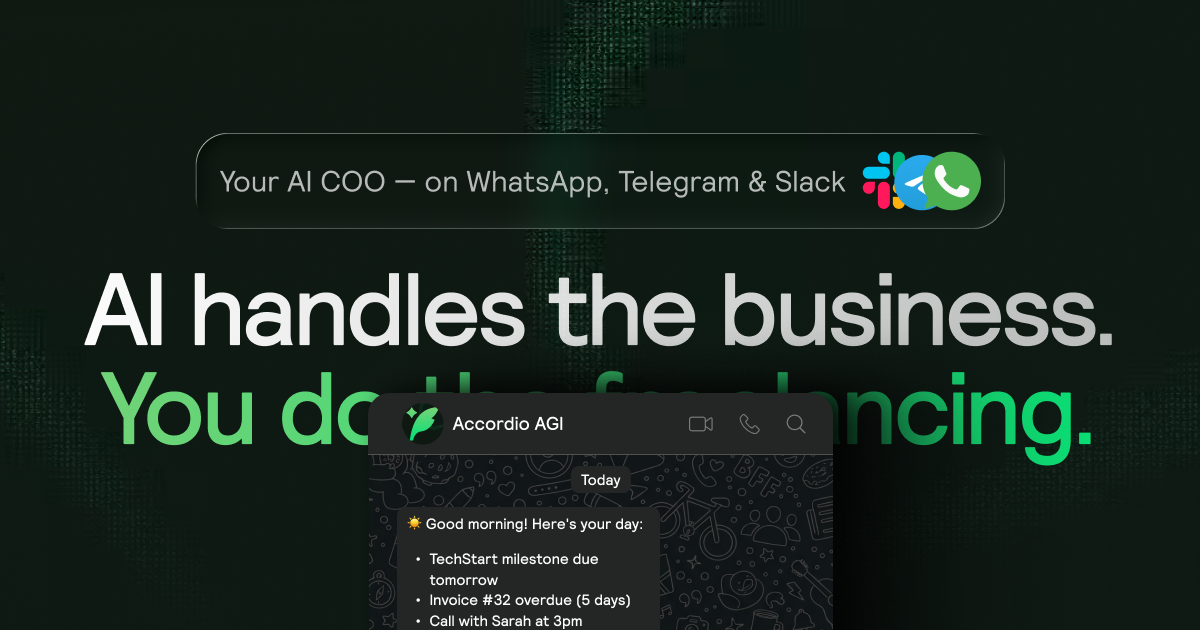
Accordio is an AI back office built for people who run a business alone. It tracks your time, drafts contracts, proposals and invoices, gets them signed and collects the money, and it does all of it from a chat message rather than a dashboard. You connect it to Claude with a single URL, or text it on WhatsApp, Telegram or Slack. The product is aimed at consultants, designers, developers, coaches, founders, fractional CXOs and agencies of one who need the admin handled without hiring anyone. Most solo operators do not lose money because of their craft; they lose it to the paperwork around it. Hours go untracked, contracts are sent late, invoices sit unpaid and receipts pile up until tax season. Roma Bors, Founder at Deduxer, states the problem directly: he lost 50 thousand dollars to clients who never paid, so he built the app that makes sure it never happens again. Accordio exists to close that gap. Instead of subscribing to an e-signature tool, an invoicing app, a time tracker and a contract template library, the whole office ships inside one product that already knows your hours, your clients and what you are owed, so it never has to ask you for context before it acts. Time tracking is the foundation of the product. A Mac app tracks the day on its own, so you can ask what you worked on today and see what is still unbilled without ever starting a timer, while manual timers remain available when you want them. The tracker keeps a full history and produces client-ready timesheets, and it breaks the work day down into focus, meetings and breaks so you can see where the hours actually went. The tracker is open source on GitHub and free forever, and Claude and ChatGPT can both read and log your time. Billable hours convert into an invoice in one click, which is the real point: hours captured at the moment they happen do not get lost or forgotten at the end of the month. Documents are the second pillar. Describe a project and Accordio returns a complete contract with the right clauses and payment terms; an AI advisor flags gaps before you send it, and clients sign without creating an account. Those e-signatures are legally binding and meet the US ESIGN Act and EU eIDAS rules, with a timestamp, IP address and a full audit trail behind every signature. Proposals follow the same flow: Accordio drafts the scope and price, sends the proposal and tracks opens, and when the client says yes the proposal turns into a contract and an invoice without retyping anything. Forms and questionnaires capture leads and intake, and an estimate widget can be embedded on your website. Pitch decks round out the document set, and 12 themes, your own logo and colours and editable clauses mean clients see your brand rather than Accordio's. Existing contracts can be imported from Google Docs and elsewhere and become editable, signable documents. Invoicing and payments are where Accordio is most differentiated. An invoice can be generated from a project, from tracked time or from a contract milestone, and every invoice carries a pay page with your bank details configured for the US, EU and UK. Bank transfer payments carry no fees and no commission, and if you want to accept cards you add your own payment link and it appears on every invoice. Connect your bank through Plaid and incoming deposits are matched to open invoices on their own; when a match is unclear, Accordio asks you rather than guessing. Overdue invoices are chased automatically with payment reminders, and the accounting layer keeps expenses, a profit and loss report and a tax report ready so your books never need a bookkeeper. Snap a receipt and it is categorised, marked deductible and filed to the right report, with bank reconciliation happening continuously in the background. Around the paperwork sit the meeting, inbox and notification features. Booking links let clients find a slot on your calendar without back-and-forth email, and a meeting recorder auto-joins calls, transcribes everything and extracts action items so you can stay present instead of taking notes. Meeting briefs arrive before calls, and follow-ups are drafted afterwards. Accordio also manages your inbox: it reads new mail, drafts replies in your voice and flags the messages that need you. Proactive alerts push morning briefings, overdue reminders and deadline warnings before you even ask for them, and each client gets a branded portal with their contracts, invoices and files behind a magic link, so there is no password and no signup for them. The delivery mechanism for all of this is the MCP connector. Accordio speaks MCP, so pasting a single URL into Claude, through Settings, then Connectors, then add custom connector, gives Claude 30 tools covering your hours, clients, unbilled totals, invoices, contracts, calendar and tasks. Claude can see your business and act on it: ask what you promised a client on Tuesday's call and it answers from the recording. It can draft the contract, log the hours and prepare the invoice, while sending, signing and payments stay in the app, so Claude proposes and you approve. The connector is free forever and also works in Claude Code, Codex and ChatGPT, and the same assistant is reachable by plain text on WhatsApp, Telegram and Slack. Setup is described as a two-minute job with nothing to migrate, and the product is also available in the browser and as a Mac menubar app. The benefit is that the admin stops being a separate job. Because Accordio already holds the invoice, the contract and the hours, it does not ask you for context when you give it an instruction; it just does the work. You open one product instead of four subscriptions, and it replaces an e-signature tool, an invoicing app, a time tracker and contract templates with a single place. Payments arrive without chasing, receipts file themselves, calls are followed up and mornings start with a briefing rather than a backlog. The tracker stays free forever, so time tracking and asking an AI about your hours never carries a cost, and the paid tier adds the money documents and the agent that sends and chases them. Concrete workflows show how this plays out. A consultant asks who still owes them and Accordio reports that a client is 12 days late on a 2,400 dollar invoice and offers to send the reminder. A designer describes a retainer and gets a draft on their usual terms, sent to the client for signature. A solo operator asks Accordio to bill the hours for last week and it invoices 14.5 tracked hours, sends the invoice and attaches bank details. Someone asks for 30 minutes with a contact next week, Accordio sends the booking link, and the accepted slot lands on the calendar. A receipt for a software subscription is messaged in and filed under expenses, matched to the card charge. For founders, the pattern is broader: customer contracts described and signed, each customer billed on their own cadence with deposits matching themselves, books kept without a bookkeeper, and every call recorded with action items filed and follow-ups drafted. Accordio is built for people who run a business alone: consultants, designers, developers, coaches, founders, fractional CXOs and agencies of one, with dedicated solutions for software companies. It integrates with Google Workspace, Slack, Notion, Asana, Trello, Linear, GitHub, Figma, Zoom and more, and the site references Gmail, Google Calendar, Google Drive and 160+ apps, with bank connections handled through Plaid. Pricing is simple: the Mac time tracker, timers, time entries, clients, projects and the Claude and ChatGPT connector are free forever with unlimited clients and projects, while the Legend plan costs 39 dollars a month, or 29 dollars a month billed yearly at 348 dollars a year, and includes every feature, unlimited e-signatures, zero commission and 10,000 AI credits a month. There is a 14-day free trial with no credit card, and if it ends, nothing is deleted. Accordio's core proposition is that the assistant you already talk to should be able to run the admin around your work. Track time, create and sign contracts, send invoices, get paid, and let one message do the rest.
Cadenya is a hosted agent runtime that layers tools, agents, and objectives on top of the APIs you already run. It is explicitly not a framework you bolt into your application stack; instead, Cadenya runs the agentic loop for you. You connect your MCP servers, OpenAPI specs, and existing endpoints through a single tool layer that agents can use, then define an agent, shape its abilities, and run objectives against it. The product is positioned for developers and teams who want to bring agentic possibilities to life in software they already operate, testing safely and improving quickly without rebuilding the stack that supports them. The problem Cadenya addresses is the cost of adopting agentic capabilities inside a system that already works. Building agents typically means invasive change: framework glue inside the application, wrapper layers around APIs, and hand-built machinery for streaming, approvals, retries, context limits, and visibility into what an agent actually did. Cadenya's answer is a hosted loop that handles those concerns out of the box. The product states that it handles context compaction, tool approvals, webhooks and SSE streaming, embeddable widgets, and SDKs in four languages. A frequently asked question on the site answers directly that you do not need to rewrite your APIs: connect MCP servers, OpenAPI specs, and existing endpoints through a single tool layer, and agents can use them as they are. That preserves existing infrastructure investment while new agentic behaviour is layered on top, which matters because teams can iterate on agent behaviour without destabilising the services their business already depends on. The first layer is the tool layer, and the product's guidance is to start with your stack. You connect MCP servers, OpenAPI specs, and existing endpoints through a single tool layer agents can use. Because connection is based on specifications developers already know, existing services become available to agents as they are. Tools can be assigned to an agent individually, organised as tool sets, and combined with sub-agents. In the interface example shown on the site, a shipment-exceptions agent carries assignments such as a reroute shipment tool, an update ETA tool, a Dispatch API tool set, and a Customs Broker sub-agent, alongside memory layers such as a Carrier Playbook covering SLA policies. This layer is what lets an agent reach into real systems rather than only producing text. Experimentation is handled through variations. The interface shows a Default variation and Canary variations, each tied to a specific model, such as Anthropic Claude Sonnet as the default and OpenAI GPT-5.5 or GPT-5.2 as canaries, with a creation timestamp. A variation also carries its own system prompt, its own assignments, and its own memory layers. The product's stated goal for this area is to let you iterate without uprooting: swap models, evolve behaviours, and expand capabilities while retaining infrastructure. It also frames the runtime as a way to evolve with what is next, so you can adopt frontier models fast, test behaviours and compare approaches, and add functionality rather than complexity. Practically, that means model and behaviour changes are configuration inside the runtime rather than a rewrite of the surrounding application. Cost and context are managed through the token usage layer. Cadenya provides live token metering so teams can stay on top of costs, and describes reducing waste through progressive discovery, with efficiency improving as agents adapt. Progressive tool discovery can be enabled, with a maximum number of tools per search set between 1 and 10 (5 shown in the example), search hints of up to 5 terms, and a rerank threshold between 0.0 and 10 that can be left blank to skip reranking. The mechanism is described precisely: tool schemas stay out of the context window until the agent asks for them, and only names ride along, so every request gets smaller. That matters for agents with many connected tools, where schema bloat would otherwise consume context and budget before the agent does any work. Cadenya is also built to power real-time services. Webhooks and SSE push live updates, and the product states it makes it easy to wire agent events into your applications. The webhook delivery view on the site lists event types including assistant message, tool_result, tool_approval_requested, sub_agent_spawned, context_window_compacted, and timed_out, each with an HTTP status and target URL. Around this, the product provides tool approvals: approval-gated tools pause the agent and deliver a tool_approval_requested event so a person or system can approve before anything runs. It also ships embeddable widgets, described as a feature called Widgets that can be dropped into any frontend to enable agentic features like conversations and, per the product, so much more. Observation closes the loop. Cadenya is designed to let you monitor outcomes and understand how behaviours take shape in the real world, with the stated goal that clear visibility means your agents show their worth. Every objective keeps its trail: tool calls, webhook deliveries, token usage, and the feedback people leave on the outcome. The feedback view shows comments scored by sentiment, attributed to a variation and an objective, such as a reroute completed before an SLA breach, a customs hold caught with a proactive ETA update, a reroute that notified the recipient twice, a hold that occurred when a reroute was available, and a correctly escalated frozen-goods lane. Those scored outcomes are what make comparison between variations meaningful. Overall the product works as a hosted agentic loop in three steps: define an agent, shape abilities, and run objectives. Inference is model-agnostic. You point Cadenya at OpenRouter or any OpenAI-compatible endpoint and it uses that for inference. Each new account comes with $5 in credits on OpenRouter pre-configured; after that you provide your own LLM provider credentials. Agents can dispatch sub-agents, and the model configuration for sub-agents can be changed to be best suited for the job, which the product describes as giving the most efficient token usage and outcome. The runtime itself is described as unified: you add functionality, not complexity. The benefits follow from that design. Because the loop is hosted rather than embedded, teams can experiment safely and improve quickly. Because APIs are not rewritten, capabilities expand while infrastructure is retained. Because variations, memory layers, and assignments sit in configuration, frontier models can be adopted fast and behaviours compared rather than guessed at. Because events flow through webhooks and SSE, downstream services react immediately instead of polling. Because token metering and progressive tool discovery are built in, spend is visible and requests stay smaller. And because every objective keeps a trail of tool calls, webhook deliveries, token usage, and human feedback, improvement is grounded in recorded outcomes rather than impressions. Concrete scenarios appear throughout the product's own material. The site's worked example is a freight and logistics agent named for Meridian, a shipment-exceptions agent instructed to reroute a stalled delivery via a dispatch API, with assignments covering rerouting, ETA updates, a Dispatch API tool set, and a Customs Broker sub-agent, and memory layers holding a Carrier Playbook and SLA policies. Feedback entries describe rerouting before an SLA breach, catching a customs hold and updating the ETA proactively, and escalating a frozen-goods lane. Other described workflows include dropping Widgets into a frontend for conversations, pushing agent events into applications via webhooks and SSE so downstream services react immediately, gating tool calls behind approvals, and dispatching sub-agents for parts of a job. On integrations, Cadenya connects MCP servers, OpenAPI specs, and existing endpoints through a single tool layer, uses OpenRouter or any OpenAI-compatible endpoint for inference, and delivers webhooks and SSE streams to endpoints you provide. It ships SDKs in four languages and embeddable widgets for frontends. The site notes that each new account includes $5 in credits on OpenRouter pre-configured, after which you supply your own LLM provider credentials, and states that you can email support@cadenya.com to get a free month. Getting started is described as a few steps, the first of which is signing up, with sign-up available at app.cadenya.com and API documentation linked from the site. Cadenya's core promise is that you can bring agentic possibilities to life on the stack you already run. It converts agent development from a rebuild project into a hosted runtime you configure, connect, observe, and improve, with the surrounding concerns of context, approvals, streaming, cost, and feedback handled as part of the loop.
sizeless is an AI-powered workflow for civil engineering that delivers precise 3D digital twins of open trenches and house connections, directly for GIS and CAD. The company describes its core promise simply: it turns a smartphone video of an open trench into the documentation utilities and contractors are legally required to produce — a 3D model, CAD/BIM plans, and the quantities they bill from. The product is aimed at network operators, civil engineering teams, district heating projects, and pipeline construction work, and it replaces a process that today takes months and a surveyor with one that the company says is completed in hours, from a video the crew films themselves. Underground infrastructure work has a documentation problem that is both expensive and time-sensitive. Once a trench is backfilled, the evidence of what was actually installed — pipe routes, couplings, house entries, third-party utilities crossing the excavation — is gone. Historically, capturing that evidence required waiting for separate surveying appointments before the trench could be closed, which delayed backfill, delayed billing, and delayed cash flow. Where documentation was handled manually, teams relied on manual sketches and created data silos that were hard to audit. Basement areas and other below-grade spaces made matters worse because GPS is not available there, so conventional positioning-based capture methods struggle. sizeless targets exactly these pain points by making documentation a by-product of work the crew already performs on site. The capture side of the workflow centres on SiteScan, the sizeless iPhone app. Field teams use a guided iPhone Pro workflow to capture properties, trenches, and technical rooms in minutes. The company emphasises that this requires no special hardware and no specialist training: the existing project team carries out the capture as part of the job. Because capture happens directly at the excavation, technicians can document house connections independently via smartphone, and trenches are backfilled immediately after the video is taken rather than waiting for a separate surveying appointment. SiteScan is distributed through the App Store, where it is listed as the Sizeless iPhone app. A single smartphone scan produces every deliverable the team already works with, described on the site as "one capture, every output". Those outputs fall into three families: 3D point cloud, 2D CAD, and BIM/GIS. The centimeter-accurate point cloud is a high-resolution 3D reconstruction of the scanned space and serves as the objective basis for earthwork volumes, dimensions, and audit trails. From it, sizeless generates industry-standard 2D CAD as-built plans in DWG and DXF for revision documentation, with the company noting that couplings and pipes are quickly identified and that measurement extraction is simplified. On the 3D side, sizeless produces digital twins of the pipe route including house entries, with seamless integration into GIS systems for future-proof planning and maintenance. Beyond the deliverables themselves, sizeless positions three core benefits for network operators. Quality and audit-proof documentation is provided as continuous 3D evidence that includes third-party utilities and house entries, and that works without GPS in basement areas. This eliminates manual sketches and data silos, and means construction errors can be identified before backfilling rather than after. Process autonomy means technicians document house connections independently via smartphone, so existing internal or external teams can handle a higher project volume through efficient workflows. Accelerated construction and billing follows from immediate backfill after the video: complete documentation is available weeks earlier, described by the company as "72h docs", enabling faster billing and cash flow. The workflow is presented as four steps. Step 01, trench capture, is standardized capture via iPhone Pro directly at the excavation — no special hardware and no extra appointments, carried out by the existing project team. Step 02, 3D point cloud, uses algorithms developed at ETH Zurich to generate a high-resolution 3D point cloud of the open trench, which the company describes as centimeter-accurate. Step 03, 2D CAD as-built plan, produces industry-standard as-built plans in DWG/DXF for revision documentation. Step 04, 3D model and GIS, creates digital twins of the pipe route including house entries and integrates them into GIS systems. The differentiator is therefore spatial AI for underground infrastructure: reconstruction algorithms combined with a capture method that needs nothing more than a phone the crew already carries. For the people doing the work, the outcomes stated on the site are concrete. Trenches can be backfilled immediately because no separate surveying appointment is needed, and complete documentation is available weeks earlier than the traditional route, which supports faster billing and cash flow. Documentation becomes audit-proof and GIS-ready, with continuous 3D evidence replacing manual sketches and disconnected data silos. Errors surfaced in the record can be addressed before backfilling. Because no specialists are required, technicians can work independently and teams can take on higher project volume. The site summarises the outcome as 72h docs, DWG/DXF output, and instant backfill. Several concrete scenarios appear in the material. Trench documentation during civil engineering works: a crew films an open trench with an iPhone Pro and the trench is backfilled immediately afterwards. House connection documentation: technicians document house connections independently via smartphone, including house entries, and those entries are captured in the 3D twin. District heating projects: the workflow is explicitly named for civil engineering, district heating, and house connections. Pipeline construction: automated as-built documentation is described for pipeline construction, where pipes and couplings must be identified for revision documentation. Network operation and maintenance: the resulting digital twins integrate into GIS systems for future-proof planning and maintenance of the pipe network. Property and technical room scanning is also mentioned as something the SiteScan app captures. sizeless is built for network operators and for the civil engineering, district heating, and pipeline construction teams that build and maintain underground infrastructure. The company states that it was founded by engineers from ETH Zurich and UC Berkeley and that it is backed by Y Combinator, ETH Zurich, UC Berkeley, Cambridge, and MIT. Integration points named in the content are GIS systems, CAD and BIM workflows, and industry-standard DWG/DXF file formats, alongside the SiteScan iOS app. The site's primary calls to action are booking a demo, seeing it in action, and requesting an in-person demo with a full name, email address, company name, and preferred demo date. Taken together, sizeless reframes as-built documentation as something a construction crew produces as it works rather than something a surveyor delivers afterwards. The combination of a guided iPhone Pro capture workflow, ETH Zurich-developed reconstruction algorithms, and outputs that drop into existing CAD, BIM, and GIS tools means the trench can be closed immediately, the documentation arrives in hours instead of months, and the resulting record is a continuous, audit-proof 3D twin that supports both billing today and planning tomorrow.
Wisry is an agentic ad-cloning platform built for ecommerce brands, described on its website as an 'Agentic AdClone for ecommerce.' Its core promise is simple to state and ambitious to deliver: AI agents run the whole play. They scan the Meta and TikTok ad libraries for the ads already winning in your market, clone them into your brand as static and video ads, and launch them to Meta and Google, optimized for ROAS. Wisry presents itself as a way to get 'Winning ads, without the guesswork,' and headlines its home page with the claim 'Launch high-ROAS ads, 10x faster.' The platform says it is trained on over $1B of ad spend, and that the strategist agent is backed by $1B+ in ad spend used to train it. The intended audience is ecommerce brands and the marketers, agencies and growth teams that run paid social for them. Onboarding begins with a single input: paste your store URL, and Wisry builds brand memory covering products, voice, visual identity and audience, so that every agent stays on-brand. From there the platform is meant to act as an autonomous ecommerce growth team. Paid social for ecommerce is a research-and-iteration problem as much as a creative problem. The Wisry site frames the status quo as slow and uncertain: marketers spend weeks on research, creative production and launch, and much of that effort is guesswork about which hooks, angles and formats will actually convert. Wisry's own customers describe the pain directly. One supplement brand says that in its category 'speed is everything' - it does not need more creative ideas, it needs to spot what is winning and replicate it before the window closes. An agency customer says the bottleneck 'was always research and iteration,' and that agentic research finds what is working across a market and turns it into output at a pace a manual team could not touch. Another customer, selling hardware to Tesla owners, notes that it operates in a niche audience 'where every ad dollar counts' and that it is no longer 'testing blindly' but scaling what is proven. Wisry's answer to this is to replace open-ended guessing with evidence pulled from ads that are already spending and converting in the market. The first group of capabilities is research and strategy. Wisry's flagship feature is agentic ad research: research agents read the ads already running in your market, cite what they found, and turn the winners into angles you can brief. The site shows this working against the Meta ad library and TikTok top ads, ranking the ads it finds - for example, a ranked set where the top three of nineteen are surfaced with details such as how long each ad has been live (64 days, 35 days, 23 days), how many variants sit behind the concept (17, 10 and 6), and impression counts in the millions. The reasoning shown is explicitly performance-based: the longest unbroken spend in the run, a format that survived a full test cycle, and the fastest variant ramp in the category. A strategist agent then turns that research into campaign concepts covering audience, hooks and messages, and attaches source citations behind every angle. Because Wisry builds brand memory from your store URL - products, voice, visual identity and audience - every agent in this chain stays on-brand rather than producing generic output. The second group is creative production. Wisry clones video ads: point it at a video ad that works and get your own version of it, matching the same structure and pacing while swapping in your product and your brand; the site illustrates this as 'Structure matched' across hook, proof and close. Static ad cloning follows the same logic: Wisry rebuilds a winning static in your palette, your type and your product shots, then fans it out into every placement you need. The site is explicit about what is kept and what is swapped - layout, headline structure and type are kept, while palette, product and type are swapped for your brand. On top of cloning, Wisry ships ad templates so campaigns start from formats with a track record instead of a blank canvas; templates include listicle, problem-solution, quiz, portrait, us-vs-them, seasonal, feature-benefit and how-to, arriving in feed (1:1 and 4:5), portrait (2:3), landscape (16:9) and story (9:16) sizes, and each one is sized and safe-area-checked for its placement, including Reels, Story and Feed. Finally, every generated cut opens in a real video editor inside Wisry, where you can retime scenes, restyle captions, swap a shot and re-render without leaving the platform. The third group is launch and optimization. Once creatives exist, an ads agent ships them to Meta and Google, watches performance, moves budget to winners, and keeps new creatives coming - a loop the site summarizes as 'launches, optimizes, repeats. 24/7.' This is what makes the system agentic rather than a one-off generator: the same platform that produced the ads from market evidence also handles distribution and budget allocation based on how those ads perform. Wisry describes its studio as shipping nine capabilities, all pointed at selling more of your products, with the two flagship features being the ones everything else is downstream of. The end-to-end loop is presented as a continuous cycle rather than a campaign: research feeds strategy, strategy feeds creative, creative feeds launch, and launch performance feeds the next round of iteration. Wisry's overall approach is deliberately end-to-end and evidence-first. The workflow is described in five steps: first, Wisry pulls your brand and products after you paste your store URL, building brand memory across products, voice, visual identity and audience; second, a research agent deep-analyzes your Meta and TikTok competitors' ads and content to find what is already converting; third, the strategist agent generates evidence-backed angles for your campaigns, including audience, hooks and messages with source citations; fourth, the agents copy winning creatives for your products, generating video and static ads from the best-performing ads and your chosen angles; and fifth, the ads agent launches, optimizes and repeats around the clock. The site summarizes the whole flow as 'Your store in. Winning ads out.' Under the hood, Wisry says it is orchestrated using leading models, listing Grok, Gemini, OpenAI, Claude, KlingAI and Nano Banana as the models involved. The distinguishing idea is that every angle is traceable to a real ad that is already winning, and every output stays inside the brand memory built at onboarding. The benefits Wisry claims are framed in performance and speed terms. The site advertises a +200% average boost in ad performance, $1B+ in ad spend used to train the strategist, a 10x faster path to launching a high-ROAS campaign, and a shift from weeks to minutes for research, creative and launch handled end to end. Customer quotes add concrete outcomes: a hardware brand selling to Tesla owners reports ROAS up 300% since starting and describes scaling what is proven instead of testing blindly; a supplement brand reports shipping winning variations 2x faster and describes the difference as reacting to trends versus riding them; and an agency says it has scaled client accounts much faster because agentic research finds what works across a market and turns it into output at a pace its team could not match manually. Concrete scenarios described in the content include a niche hardware brand that sells to Tesla owners and needs every ad dollar to count, scaling what already works in its account; a supplements brand operating in a fast-moving category that needs to spot winning creative and replicate it before the window closes; and an agency running ads for many clients, where research and iteration were the bottleneck and agentic cloning lets it scale client accounts faster. More generally, the product is built around the ecommerce advertising workflow of importing a store, researching a market's Meta and TikTok ads, generating evidence-backed angles, cloning winning static and video creatives into a brand's own palette, product shots and type, fanning them out across placements using templates, launching to Meta and Google, and then continuously moving budget toward the winners while new creatives are produced. Wisry is a paid product. The pricing section offers three commitment lengths with one payment up front, after which the plan continues month to month: 2 weeks at $49.50 (discounted to $34.65, saving 30%), 4 weeks at $99 (discounted to $49.50, saving 50%, marked Most Popular), and 8 weeks at $198 (discounted to $89.10, saving 55%). The site highlights a per-day cost of $3.53 at full price, reduced to $2.48, $1.77 and $1.60 per day at the three tiers, and the entry call to action is 'Get started for $49.50' with the note that this is one payment of $49.50 for 4 weeks, then $99/month, cancel anytime, secured by Stripe. Wisry runs in the browser as a web app. The site also notes a Product Hunt launch promotion offering up to 55% off. In short, Wisry's primary value proposition is that ecommerce advertisers no longer have to guess what creative will work. By researching the Meta and TikTok ads already winning in a market, converting that evidence into cited angles, cloning the strongest static and video creatives into a brand's own identity, launching them to Meta and Google, and then optimizing budget around performance around the clock, Wisry turns paid social from a slow, speculative process into a faster, evidence-driven loop - 'Winning ads, without the guesswork.'
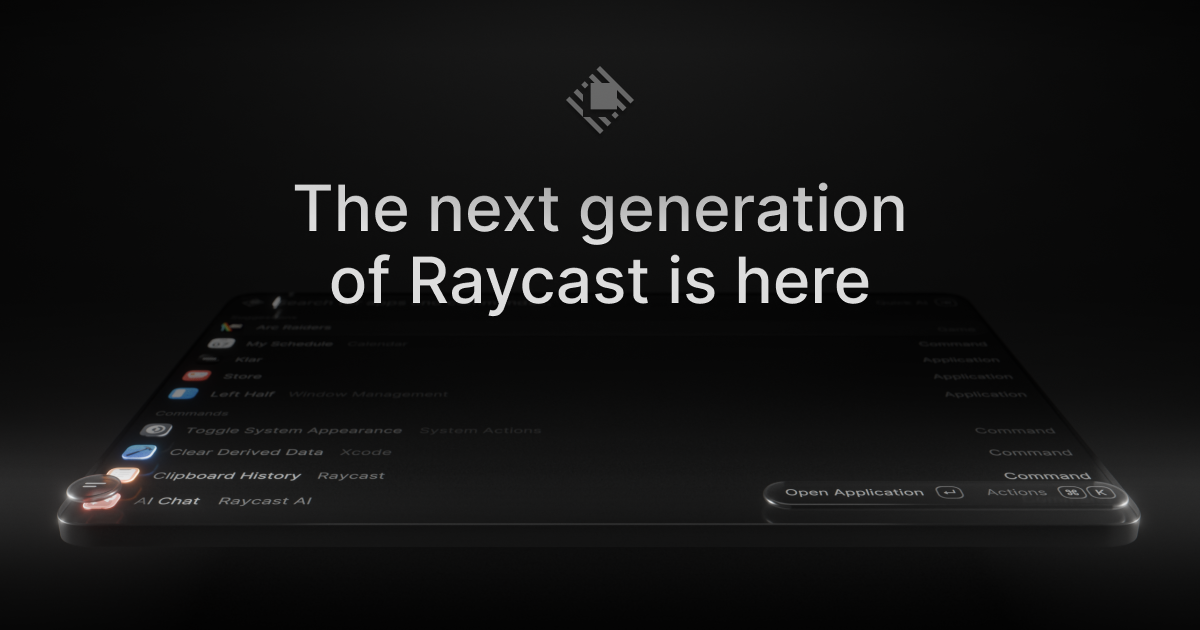
Raycast 2.0 is the next generation of Raycast, described by its creators as a new foundation, redesigned from the inside out. It is a launcher for macOS that acts as your shortcut to everything, and this release adds AI that can take action across your apps, Automations for recurring tasks, and Projects to keep ongoing work together. It is built for Mac users who want to move quickly across their desktop, combining a command launcher, file search, dictation, and an AI chat experience in one place. Raycast 2.0 is available to download now, and it requires macOS Tahoe and Apple Silicon. The update exists because Raycast chose to rebuild its launcher on a new foundation rather than continue patching the previous one. Raycast V1 was already described as the best Launcher, so the bar for 2.0 was high: the goal was to keep what people relied on while modernizing the interface, the hotkey handling, and the AI experience. That scope comes with trade-offs the team states openly. Raycast calls this a major update and tells users to expect frequent updates and occasional rough edges. On installation, the new Raycast will replace Raycast V1; there are just a handful of missing features, and those will be added soon. The most concrete risk of any rebuild is losing a carefully tuned setup, so 2.0 is designed to bring your configuration with you instead of asking you to start over from scratch. The core of the new release is a reworked AI experience built around two surfaces. Quick AI keeps you in the same Tab while adding more power, so you do not have to leave what you are doing to get an answer. AI Chat collects skills, agents, and memory in one place, giving AI work a persistent home inside the launcher rather than a one-off query box. Beyond answering questions, the AI in Raycast 2.0 can take action across your apps, which means the assistant is not limited to conversation alone. You can also connect your own ChatGPT or Claude account and put AI to work alongside the commands and extensions you use every day. Connecting your own account lets the AI you already use become part of the same surface as your launcher commands and extensions. Several changes target the everyday speed of the launcher itself. File Search now sits in Root, described as one less step to find your files, so files are reachable from the top level of your search instead of requiring extra navigation. File search is also faster in v2, and the FAQ lists quicklinks and snippets tagging among the additions in this release. Because root search is where queries begin, moving File Search there shortens the path between thinking of a file and opening it. Quicklinks and snippet tagging build on the same idea: your own shortcuts, snippets, and saved searches stay close at hand rather than buried inside menus, which matters for people who run the same workflows dozens of times a day. The look and feel of Raycast has been updated to feel right at home on macOS Tahoe, giving the v2 interface a refreshed appearance. The release also adds built-in dictation under the banner Type with your voice, so text can be entered by speaking without leaving the launcher. Settings have been reorganized, making the growing set of options easier to navigate as the product adds capabilities. In addition, you can configure inline, meaning hotkeys and aliases can be assigned directly from root search. That combination matters because a launcher is only fast when it is configured the way you actually work, and v2 places configuration and voice input on the same surface as search. Raycast 2.0 also treats the upgrade itself as a migration rather than a fresh start. During onboarding you are prompted to import or migrate your data from Raycast v1, and if you skip the step or want to rerun it later, you can use the documented commands. The Migrate from Raycast v1 command automatically migrates your data, and importing settings at this step also imports and migrates all of your shortcuts to Raycast v2 and disables them from working in Raycast v1, ensuring that your hotkeys do not conflict. Raycast calls this the recommended approach because some extra data is not imported with the manual route, including Clipboard History, Wrapped, and the Emoji picker. The alternative, Import Settings and Data, is a manual import from a .rayconfig file that you must export from Raycast v1. For people who build their own tools, custom extensions also need attention: to import correctly you must be on the latest version of Raycast V1, or at least v1.104.16, and if they did not import automatically you can run npx @raycast/api@latest dev, which is designed to pick up the new version if it is running. The benefits of Raycast 2.0 come from combining a faster launcher with AI that can act. Files are reachable in fewer steps, AI answers arrive in the same Tab through Quick AI, and longer AI work has a dedicated place in AI Chat with skills, agents, and memory. Built-in dictation offers a different way to input text when typing is slower than speaking. Because hotkeys and aliases can be assigned from root search and your existing shortcuts migrate from v1, the muscle memory you have already built keeps working in the new version. The result is a launcher that feels familiar on day one while offering more capability than before, which is exactly the balance the team set out to strike with a major rebuild. In practice, that shows up in concrete workflows. You can type a file name and open the result directly from root search instead of navigating to a separate file search view. You can ask Quick AI a question in the same Tab while staying in the flow of your current task, or move into AI Chat when a task needs skills, agents, and memory to be sustained over time. Ongoing work can be kept together in Projects, while Automations handle recurring tasks so they do not have to be triggered by hand. When writing is faster by voice, built-in dictation takes over, and when you want a command at your fingertips you can assign a hotkey or alias to it straight from root search. Upgrading is itself a workflow: import during onboarding, or run the migration commands afterwards. Raycast 2.0 is aimed at Mac users, and specifically at anyone running macOS Tahoe on Apple Silicon, since those are the stated minimum requirements. People already using Raycast V1 are the primary audience for the upgrade, and that includes extension developers, who need to be on Raycast V1 v1.104.16 or later for custom extensions to import correctly, or run the Raycast API dev command if they did not. Alongside the free download, Raycast offers Pro, Teams, and Enterprise plans, with pricing published on the Raycast site, plus an iOS app, a Windows page, and a browser extension in the wider Raycast family of products. AI in v2 can be used with your own ChatGPT or Claude account, letting you bring an existing AI subscription into the launcher. Taken together, Raycast 2.0 is a rebuild of a launcher that many Mac users already depend on, and the site sums it up directly: the launcher, relaunched. A new foundation, redesigned from the inside out, with AI that can take action across your apps, Automations for recurring tasks, Projects that keep ongoing work together, AI Chat with skills, agents, and memory, built-in dictation, faster file search in root, and a migration path that carries your settings, shortcuts, and extensions forward. The value proposition is the combination: more capability in the same fast surface you already know, without asking you to rebuild your setup from zero.
Viso Now is a self-building AI vision platform that turns images, video, and camera feeds into working computer vision applications. Rather than assembling a machine learning pipeline from scratch, users describe in plain language what they want to understand in their footage, and Viso Now builds the agentic vision logic and the custom live dashboards to go with it. The website positions the product around a single promise: bring a new AI vision application to life. It is designed for anyone who can describe a problem, from individuals who want a vision agent running in minutes to enterprises that need governed vision intelligence across many sites and cameras. The problem Viso Now addresses is the cost and complexity that traditionally surrounds computer vision. Building a vision application normally means model training, image annotation, ML engineering and ongoing model maintenance, which puts bespoke vision projects out of reach for most operational teams. Viso's own messaging states that isolated solutions are no longer enough and that not all computer vision is equal: single-purpose tools lease one outcome for one use case, while Viso positions its platform around multiple use cases across multiple locations. The site argues for flexible solutions with a lower total cost of ownership, complete control of your data, and the ability to customise outcomes and hit KPIs, and for handling today's challenges while preparing for tomorrow's opportunities. The core of Viso Now is prompt-driven building. A user describes the real-world situation they want AI to solve in plain language, with no model training and no annotation needed, and watches as Viso builds the application with them in real time. The site describes this as starting from a prompt, testing instantly, and turning ideas into vision agents. An 'Ask Viso to create a camera agent' flow sits directly in the product interface, where users work alongside the builder and refine the application until they are happy with the finished solution. Viso describes the underlying capability as visual general intelligence that applies to any use case, which is why the same engine can be pointed at very different operational questions without rebuilding anything from the ground up. Supporting that building process is a template gallery. Viso Now shows ready-made templates including Task-Aware PPE Check, Excavator Near-Miss Monitor, Hot Work Safety Check, Work-at-Height Safety Check, Clinical PPE Protocol Check, GMP Hygiene Check, Loading Dock Exclusion Zone, Front Desk Wait Tracking, Restricted Site Vehicle Alert, Hazardous Area PPE Check, Pipeline Integrity Scout, Visible Release Detection, Robot Cell Intrusion Detection, Production Area Access Check, 5S Shop Floor Audit, Emergency Exit Clearance, Reversing Vehicle Danger Zone and MEWP Fall Protection Check. Further templates cover Dock Turnaround Intelligence, Check-in Queue Orchestrator, HSE Workplace Audit, Commercial Vehicle Safety Screening, Dump Zone Safety Inspector, Abandoned Luggage Response, Handling Risk Assessment and Service Queue Pressure Analysis. Users can also feed the system their own media by clicking to upload or dragging a video in, with MP4, MOV, MKV, PNG and JPG supported, by capturing a photo, or by recording video, and they can choose between Fast, Balanced and In-Depth analysis modes depending on how much detail the task needs. Once an application behaves as intended, the workflow moves to deployment. Users iterate on the app until they are satisfied with the finished solution, then connect cameras or upload connectors to start using it immediately. Viso handles the end-to-end infrastructure behind the scenes, covering compute, visual analysis, governance, authentication and integrations, so teams do not have to stitch those layers together themselves. The platform produces custom live dashboards as part of the build, which turn what the camera agent observes into something an operator can actually monitor and act on rather than raw detections. Viso Now's distinctive approach is that the application builds itself. The website frames this as 'Your idea, the vision app builds itself' and 'If you can describe it, you can build it.' Instead of choosing from a fixed catalogue of detection types, users state the outcome they want and the platform constructs the agentic vision logic around that outcome. Build, refine, go live is the entire loop, and the security and infrastructure concerns are handled by the platform rather than by the user. The site summarises the free tier as dropping any video, describing what to build, and getting a working vision application in minutes, with no labelling, no training and no big team required. Viso reports concrete outcomes on its website. A customer story from a global manufacturer states that the company replaced four point solutions with one Viso deployment and that, by month three, near-miss incidents were down 54%, with the safety team spending zero hours rebuilding models. The same page cites 24/7 eyes on every camera that never blink and never tire, 10x faster AI vision versus other methods, and 90% less ML engineering effort with no labelling and maintenance. Elsewhere the site claims a 10x faster understanding of visual data to drive efficiency, automation and innovation, and an 85% reduction in time-to-value of computer vision applications. For teams, the practical benefit is speed: ideas become running vision agents without a dedicated ML function, and the same deployment keeps working as requirements change. The template library also shows the concrete scenarios the product is used for. In construction, Task-Aware PPE Check, Excavator Near-Miss Monitor, Hot Work Safety Check, Work-at-Height Safety Check and MEWP Fall Protection Check address worker safety and site hazards. In oil, gas and energy, Pipeline Integrity Scout, Visible Release Detection, Restricted Site Vehicle Alert and Hazardous Area PPE Check cover asset inspection and restricted zones. In manufacturing, Robot Cell Intrusion Detection, Production Area Access Check and 5S Shop Floor Audit support safety, access control and lean audits. In logistics and warehousing, Loading Dock Exclusion Zone, Dock Turnaround Intelligence, Dump Zone Safety Inspector and HSE Workplace Audit assess dock performance and workplace safety. Healthcare, food and beverage templates such as Clinical PPE Protocol Check and GMP Hygiene Check cover protocol and hygiene compliance, while Front Desk Wait Tracking, Service Queue Pressure Analysis, Check-in Queue Orchestrator, Abandoned Luggage Response and Commercial Vehicle Safety Screening serve hospitality, public venues and transport environments. Two products sit on one platform. Viso Now is the free entry point, marked 'Free · No Credit Card', offering a free forever tier with the ability to invite your team, prompt-to-agent building in minutes, visual general intelligence for any use case, and seamless connection to other systems. Viso Suite is the enterprise option, described as the complete operating system for enterprise vision intelligence: connect every camera across every site, build governed applications, and operate agentic workflows at scale, with support for 10,000+ cameras and hundreds of sites, full lifecycle from build to deploy to govern to scale, edge AI with on-prem or cloud support, and compliance with SOC 2, ISO 27001, GDPR and CCPA. Viso also states it is trusted by Fortune 500 companies and lists 136+ applications tuned for every industry. Viso Now's value proposition is straightforward: describe the real-world situation you want AI to solve, and the platform builds, refines and runs the vision application for you. No model training, no annotation, no code writing, and no large team, but with the same platform able to scale into governed enterprise deployments across thousands of cameras. It turns any camera into an analyst that can detect, inspect, alert and understand what is happening in the physical world.
Gsheet CRM is a CRM application built on top of the Google Sheet that a team already uses. Rather than importing customer rows into a separate database, it connects to one spreadsheet and turns it into a leads board with follow-ups, reports, a team and automations. Every feature in the product reads from and writes to that single connected sheet — the same rows and the same columns — so there is no copy of the data living anywhere else. It is designed for businesses that already run their customer list in a spreadsheet, from real estate agents and travel agencies to clinics, recruitment firms, insurance agents, car dealers, fitness studios, salons, trading and wholesale operations, cash-on-delivery e-commerce sellers and consultancies. Its main purpose is to give a spreadsheet-driven business the structure and visibility of a CRM without a migration project. Plenty of small businesses already keep their customers in a spreadsheet, and for good reason: it is flexible, familiar and free. The trouble is that a spreadsheet is not a CRM. Rows scroll out of view and follow-ups get forgotten. There is no shared board showing which leads are new, contacted or won, no reporting unless somebody builds formulas, and no way to give a team member access to their own leads without handing over the whole file. Most CRM products solve this by asking businesses to move everything into a new system — import wizards, field mapping, data migration and the loss of a file the team already understands. Gsheet CRM takes the opposite approach. It keeps the spreadsheet as the database, in the customer's own Google Drive, and layers CRM behaviour on top of it, so nothing is migrated and there is nothing to learn twice. The centrepiece is a leads board built on the user's own sheet. Customers can be dragged between stages such as New, Contacted and Won, and every change lands straight back in the spreadsheet — same rows, same columns, with no copy kept anywhere. Because the board and the sheet are the same data, a team can keep working in either place. Alongside the board sits a follow-up system: a reminder can be put on any customer, and overdue, today and this-week follow-ups are gathered in one place. That means a customer does not get forgotten simply because their row scrolled out of view. According to the product's Product Hunt listing, reminders run inside the sheet itself, so they fire even when the app is closed. Reporting is generated without formulas. The funnel, what is stuck, wins by month and who is handling what are all computed live from the sheet every time the reports are opened — nothing has to be built and nothing can break. This gives a manager a current picture of the pipeline without maintaining a separate dashboard. Around that sits team management with boundaries. People can be invited with roles and teams, and the account owner decides whether each person sees everyone's leads, their team's leads, or only their own, while managers always see everything. That combination means a spreadsheet-based business can bring on staff without simply sharing the file with everybody, which is usually the point at which a spreadsheet stops working as a sales tool. Gsheet CRM also supports linked lists. Properties, courses or packages can be kept in their own tabs and linked to leads, and viewings and payments then roll up onto the customer's card by themselves — so a record for a customer shows what they have viewed or bought without manual entry. On top of this are small automations that trigger when a lead is created or changes stage. Within a single sentence of configuration, a rule can set a follow-up, add a note, or hand the lead to whichever team member currently has the fewest open leads. These rules keep repetitive admin out of the team's day: assignments stay balanced, notes get logged, and follow-ups get scheduled automatically at the moment a lead moves. The setup process is deliberately short and the product describes it as working in three minutes, with no import wizards, no field mapping homework and no sales call. The user signs in with Google — one tap, with the product asking only to see their email address at that point — and then picks their type of business from roughly a dozen ready-made setups. Gsheet CRM then creates a working sheet in the user's own Drive, complete with stages, dropdowns and an example lead already in place. From there the user simply works the board: adding leads, dragging cards and setting follow-ups, and can open the spreadsheet at any time because it is the same data. Businesses that already have a sheet full of customers can start from a ready-made sheet and paste their rows in, with ids and formatting handled for them. Data ownership is treated as a core part of the design rather than a policy page. Gsheet CRM uses Google's narrowest Drive permission, which allows it to open only the single spreadsheet that has been connected and never the rest of the user's Drive. Rows, notes and numbers stay in the spreadsheet; the company's servers keep only the wiring — which columns mean what, and when follow-ups are due — not the customer list itself. If a user disconnects the app, every row stays exactly where it always was, in a Google Sheet they own that continues to work without the product. For businesses whose customer list is their most valuable asset, this answers the most common objection to adopting a CRM. The outcome for a user is a customer list that behaves like a CRM while remaining a spreadsheet. Follow-ups no longer slip because they are surfaced in one place and fire from inside the sheet. Managers get live visibility of the funnel, what is stuck, monthly wins and workload per person without building a single formula. Teams get access boundaries so more people can work the same pipeline without everyone seeing everything. Repetitive tasks — assigning a lead, logging a note, scheduling a follow-up — happen automatically. And nothing has to be migrated, so the switch costs a few minutes rather than a project, with the reassurance that leaving is equally easy and the data stays in the Drive. The product lists the kinds of businesses it is built for: real estate, travel agencies, clinics, education, recruitment, insurance, car dealers, fitness studios, salons, trading and wholesale, cash-on-delivery e-commerce and consultancies. A real estate agency, for example, could keep properties in a linked tab, drag buyers through New, Contacted and Won, and see viewings roll up onto each customer's card. A recruitment or insurance business could set a rule so each new lead is handed to whoever has the fewest open leads. A cash-on-delivery e-commerce seller could chase overdue follow-ups from a single list. For teams selling on WhatsApp, Gsheet CRM also runs inside Libromi Team Inbox, where the team sees each customer's card beside the conversation and new WhatsApp leads land on the same board. There are two plans, both including the board, follow-ups, reports and automations. Startup is listed at $20 per month, discounted to $10 per month, and covers 5 team members, 5,000 leads and 1 linked table. Growth is listed at $50 per month, discounted to $25 per month, and covers 25 team members, 50,000 leads and 5 linked tables, plus the developer side: API access and webhooks. A free trial is included and no card is required to start, and both plans can be billed monthly or yearly. The site advertises 50% off for the first 999 customers as a limited-time launch deal, with the price a customer joins at locked in for life. Gsheet CRM is a web product that connects directly to Google Sheets and Google Drive, and integrates with Libromi Team Inbox for WhatsApp. Gsheet CRM's proposition is simple to state and unusual in the CRM market: the spreadsheet stays the database, and the CRM is layered on top of it. That means a leads board, follow-ups that do not slip, live reports, team roles and boundaries, linked lists and one-sentence automations all operating on the rows a business already keeps — in its own Drive, under Google's narrowest permission, with nothing to migrate and nothing to learn twice. For spreadsheet-driven businesses that have outgrown their sheet but do not want to hand over their customer list, it offers the structure of a CRM without giving up ownership of the data.
Type is a shared workspace where your entire team can collaborate with Claude or Codex using the AI subscriptions you already pay for. Its stated purpose is to make a team's best AI work compound rather than scatter across individual accounts. The site describes sharing work from individual Claude or ChatGPT conversations into a central, collaborative space where people can collaborate on chats, docs, and apps together. Type is designed for the entire team, and the website specifically highlights marketing teams, along with operations and GTM teams, as the groups it helps get the most out of AI, with every ad, image, landing page, and analytics question grounded in the company's own context. The product addresses a set of problems that the website states directly. AI work currently lives inside individual Claude or ChatGPT conversations, which are not collaborative by default. Teams also risk being locked into a single model provider; Type states plainly, "Don't get locked into one model provider," and frames the goal as owning your data while renting the best intelligence. Rolling AI out across a group also raises trust and access questions, which Type answers with one integration gateway, enterprise grade security, and granular permissions by user, space, and role. Finally, teams need help getting good at using AI, something Type addresses through built-in best practices. Multiplayer AI is the first pillar described on the site. Type lets you share work from individual Claude or ChatGPT conversations into a central, collaborative space. From there, teams can collaborate on chats, docs, and apps, securely share access to integrations, and build a shared company brain made of context, memory, and skills that constantly self-improve. This turns isolated prompts and one-off answers into reusable, shared assets that the whole team can see, edit, and build on, which is the mechanism behind the claim that a team's best AI work compounds. The second pillar is "works where you do." Type can be used from Slack, email, or wherever your team already communicates. You can tag Type in any channel, email, or meeting, and everything syncs to Type's dedicated Desktop and Mobile apps. The site also states that Type works 24/7 in shared cloud computers. A worked example on the page shows a colleague asking in a Slack channel whether any creative assets exist for an upcoming photoshoot, a teammate tagging the Creative agent in that thread, and the agent responding with four brand images generated from recent creative and brand guidelines, followed by an "Open in Type" action. The third pillar is that Type is easy to use but powerful underneath, and it is designed for the entire team. The site says Type proactively finds, suggests, and does work. It is explicitly positioned as more than chat: teams can build custom dashboards, apps, and automations tailored to their business. A detailed example shows a user asking Type to combine the last 30 days of customer feedback from Zendesk, Slack, and Intercom into one dashboard so the success team can see the fastest-moving themes. Type reports connecting all three sources, deduplicating repeated conversations, and grouping 1,284 feedback items by theme and sentiment, then turning that analysis into an app with movement over time and source coverage. On request, it adds a daily refresh and ranks emerging themes by their change from the prior 30-day period, producing a live app called Feedback pulse that refreshes daily and highlights the three themes with the strongest movement, with a 68% positive sentiment split across the included channels. Model flexibility is another stated capability. Type makes it easy to switch between models, with prompts on the site to connect your Claude and connect your Codex. The framing is that you own your data and rent the best intelligence, so teams are not locked into one model provider. Connecting those models sits inside a single integration gateway for enterprise-grade security. That gateway lets teams connect integrations via OAuth, MCP, or API, and define granular permissions by user, space, and role. The page illustrates space-level permissions, asking "Who can use the Creative Space?" with options for specific people or all of a company, and shows API connection permissions that are either private to one user or usable by everyone in the organization. The site points to more than 900 integrations to explore. Alongside integrations, Type ships best practices built in, aimed at helping an entire team get great at using AI, and it surfaces a library of agent-style templates and their recent activity, including competitor research, generating ad creative for October's campaigns, brand voice content review, campaign artwork, social media campaign strategy for October, and launch video. The page also shows usage and cost views over time. The overall approach ties these pieces together. Type puts skills, files, and threads in one place that the whole team can see, connects tools once instead of per person, and lets a team use any model on top of that shared foundation. Work that happens in Slack, email, or meetings syncs back to Type's desktop and mobile apps, and shared cloud computers keep it running continuously. Because the workspace is grounded in the company's context, the resulting company brain gets smarter as the team works, and that shared context is what custom dashboards, apps, and automations are built on. The benefits stated on the site follow from that approach. Teams can collaborate on chats, docs, and apps instead of working alone, share access to integrations securely rather than passing around credentials, and let context, memory, and skills accumulate and self-improve over time. Type proactively finds, suggests, and does work, which reduces the need for every teammate to know exactly how to prompt. Because it works in Slack, email, and meetings, adoption does not require a new place for everyone to check. And because teams can build custom dashboards, apps, and automations, they can move beyond chat into purpose-built tools grounded in their own data. Concrete use cases appear throughout the page. A marketing lead asks Type to start a new product announcement email in Customer.io for September by duplicating the August email and updating the content based on the latest releases to Shopify. A brand team asks in Slack for creative assets to steer an upcoming photoshoot and receives four generated brand images built from recent creative and brand guidelines. A support or success team asks for the last 30 days of customer feedback from Zendesk, Slack, and Intercom to be combined into one dashboard, later asked to refresh daily and rank emerging themes by change versus the prior period. The template library shows additional workflows: competitor research, ad creative generation for a month's campaigns, brand voice content review, campaign artwork, social media campaign strategy, and launch video work. On audience and setup, the site says Type is designed for the entire team and specifically helps operations and GTM teams get the most out of AI, with marketing teams used as the headline example. Connections happen through one integration gateway via OAuth, MCP, or API, with permissions managed by user, space, and role, and more than 900 integrations available to explore. Type runs on the web, with dedicated Desktop and Mobile apps and shared cloud computers, and works from Slack, email, or wherever the team already communicates. The site offers a free way to get started through a "Get started for free" call to action. In short, Type is a shared AI workspace that compounds a team's best AI work. It connects tools once, lets teams use Claude, Codex, or other models, and keeps skills, files, and threads in one visible place, so custom apps and automations can be built on a company brain that gets smarter as the team works.