Category Focus/categories/marketing
Marketing AI Tools
Discover and compare the best marketing AI tools and software. Browse 198+ curated tools with reviews and rankings.
Projects tracked
198
Sort mode
RECENT
Page
1
Discover and compare the best marketing AI tools and software. Browse 198+ curated tools with reviews and rankings.
Projects tracked
198
Sort mode
RECENT
Page
1
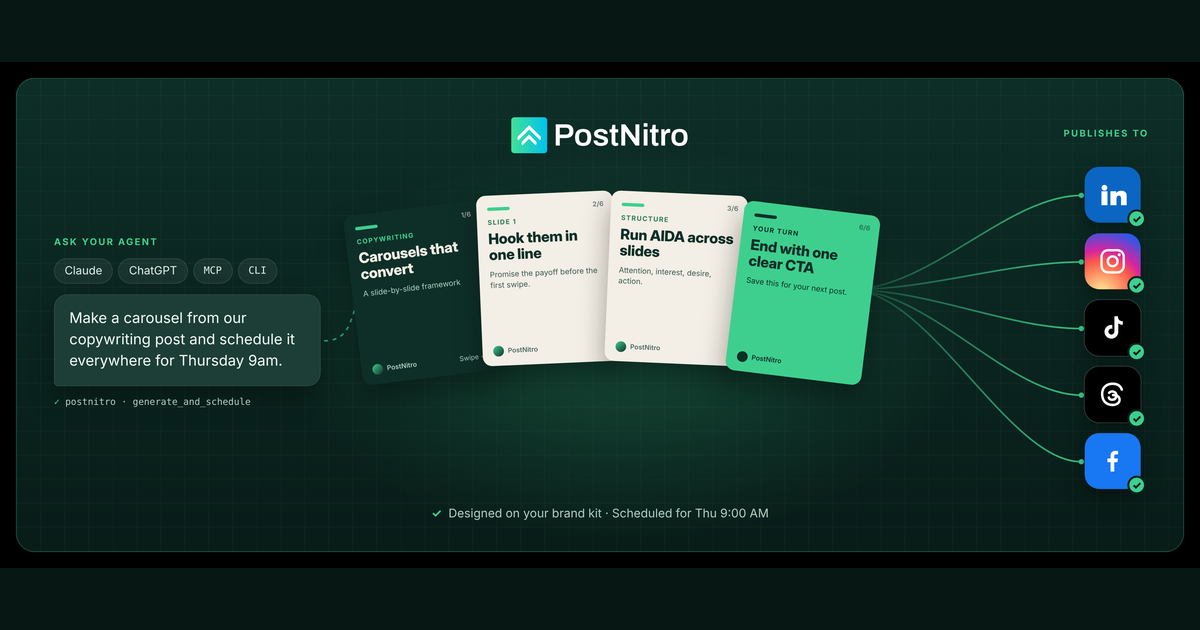
PostNitro for Agents is a social media API for AI agents that designs the post and publishes it, not just writes the caption. It gives an agent a design engine: on-brand carousels, single-image posts and animated video built from over 100 templates and the user's brand kit, then scheduled and published natively to LinkedIn, Instagram, TikTok, Threads, Facebook and Pinterest. The product is aimed at creators, marketing teams and developers who want their AI agent to carry a social post from a raw idea to a finished, on-brand publication in one chain, with no human in the loop unless they want one. Most social APIs an agent can reach will publish text and pre-made media — they assume the design already exists and that a person made it. That leaves the hardest and most time-consuming part of social publishing untouched: producing the artwork, keeping it on brand, sizing it for each network and turning a long article or thread into a readable visual format. PostNitro addresses that gap by putting the design engine itself behind the API, so an agent can convert a topic, article or X thread into a carousel, image post or video and then schedule it. The company frames this as giving an agent a design engine rather than just a publishing API. The creation tools cover carousels, single-image posts and short video, generated from a topic, raw text, an article URL or an X post. Agents can also add AI-generated images and bake them straight into slides, so the artwork appears inside the post rather than alongside it. Alongside generation, there is an import path: a user can bring their own slide content and let PostNitro design it, using the same templates and the same brand kit with no AI writing step involved. That distinction matters for teams that already have approved copy and only need a consistent visual treatment applied to it. Brand is handled through brand kits that agents can list, read, create and update. A brand kit holds fonts, colours, logos and headshots, which means the output stays on-brand without anyone having to describe the brand in a prompt. Because the agent works from the kit rather than from a text description, results are consistent across posts and across sessions. A browsing set of tools rounds this out: agents can list templates, AI presets and audio tracks, then pick deliberately instead of accepting a default. That gives an agent or its operator a way to steer the look and sound of the output before anything is generated. Scheduling and publishing tools let an agent create, read, update and delete scheduled posts, connect and inspect social accounts, and publish natively to six networks: LinkedIn, Instagram, TikTok, Threads, Facebook and Pinterest. Output can take the form of PNG, PDF, MP4 or an editable design, depending on what the caller asks for. X (Twitter) is supported as a content source and as an export format, but not as a publishing destination. Recently PostNitro added direct publishing to Facebook Pages and Pinterest boards, extending where an agent can deliver without a manual upload step. Operating the product follows a simple three-step flow. First, connect the agent: add PostNitro to Claude or ChatGPT in one click with no API key, or point any MCP client, the CLI or the REST API at it. Second, ask for a post — for example, turn an article into a six-slide LinkedIn carousel on the brand kit and schedule it for Thursday at 9am. Third, approve it or let it run: the post is designed on the brand kit and then scheduled, or it is saved as a draft on the calendar so a person can review it and hit schedule. That choice between full automation and human review is available on every job. There are six documented ways into the same engine, all sharing one account, one brand kit and one template library. Claude connects in one click via Claude's Connector Directory using OAuth, so there is no API key to fetch. ChatGPT installs in one click from its plugin directory with the same OAuth sign-in. The MCP server exposes 35 tools at mcp.postnitro.ai for any MCP client. The CLI, installed with npm i -g @postnitro/cli, takes JSON in and returns a designed post out, and is built to be script-safe for CI and automations. The REST API, the layer the others are built on, designs and publishes in one chain. A Skill for OpenClaw and Claude Code lets an agent drive PostNitro end to end. Long-running work is handled explicitly: every generator has a fire-and-forget form and an and-wait form, plus status and output polling, so an agent can choose between streaming and blocking depending on its own architecture. Authentication is unified across the MCP server, CLI and REST API, which all use the same PostNitro API key, so moving between interfaces needs no new setup. Claude and ChatGPT are the exception and the easier case — they connect through their respective directories with OAuth, so there is no key to fetch at all. The MCP server implements OAuth 2.1 with dynamic client registration, which is what removes the key step. A distinctive part of the product is the handoff between agent and human. If the caller asks for the DESIGN output, PostNitro returns an editable design instead of a rendered file. An agent can produce the work at 3am, and a person can then open it in the editor, change the headline and publish. PostNitro contrasts this with publish-only APIs, which return something that cannot be edited, describing its own approach as the one place where the human and the agent share a workspace rather than a handover. For teams that want oversight without slowing the agent down, this makes review a matter of light editing rather than rebuilding. PostNitro is explicit about one boundary: video output is not AI-generated. The video that an agent produces is the carousel slides rendered as an MP4, with animated slide text and audio chosen from the available tracks. It is a design feature rather than a generative video model, and the company notes that this is how carousels reach TikTok, which static-export tools cannot do. Being clear about that distinction helps set expectations for anyone comparing the product with generative video tools, and it keeps the output tied to the brand kit that the slides were built on. Agent access is priced separately from the broader product. It is included in Creator+ at $30 per month with 200 credits per month, and in Team+ at $60 per month with 500 credits per month. On the Starter plan, agent access is a $10 per month add-on with 250 credits. Credit volume can be increased, and the cost per output is stated plainly: an imported slide costs 1 credit and an AI-generated slide costs 2. There is no free tier for the API, so teams evaluating agent-driven publishing should plan for a paid plan or the Starter add-on from the start. Typical uses are described through the prompts the product suggests pasting into an agent. A user might ask it to turn a latest blog post into a LinkedIn carousel, which returns a carousel PDF. Another might announce a launch as an Instagram post on the brand kit, producing an image post. A third might request a 20-second TikTok video from five tips, producing an MP4. A planner-style prompt can ask for next week's schedule — three carousels, Monday to Wednesday at 9am — saved as drafts for review. Each of these maps directly onto the create, schedule and publish tools the agent can call. PostNitro says the product is used by more than 85,000 creators, with its editor embedded in over 200 platforms and a 4.9-star rating on Product Hunt. On the technical side, supported clients include anything that speaks MCP: Claude (Desktop, Code and the web app), Cursor, ChatGPT, VS Code and agent frameworks that support MCP servers. Anything that can run a command works with the CLI, including OpenClaw through the Skill, n8n, Make and CI pipelines, while anything that can make an HTTP request works with the REST API. That breadth means the same engine can be driven from a chat window, a script or a scheduled job. The core value proposition is a design engine and a publishing pipeline in one chain. Rather than handing an agent a caption it can already write and a media file someone else had to produce, PostNitro lets the agent build the carousel, image post or video on the brand kit and then schedule it natively to six networks — six ways in, 35 MCP tools, editable design output when a human wants to finish the job, and paid agent access that starts with Creator+, Team+ or a Starter add-on.
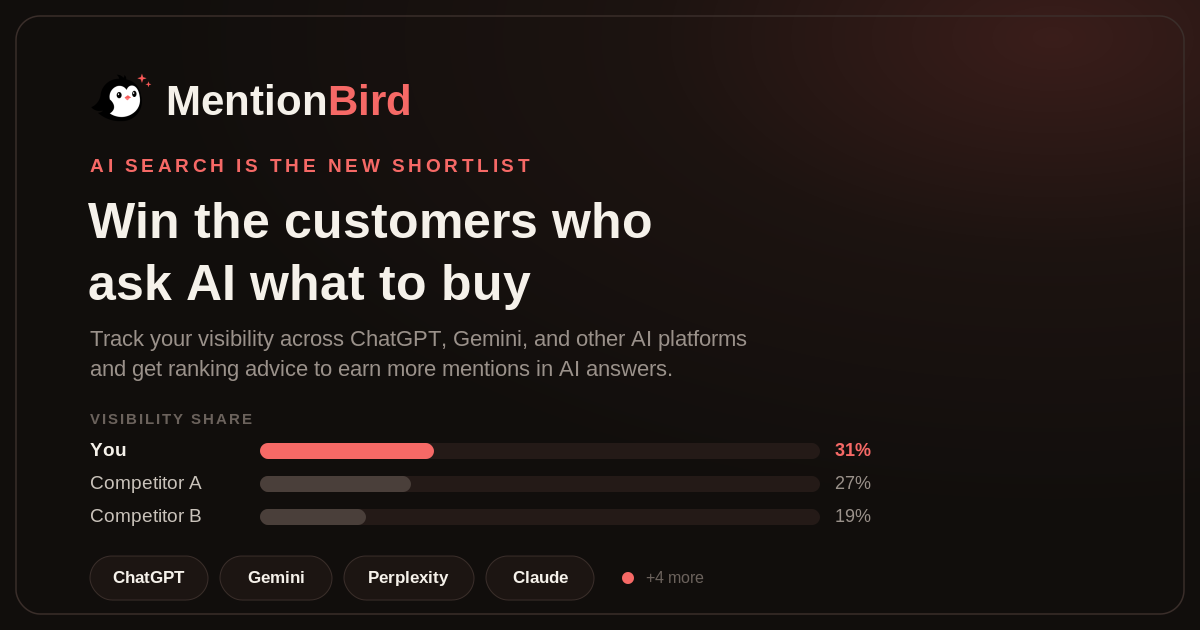
MentionBird is an AI visibility platform that tracks what AI assistants say when buyers ask them what to buy. It monitors the prompts that matter to a business across ChatGPT, Perplexity, Gemini, and Claude, as well as Google AI Overviews, Grok, Microsoft Copilot, and DeepSeek, and shows which sources each model cites when it answers. From there, MentionBird produces a per-prompt plan to get a brand into those sources. The product is aimed at marketing and SEO teams, founders, e-commerce stores, SaaS companies, and agencies that want their brand to be named in AI answers rather than only ranked in Google. The problem MentionBird addresses is that the shortlist for a purchase now forms inside the AI answer. Buyers no longer start with ten blue links; they ask AI, get two or three brand names, and shop from that list. If AI does not say your name, you were never in the running, and you would never know it. MentionBird's own launch story makes the point bluntly: the team took the top three Product Hunt launches and asked ChatGPT, Gemini and Claude the exact questions their buyers ask, such as 'Best browser for Claude Code?' and 'How do I track agent run costs?'. The result was nine answers and zero mentions, which means AI sent those buyers elsewhere. AI search pulls from pages it trusts, including listicles, Reddit threads, comparisons and YouTube videos, and if a brand is not there, it is not in the answer. Tracking the right prompts is the starting point. Users add the questions buyers actually ask, such as 'Best running shoes for daily use', 'Best marathon shoes for men', 'Best running shoes for flat feet' and 'Most comfortable shoes for long runs', and MentionBird keeps them in one workspace as prompts ready to track. The product guidance is to start with the prompts customers might use when searching for products or services like yours, which for most brands means tracking 20 to 50 real questions. A focused set of pre-purchase questions is described as more valuable than hundreds of broad prompts, and users can add, label or regroup prompts at any time as they learn what matters. Once prompts are tracked, MentionBird shows exactly which sources AI cites for each one. For a tracked prompt, the interface lists the sources AI checks and marks each as cited or not cited, covering domains such as runnersworld.com, runrepeat.com, YouTube shoe reviews and zappos.com listings, or verywellfit.com, rei.com expert advice, YouTube channels and fleetfeet.com. This matters because every prompt has its own set of sources: AI answers are built from a small set of pages, reviews and videos that the model trusts for that specific question. Sources decide the shortlist, so getting into them means getting recommended, while staying out means your competitor takes the customer. Seeing per-prompt citation status turns an opaque AI answer into a concrete list of places where a brand must earn a mention. AI Ranking Advice converts that list into work. Choose any tracked prompt, or customer question, and MentionBird reviews the answers, the named brands and the cited sources, then recommends practical steps while showing the effort required for each one. Advice is rated by impact and effort, for example 'Get featured in trusted running shoe roundups' marked medium effort and high impact because it targets the most-cited sources, 'Publish a guide to daily running shoes' marked medium effort to answer the questions buyers ask before choosing, and 'Add fit and durability details to product pages' marked low effort to give AI clearer product facts to quote. Recommendations may include better product pages, clearer product details, comparison guides, videos, or mentions from trusted websites. MentionBird also proves whether the plan is working. Every plan a team executes shows up in the numbers through daily checks across the supported AI platforms, with AI visibility data checked and updated once every 24 hours. Tracking is prompt by prompt: cited, not cited, or no brand named yet, and that gap is yours to take. It reports share of AI recommendations against each competitor week over week, and every score change is traced back to the exact prompt, model or citation that caused it. Example reporting shows brands such as Nike at 31 percent visibility share and up four points, Adidas at 27 percent and unchanged, Puma at 19 percent and down three points, and New Balance at 12 percent and up one point. The methodology is deliberately action-oriented. Other tools chart AI mentions and tell you when you dropped, leaving the 'now what?' to you; MentionBird is built around the question of what to do to get mentioned for a specific prompt. Its three steps are: pick the prompts that bring you customers, track exactly which sources AI cites for each one, and get ranking advice to win those sources. Setup requires no code, plugins or tracking tags: users add their brand, prompts and competitors, and MentionBird then checks AI answers without making any changes to the website, with setup taking only a few minutes. Unlike SEO rank trackers that report a webpage's position in Google search results for keywords, MentionBird tracks brand mentions across AI answers and the sources behind them. The payoff is visibility that turns into consideration. Because AI answers influence sales by shaping which brands buyers consider, and a buyer may visit only the brands included in the answer, appearing in those answers is directly relevant to revenue. If a brand is missing, a competitor may reach that buyer first. MentionBird's customers report discovering that they win category questions but lose comparison questions, that they were invisible on the exact questions engineering buyers ask about automating environment provisioning, and that AI was recommending an ATS to every buyer who asked while never naming theirs. One customer reports being in 83 percent of 'alternatives to the category leader' answers after MentionBird found the gap and told them exactly what to fix first. Another notes that having 3,300+ reviews was not enough while AI still failed to recommend them. Concrete use cases include e-commerce and retail brands competing on product-category prompts, such as running shoes or apparel, where being cited in trusted roundups, review sites and YouTube reviews determines whether AI names the brand. Software companies use it to find the questions where they are invisible among engineering or business buyers and then publish content that answers them. Agencies manage several clients in one workspace, while marketing and SEO teams track their brands and products and compare their visibility with competitors. Mentions of AI ranking advice also point to comparison guides and clearer product pages as fixes. Beyond those, MentionBird states it supports e-commerce stores, software companies, healthcare providers, law firms, financial services, real estate, travel and education, as well as home services, automotive companies and local businesses, meaning any business whose customers research online. MentionBird is designed for teams whose buyers ask AI what to buy, including marketing and SEO teams, founders, and agencies. Competitors can be added so a brand's AI mentions can be compared with theirs, and businesses managing several brands or product lines can keep them in one workspace, using tags to organize prompts by brand, product or project. Subscription plans can be changed at any time, with upgrades applying immediately and downgrades beginning with the next billing period, while saved prompts, labels and past data remain available. During the Product Hunt launch, code PH19 gives Starter at $19/mo for three months, and a free AI visibility report is available to start. MentionBird's core proposition is simple: AI search is the new shortlist. MentionBird shows which sources AI trusts for the prompts that drive sales, why competitors get recommended, and what to fix to win the mention, then proves the plan worked with daily tracking. For brands that suspect AI is sending their buyers elsewhere, it replaces guesswork with a prompt-by-prompt picture of the gap and a ranked set of actions to close it.
Manifold MCP is a hosted marketing MCP server that gives AI agents live marketing data across SEO, AI answers, social, ads and lead research, inside the AI app the user already works in. According to the website, Manifold "gives your agent the tools to grow on every channel" and covers SEO, AEO, social, ads and lead research in Claude, ChatGPT, Cursor and other MCP apps. Connect it once in a minute and the agent can look things up on every channel whenever it needs to. Every client uses a single URL, https://mcp.manifoldmcp.com/mcp, and a single credit balance, and the product states there are no API keys to set up. New workspaces get 250 free credits, so marketers, growth teams and founders can start asking questions in plain words immediately. The problem Manifold is built around is channel fragmentation. Marketing research normally means jumping between an SEO tool for rankings, a separate dashboard for AI visibility, another tool for TikTok and YouTube creators, ad libraries for competitor creative, Reddit for community threads, and a data provider for contact emails. The site describes the alternative as "no pile of tabs": instead of opening each tool itself, the user asks their agent a question and the agent picks the right tools and brings back the answer. Manifold is explicitly positioned as the data your agent works from rather than a scheduler or an autoposter, which matters because it lets teams keep using the AI clients they already pay for and trust while gaining live marketing data they would otherwise have to collect by hand. For SEO, Manifold lets an agent see every keyword a site ranks for, who outranks it and why, and what to fix on the site. The workflow example on the site asks the agent which keywords rank between positions 5 and 15 that could reach page one, with volumes such as "crm for startups" at 72,900 and "simple crm" at 96,600. The underlying tool is exposed as seo_get_ranked_keywords. For AI answers, the aeo_run_ai_answers tool lets an agent ask ChatGPT, Claude, Gemini, Perplexity and Google's AI Overviews any prompt on demand and report which brands each answer names, in what position, and which pages it cites. This is billed per prompt and engine rather than as a monthly fee for tracked prompts, and a free check shows whether a site lets AI crawlers read it, so teams can see whether AI assistants recommend them for the questions their buyers actually ask. Manifold's social coverage finds the TikTok, YouTube and Instagram creators a brand's buyers watch, their audience, and their top videos with transcripts, so the agent can answer questions like which sales creators on TikTok and YouTube get the most views and what their top videos are. The site shows YouTube Shorts and TikToks from named creators as examples of what the data surfaces, along with view and like counts. Alongside social, the ad libraries capability returns competitors' live ads on Meta and Google, including what each ad says and how long it has run, for example three live Attio ads on Meta, an image ad live 47 days and two creator videos live 76 and 42 days. Being able to see creative that is already running, and for how long, gives teams a factual basis for writing their own ads. The People capability spots posts on LinkedIn and X about the problem a product solves and then returns each author's verified work email, so an agent can answer questions like who posted about leaving their CRM this week and hand back a contactable list. Reddit coverage finds every thread that asks for what the product makes, reads the replies, and helps draft an answer, with example queries such as finding threads this month asking for a CRM and example communities such as r/CRM and r/CRMSoftware. The site lists tools including reddit_search_posts, linkedin_search_posts and aeo_run_ai_answers to illustrate how the agent calls these capabilities on demand. Manifold works in three steps. First, the user connects their agent by adding Manifold to the AI app they already use; the site says it takes a minute with no API keys to set up. Second, the user asks for what they need in plain words and the agent picks the tools, with Manifold reading live data from Google, AI answers, Reddit, social, ads and leads. Third, the agent returns answers you can act on, such as what to fix on a page, who to reach out to, or which threads to join, and can take the next steps itself. Because Manifold is hosted, the agent signs in once and uses Manifold's own provider accounts; there is no need for a Reddit API app, a LinkedIn login or a DataForSEO deposit, and clients without OAuth use a Manifold API key instead. Data is fetched live from specialist providers when the agent asks: search, keyword, backlink and AI answer data come from DataForSEO, while Reddit, TikTok, Instagram, YouTube, Facebook, LinkedIn, X and the ad libraries come from the platforms' public data. Results are cached briefly, most for a day to a week, so a repeat question comes back fast and costs less. The stated outcome is answers built on real data rather than guesses. Your agent writes from Manifold's data, drafting blog posts, Reddit replies, ad copy and outreach emails in the chat with real numbers behind them, and the user checks the drafts and uses them where they want. Cost control is part of the design: every call is paid from one credit balance, each tool states its price before it runs, and the agent can cap what a call spends. A three-step example on the site shows an agent answering what to fix on a /pricing page, namely to put "crm for startups" in the title because the site ranks 7th for it, to answer "is there a free plan?" on the page because ChatGPT gets it wrong, and to link to it from the four best-ranking posts, which illustrates how concrete the output is. Concrete workflows follow the same pattern of asking in plain words and letting the agent choose the tools. A SEO lead might ask which keywords the site ranks 5 to 15 for that could reach page one, then ask what to fix on a specific page, and finally have the agent draft the changes or an outreach email about them. A growth marketer might check whether ChatGPT and Gemini recommend the brand for "best CRM for startups", then look at what competitors are running on Meta this week, then ask which TikTok and YouTube creators in the niche get the most views. A founder doing outbound might ask who posted on LinkedIn about leaving their CRM this week, request verified work emails for those authors, and then ask the agent to draft the outreach. In each case the agent returns real numbers and drafts the follow-up content in the chat. Manifold is aimed at marketers, growth teams and founders who already work inside AI clients and want marketing data there rather than in another dashboard. It works with Claude, ChatGPT, Cursor, Claude Code, Codex, Gemini CLI, Grok, OpenCode and any other client that supports remote MCP servers, all through one URL and one credit balance; in Claude you add the URL as a custom connector and sign in, and in Claude Code you run claude mcp add --transport http manifold followed by the URL, with per-client steps in the docs. Pricing is free to start with 250 free credits per new workspace, then a Pro plan from $20 a month for 2,500 credits or a Max plan at a lower rate per credit, with top-ups from $10 between renewals. Manifold is a marketing data MCP server founded in London in September 2026 by Jesse Sibley, and the site notes it is unrelated to Manifold Markets, the prediction market. Manifold MCP's value proposition is simple: connect your agent once and it can pull live SEO, AI answer, social, ad and lead data on demand, then turn that data into drafts and decisions in the same chat. It replaces a pile of tabs with plain-language questions, keeps costs visible through a single credit balance with per-tool pricing, and gives marketers real numbers to act on rather than estimates. Free credits make it easy to test what the agent can answer before committing to a paid plan.
nestd.ai is an AI tool that turns property photos into structured property features and then into professional listing descriptions. You can paste an Airbnb or Booking.com listing URL, or upload your own photos, and the platform analyzes each room to understand what makes every space unique — the light, the style, the feel, and the neighborhood character — before writing copy that is ready to publish. Instead of starting from a blank form or a blank page, users get a room-by-room breakdown of materials, finishes, appliances, and style, followed by descriptions, highlights, and insights. The product is built for landlords, Airbnb and Booking.com hosts, real estate agents, and agencies or catalog operators who need listing copy that matches what is actually in the photos. The product addresses a familiar set of frustrations. As the site puts it: 'I spend 45 minutes staring at a blank page for every listing,' 'My descriptions all sound the same. I'm running out of ways to say spacious,' 'I've tried ChatGPT but it writes generic fluff that doesn't match my photos,' and 'Guests ask for a quiet place with a real kitchen and my catalog filters can't find it.' Those quotes capture two related problems. On the writing side, hosts, landlords, and agents lose time staring at blank pages and reusing interchangeable language that does not reflect the actual unit. On the discovery side, catalog search built on checkbox filters cannot answer natural-language requests from guests and buyers. nestd.ai addresses both by first turning photos into a structured, reviewable feature graph, and then writing copy — and powering search — from that same analysis. Getting started requires no manual feature forms. You can drop interior, exterior, and amenity shots directly into the app, or import a listing by pasting an Airbnb or Booking.com URL, which pulls the title, room details, location when available, and photo links. Smartphone photos work perfectly, and the AI is described as trained on real-world listing photos, not just professional shots. Once the images are in, nestd.ai groups them into rooms. The import flow opens the app with your URL ready and requires the user to confirm ownership before analysis begins; users must own or manage the listing and are responsible for complying with the platform's terms. From those photos, nestd.ai builds a feature analysis. It identifies each space — kitchen, bedrooms, bathrooms, living room — and extracts materials, finishes, appliances, furniture, and condition signals. Every property gets deep analysis: room-by-room identification, feature extraction of materials, appliances and finishes, style classification such as modern, traditional or luxury, and quality assessment covering condition and renovation level. The analysis is surfaced as a list of structured features such as open plan, vaulted ceiling, ceiling beam, kitchen island, breakfast bar, pendant lighting, recessed lighting, fireplace, built-in cabinets, refrigerator, range, oven, range hood, dishwasher and kitchen sink, alongside descriptors such as white, light wood, black, gold, beige and gray. Users review the analysis before generating any copy, so they can see exactly what the system detected in each room. Location intelligence is built in. Add the address and nestd.ai researches nearby amenities, transit and accessibility signals, schools, neighborhood vibe, and local characteristics. That context is then woven into the descriptions for guests or buyers who care about location. The sample outputs show how this appears in practice: the Brookhaven villa description references Wertheim Wildlife Refuge, Row Boat Beach, and Painters' Restaurant, while the Warsaw apartment description mentions cafes, parks, the Vistula waterfront, and public transport. The platform also suggests a listing name, property type, and room counts from the photos, plus a location when EXIF GPS data is available, and lets users review and edit anything before continuing. Descriptions are generated from the analysis rather than from a blank prompt. When generating, users choose a style — marketing or social — along with a length, a language, and a target audience such as families, couples, digital nomads, professionals, or a custom audience. The AI adapts the wording so it speaks to the right guests or buyers. Descriptions can be regenerated as many times as needed, and style, tone, or length can be adjusted until they are right; an additional prompt can be added if desired. The dashboard shows the complete property breakdown — rooms identified, features extracted, style classification, and location insights — so users can see the analysis behind the copy. Published examples include a social-style description for a luxury villa with vaulted ceilings, a fireplace and a barn door into a spa bathroom, a marketing-style description for a one-bedroom coastal apartment in Cabarete with turquoise accents and a private balcony, and a marketing-style description for a small one-bedroom Warsaw apartment with a galley kitchen and stone-veneer feature wall. The differentiating idea is that photos replace manual feature forms. Generic one-shot prompts often miss room-level detail; nestd.ai analyzes each room in the photos separately and highlights what makes that specific property unique. The result is copy that mentions the marble countertops in the kitchen and the barn doors in the bedroom because the system looked at each room, not just the first photo. No prompt writing is required: upload your photos and location, and the platform automatically analyzes rooms, features, style, and neighborhood context. Structured features then power both the descriptions and, for catalogs and platforms, natural-language search — so guests and buyers can find properties by how they actually think, rather than by checkbox filters. The stated benefits are speed and specificity. Landlords can list rental properties faster, generating descriptions for multiple units in minutes instead of hours. Airbnb and Booking.com hosts can import a listing in one click and produce compelling descriptions intended to get more bookings without hiring a copywriter. Real estate agents can speed up their listing process with consistent, high-quality descriptions for every property they represent. Because the copy is generated from a structured analysis of each room, descriptions are accurate and specific rather than generic AI filler, and they can be tailored to the audience reading them. As the site notes, every description written by hand is an hour that could be spent on showings, client calls, or closing deals. Concrete scenarios include a landlord publishing multiple rental units who wants descriptions for each unit without starting from a blank page every time, and a short-term rental host who pastes an Airbnb or Booking.com URL and confirms ownership to begin analysis. A real estate agent photographing a listing with a smartphone can upload interior, exterior, and amenity shots to receive a room-by-room feature breakdown and marketing copy. Agencies and catalog operators running larger inventories can use the same photo analysis as the basis for natural-language search across their catalog, and hosts can use natural-language search in-app. Users who do not want to upload photos can enable demo mode in the app to search example properties using natural language. nestd.ai is aimed at landlords, Airbnb and Booking.com hosts, real estate agents, and agencies and catalog operators, with an Enterprise path for organizations that want natural-language search across a catalog. The product runs on the web at nestd.ai, with the application at app.nestd.ai; no mobile or desktop app is mentioned. Pricing is free to start: users get free credits with no credit card required and no expiration, and the homepage advertises instant demo access. Importing a listing requires that you own or manage it. For catalog and platform search, the site points interested organizations to an Enterprise page and offers a call-booking link. In short, nestd.ai turns property photos into property intelligence: structured, reviewable features first, then professional listing descriptions written from that analysis, with optional location research and audience targeting. For hosts, landlords, and agents the value is faster, more specific listing copy; for agencies and portals it is a structured feature graph that also powers natural-language property search. Upload photos or paste a listing URL and get structured features and professional copy in minutes.
MePersona is an AI unified inbox built for content creators, designed to help them answer fan comments and direct messages without living inside a dozen apps. It drafts replies in the creator's own voice, gathers fan DMs from twelve platforms into a single place, and waits for approval before anything is sent. Its stated purpose is simple: stop drowning in DMs and reclaim personal time while still giving every fan a real answer. MePersona works in English and Spanish, so bilingual creators no longer have to choose which half of their audience receives a real response. Creators build audiences on multiple platforms, and each platform brings its own stream of comments and DMs. The result is fragmented attention: messages spread across X (Twitter), Instagram, TikTok, YouTube, Telegram, Discord, LinkedIn, Bluesky, Facebook, Mastodon, WordPress and Pinterest, with Twitch, WhatsApp and Reddit listed as coming soon. Answering every fan personally costs hours, while replying only to some leaves other fans feeling ignored. MePersona's positioning is that replying to every fan yourself costs hours of personal time, and its pricing page notes that Premium costs less than a dollar a day. Rather than replacing the creator with generic bot replies, MePersona is presented as a way to keep a real voice present at scale, with the creator retaining final control over what is sent. Everything in MePersona runs off a single AI persona. Training it is quick: the creator reads a short sample aloud and MePersona maps their real voice from that sample, then learns to talk, write and post like them. The Product Hunt description adds that the persona improves with every reply the creator approves and that it scores how much each draft sounds like the creator. Because every other part of the product runs off this one brain, the inbox, the vault, the marketing agent and any connected tools all draw on one consistent voice rather than separate systems. The unified inbox brings fan DMs from the supported platforms into one place. For each message, MePersona prepares a drafted reply, and the Product Hunt description notes that it remembers what each fan said last time, so context carries across conversations. Nothing posts until the creator hits Send. Every AI-drafted reply, post and campaign waits in the Review Queue until it is approved, so the creator can check each draft rather than publishing automatically. Once the persona has earned trust, auto-reply can be switched on for the routine messages the persona is sure about, while anything less certain still goes through review. This staged approach is what the FAQ contrasts with ordinary DM automation. Beyond the inbox, MePersona includes an auto-tagged content vault that stores material, alongside a Marketing Agent that plans campaigns in the creator's voice. Paid plans include one free Marketing Agent plan per month. Vault storage scales by plan, from 10 GB on Free through 100 GB on Premium, 500 GB on Pro and 1 TB on Pro Elite. Premium and above also add post scheduling across all platforms, a unified inbox and an analytics dashboard. Scheduling means the creator can plan posts from the same place they plan marketing instead of moving between tools, and the analytics dashboard gives visibility into how that activity performs. The persona is not locked inside MePersona. A Persona API, included with the Pro Elite plan at 1,500 AI calls a month, lets creators connect it to tools they already use. The documented scenarios include pointing an autonomous agent or runtime at the persona so it acts in the creator's voice, building n8n and Zapier workflows that pull new fan messages and draft replies that sound like the creator, powering a chat on the creator's own website so it talks like a person rather than a bot, and letting agencies and builders add voice-matched drafting inside their own tools and dashboards. Discord bots are also named as a possible connection point. A Creator Studio is described as on its way and marked coming soon. It is framed as create it, post it, answer it, all in your voice. The Create step generates images and videos, or remixes content already stored in the Vault. The Post step adds captions, music and templates, then schedules the result from the same place marketing is planned. The Reply step covers what happens when fans respond: the persona drafts replies in the creator's voice and the creator approves them. Studio is stated to work with a MePersona account. Because it is labeled coming soon, these capabilities are announced rather than currently available. MePersona's approach is a chain of small confirmations. First the creator trains a persona by reading a short sample aloud. The persona then produces drafts for comments, DMs, posts and campaigns, and each draft is scored for how much it sounds like the creator. Those drafts wait in the Review Queue, which makes approval the default state and publishing an explicit action. Approvals feed back into the persona, which the Product Hunt description says improves with every reply the creator approves. Only once a persona has demonstrated reliability does the creator enable auto-reply for routine messages. The FAQ positions this against plain DM automation and also addresses whether fans will know it is AI, whether the account could be banned, and whether the product can create content as well as reply to it. The stated outcome is time back. The pricing page argues that Premium costs less than a dollar a day, while replying to every fan yourself costs hours. Creators who adopt it can answer every fan rather than a subset, which as the Product Hunt description puts it stops bilingual creators from choosing which half of their audience gets a real answer. Being present across platforms at once means fans on Instagram, TikTok, YouTube or Discord are not deprioritized because the creator only had time for one app. The Review Queue protects the creator's output, since no unvetted message leaves the account, and auto-reply absorbs the routine traffic once trust is established. Concrete workflows appear throughout the site. A creator opens the unified inbox, sees a fan message with a draft already prepared, checks that it sounds right, and sends it. A bilingual creator runs the same flow in English and Spanish without splitting the audience. A creator with a large following switches on auto-reply for routine questions while keeping other messages in review. A Marketing Agent plans a campaign in the creator's voice, and the resulting drafts wait in the Review Queue. A developer connects the Persona API to n8n or Zapier so new fan messages are pulled and drafted automatically, or embeds a chat on their own website that speaks in the creator's voice. Once Creator Studio ships, the same pipeline extends to images, videos and captioned reels. MePersona is built for creators across niches, with Beauty, Fitness, Gaming, Music, Cooking, Lifestyle, Education and Comedy named on the site, plus a short five-question quiz that asks what kind of creator you are. Pricing starts with a Free plan at $0 that includes an authentic persona, 300K tokens per month (roughly 300 replies), two platforms, 10 GB of vault storage and post scheduling, with no card required. Premium is $29 per month or $299 per year with 2.5M tokens (roughly 2,500 replies), unlimited platforms and 100 GB of storage. Pro is $99 per month or $999 per year with 10M tokens (roughly 10,000 replies) and 500 GB. Pro Elite is $149 per month or $1,599 per year with 25M tokens (roughly 25,000 replies), 1 TB of storage and an API key. Paid plans begin with a 7-day free trial and offer a full refund within the first 30 days. Enterprise pricing is custom. Payments run through Stripe with Apple Pay supported, and the project has a Discord community. MePersona combines a unified inbox, a trainable voice persona and a review-first approval flow so creators can respond to every fan on every platform without losing their voice or their time. One persona powers replies, content, campaigns and connected tools, and the creator always hits Send.
ReSO AI is a generative engine optimization platform that helps brands get discovered and recommended when customers ask AI. It is built for founders, CMOs, and growth teams who want to turn buyer intent expressed in ChatGPT, Perplexity, and Google AIO into visibility, citations, and traffic. Rather than simply tracking where a brand appears, ReSO analyzes intent, competitors, content gaps, and technical issues, then turns those findings into priority actions that can improve how AI platforms mention, cite, and recommend the brand. Onboarding the ReSO agentic employee is presented as the starting point: a buyer searching on ChatGPT should receive an answer that recommends your brand. Buyer behavior is shifting toward AI-led discovery, and the product states that in 2026 AI will dictate discovery. Buyers increasingly research on ChatGPT rather than on traditional search result pages, which means a brand that is absent from AI answers can lose influence before a prospect ever reaches its website. Traditional SEO tools were built to track keyword rankings, not to decode the intent behind the questions people ask large language models. ReSO positions itself against that gap, offering a way to understand how LLMs interpret intent, what they cite in a category, and which technical signals limit a site's ability to be read and trusted by AI systems. The discovery side of the platform is built on a proprietary intent model that analyzes 30+ intent-driven search variables to decode what customers are looking for. It maps those variables to real buyer queries on AI and organizes them by stage, including Discovery, Feature Comparison, and Persona, where Discovery covers the exploratory phase in which people look for the best options, trends, and possibilities before narrowing down what fits their needs. Users can curate a list of 75 high search intent-based prompts, track brand share of voice across the entire awareness-to-conversion funnel, and map their visibility against competitors so they can see where they are mentioned and where rivals are recommended instead. Content creation is handled through citation intelligence. Each piece of content is built around signals that influence AI visibility: prompt trends, citation behavior, and content gaps across the category. The platform supports a consistent weekly publishing cadence, a 100% customized content strategy intended to make the brand a category leader on LLMs, and content created in formats that improve mention potential. This matters because getting cited by AI search engines requires clear, authoritative answers, strong entity signals, useful source material, and structured content that AI systems can interpret easily, so the content work is aimed at the sources and authority signals that AI platforms actually draw on. A third pillar is the technical engine, which audits the technical issues that affect how AI systems and search engines access, interpret, and trust a website. It delivers technical edits intended to increase LLM visibility, entity mapping and code-level changes to make the website AI-readable, and improvements to discoverability across search platforms. Because AI systems must be able to reach, parse, and trust a site before they can cite it, these fixes complement the content and prompt work rather than standing alone. Overall, ReSO replaces the work of an SEO agency with an agentic employee that handles the process end to end, and it is designed to replace agencies, consultants, and fragmented internal workflows with one system. Its methodology is to measure first, through an AI visibility check, then act on the gaps it finds in brand presence, content, technical setup, and competitive positioning, and then keep publishing and optimizing on an ongoing cadence. The platform states that it works alongside traditional SEO while extending visibility into AI search, combining content, technical optimization, authority, and AI visibility tracking so that both traditional search and AI platforms are addressed inside one search visibility strategy instead of treating AI search as a separate channel. Reported outcomes from the company's own case studies include a 3X traffic increase from LLM-driven search, a +38% month-on-month citation growth, a +25% signup conversion directly from ChatGPT referrals, and a +30% quarter-over-quarter visibility score growth. A publicly listed fintech in India, SMC Global, saw a 132% increase in clicks from ChatGPT, a 162% increase in website clicks up from 37,200, and a 516% increase in impressions up from 923,000. An HRTech EoR platform achieved a 12X increase in citations from LLMs in three months, a 364% increase in blog traffic from 824 to 3,825 monthly clicks, a 5x increase in AI mentions from 10 to 50, and a 41% increase in AI visibility up from 8%. A US-based LegalTech company recorded a 92% increase in brand mentions up from 288, a 60% increase in total traffic up from 23,400, and a 55% increase in impressions up from 2,080,000. Concrete workflows described in the content include improving a brand's visibility in ChatGPT by identifying the questions buyers ask LLMs and where the brand currently appears in those answers, then prioritizing the pages, topics, and site improvements most likely to increase mentions and recommendations. Another is getting cited by AI search engines by analyzing which sources AI platforms cite in a category, finding gaps in content and authority signals, and optimizing the website accordingly. A third is competitive analysis: measuring share of voice across intent-driven prompts, seeing where competitors are mentioned or recommended, and locating the buyer-intent stages with the largest visibility gaps. The Discovery stage content shows the exploratory questions buyers ask, such as the best budgeting apps for managing personal finances, the best fitness trackers for everyday use, or the best tools for automating B2B lead qualification, which illustrates the kind of prompt-level work the platform supports. ReSO is aimed at founders, CMOs, and growth teams across high-growth startups and enterprise, and it is described as trusted by founders and CMOs. Its content highlights B2B brands in particular, noting that B2B buyers increasingly use ChatGPT, Perplexity, or Google AIO to research solutions, compare vendors, and shortlist providers, and that the platform also serves verticals such as fintech, HRTech, and LegalTech. Access begins with an AI visibility check from the onboarding flow, and the brand offers a detailed AI visibility analysis across brand, content, technical setup, and competitive gaps, stated as worth $500 at no cost for the time being, with no credit card and no commitment required to get started. The platform notes that AISO, GEO, AEO, LLMO and similar terms overlap, with AISO focused broadly on AI search, GEO on generative engines, AEO on direct-answer visibility, and LLMO on large language models, while the underlying goal is the same: making a brand easier for AI platforms to understand, mention, cite, and recommend. In short, ReSO AI's core value proposition is turning AI answer engines into a growth channel: it shows brands how LLMs see them, why competitors are recommended instead, and what to change in content and on-site technical signals so that the brand becomes the one AI recommends to buyers.
Proofsource is an AI intelligence platform that shows whether ChatGPT, Perplexity, Claude and Google AI Overviews name your brand when buyers ask category questions, who those engines name instead, which sources they cite, and what to fix. It is built for the teams that own the shortlist: growth and brand leaders, writers and search teams, agencies running many brands, and founders or small businesses. Its stated purpose is simple and direct — be the brand AI recommends. Rather than measuring blue links or ranking positions on a search results page, Proofsource measures the answer itself: whether your brand appears inside it, where it appears, and which other brands appear alongside it. Buyers now ask AI for a shortlist. An answer engine names three to five brands and moves on. If your brand is not one of them, there is no second page to rank on and no click to measure, so the loss is invisible in conventional reporting. Proofsource says most brands never see this shortlist. Its own measurement illustrates how contested the space is: across 947 citations, four engines and a scan dated 4 October 2026, 43.5% of the sources AI cited for category questions were comparison pages — listicles, alternatives and versus pages. In the same research, 387 different websites were cited across just 80 answers, meaning a brand's own site is one voice among hundreds. A separate finding reported on the site states that only 1 of 4 engines described a brand-new company correctly, with the other three answering from what they already believed. New research highlighted on the homepage notes that 0.8% of AI citations point to the brand's own website. The first feature group is visibility measurement. Proofsource asks each engine the questions your buyers ask and records whether you are named, in what position, and next to whom. It reports mention rate, share of voice and average position per engine, and every number carries a 95% confidence range, described in the product as a 95% Wilson interval, so a bad day never looks like a trend. Answers are kept in full, both as text and as a screenshot, so the evidence behind a number can be revisited. In the Tesla example shown on the site, 53 of 100 answers named Tesla overall, split as 16 of 25 on ChatGPT, 16 of 25 on Google AI Overviews, 11 of 25 on Claude and 10 of 25 on Perplexity. Second, Proofsource shows who AI names instead of you. Every brand the engines name for your questions lands on one leaderboard, ranked by answers per engine, including brands you never thought of as competitors. You can add any of them to tracking with one click, and the platform highlights the questions where each competitor beats you. The Tesla example lists Rivian at 13 answers, SunPower at 13, Ford at 10 and Enphase Energy at 9, alongside Tesla at 53. This matters because a shortlist loss is usually a competitive loss, and the leaderboard makes the set of rivals that answer engines actually consider — not the set you assume — explicit and trackable. Third, Proofsource shows the pages AI trusts in your category. Because answers are built from sources, the platform lists every page the engines cite for your questions, which of those pages mention you, and which are open to a pitch, a listing or a correction. It surfaces cited domains alongside the exact pages, the listicles that leave you out, and the pages on your own site that engines read versus the ones they skip. In the Tesla example, youtube.com was cited in 29 answers, en.wikipedia.org in 24, reddit.com in 20 and tesla.com in 17, with the platform noting whether each source names the brand, partly names it, or is the brand's own site. Fourth, Proofsource catches what AI gets wrong about you. Engines answer from what they already believe, so the platform asks about your brand by name, reads the answers, and flags wrong prices, old features and mixed-up identities, along with the source behind each claim. It reports wrong claims together with the page that caused them, runs profile checks on the sites engines lean on, and checks crawler access — whether GPTBot, ClaudeBot and PerplexityBot can read you at all. One illustrative claim check on the site shows an engine stating that plans start at a price the brand retired last year and that the free tier includes unlimited seats, flagging it as wrong on both counts, pointing to a 2024 review page as the likely source, and suggesting an update to the pricing page plus a request for the reviewer to refresh. Fifth, and central to the product, Proofsource does not stop at a score. It keeps going through a loop it describes as Know, Act, Prove, Repeat: what the engines say, why they say it, what to change, and whether the change worked. It ranks the gaps behind each lost answer by likely lift against effort, names the page or source to change, and drafts the fix from your own content for you to approve. After approval, its agents publish the change, verify that the answers have changed, and learn from every change. The workflow starts from your website and reaches first answers in minutes. You tell Proofsource your site; it reads it, works out your category and your competitors, and drafts the buyer questions worth tracking, with you approving every one. It then asks 25 questions on ChatGPT, Perplexity, Claude and Google AI Overviews, and keeps every answer with its sources and a screenshot. You receive the shortlist and the fixes: where you are named, who is named instead, which sources decided it, and the gaps worth closing first. On paid plans answers are checked every day, because AI answers shift from day to day and a weekly snapshot can miss the day a competitor enters your shortlist. The free trial runs two scans, today and tomorrow. The site links to a published methodology page describing how it measures AI answers. Proofsource is positioned for every team that owns the shortlist. Growth and brand leaders get one number for AI visibility they can defend in a board meeting, with the questions, engines and confidence range behind it. Writers and search teams get the questions they lose, the pages the engines cite instead, and drafts grounded in their own site — the site frames the shift as "search taught you to rank; this shows you how to be quoted." Agencies running many brands get unlimited brands on one account, a weekly report per client, and a roll-up of who is winning and losing across their book. Founders and small businesses use the free trial to see in minutes whether ChatGPT recommends them and then fix the one page that matters most. Engines tracked on every plan are ChatGPT, Perplexity, Claude and Google AI Overviews; the site also displays Google AI Mode, Gemini, Microsoft Copilot, Grok, DeepSeek and Meta AI logos, and the FAQ states that Grok and DeepSeek are available as add-ons on Custom plans. Pricing is free to start: 200 answers, 25 questions on every engine, top AI engines, two days, no card. After that, you choose how many questions each brand tracks, and custom plans start at $64 per brand per month, with the final price discussed on a demo call. Proofsource also publishes side-by-side comparison pages against Profound, Otterly.AI, Peec AI, Semrush, Ahrefs, Scrunch, SE Ranking, Rankscale and AthenaHQ, covering engines covered, sampling cadence, statistics, fixes and price, with sources for every claim about another product. The FAQ clarifies that Proofsource is not ProveSource, the social-proof popup tool, and explains how it differs from SEO rank tracking: rank trackers measure blue links, while answer engines write one answer and name a few brands. The takeaway Proofsource reinforces throughout its site is that the shortlist is being written right now — answer engines are deciding, question by question, which brands get named. By measuring those answers across the major engines, showing who is named instead and which sources decided it, and then drafting, publishing and verifying the fixes, Proofsource turns AI visibility from an invisible loss into a measurable, actionable loop.
Ownfeed is a tool that builds a daily social feed of posts from people who appear to need your product. You paste your product's URL, and Ownfeed reads that page to learn what the product does and who it is for. From there, it searches public posts across Reddit, X, Bluesky and Hacker News and uses AI to keep only the posts where your product helps. The result is a personal timeline of relevant posts, refreshed every day, that you scroll for about five minutes and reply to yourself. It is built for indie makers. The problem Ownfeed addresses is stated plainly on its own site: you built it, you shipped it, nobody came. Launch posts get removed by moderators. Searching for people to talk to eats your whole day. A good product exists, but no one who needs it can see it. The site shows real examples of the frustration: a maker asking how to find the first 10 users without spamming, another spending three hours on Reddit looking for people who might need their app, and another wishing for a tool that tells them when someone asks for something like their product because they keep finding those threads a week too late. Ownfeed's core observation is that the people who need your product are writing about their problem today, you just cannot see them. The product exists to close that visibility gap without keyword setup, alert inboxes or automation. Setup is deliberately minimal. You paste your product's URL, and that is the whole setup. Ownfeed reads your page to learn what the product does and who it is for, then writes about 30 search terms to find your people. Your first feed is ready in a few minutes, with posts from the last 24 hours. The site's own working view shows the process for a sample product: reading the product page and generating 30 search terms, then searching four sources at once. Discovery across sources is the second core capability. Ownfeed searches Reddit, X, Bluesky and Hacker News, and the sample feed shows example result counts per source — 9 posts from Hacker News, 11 from Bluesky, 42 from Reddit and 18 from X in that illustration. AI then picks the posts that matter, keeping only the ones where your product helps. The feed can be filtered between 'Today' and 'All relevant.' The example posts shown include freelancers asking how to chase unpaid invoices, a solo designer looking for a dead-simple invoicing app, a Bluesky post about third reminder emails, an Ask HN thread about late payments, a mention of a specific invoicing tool, and a Reddit request for an invoicing app that sends polite reminders automatically. These illustrate the kinds of posts Ownfeed surfaces and are labeled as pain points, tool requests and mentions. Reading and replying is the third step, and it is intentionally manual. You spend five minutes in your feed each morning and reply to the people you want to talk to. Ownfeed states there is no alert inbox and no keywords to set up, and that you write the replies, not an AI — which is why they land. The FAQ reinforces this: Ownfeed never posts or replies automatically, and it never touches your social accounts. You reply in your own words, as usual. Ownfeed's approach differs from keyword alerts and monitoring inboxes in a few ways the site makes explicit. Instead of you defining keywords, Ownfeed derives roughly 30 search terms automatically from your product page. Instead of delivering an inbox of alerts to triage, it delivers a daily timeline you scroll. Instead of automating outreach, it deliberately leaves the writing to you, on the stated reasoning that human-written replies are the ones that land. The whole workflow is framed as three steps — add your product, AI finds your people, scroll and reply — and as a five-minute-a-day habit. For users, the stated outcome is time saved and better-targeted conversations. Instead of spending hours hunting Reddit for people who might need your app, you get a ready feed of posts where your product helps, drawn from the last 24 hours. Instead of finding relevant threads a week too late, you see people writing about their problem the day they write it. And because you write the replies yourself, there is no automated spam risk to your account and the replies are more likely to land. The concrete use cases shown on the site are indie makers shipping a product and looking for the first users, freelancers and solo operators searching for tools, and makers replying to pain-point threads, tool recommendation requests and mentions of their product. In the sample feed, the product being monitored is an invoicing tool, and the relevant posts are freelancers with late invoices, solo designers wanting a simple invoicing app, an Etsy seller needing automatic polite reminders, and a Bluesky user mentioning they switched invoicing to that tool for automatic reminders. In general terms, Ownfeed suits anyone who wants to find and reply to public conversations where their product is the answer. Pricing starts with a $1 one-day trial that shows a day of your feed before you decide; $1 today, then $39/month starting the next day unless you cancel before then. The monthly plan is $39/month, renewing monthly and cancellable anytime from Billing in Settings. The 3-month plan is $89 every 3 months. Every plan includes one product and a daily timeline, and the 3-month plan additionally includes beta sources: LinkedIn, Threads, TikTok, Instagram, YouTube and Product Hunt, delivered in small daily amounts with no guarantees while in beta. Every option renews automatically until cancelled; prices are in USD and tax may be added at checkout. The trial, monthly and 3-month options all include Reddit, X, Bluesky and Hacker News. Ownfeed is a web product accessed through the browser. In short, Ownfeed's value proposition is visibility without automation: paste your product URL, get a daily feed of posts from people who need what you built, and spend five minutes replying in your own words.
Supademo's AI Demo Agent is an always-on agent that runs product demos for prospective buyers. According to Supademo, you deploy self-improving AI agents that run discovery, answer questions, handle objections, and showcase interactive content to drive warmer leads from day one. Rather than filling out a demo form and waiting for a sales representative, a buyer meets the agent, is asked about their role, goals, pain points, and what brought them there, and then receives a tailored experience assembled from the vendor's own interactive demos, videos, decks, pricing, case studies, and documentation. The agent is aimed at revenue teams — sales and SDR teams, solutions engineers and presales, and PLG and growth teams — that need to qualify and educate buyers at scale. It runs 24/7 across time zones and supports voice and text in more than fifty languages, so buyers can interact however they prefer, whenever they arrive. Supademo frames the problem bluntly: your demo process is losing you deals. Buyers want to see the product before they talk to sales, but today they have to fill out a form, wait for a rep, and hope the timing works — and most don't bother. A prospect who lands at 11pm sees a "Book a demo" button, and by morning has shortlisted a competitor that let them explore instantly. Meanwhile, reps repeat the same pricing, integration, and security questions every week instead of spending that time closing. Static assets such as decks, one-pagers, and case studies get skimmed and, without guided context, even great content fails to prove value. And demos are limited by capacity: the team has limited hours, but buyers have questions 24/7 across every time zone, meaning prospects slip through the cracks. Supademo positions the AI Demo Agent as the replacement for dead-end demo forms — an always-on experience that answers questions, shows the product, and guides each buyer to the next step based on what matters most to them. The experience begins with smart discovery. Supademo states that every demo starts by understanding who is on the other side: the agent asks about the buyer's role, goals, pain points, and what brought them there, then uses that context to shape the entire experience. From there, personalization happens in real time. Based on what each buyer shares, agents surface the most relevant demos, videos, decks, content, and use cases for that specific person. Supademo explicitly contrasts this with generic walkthroughs, noting that no two demo sessions are exactly the same. Crucially, the buyer is not passively watching a screen: they click through real interactive demos hands-on, take any path, jump back, skip ahead, or have the agent guide them step by step. The agent listens, answers the actual question asked, and surfaces the right proof — by voice or by text — rather than continuing a scripted monologue. Agents then score, summarize, and route buyers to the right next step. Supademo says agents identify high-intent visitors, recommend next steps, and give the sales team a full session summary with key takeaways and action items. The example summary shown on the site includes the topics discussed (team size and structure, SOC 2 and GDPR compliance needs, integration with an existing CRM, pricing for a 50-seat team, and implementation timeline), key takeaways (the buyer is evaluating two other vendors, security and compliance is the top concern, and CRM integration is needed before trial), the assets viewed (a security demo, an SOC 2 case study, a pricing page, and a CRM integration guide), and the outcome, such as a meeting booked and sent to a rep. Instead of a rep starting cold with a name and email from a form, the handoff carries a conversation summary, topics discussed, a fit score, and the assets the buyer actually viewed. Control and grounding are central to how the agent behaves. Guardrails govern how the agent handles pricing, competitors, escalation, and sensitive topics. In the configuration example on the site, Supademo shows three guardrail types: off-limits topics as a hard rule (for example, competitor pricing and internal roadmap), escalation triggers as a hard rule (enterprise security and custom contracts), and approved responses as a soft rule (pricing tiers, integrations, and compliance). The agent is trained on approved sources you choose — interactive demos, decks, pricing, case studies, and docs — and stays grounded in that content with no hallucination and no off-brand answers, evolving automatically as you add or update sources. Interaction happens through both voice and text: voice mode handles natural back-and-forth including clarifying questions, follow-ups, and objections while still surfacing interactive demos and visual proof in real time, and both modes use the same approved sources and guardrails so the experience stays consistent. The agent can also generate tailored proof experiences and lightweight visuals based on buyer context, and it can route a buyer who says they would rather talk to a human to a team member. Getting live is deliberately lightweight. Supademo describes a four-step setup: add interactive demos, decks, pricing, and case studies; guide buyers with conversation, interactive demos, and approved assets; qualify and route buyers to the right actions around the clock; and learn from every conversation automatically. The site states most teams go live in days, not weeks, and that the agent improves from real conversations rather than manual retraining. Every buyer interaction generates signal — which demos resonate, what questions come up most, where buyers drop off, and what content drives conversion — and the agent uses these patterns to surface better answers and assets over time. Supademo calls this self-improving expertise and compounding value: every interaction sharpens qualification, surfaces better proof, and improves conversion without adding headcount. A sample agent performance dashboard tracks conversations, demos surfaced, CTA conversion, and top topics such as pricing and plans, security and compliance, and integration support. The outcomes Supademo claims for buyers and sellers follow directly from that workflow. Buyers get answers and see the product instantly instead of waiting for a callback. Interactive demos are surfaced based on what the buyer actually asks, rather than being gated behind a scheduled call or a generic recording. Availability is no longer limited to rep working hours: the agent runs 24/7 across every timezone in 50+ languages. Qualification happens in real time, before the call, instead of being done manually on a 30-minute call. Content delivery is personalized — the agent surfaces the most relevant asset for that buyer's use case rather than a generic PDF or a follow-up email. On the rep side, handoff stops being a cold start: sellers receive a conversation summary, topics discussed, fit score, and assets viewed, plus a concise summary instead of a blank form fill. And intelligence is no longer trapped in individual rep notes: every conversation generates structured data covering top questions, feature interest, and conversion patterns. Supademo presents the ROI for teams that need to qualify and educate at scale in terms of fewer unqualified sales calls, a short average setup time to go live, and more buyers arriving at the "aha" moment. Concrete use cases map to three stated audiences. Sales and SDR teams use the agent to qualify inbound buyers faster and move the right accounts to a meeting or next step without waiting on rep availability. Solutions engineers and presales use it to offload repetitive technical walkthroughs while keeping the live demo focused on high-value discussion. PLG and growth teams use it to give high-intent prospects a self-serve path to understand fit and experience the product before they talk to sales. In session, the agent can run structured discovery around role, use case, and urgency; pull up the most relevant Supademos, docs, pricing, or case studies in real time; let buyers explore multiple demos in a learn-by-doing way or guide them step by step; answer pricing, integration, and security questions; and hand qualified buyers to a rep with full context attached. Supademo is explicit that the agent does not replace the sales team — it replaces the dead space before and after the sales conversation. AI SDRs chase and schedule meetings, while the AI Demo Agent qualifies and educates buyers through real product experiences, so reps spend less time on basics like pricing and integrations and more time on deal strategy and relationships. On target users and commercial details, Supademo says the product is trusted by 200,000+ top operators and 3,000+ paying organizations across companies such as Beehiiv, Lightspeed, Khan Academy, Jotform, Bullhorn, Typeform, NetApp, Turo, Siemens, and others, with quoted users in sales enablement, presales, product enablement, customer education, and instructional design roles. AI Demo Agents are a usage-based add-on available on all paid plans (Scale and up); Enterprise customers enable it through their account team. Every workspace starts with 1,500 free credits (roughly 75 demo calls) and credits never expire. On security, agents run within Supademo's SOC 2 Type II framework with AES-256 encryption at rest and TLS in transit; customer data is never used to train AI models, and third-party AI providers the agent calls don't retain or train on your data either. The Enterprise plan adds workspace governance, role-based access control, audit logs of every conversation, and approved-source grounding. The takeaway Supademo reinforces is simple: stop losing deals to slow follow-ups and gated demos. The AI Demo Agent lets buyers experience your product and self-qualify on their own terms, 24/7 and in 50+ languages, with guardrails your team controls and every conversation feeding back into a demo experience that compounds in value the longer it runs.
Oogwai Beacon is Oogwai's answer engine optimization audit. It puts 20 real buyer questions about your category to the AI assistants your buyers use — none of them naming you — and records how often each engine names your brand, who it names instead, and which sources it relied on to decide. The free check covers ChatGPT and Gemini, while the paid audit adds Claude, and Perplexity is covered on the managed programme. Beacon measures the two things that determine whether you get recommended: whether AI crawlers can read your site at all, and whether the engines actually cite you when they answer. The first result lands on the page in seconds; the second arrives as a report in your inbox, with a ranked list of the sources worth being on next. Buyers have stopped searching in the old sense. A buyer evaluating your category used to type a query, scan a page of results and form their own shortlist. Now they ask an assistant, and the assistant hands back a shortlist that is already formed: three names, a sentence each, and a follow-up question. Whoever is not in those three names is not in the evaluation at all. Answer engines do not rank pages the way a search engine does. They assemble a reply from three things — what the model absorbed during training, what it retrieves live from the web at the moment of asking, and which of those sources it trusts enough to lean on. Your own website influences the first two weakly and the third barely at all, because when a buyer asks who the best vendor is, an engine will not settle the question by quoting the vendor. That is the gap answer engine optimisation works in: not keywords and rankings, but presence, corroboration and machine legibility, measured by whether you get named. Most AEO tools score your HTML and call it AI visibility; Beacon actually asks the engines. AEO has two halves, and only one of them is a technical problem. Most tools sell you a single number, and a single number hides the distinction that matters, so Beacon reports the two halves separately. Half one is readability: can a crawler read you at all? This check is pure HTTP with no engine calls, which is why it lands in seconds, and it answers whether GPTBot, ClaudeBot, PerplexityBot and Google-Extended can reach your pages and find anything on them. It examines robots.txt rules for each named AI crawler, whether pages are server-rendered HTML rather than an empty shell filled in by JavaScript, Organisation, Product and FAQ structured data, llms.txt and a machine-readable summary of what you sell, heading structure, canonical URLs and clean sitemaps, and consistent entity facts — one name, one description. The readability check is free, runs in seconds and requires no sign-up. Half two is citation: do the engines actually name you? Beacon puts buyer questions about your category to the engines in your tier — ChatGPT and Gemini on the free check, with Claude added on the paid audit — and none of them mention your brand, because a question that names you proves nothing. The report records how often each engine names your brand unprompted, which competitors it names instead and how consistently, the sources each engine cited to get there, what the engines believe you do (correct or not), the question types where you are strong and where you vanish, and a ranked list of the sources worth being on next. The free citation report, showing who ChatGPT and Gemini name instead of you, needs a free business-email account. The full citation report is usually in your inbox within a few minutes, and always within one business day. Which engines run depends on your tier. The free check queries ChatGPT and Gemini. The paid audit adds Claude, and Perplexity is covered on the managed programme, where Oogwai also tests regional variations and buyer personas. Claude grades markedly harder than the other two, so a two-engine result reads higher than a three-engine result — which is why the AEO score is reported only on the paid audit, where it is measured against the full set. The readability check and the two-engine visibility check are free with no credit card required, while the three-engine audit and the media and content programme sit behind the paid tier. Beacon's approach is deliberately different from tools that inspect markup and infer visibility. Because it asks the engines themselves, the audit produces two separate answers that can be read independently: can AI crawlers read your site, and do the engines recommend you? Every gap comes with the fix, and technical readability issues are usually a short engineering fix — Oogwai hands over the exact changes whether or not you work with them. A perfect readability score with zero citations is common, and it is the most useful result the audit produces, because it tells you the problem is not on your website. Being readable is not the same as being recommended. Fixing robots.txt takes an afternoon; getting named takes presence on the pages an engine reaches for when it is asked to compare vendors — roundups, review platforms, comparison pages, community threads, editorial coverage and transcripts. Almost never the vendor's own homepage. That is what the Oogwai media and content team works on, and the audit is the brief: every run records the exact domains each engine cited for your category, so the target list is evidence from your own market rather than a generic media plan. Source mapping starts from the citations in your report — which twenty domains ChatGPT, Claude and Gemini actually pull from when someone asks about your category, and which of them already mention your competitors — and that list becomes the workplan, re-derived every quarter because the sources move. Editorial placement covers contributed articles, expert commentary and product inclusion in the trade publications and roundups that keep appearing in those citations, written to the publication's standard and pitched on a real angle, with no syndicated filler. Review platforms include G2, Capterra, Product Hunt, Clutch, TrustRadius and category directories, with profiles completed properly, categories chosen deliberately and a steady review cadence, because engines lean on these surfaces for being structured, current and third-party. Comparison coverage targets "X vs Y" and "alternatives to X" questions, the highest-intent questions in any category, through honest comparison and alternatives pages on your site and third-party ones that already exist. Community answers cover Reddit, Quora, Stack Overflow, industry Slack and Discord recaps, disclosed as coming from you. Video and audio work turns YouTube descriptions, chapters, transcripts and podcast transcripts into retrievable, indexed text. Quotable owned content — original data, plain definitions, question-shaped headings, clear attribution and schema markup — is written so a model can lift one sentence and credit you for it, and it is the only part of the programme that lives on your domain. Entity consistency keeps one company name, one description and one set of founding and product facts across every profile, directory and press mention, because inconsistency splits you into two half-known entities. Measurement re-runs the same 20 questions monthly against all three engines, showing share of answers over time, which competitors gained or lost ground, and which specific placements moved the number — so the programme is judged on citations, not impressions. The engagement runs in four stages. Audit: 20 category questions across three engines, plus the readability pass, so you get the baseline before anything is promised — including the possibility that you are already being named and need less work than you thought. Map: the cited domains are turned into a ranked target list, weighted by how often each source is quoted, how hard it is to appear on, and whether your competitors are already there. Place: editorial, review, comparison, community and video work runs in parallel against that list, alongside the technical fixes the readability half surfaced. Measure: monthly re-runs of the identical question set, with share of answers as the metric, and any channel that does not move a number is retired rather than defended. The outcome Beacon aims at is a measured share of answers in the assistants your buyers actually use. Because retrieval-based mentions can shift within weeks of a placement going live — the engine reads the source at question time — while what the model itself has absorbed moves on the far slower training cycle, Oogwai reports both separately rather than blending them into one flattering number. That separation is what makes the audit actionable: a readability gap is fixed by engineering, a citation gap is fixed by presence on the pages engines trust. The audit is also a baseline you own, and the ranked source list is derived from your own market's citations rather than a generic media plan. Typical use cases follow the two halves. A marketing lead runs the free readability check with no sign-up to find out in seconds whether GPTBot, ClaudeBot, PerplexityBot and Google-Extended can reach their pages and find anything on them. A founder requests the free citation report to see which competitors ChatGPT and Gemini name instead when buyers ask about their category. An SEO or content team uses the ranked source list to decide where to pitch next. A product marketer builds comparison and alternatives pages for the highest-intent "X vs Y" questions. A brand with a perfect readability score and zero citations learns that the problem is off-site and starts a media and content programme. And a team under pressure to prove ROI re-runs the same 20 questions monthly to track share of answers. Beacon is built for the teams whose buyers now ask assistants instead of searching: marketing and SEO teams, founders, product marketers and content teams at companies that sell into a category where buyers compare vendors before they talk to sales. The free tier covers the ChatGPT and Gemini visibility check and the instant readability check, with no credit card required, though the free citation report needs a business-email account. The paid audit adds Claude and carries the AEO score measured against the full engine set; Perplexity, Copilot, regional variations and buyer personas are covered on the managed programme. Oogwai Beacon's value proposition is narrow and testable: instead of scoring your HTML and calling it AI visibility, it asks the answer engines what they say when your buyers ask about your category, shows how often you are named, who is named instead and which sources decided it, and pairs every gap with the fix.