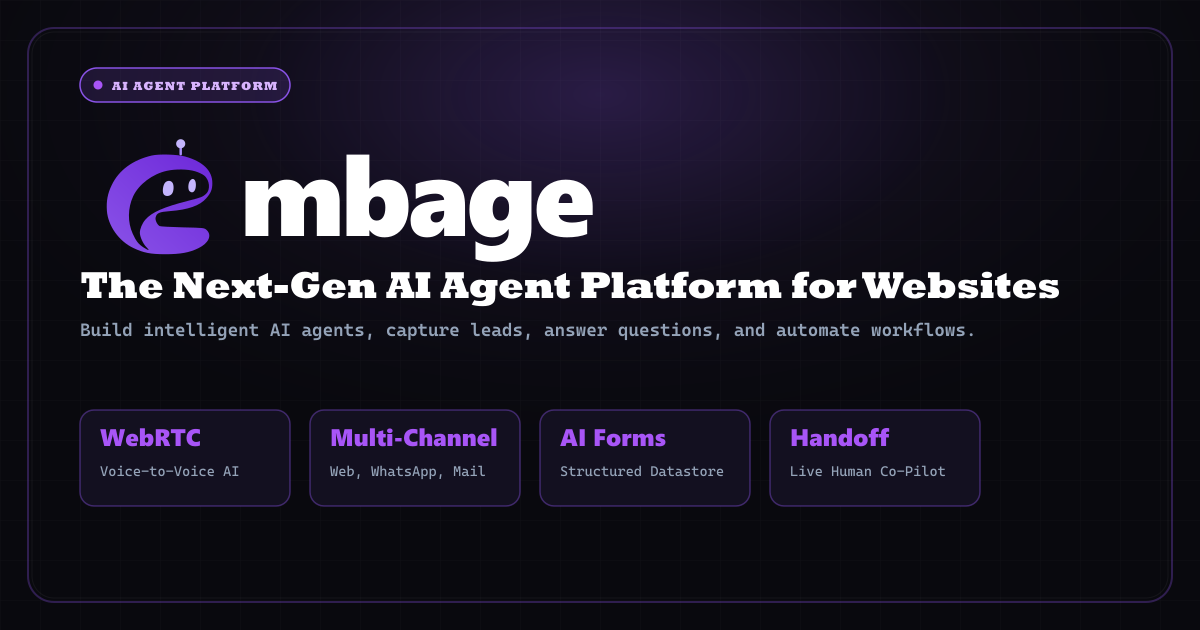
Embage is a no-code platform for building AI chat and voice agents that talk to your customers. You choose whether the agent handles support, sales or feedback, shape its tone, and put it live on your website as a chat window, a browser-based voice agent, or both — and on Telegram for chat. The agent answers from your own documents, acts inside the tools you already use through sub-agents, and leaves your team a scored record of every conversation. It is built for teams that want customer conversations handled automatically without writing code or installing anything, and it can be live in three steps: build, connect and embed.
Embage frames the underlying problem simply: most companies throw the conversation away. Visitors arrive, ask questions, and leave, and whatever they said is lost unless someone happens to be watching. Embage positions its agent as a way to answer 24/7 while your team sleeps, to save every chat as a lead, ticket or feedback record, and to end each conversation with a next step — a score and a follow-up — rather than a raw transcript nobody reads. That framing runs through the whole product: the conversation is treated as data worth keeping and acting on, not just a support cost.
Chat and voice both run live on your site. You can add a chat window, a voice agent, or both, and chat agents can also answer on Telegram. Voice runs in the browser with nothing for visitors to install, and visitors can interrupt mid-sentence instead of waiting for the agent to finish. At any point the conversation can be handed off to your team. Because the voice agent acts mid-call, it can book meetings and save records while it is still talking, and when a human takes over their replies are spoken aloud to the visitor. The same documents, tools and scored record apply whether the conversation happens by chat or by voice.
The knowledge base is what the agent answers from. You upload files or add web pages, and the agent searches them before it answers rather than improvising. Supported formats include PDF, Word, PowerPoint, Excel, CSV and Markdown. Articles can be edited in place so answers update to match, and questions the agent could not answer are surfaced as knowledge gaps — a direct signal of what your documentation is missing. This keeps replies grounded in your own material and gives the team a feedback loop for improving it over time.
The datastore turns chats into records. While the agent talks, it saves tickets, leads and feedback, using templates for tickets, a sales CRM, feedback and events. It asks for missing fields before saving, so a half-complete ticket does not land in your queue, and every row can be filtered, edited and acted on afterwards. That means the outcome of a conversation is structured data your team can work with, rather than free text someone has to re-read and retype into another system.
Sub-agents are how the agent does the work rather than only describing it. They are workflows written in plain English that call your tools mid-conversation, connected through 360+ apps with one-click sign-in — Zendesk, Shopify, HubSpot, Gmail, Salesforce, Google Calendar, Google Meet, Slack and Stripe among them. Every tool call is logged. The contrast Embage draws is between the old sequence — leave the chat, search the docs in another tab, do the task in Shopify — and running the sub-agent, where the knowledge base is checked, the workflow is done and the reply is ready, all inside the conversation.
Embage lets you bring your own model key. You can pick from 200+ models, or plug in your own key so your agent's replies bill to your provider rather than to Embage credits. Connection is through OpenRouter or Vercel AI Gateway, and a different model can be assigned to each agent and each sub-agent. Keys are encrypted and never shown again after they are entered. Mixed model choice matters because different agents and sub-agents have different jobs, and the option to run on your own key changes the cost profile: on the Free plan, chat replies on your own API key use zero Embage credits.
After the conversation ends, Embage evaluates it. Every chat receives a 0–100 score plus a sentiment reading and a summary, action items with a priority and an owner, and a note of what your docs are missing. A conversation record might show a score, a short description of what the customer asked, a next step marked high priority, and a knowledge gap such as international returns. This is the second half of the product's promise: the interaction is not finished when the visitor leaves, because the record of it continues to drive follow-up work.
Getting an agent live follows three steps. First you build: pick support, sales or feedback, and shape its tone — no code involved. Second you connect: add your docs, your forms and the apps you use. Third you embed: paste one snippet on your site, or connect Telegram. From there the agent runs on the channels you connected, using the same knowledge base, the same sub-agents and the same scored record, whether a customer reaches it by chat window, browser voice or Telegram.
The stated outcomes follow from those pieces. The agent answers while the team is unavailable, including 24/7, so visitors are not left waiting. Every conversation becomes a lead, ticket or feedback record instead of disappearing when the tab closes. Questions that the agent cannot answer become visible knowledge gaps instead of silent failures. And each conversation closes with a score, a summary and a prioritized next step, so follow-up starts from a structured record. Because the voice agent acts mid-call, booking and record-saving happen during the conversation rather than afterwards.
In support, the agent handles questions such as changing a delivery address on an order, starting a return within the free 30-day window, or looking up a refund, while the outcome is logged as a ticket. In sales, it qualifies visitors and saves them into a sales CRM template, then books meetings through connected calendar tools. In feedback collection, responses land in the datastore as feedback records. With voice enabled, an agent can act as a receptionist that books a demo for a specific slot and confirms it out loud. Each of these sessions is then scored and summarised, and the lead quality or follow-up work is attached to the record.
Embage is in early access and priced to match usage. The Free plan costs $0 forever and is enough for a website agent if you bring your own OpenRouter or Vercel AI Gateway key, with chat replies using 0 Embage credits; it includes 200 knowledgebase searches, 500 datastore writes and 250 integration calls per month plus the website chat embed. Starter is $19/month with 1,000 AI credits, 100 voice sessions, 1,000 knowledgebase searches, 1,000 datastore writes and 200 integration calls, aimed at small businesses adding support, leads and feedback to a site. Pro is $59/month with 3,800 AI credits, 500 voice sessions, 1,500 knowledgebase searches, 10,000 datastore writes and 300 integration calls, positioned for growing teams using Embage as a daily AI receptionist. Enterprise is custom, for teams needing custom limits, dedicated support and security and deployment review. Paid plans are free for 7 days, voice is priced per session, and no credit card is required to start.
Taken together, Embage is a way to put a working agent on your website and Telegram that answers from your own material, performs tasks in your connected tools, keeps every conversation as structured data, and reports back on what happened. Its value proposition is that the conversation is captured, acted on and analysed rather than thrown away.
Publisher
A
admin
Launch Date2026-11-02
Platformweb
Pricingfreemium
Tech Stack
#OpenRouter#Vercel AI Gateway