Category Focus/categories/seo
SEO AI Tools
Discover and compare the best seo AI tools and software. Browse 47+ curated tools with reviews and rankings.
Projects tracked
47
Sort mode
RECENT
Page
1
Discover and compare the best seo AI tools and software. Browse 47+ curated tools with reviews and rankings.
Projects tracked
47
Sort mode
RECENT
Page
1
ReSO AI is a generative engine optimization platform that helps brands get discovered and recommended when customers ask AI. It is built for founders, CMOs, and growth teams who want to turn buyer intent expressed in ChatGPT, Perplexity, and Google AIO into visibility, citations, and traffic. Rather than simply tracking where a brand appears, ReSO analyzes intent, competitors, content gaps, and technical issues, then turns those findings into priority actions that can improve how AI platforms mention, cite, and recommend the brand. Onboarding the ReSO agentic employee is presented as the starting point: a buyer searching on ChatGPT should receive an answer that recommends your brand. Buyer behavior is shifting toward AI-led discovery, and the product states that in 2026 AI will dictate discovery. Buyers increasingly research on ChatGPT rather than on traditional search result pages, which means a brand that is absent from AI answers can lose influence before a prospect ever reaches its website. Traditional SEO tools were built to track keyword rankings, not to decode the intent behind the questions people ask large language models. ReSO positions itself against that gap, offering a way to understand how LLMs interpret intent, what they cite in a category, and which technical signals limit a site's ability to be read and trusted by AI systems. The discovery side of the platform is built on a proprietary intent model that analyzes 30+ intent-driven search variables to decode what customers are looking for. It maps those variables to real buyer queries on AI and organizes them by stage, including Discovery, Feature Comparison, and Persona, where Discovery covers the exploratory phase in which people look for the best options, trends, and possibilities before narrowing down what fits their needs. Users can curate a list of 75 high search intent-based prompts, track brand share of voice across the entire awareness-to-conversion funnel, and map their visibility against competitors so they can see where they are mentioned and where rivals are recommended instead. Content creation is handled through citation intelligence. Each piece of content is built around signals that influence AI visibility: prompt trends, citation behavior, and content gaps across the category. The platform supports a consistent weekly publishing cadence, a 100% customized content strategy intended to make the brand a category leader on LLMs, and content created in formats that improve mention potential. This matters because getting cited by AI search engines requires clear, authoritative answers, strong entity signals, useful source material, and structured content that AI systems can interpret easily, so the content work is aimed at the sources and authority signals that AI platforms actually draw on. A third pillar is the technical engine, which audits the technical issues that affect how AI systems and search engines access, interpret, and trust a website. It delivers technical edits intended to increase LLM visibility, entity mapping and code-level changes to make the website AI-readable, and improvements to discoverability across search platforms. Because AI systems must be able to reach, parse, and trust a site before they can cite it, these fixes complement the content and prompt work rather than standing alone. Overall, ReSO replaces the work of an SEO agency with an agentic employee that handles the process end to end, and it is designed to replace agencies, consultants, and fragmented internal workflows with one system. Its methodology is to measure first, through an AI visibility check, then act on the gaps it finds in brand presence, content, technical setup, and competitive positioning, and then keep publishing and optimizing on an ongoing cadence. The platform states that it works alongside traditional SEO while extending visibility into AI search, combining content, technical optimization, authority, and AI visibility tracking so that both traditional search and AI platforms are addressed inside one search visibility strategy instead of treating AI search as a separate channel. Reported outcomes from the company's own case studies include a 3X traffic increase from LLM-driven search, a +38% month-on-month citation growth, a +25% signup conversion directly from ChatGPT referrals, and a +30% quarter-over-quarter visibility score growth. A publicly listed fintech in India, SMC Global, saw a 132% increase in clicks from ChatGPT, a 162% increase in website clicks up from 37,200, and a 516% increase in impressions up from 923,000. An HRTech EoR platform achieved a 12X increase in citations from LLMs in three months, a 364% increase in blog traffic from 824 to 3,825 monthly clicks, a 5x increase in AI mentions from 10 to 50, and a 41% increase in AI visibility up from 8%. A US-based LegalTech company recorded a 92% increase in brand mentions up from 288, a 60% increase in total traffic up from 23,400, and a 55% increase in impressions up from 2,080,000. Concrete workflows described in the content include improving a brand's visibility in ChatGPT by identifying the questions buyers ask LLMs and where the brand currently appears in those answers, then prioritizing the pages, topics, and site improvements most likely to increase mentions and recommendations. Another is getting cited by AI search engines by analyzing which sources AI platforms cite in a category, finding gaps in content and authority signals, and optimizing the website accordingly. A third is competitive analysis: measuring share of voice across intent-driven prompts, seeing where competitors are mentioned or recommended, and locating the buyer-intent stages with the largest visibility gaps. The Discovery stage content shows the exploratory questions buyers ask, such as the best budgeting apps for managing personal finances, the best fitness trackers for everyday use, or the best tools for automating B2B lead qualification, which illustrates the kind of prompt-level work the platform supports. ReSO is aimed at founders, CMOs, and growth teams across high-growth startups and enterprise, and it is described as trusted by founders and CMOs. Its content highlights B2B brands in particular, noting that B2B buyers increasingly use ChatGPT, Perplexity, or Google AIO to research solutions, compare vendors, and shortlist providers, and that the platform also serves verticals such as fintech, HRTech, and LegalTech. Access begins with an AI visibility check from the onboarding flow, and the brand offers a detailed AI visibility analysis across brand, content, technical setup, and competitive gaps, stated as worth $500 at no cost for the time being, with no credit card and no commitment required to get started. The platform notes that AISO, GEO, AEO, LLMO and similar terms overlap, with AISO focused broadly on AI search, GEO on generative engines, AEO on direct-answer visibility, and LLMO on large language models, while the underlying goal is the same: making a brand easier for AI platforms to understand, mention, cite, and recommend. In short, ReSO AI's core value proposition is turning AI answer engines into a growth channel: it shows brands how LLMs see them, why competitors are recommended instead, and what to change in content and on-site technical signals so that the brand becomes the one AI recommends to buyers.
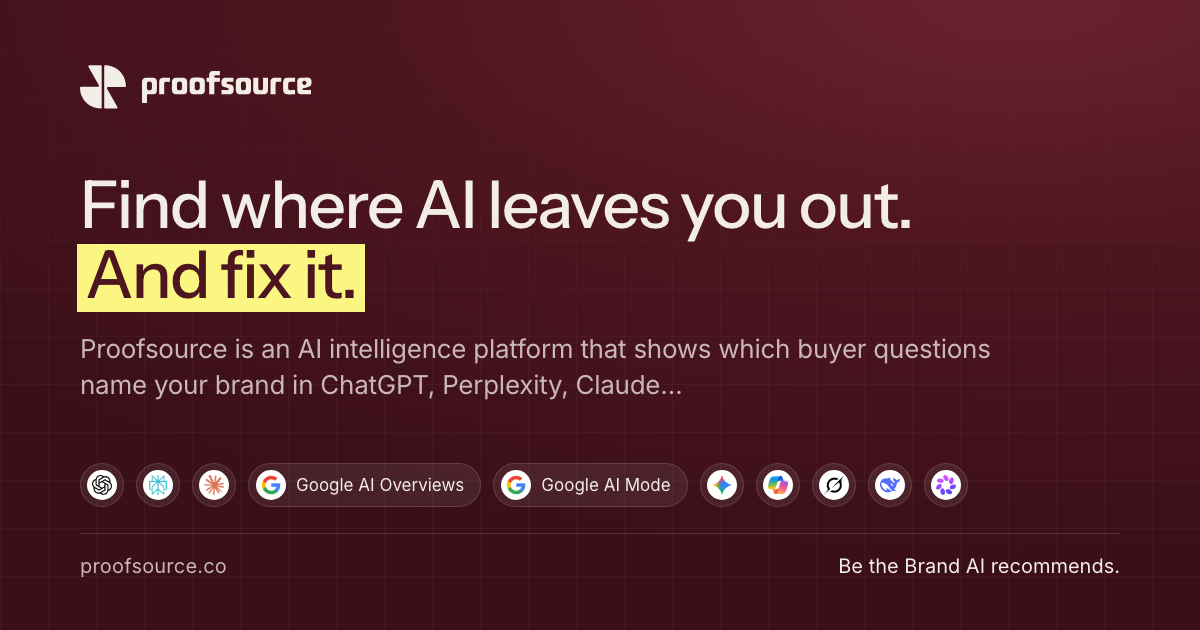
Proofsource is an AI intelligence platform that shows whether ChatGPT, Perplexity, Claude and Google AI Overviews name your brand when buyers ask category questions, who those engines name instead, which sources they cite, and what to fix. It is built for the teams that own the shortlist: growth and brand leaders, writers and search teams, agencies running many brands, and founders or small businesses. Its stated purpose is simple and direct — be the brand AI recommends. Rather than measuring blue links or ranking positions on a search results page, Proofsource measures the answer itself: whether your brand appears inside it, where it appears, and which other brands appear alongside it. Buyers now ask AI for a shortlist. An answer engine names three to five brands and moves on. If your brand is not one of them, there is no second page to rank on and no click to measure, so the loss is invisible in conventional reporting. Proofsource says most brands never see this shortlist. Its own measurement illustrates how contested the space is: across 947 citations, four engines and a scan dated 4 October 2026, 43.5% of the sources AI cited for category questions were comparison pages — listicles, alternatives and versus pages. In the same research, 387 different websites were cited across just 80 answers, meaning a brand's own site is one voice among hundreds. A separate finding reported on the site states that only 1 of 4 engines described a brand-new company correctly, with the other three answering from what they already believed. New research highlighted on the homepage notes that 0.8% of AI citations point to the brand's own website. The first feature group is visibility measurement. Proofsource asks each engine the questions your buyers ask and records whether you are named, in what position, and next to whom. It reports mention rate, share of voice and average position per engine, and every number carries a 95% confidence range, described in the product as a 95% Wilson interval, so a bad day never looks like a trend. Answers are kept in full, both as text and as a screenshot, so the evidence behind a number can be revisited. In the Tesla example shown on the site, 53 of 100 answers named Tesla overall, split as 16 of 25 on ChatGPT, 16 of 25 on Google AI Overviews, 11 of 25 on Claude and 10 of 25 on Perplexity. Second, Proofsource shows who AI names instead of you. Every brand the engines name for your questions lands on one leaderboard, ranked by answers per engine, including brands you never thought of as competitors. You can add any of them to tracking with one click, and the platform highlights the questions where each competitor beats you. The Tesla example lists Rivian at 13 answers, SunPower at 13, Ford at 10 and Enphase Energy at 9, alongside Tesla at 53. This matters because a shortlist loss is usually a competitive loss, and the leaderboard makes the set of rivals that answer engines actually consider — not the set you assume — explicit and trackable. Third, Proofsource shows the pages AI trusts in your category. Because answers are built from sources, the platform lists every page the engines cite for your questions, which of those pages mention you, and which are open to a pitch, a listing or a correction. It surfaces cited domains alongside the exact pages, the listicles that leave you out, and the pages on your own site that engines read versus the ones they skip. In the Tesla example, youtube.com was cited in 29 answers, en.wikipedia.org in 24, reddit.com in 20 and tesla.com in 17, with the platform noting whether each source names the brand, partly names it, or is the brand's own site. Fourth, Proofsource catches what AI gets wrong about you. Engines answer from what they already believe, so the platform asks about your brand by name, reads the answers, and flags wrong prices, old features and mixed-up identities, along with the source behind each claim. It reports wrong claims together with the page that caused them, runs profile checks on the sites engines lean on, and checks crawler access — whether GPTBot, ClaudeBot and PerplexityBot can read you at all. One illustrative claim check on the site shows an engine stating that plans start at a price the brand retired last year and that the free tier includes unlimited seats, flagging it as wrong on both counts, pointing to a 2024 review page as the likely source, and suggesting an update to the pricing page plus a request for the reviewer to refresh. Fifth, and central to the product, Proofsource does not stop at a score. It keeps going through a loop it describes as Know, Act, Prove, Repeat: what the engines say, why they say it, what to change, and whether the change worked. It ranks the gaps behind each lost answer by likely lift against effort, names the page or source to change, and drafts the fix from your own content for you to approve. After approval, its agents publish the change, verify that the answers have changed, and learn from every change. The workflow starts from your website and reaches first answers in minutes. You tell Proofsource your site; it reads it, works out your category and your competitors, and drafts the buyer questions worth tracking, with you approving every one. It then asks 25 questions on ChatGPT, Perplexity, Claude and Google AI Overviews, and keeps every answer with its sources and a screenshot. You receive the shortlist and the fixes: where you are named, who is named instead, which sources decided it, and the gaps worth closing first. On paid plans answers are checked every day, because AI answers shift from day to day and a weekly snapshot can miss the day a competitor enters your shortlist. The free trial runs two scans, today and tomorrow. The site links to a published methodology page describing how it measures AI answers. Proofsource is positioned for every team that owns the shortlist. Growth and brand leaders get one number for AI visibility they can defend in a board meeting, with the questions, engines and confidence range behind it. Writers and search teams get the questions they lose, the pages the engines cite instead, and drafts grounded in their own site — the site frames the shift as "search taught you to rank; this shows you how to be quoted." Agencies running many brands get unlimited brands on one account, a weekly report per client, and a roll-up of who is winning and losing across their book. Founders and small businesses use the free trial to see in minutes whether ChatGPT recommends them and then fix the one page that matters most. Engines tracked on every plan are ChatGPT, Perplexity, Claude and Google AI Overviews; the site also displays Google AI Mode, Gemini, Microsoft Copilot, Grok, DeepSeek and Meta AI logos, and the FAQ states that Grok and DeepSeek are available as add-ons on Custom plans. Pricing is free to start: 200 answers, 25 questions on every engine, top AI engines, two days, no card. After that, you choose how many questions each brand tracks, and custom plans start at $64 per brand per month, with the final price discussed on a demo call. Proofsource also publishes side-by-side comparison pages against Profound, Otterly.AI, Peec AI, Semrush, Ahrefs, Scrunch, SE Ranking, Rankscale and AthenaHQ, covering engines covered, sampling cadence, statistics, fixes and price, with sources for every claim about another product. The FAQ clarifies that Proofsource is not ProveSource, the social-proof popup tool, and explains how it differs from SEO rank tracking: rank trackers measure blue links, while answer engines write one answer and name a few brands. The takeaway Proofsource reinforces throughout its site is that the shortlist is being written right now — answer engines are deciding, question by question, which brands get named. By measuring those answers across the major engines, showing who is named instead and which sources decided it, and then drafting, publishing and verifying the fixes, Proofsource turns AI visibility from an invisible loss into a measurable, actionable loop.
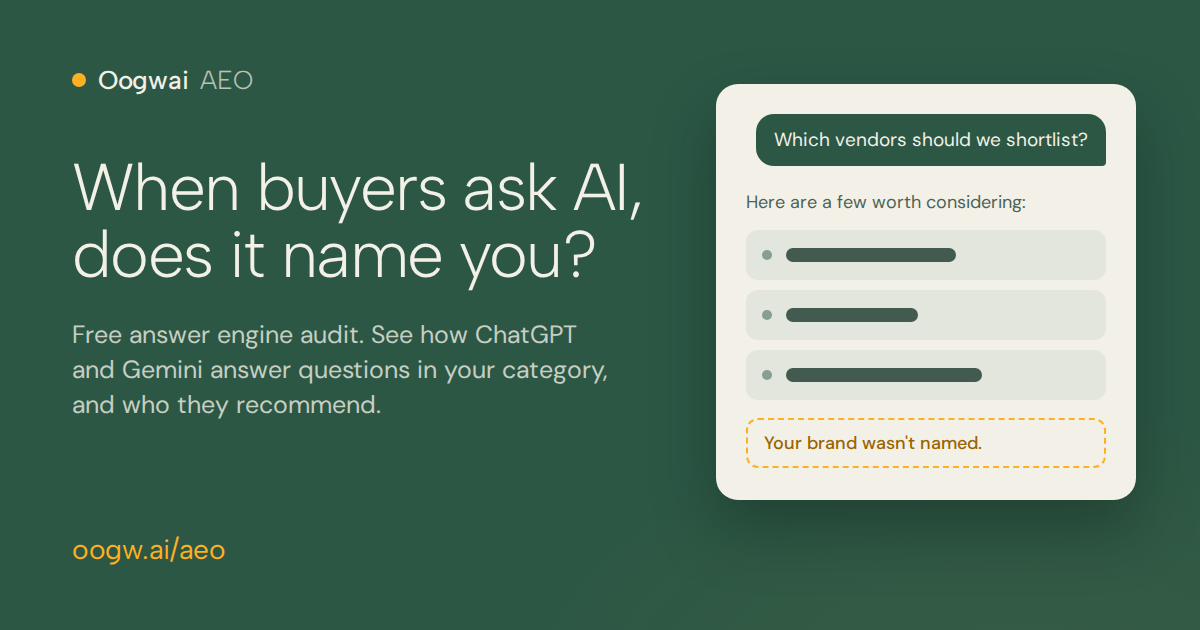
Oogwai Beacon is Oogwai's answer engine optimization audit. It puts 20 real buyer questions about your category to the AI assistants your buyers use — none of them naming you — and records how often each engine names your brand, who it names instead, and which sources it relied on to decide. The free check covers ChatGPT and Gemini, while the paid audit adds Claude, and Perplexity is covered on the managed programme. Beacon measures the two things that determine whether you get recommended: whether AI crawlers can read your site at all, and whether the engines actually cite you when they answer. The first result lands on the page in seconds; the second arrives as a report in your inbox, with a ranked list of the sources worth being on next. Buyers have stopped searching in the old sense. A buyer evaluating your category used to type a query, scan a page of results and form their own shortlist. Now they ask an assistant, and the assistant hands back a shortlist that is already formed: three names, a sentence each, and a follow-up question. Whoever is not in those three names is not in the evaluation at all. Answer engines do not rank pages the way a search engine does. They assemble a reply from three things — what the model absorbed during training, what it retrieves live from the web at the moment of asking, and which of those sources it trusts enough to lean on. Your own website influences the first two weakly and the third barely at all, because when a buyer asks who the best vendor is, an engine will not settle the question by quoting the vendor. That is the gap answer engine optimisation works in: not keywords and rankings, but presence, corroboration and machine legibility, measured by whether you get named. Most AEO tools score your HTML and call it AI visibility; Beacon actually asks the engines. AEO has two halves, and only one of them is a technical problem. Most tools sell you a single number, and a single number hides the distinction that matters, so Beacon reports the two halves separately. Half one is readability: can a crawler read you at all? This check is pure HTTP with no engine calls, which is why it lands in seconds, and it answers whether GPTBot, ClaudeBot, PerplexityBot and Google-Extended can reach your pages and find anything on them. It examines robots.txt rules for each named AI crawler, whether pages are server-rendered HTML rather than an empty shell filled in by JavaScript, Organisation, Product and FAQ structured data, llms.txt and a machine-readable summary of what you sell, heading structure, canonical URLs and clean sitemaps, and consistent entity facts — one name, one description. The readability check is free, runs in seconds and requires no sign-up. Half two is citation: do the engines actually name you? Beacon puts buyer questions about your category to the engines in your tier — ChatGPT and Gemini on the free check, with Claude added on the paid audit — and none of them mention your brand, because a question that names you proves nothing. The report records how often each engine names your brand unprompted, which competitors it names instead and how consistently, the sources each engine cited to get there, what the engines believe you do (correct or not), the question types where you are strong and where you vanish, and a ranked list of the sources worth being on next. The free citation report, showing who ChatGPT and Gemini name instead of you, needs a free business-email account. The full citation report is usually in your inbox within a few minutes, and always within one business day. Which engines run depends on your tier. The free check queries ChatGPT and Gemini. The paid audit adds Claude, and Perplexity is covered on the managed programme, where Oogwai also tests regional variations and buyer personas. Claude grades markedly harder than the other two, so a two-engine result reads higher than a three-engine result — which is why the AEO score is reported only on the paid audit, where it is measured against the full set. The readability check and the two-engine visibility check are free with no credit card required, while the three-engine audit and the media and content programme sit behind the paid tier. Beacon's approach is deliberately different from tools that inspect markup and infer visibility. Because it asks the engines themselves, the audit produces two separate answers that can be read independently: can AI crawlers read your site, and do the engines recommend you? Every gap comes with the fix, and technical readability issues are usually a short engineering fix — Oogwai hands over the exact changes whether or not you work with them. A perfect readability score with zero citations is common, and it is the most useful result the audit produces, because it tells you the problem is not on your website. Being readable is not the same as being recommended. Fixing robots.txt takes an afternoon; getting named takes presence on the pages an engine reaches for when it is asked to compare vendors — roundups, review platforms, comparison pages, community threads, editorial coverage and transcripts. Almost never the vendor's own homepage. That is what the Oogwai media and content team works on, and the audit is the brief: every run records the exact domains each engine cited for your category, so the target list is evidence from your own market rather than a generic media plan. Source mapping starts from the citations in your report — which twenty domains ChatGPT, Claude and Gemini actually pull from when someone asks about your category, and which of them already mention your competitors — and that list becomes the workplan, re-derived every quarter because the sources move. Editorial placement covers contributed articles, expert commentary and product inclusion in the trade publications and roundups that keep appearing in those citations, written to the publication's standard and pitched on a real angle, with no syndicated filler. Review platforms include G2, Capterra, Product Hunt, Clutch, TrustRadius and category directories, with profiles completed properly, categories chosen deliberately and a steady review cadence, because engines lean on these surfaces for being structured, current and third-party. Comparison coverage targets "X vs Y" and "alternatives to X" questions, the highest-intent questions in any category, through honest comparison and alternatives pages on your site and third-party ones that already exist. Community answers cover Reddit, Quora, Stack Overflow, industry Slack and Discord recaps, disclosed as coming from you. Video and audio work turns YouTube descriptions, chapters, transcripts and podcast transcripts into retrievable, indexed text. Quotable owned content — original data, plain definitions, question-shaped headings, clear attribution and schema markup — is written so a model can lift one sentence and credit you for it, and it is the only part of the programme that lives on your domain. Entity consistency keeps one company name, one description and one set of founding and product facts across every profile, directory and press mention, because inconsistency splits you into two half-known entities. Measurement re-runs the same 20 questions monthly against all three engines, showing share of answers over time, which competitors gained or lost ground, and which specific placements moved the number — so the programme is judged on citations, not impressions. The engagement runs in four stages. Audit: 20 category questions across three engines, plus the readability pass, so you get the baseline before anything is promised — including the possibility that you are already being named and need less work than you thought. Map: the cited domains are turned into a ranked target list, weighted by how often each source is quoted, how hard it is to appear on, and whether your competitors are already there. Place: editorial, review, comparison, community and video work runs in parallel against that list, alongside the technical fixes the readability half surfaced. Measure: monthly re-runs of the identical question set, with share of answers as the metric, and any channel that does not move a number is retired rather than defended. The outcome Beacon aims at is a measured share of answers in the assistants your buyers actually use. Because retrieval-based mentions can shift within weeks of a placement going live — the engine reads the source at question time — while what the model itself has absorbed moves on the far slower training cycle, Oogwai reports both separately rather than blending them into one flattering number. That separation is what makes the audit actionable: a readability gap is fixed by engineering, a citation gap is fixed by presence on the pages engines trust. The audit is also a baseline you own, and the ranked source list is derived from your own market's citations rather than a generic media plan. Typical use cases follow the two halves. A marketing lead runs the free readability check with no sign-up to find out in seconds whether GPTBot, ClaudeBot, PerplexityBot and Google-Extended can reach their pages and find anything on them. A founder requests the free citation report to see which competitors ChatGPT and Gemini name instead when buyers ask about their category. An SEO or content team uses the ranked source list to decide where to pitch next. A product marketer builds comparison and alternatives pages for the highest-intent "X vs Y" questions. A brand with a perfect readability score and zero citations learns that the problem is off-site and starts a media and content programme. And a team under pressure to prove ROI re-runs the same 20 questions monthly to track share of answers. Beacon is built for the teams whose buyers now ask assistants instead of searching: marketing and SEO teams, founders, product marketers and content teams at companies that sell into a category where buyers compare vendors before they talk to sales. The free tier covers the ChatGPT and Gemini visibility check and the instant readability check, with no credit card required, though the free citation report needs a business-email account. The paid audit adds Claude and carries the AEO score measured against the full engine set; Perplexity, Copilot, regional variations and buyer personas are covered on the managed programme. Oogwai Beacon's value proposition is narrow and testable: instead of scoring your HTML and calling it AI visibility, it asks the answer engines what they say when your buyers ask about your category, shows how often you are named, who is named instead and which sources decided it, and pairs every gap with the fix.
lurk is a free, open-source monitoring tool that watches Reddit and X for people asking for a product like yours, scores each post and comment with a one-line reason, and delivers new leads to wherever you work. It is built for founders, marketers and sales teams who want to find customers in public conversations, get cited by AI assistants such as ChatGPT, Claude, Perplexity, Gemini and Google AI Overviews, and rank on Google. The product combines lead monitoring, Reddit SEO, competitor tracking and pain-point analysis in a single dashboard, and it never posts or sends DMs on your behalf. Most social monitoring tools stop at keyword matching. A keyword alert fires every time a phrase appears, which means you get a flood of matches you have to read yourself, no sense of whether the person is actually shopping, and no idea whether the community you would reply in even allows promotion. lurk states the difference directly: unlike a keyword alert, lurk reads the whole post and the community rules before it calls something a lead. That matters because the valuable moments on Reddit and X are specific - someone asking for an alternative to a tool you sell, someone whose licence just ran out, or someone who built their own version because nothing on the market fit. Those are the conversations where a careful, useful reply can win a customer. The core of lurk is lead monitoring. Every post and comment it finds is scored, and each one carries a written reason plus the exact phrase that matched. For each lead you can see who asked, why it matched and what the community allows, so you decide whether to join the conversation. Leads are grouped by intent: asking for what you sell, meaning someone wants a tool like yours and says what it has to do; leaving a competitor, where a licence ran out or the price went up and they are asking what to use instead; and building their own, where they built or vibe coded their own solution and big posts are ranked by reach, so a reply gets seen. lurk also keeps conversations together. One thread can contain more than one person asking, and lurk saves that conversation, marking each participant as a post, comment, comparing or solution-seeking, so you can see the whole opportunity at once. Reddit SEO is the second major surface. lurk finds the threads Google already ranks for your keywords and filters them down to the Reddit discussions that get search traffic, so a single reply keeps working long after it is posted. Each ranked thread shows its Google position, when it was posted, and how many comments it has, saved at the time it was observed so you can see which threads are still alive. lurk also flags when a competitor is named in a thread, because a thread that already compares tools is where a careful answer is welcome. In the example shown in the product, keywords such as "free form builder" and "typeform alternatives" surface r/Entrepreneur and r/marketing threads sitting at positions #1, #2, #4 and #5. Competitor tracking shows who gets recommended in the threads your leads sit in, over the last 30 days, and how each mention was meant. In the sample data, Jotform, Typeform and Google Forms each appear seven times, giving 21 mentions read with one negative. Because lurk reads the surrounding text, it can label a mention as positive, negative or simply named in a comparison. Alongside mention counts, lurk surfaces pain themes that keep coming up across your saved leads, such as "Simpler Alternative To Jotform" or "Repetitive Training Feedback Forms", so you can see which complaints are recurring rather than treating every lead as an isolated event. A distinguishing part of the workflow is that lurk puts the community's promotion policy next to the lead. Each community's rules are read from its sidebar and shown with the post, so before you reply you can see what that subreddit expects. In the example, r/nocode states "No blatant self-promotion without giving value back" and "No blatant self-promotion; contribute value". lurk's own promise is that it never posts or DMs: it is a listening and reading tool, and the decision to join a conversation stays with you. Leads arrive as a digest. New leads are sent to Slack, Discord, email or a webhook, each with the score, the reason and a link. Under the hosted free plan, scans run daily at the hour you pick, SEO data refreshes every seven days, and you get daily alerts to Slack and Discord plus one custom webhook. Saved examples are kept for 30 days and can be filtered by community. Each project supports up to 25 keywords and 10 communities, and there is an allowance of 1,000 API reads per day. You can start on a house wallet within the hosted free limits. lurk is open source under the MIT licence, and it is designed to run on your own key with your own model. Self-hosting takes one command: Docker starts the app and Postgres together, and the scoring instructions are a file in src/lib/prompts.ts rather than a hidden secret, so you can read and change exactly how leads are judged. There is a read-only API and an MCP server so your own tools and agents can read projects, leads and SEO rows; there is deliberately no tool for posting or sending a DM. An API schema is published at /openapi.json and an agent guide at /agent-guide.md. The data layer is powered by AnyAPI, which provides one key for every platform - Reddit, TikTok, Instagram and YouTube among them - with no scraper to run, no proxies to rent and no developer account on each site. Pricing is simple: lurk itself is free. The comparison table in the product shows F5Bot as another free option that only emails keyword matches, with no dashboard, no AI scoring, no competitor tracking and no SEO, while ReplyGuy starts at $10 per month, LeadsRover at $13.99 per month and GummySearch at $29 per month on their entry plans with monthly billing. Self-hosting is free as well, and the hosted plan asks for no card. AnyAPI, the data provider behind lurk, is pay per request with no subscription and failed calls costing nothing; example prices run from $0.38 per 1,000 requests for reddit.search, $0.70 for tiktok.video_comments, $1.00 for amazon.product, $1.20 for instagram.profile, $3.50 for maps.reviews and $4.00 for linkedin.profile. New users get about 150 requests on the house, no card required. Concrete scenarios from the product: a founder selling a scheduling tool watches X for people asking for a Calendly alternative with round-robin scheduling and finds both buyers and the moment a competitor's customer starts building their own. A no-code form tool watches r/nocode for people looking for a simpler Jotform alternative, and sees two people in the same thread asking for the same thing. A marketer searches "typeform alternatives" and finds the exact Reddit threads ranking on Google, writes one reply and keeps collecting traffic. Someone working on AI visibility watches the terms that appear in ChatGPT, Claude, Perplexity, Gemini and Google AI Overviews. A self-hoster runs lurk on their own infrastructure with their own model. lurk is aimed at founders and small go-to-market teams who sell software and need to find buyers in public conversations: sales and marketing people doing outbound by hand, growth marketers pursuing Reddit SEO, and developers who want an open-source alternative they can audit and self-host. Because the API and MCP are read-only, it also fits teams who want their own agents and tools to query lead and SEO data without any risk of the tool posting or messaging on their behalf. lurk turns the noise of Reddit and X into a short, reasoned list of people who are actually asking for what you sell, shows you who else is getting recommended in those threads, and points at the Reddit discussions that already rank on Google so one good reply keeps paying off. It is free, MIT-licensed, self-hostable in one command, and it never posts or DMs - it just helps you find the ask and bring something useful.
CrawlRaven MCP is a remote Model Context Protocol server that plugs into Claude, ChatGPT, Cursor, Claude Code or any OAuth-capable MCP client and lets you run your whole SEO operation from the chat. It exposes the data CrawlRaven already holds — Search Console, linked GA4, ranked opportunities, your target keyword plan and your site timeline — as thirteen typed tools, so your agent reads the actual rows and tells you what to fix, refresh and write next. It is built for anyone who decides what gets written, refreshed or fixed next and would rather ask than export: SEO agencies, in-house SEO and content teams, and founders or solo marketers. Connection is one URL and an OAuth sign-in, and twelve of the thirteen tools are read-only by default. The problem CrawlRaven MCP addresses is the gap between the questions you actually have and the way Search Console answers them. Search Console answers one filtered question at a time: the Performance report caps every table at 1,000 rows, so the long, specific queries that AI search sends fall off the end, and every other angle means another filter and another export. Matching queries to pages, then pages to GA4, is manual work, so it happens once a quarter — by which time the decaying page has already lost its clicks. And when a raw CSV is pasted into a chat, the model cannot tell whether a drop lines up with a Google update or which page should own a query, so it fills the gap with a plausible story. CrawlRaven MCP replaces export, filter, match, repeat with one question and a ranked list. Four of the thirteen tools read Google Search Console. The agent can search queries by text instead of scrolling a table, narrow any report to one exact page in a single call, and pick any window from 1 to 365 days. Overview, series, queries and pages are all exposed, so the model works on the site's real performance data rather than a screenshot of a report. Because the tools return typed rows with the period and any truncation stated, answers can name the tool and the date range they used — and long, specific queries that fall off the end of a 1,000-row Performance report stay reachable. Two more tools join GA4 outcomes, returning sessions, engagement and key events for the linked property so Search Console and linked GA4 answer in the same conversation. One tool ranks what to fix next: opportunities arrive ranked with the evidence attached and an action to take, covering striking distance rankings, CTR gaps and content decay. Another checks your keyword plan, telling the model which page is meant to rank for a query and surfacing target keywords with no page ranking yet or query conflicts where no page owns the term. A further tool explains drops using your timeline, which shows verified Google updates next to your own notes. Finally, three tools write notes you approve — including one that plans a timeline note and waits for your approval in the app. Scopes and defaults shape what a connection can do. Each tool belongs to a scope you approve in the browser, and a connection only sees the tools you granted. Twelve tools only read; the single tool that plans a timeline note waits for your approval in the app. There are no API keys and no manual tokens to paste. This means a connected client cannot quietly change anything in your account, while the agent still has enough context — sites, rankings, analytics outcomes, opportunities, keyword plan and timeline — to give an answer you can act on. The server sits between your CrawlRaven data and the AI client you already use. The client picks a tool, CrawlRaven checks the scope, and typed rows come back with the period and any truncation stated. Setup is one-time and takes about two minutes: connect Search Console in CrawlRaven, and link GA4 as well if you want the analytics tools; paste mcp.crawlraven.com/mcp into your client using the remote HTTP transport; sign in and approve the scopes in a browser; then ask your first question, starting with which sites you have in CrawlRaven. The connector discovers CrawlRaven's auth metadata and prompts you to sign in before sending tool requests, and advanced OAuth metadata URLs are published for clients that inspect OAuth discovery directly. The documented workflow runs end to end without an export or a screenshot: the agent lists pages that lost the most clicks over 90 days, reads the annotations timeline, lines the drop up against a Google update, and separates a site problem from a Google one. Outcomes reported by customers include a daily and Monday content refresh routine where Claude and CrawlRaven update around five to seven pages every Monday, taking a daily SEO routine from two hours to five minutes and generative AI overview impressions from roughly 2,500 to about 9,000 a day. Another customer cut identifying the next set of keywords from three hours to thirty minutes and now describes in plain English what data it needs and gets all of it in seconds. A third moved fixing low-hanging fruit from quarterly to weekly and checks every new post against what the site already ranks for, so pages do not cannibalise each other. Underneath these numbers is a simpler benefit: follow-ups become one message rather than another afternoon of exporting. Concrete workflows where the server is used include weekly content refresh at scale, next-set keyword discovery, pre-publish cannibalisation checks, and decay triage that starts with a question such as which pages lost clicks this month or did traffic fall gradually or overnight. Users also ask which queries containing a term get impressions but no clicks, find pages sitting between position 8 and 20, group every query for a URL by intent, ask which landing pages drove key events over the last 28 days, turn the top five opportunities into a checklist for a writer, and plan a note for a launch that waits for approval. Weekly and monthly reporting can be written from live data, and answers cite their source so they hold up on a client call. Supported clients are Claude and Claude Desktop, Claude Code, ChatGPT, Codex, Cursor and any OAuth-capable MCP client, connected over the remote HTTP transport at https://mcp.crawlraven.com/mcp. Pricing starts with a free preview at $0 for eligible free accounts: seven read-only tools, one pinned website, a fixed 28-day window, up to 50 rows per call and 20 tool calls per account per day. Full access is included with every lifetime license as a one-time payment with no MCP add-on, and unlocks all thirteen tools by the scopes you approve, every website on your plan, custom ranges from 1 to 365 days, and the linked GA4 and timeline tools. In short, CrawlRaven MCP turns Search Console, GA4, your keyword plan, your ranked opportunities and your timeline into tools your AI agent can call, so you ask what to ship this week instead of exporting what shipped last quarter.
Okara is an AI Chief Marketing Officer (AI CMO) designed to put marketing on autopilot. It is built for businesses that need consistent marketing execution without building a full in-house team. By entering your website, Okara studies your product, competitors, and brand voice, then deploys 10+ specialized marketing agents that handle SEO, AI search optimization, Reddit engagement, X (Twitter) and LinkedIn posting, creator outreach, content writing, UGC video creation, and technical SEO fixes. The platform is used by over 100,000 businesses and trusted by teams at companies like HeMed, Lovie, Unlayer, Kong, Razer, and Photoroom. Marketing teams often struggle to maintain consistency across channels, keep up with SEO changes, and produce enough content to drive growth. Many businesses cannot afford a full marketing department or a dedicated CMO, leading to fragmented efforts and missed opportunities. Okara solves this by acting as an always-on marketing executive that not only drafts content but also researches and prepares strategy documents first. It automates repetitive tasks like finding keyword gaps, drafting social posts, and identifying Reddit threads, allowing lean teams to focus on higher-level decisions while ensuring nothing drifts off-message. The platform's core features begin with its research phase. Before any agent writes a word, Okara generates five foundational strategy documents: Product Information, Marketing Strategy, Competitor Analysis, Brand Voice, and Content Strategy. These documents are created by analyzing your website and other sources (e.g., 24 pages in a typical initial scan). Every agent then reads these five documents to ensure all output is aligned with your brand and strategy. This shared context prevents the common problem of different channels producing inconsistent messaging. Once research is complete, Okara's marketing agents execute the strategy channel by channel. The agent suite includes: Influencer Agent, which connects you with the right influencers automatically; Reddit Agent, which finds relevant threads and drafts reply ideas and posts for review; SEO Agent, which suggests keyword opportunities and drafts blog posts and landing pages; Writer Agent, which drafts long-form content, articles, and copy in your brand voice; X (Twitter) Agent, which generates post and thread drafts you can edit, then post or schedule; LinkedIn Agent, which drafts professional posts you can personalize and publish; GEO Agent, which works to get your brand cited in ChatGPT and Google AI Overviews; Coding Agent, which automates technical SEO fixes and site improvements; and UGC Videos Agent, which produces guided briefs, multi-aspect AI clips, and downloads for social and ads. There is also a Link Broker Agent (coming soon) for automated high-quality backlink building and management. Publishing is integrated directly into your existing stack. You can connect WordPress, Webflow, Framer, Wix, Sanity, Google Search Console, Google Analytics, GitHub, LinkedIn, X (Twitter), WhatsApp, Telegram, TikTok, Instagram, and Slack once, and then approved work publishes and reports back automatically. For example, the Writer and SEO agents publish finished posts straight to WordPress with categories and images already set; approved articles land in Webflow CMS collections; content syncs to Framer sites; finished articles publish to Wix blogs with headings, tables, and cover images; and content writes into Sanity datasets mapped to existing schemas. Google Search Console feeds live search performance data to the SEO agent, while Google Analytics provides GA4 data so agents prioritize pages and channels driving traffic. The Coding agent opens pull requests with technical SEO fixes directly in GitHub. On approval, the LinkedIn agent posts to company or personal pages, and the X agent posts threads. WhatsApp and Telegram allow you to chat with agents and receive drafts and reports. TikTok, Instagram, and Slack integrations are coming soon. Okara works through a three-step process: Research, Execution, and Publish. In the Research step, it prepares all strategy documents. In Execution, all agents work from those same documents to draft content, so nothing drifts off-message. You stay in control because every draft requires your approval. In the Publish step, connected integrations automatically distribute approved content and report back performance data. This approach combines the strategic oversight of a CMO with the execution speed of an AI-powered team. The benefits for users include significant growth in search visibility and traffic. For example, Lovie grew its search visibility by 56%, lifted click-through rates by 73%, and increased US traffic by 20% without building a separate marketing team. HeMed grew GA4 sessions by 56% and increased Google impressions by 27% over two weeks. Unlayer reached 171,600 people in 24 hours with 26 creators delivered. Users also report replacing functions that would otherwise cost $3,000–$5,000 per month in a junior marketing hire. The platform delivers actionable marketing insights and opportunities 24/7, helping lean teams maintain marketing momentum even when focused elsewhere. Okara is used across many scenarios. B2B SaaS companies use it to build pipeline from SEO and content. Startups use it to go from zero to their first users. Ecommerce businesses use it for creators, content, and ads. Digital agencies run more accounts with one team. Professional services firms turn expertise into demand. Small businesses get marketing without the headcount. Real estate professionals list properties and generate demand on autopilot. Financial advisors create compliant content and get more referrals. Healthcare providers fill their calendar with patients. Recruiters build a brand candidates trust. Restaurants own local search and social. Law firms rank for the cases they want. Additional use cases include solo founders, investment banks positioning across languages and verticals, and dating apps managing marketing resources. Okara targets businesses of all sizes, from solo founders to growing teams. It is particularly suited for B2B SaaS, startups, ecommerce, digital agencies, professional services, small businesses, real estate, financial advisors, healthcare, recruiters, restaurants, and law firms. Pricing is free to start with no credit card required, making it accessible for anyone to try. The platform is web-based. The company also offers a Learn section with Skills, Prompts, Launch Library, and Docs, as well as free tools like AI Humanizer, LLMs.txt Generator, Meta Description Generator, Meta Tag Checker, Robots.txt Generator, Sitemap.xml Generator, UTM Builder, X Video Downloader, and Schema Markup Generator. In summary, Okara serves as an AI CMO that puts marketing on autopilot by combining research, strategy, execution, and publishing. It enables businesses to maintain consistent, brand-aligned marketing across channels without expanding headcount, with the control of approving every draft. By automating SEO, content creation, social media, and creator outreach, Okara helps teams grow visibility, traffic, and engagement efficiently.
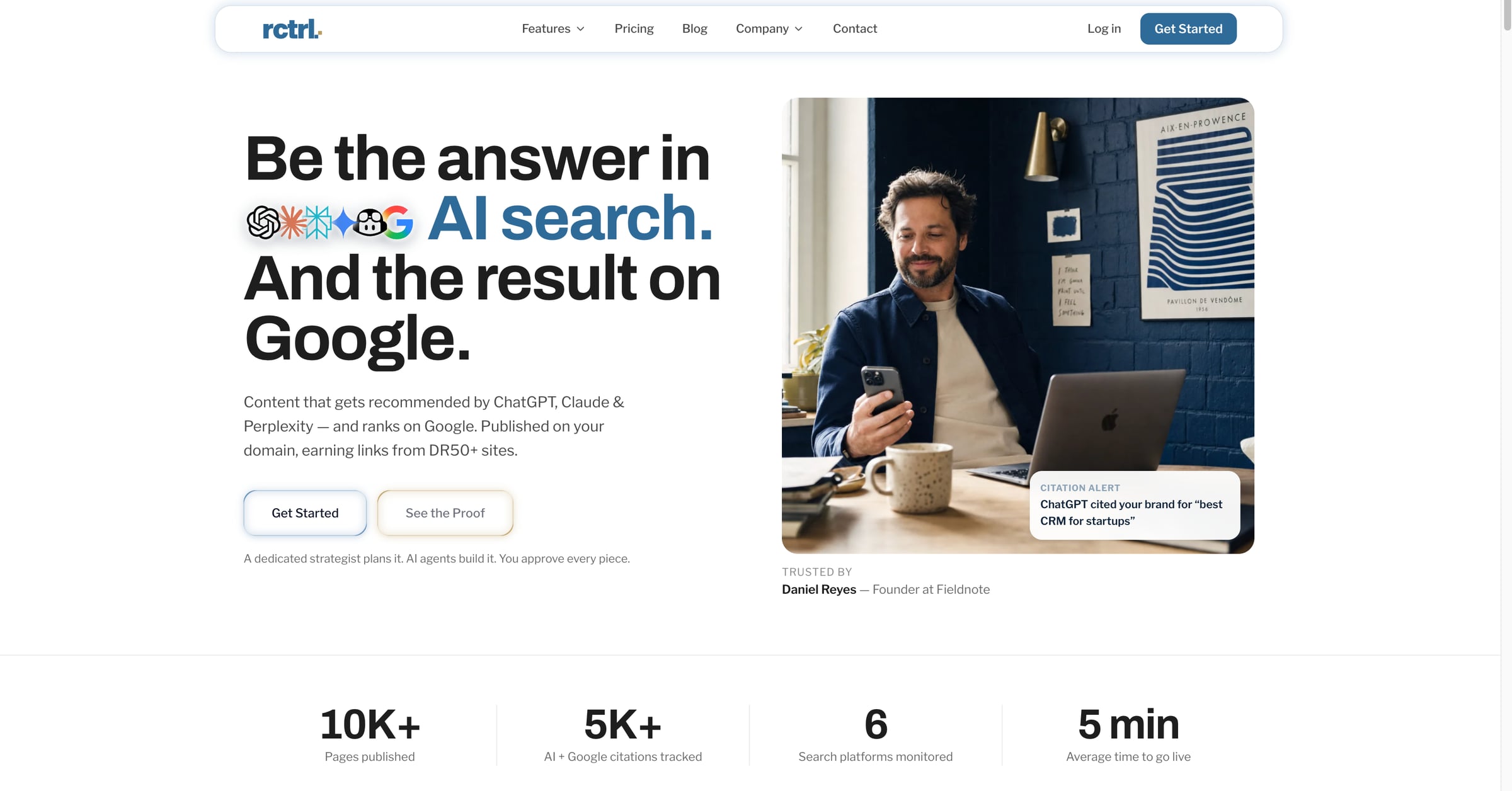
RankControl is an AI SEO platform that produces content designed to be recommended by AI search engines such as ChatGPT, Claude, Perplexity, Gemini and Grok, while also ranking on Google. The articles it creates publish as native posts on the customer's own domain, not on a subdomain, so the site keeps full SEO equity and earns links from high-DR sites. It combines content creation, AI visibility tracking, backlink earning and analytics in a single platform with one flat plan. The goal, as the site puts it, is to be the answer in AI search and the result on Google. Buyers now ask AI before they buy, and most brands are not even in the conversation. RankControl frames this as a gap: your competitors show up in AI answers and on Google, while many brands remain invisible to AI search even when they already rank on Google, because AI systems use different signals such as entity authority, citation patterns and content depth. The platform describes a shift from ten blue links, where ranking number one won the click, to AI answers that replace links, where citations replace rankings. Agencies, the site notes, burn months and thousands of dollars, cited at $5K+ per month, for results that arrive slowly. Discovery and setup are handled by Radar and the tracking layer. RankControl scans your tone, products and competitors so everything it produces reads like your brand, then tracks how ChatGPT, Perplexity, Claude, Gemini, Grok and Google AI Mode answer your market's questions. Radar surfaces every question in your market where AI names someone else, described on the site as answers where a competitor was named instead of you. It tracks up to ten competitors and ranks topics by opportunity, so you can see not only that you are missing from AI answers but why, and which gaps are worth closing first. The brand-learning component, Sounds Like You, learns voice, products and competitors from your site so content matches your brand from day one. Content creation is handled by Forge, which writes content AI trusts: 1,500 to 4,000+ word guides that are brand-matched and citation-optimized, built to answer the questions Radar found. RankControl supports 26 content formats, and sample articles shown on the site span explainers, listicles and statistics posts across travel, software, tech and coffee. Drafts go through an approval workflow where you review, comment and approve with one click; auto-publish is off by default. Articles then go live on your site as native posts through a five-minute plugin setup with no code changes. Content Refresh flags pages when rankings or citations slip and rewrites them on your approval. Visibility monitoring is covered by Sentinel, which runs weekly checks on every tracked query and competitor and sends a notification the moment something changes. Citation Signals tells you when an AI engine cites you or a competitor, turning every mention into something you can act on, and lets you search citations by platform, query or competitor in one click. Brand Perception rates every AI mention as positive, neutral or negative with the wording behind it. Citation Sources shows who the engines cite for your queries, whether that is you, your competitors, Reddit, YouTube or editorial sites. The Google AI Overviews view shows when Google's AI answer appears for your keywords and whether your page is one of its sources, while the AI Crawlers view shows which AI bots read which pages and alerts you the day one of them gets locked out. Analytics ties it together by showing which AI assistant sent each visitor, with traffic, crawls and rankings in one view. Growth is built around backlinks. RankControl drafts outreach emails with AI and supports link exchanges, with managed backlinks available as an add-on at $350 per month. Every new backlink is tracked as it lands, and rankings and citations are reported per published page, so you can see which articles are producing results. The platform also includes Link Control for tracking backlinks and managing outreach opportunities in one place, and Competitor Recon for tracking competitor citations across all AI models to find the gaps. As AI models begin recommending you, you can see exactly which answers name you and which models send the traffic, meaning the right people arrive already convinced. The methodology is a six-step playbook that runs from setup to traffic. In steps one and two you lock in your brand and spot the gaps; in steps three and four you draft, approve and publish on your own domain; in steps five and six you earn backlinks and compound your authority. Seven AI agents plan, build and publish the work, and the Agent Pipeline lets you watch every move with a full audit trail. Because AI models have memory, the more authoritative content you publish, the more they trust your brand. The site illustrates this compounding effect as first citations appearing around month one, trust compounding threefold by month three, and default answer status by month six. The stated outcomes are traffic from two channels at once. The homepage reports 10K+ pages published, 5K+ AI and Google citations tracked, 66 search platforms monitored, and an average time to go live of five minutes, along with a linked case study citing +375% traffic in 90 days. The comparison table positions RankControl at $400 per month all-inclusive against agencies at $5K+ per month and competitors at $800 to $2,200 per month, with time to results of 30 to 90 days, a full review workflow, every agent action logged, content hosted on your own domain, Google AI Overviews shown per keyword, and MCP, CLI and API access included. It positions the platform as saving $55K in year one versus agency retainers. Typical scenarios follow the product's own workflow. A marketing team starts a free trial, connects its CMS with the five-minute plugin, and lets RankControl scan the site to learn voice, products and competitors. Radar then lists market questions where competitors are named instead of the brand, and Forge drafts guides targeting those questions. The team reviews and approves drafts, the articles publish as native posts, and Sentinel plus Citation Signals notify them when an AI engine starts citing them. AI-drafted outreach emails go out to earn backlinks, and analytics show which AI assistant sent each visitor. Teams can also run the whole thing from their own AI agent through MCP, the CLI or the API. RankControl is positioned for marketing and SEO teams, and for brands that want AI visibility without paying agency retainers; the comparison repeatedly contrasts it with agencies and with competitors that are software only. It offers a 7-day free trial, one flat plan at $400 per month all-inclusive, an optional dedicated strategist at $1,500 per month, and managed backlinks at $350 per month. Integrations include Cloudflare, Google Search Console, Bing Webmaster, Gmail, Postiz, Buffer, Zapier, n8n, Make and Google Analytics, plus CMS publishing into WordPress, Shopify, Webflow, Ghost, Framer, Wix, Notion and headless Next.js sites via the Content API. MCP, CLI and API access is included, with 80+ tools and one command to connect. In short, RankControl is built on the premise that citations compound and competitors cannot easily catch up. Rather than stopping at telling you where you are mentioned, it runs the full lifecycle: create content that AI and Google recommend, publish it on your own domain, track visibility across ChatGPT, Perplexity, Claude, Gemini, Grok and Google AI Mode, earn backlinks, and measure what comes back. Being the answer, not just a ranking, is the value proposition it sells.
Simha Digital is an AI-powered SEO analytics workspace that brings all of a project's SEO together — Google Search Console, Google Analytics 4, PageSpeed Insights, Chrome UX Report and a site crawl — and turns it into a plan of what to fix first. It covers six or more data sources in one workspace, eight audit categories and more than sixty rules, and adds a check of how visible a site is in AI answers. Its stated purpose is clear insights, real strategy and sustainable growth, and its positioning is that it tells you what to fix, not just what is wrong. Most SEO tooling surfaces problems and leaves the prioritisation to the person reading the report. Simha Digital frames the problem differently: SEO data is scattered across Search Console, Analytics 4, PageSpeed, real-user Chrome UX data and crawls, and the real question is which of hundreds of issues actually matters for traffic. The site also points to a second shift: search is moving into ChatGPT, Perplexity and Google AI Overviews, so being found, read and quoted by AI engines is becoming part of SEO. Simha Digital's answer is to combine the classic data sources with AI-search checks, give the site one score, order the work by traffic at stake, and explain what changed and why — including whether ChatGPT-style answers cite your site, and who gets cited instead. The workspace starts with site health and priorities: one 0–100 score for the whole site and a task list ordered by impact, so the first item on the list is the thing that should grow traffic most. Technical audit by template then crawls the site and groups hundreds of issues into a handful of root causes — duplicate titles, missing H1s, broken links, canonicals — with the affected URLs listed for each and a fix attached. Instead of working through issue-by-issue lists, the audit is organised by template, so a root cause shared by many pages is handled once. The site states eight audit categories and sixty-plus rules behind this, and the interface preview shows an example SEO health score of 86/100 alongside site health and priorities, technical audit by template, and speed and Core Web Vitals panels. Speed and Core Web Vitals use PageSpeed plus real-user Chrome UX data for key pages, covering LCP, CLS and INP along with what slows them down — a way to see both lab and field performance rather than one number. Growth points and revenue add a commercial layer: queries that are one push away from page one, plus leads and revenue from organic search pulled from Analytics 4, so you can see whether SEO pays off rather than only whether rankings moved. A large part of the product is AI search — GEO and AEO. Readiness for AI engines (GEO) asks whether AI crawlers are allowed in, whether there is an llms.txt, and whether pages have structured data, clear headings and answers an engine can quote, producing a 0–100 readiness score with concrete fixes per page. The checks listed include crawler access for GPTBot, ClaudeBot, PerplexityBot, Google-Extended and more, llms.txt, schema.org markup, FAQ and author signals, and quotable content such as answer-first paragraphs, tables and definitions. Visibility in AI answers (AEO) goes further and tracks how often your site appears in AI Overviews and AI Mode, impressions and clicks from those surfaces, the queries where you appear and the ones where you do not, an AI-visibility trend per query, and where competitors are cited instead of you — updated as new data comes in. The output side of the workspace is a report and plan written by AI: a rebuildable snapshot for any period, including problems, solutions, growth points and a detailed AI summary of what changed and why. Alongside it runs an AI assistant, available 24/7 on your own data, which you can ask why traffic dropped or which queries are the easiest wins — it answers from your own audit, queries and traffic rather than from generic advice. The overall workflow is described in three steps: connect your website by adding your domain and connecting your data sources; see what matters by running an audit and discovering opportunities; then take the next step by setting priorities and working with the AI assistant. What the product presents as its distinctive approach is that GEO and AEO findings land in the same plan as everything else, prioritised by traffic at stake — no separate tool and no separate report for AI search. The stated outcomes are faster decisions and visible growth: a single health score to track, a prioritised list instead of an issue backlog, and an explanation of changes so you know why numbers moved. Because AI-search readiness and AI-answer visibility feed the same plan, the work needed to be read and cited by AI engines is ranked next to technical and content fixes rather than treated as a separate project. Concrete scenarios described or shown on the site include connecting Search Console and Analytics 4 for a site and running a crawl to get one health score; using the template-level audit to clear duplicate titles, missing H1s, broken links and canonical problems across many URLs at once; checking Core Web Vitals for key pages using PageSpeed and real-user data; auditing crawler access, llms.txt, schema and quotable content per page to improve GEO; monitoring AI Overviews and AI Mode for the queries where you appear and where competitors are cited instead; asking the assistant why traffic dropped; and reviewing a rebuildable AI-written report of problems, solutions and growth points for a chosen period. Plans are three: Starter at $19.90 per month for up to 5 projects with a 7-day free trial, Pro at $39.90 per month for up to 10 projects, and Turbo at $79.90 per month for 20 projects, then $3.59 per project. Every plan lists the same core capabilities — all data sources and audit, Core Web Vitals and priorities, the AI project assistant and unlimited checks — and you can cancel anytime. Project limits suggest the workspace is used by people running SEO across several sites, from validating an idea through to growing traffic. In short, Simha Digital packages SEO data collection, technical auditing, Core Web Vitals, AI-search readiness and AI-answer visibility into one workspace, then converts all of it into a single score, a plan ordered by impact, and an AI assistant that answers questions from your own data — so the question shifts from what is wrong to what to fix first.
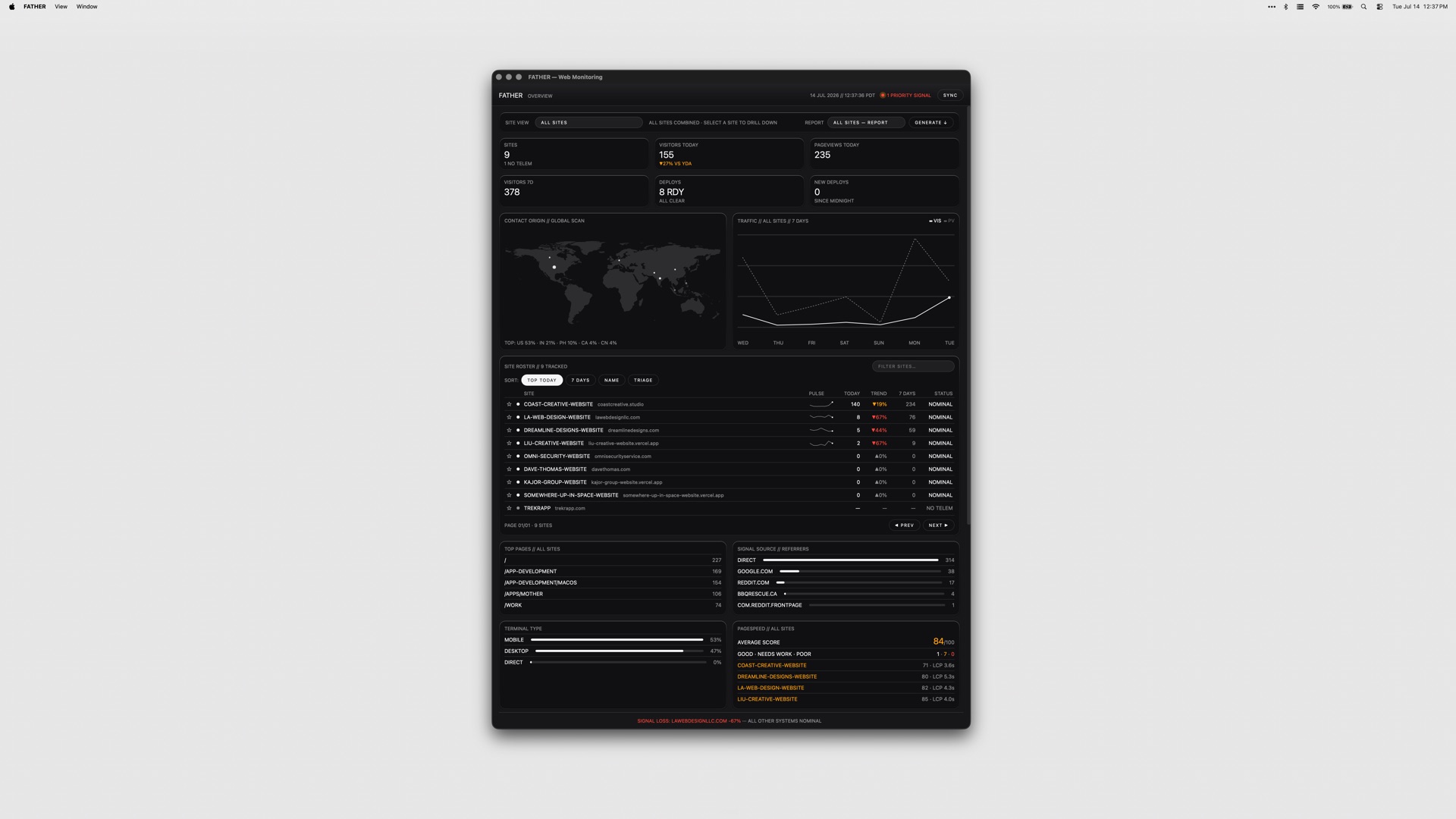
FATHER is a macOS web-monitoring app built as mission control for Vercel sites and deployments. It is designed for teams that ship on Vercel and need one place to watch the whole fleet instead of checking multiple dashboards by hand. Once you connect your Vercel account, the dashboard fills itself with deployments, uptime and speed metrics, live. Product Hunt describes it as a Mac dashboard for site traffic, deploys, uptime and SEO, while the developer's site frames it as a mission-control dashboard for your sites and deployments, built for teams shipping on Vercel. FATHER watches the fleet so you don't have to, and its stated goal is to make sure you know a site is down before your clients do. It runs as a universal app on Apple Silicon and Intel Macs. The underlying problem FATHER addresses is visibility. When a team ships on Vercel, the signals that matter — whether a build succeeded, whether traffic is arriving, whether a site is up, how fast it responds, how it ranks in search — are spread across the Vercel dashboard, Search Console, Bing, and other tools. Watching all of those manually means someone has to remember to look, and by the time a human notices a failed build or an outage, a client has usually already noticed it first. The product's framing is blunt about this: you should know a site is down before your clients do. Failing builds, expired SSL certificates, lapsing domain renewals and failing GitHub checks are all things that can take a site down or break it quietly, and each one lives in a different place. FATHER pulls those signals into a single Mac dashboard and pushes alerts to you when something needs your attention, rather than waiting for you to go looking. FATHER's data foundation is the Vercel API. Deploy tracking, speed metrics and uptime metrics all come from that API, which is why connecting your account token makes your projects appear automatically — there is no manual configuration of each project required to get started. Product Hunt's description notes that connecting your account makes every project fill in live with traffic, deploys, uptime and PageSpeed scores. Sites that are hosted somewhere other than Vercel can still be added manually, which gives them basic status checks alongside the Vercel projects. That combination means the app can act as one dashboard even for a mixed portfolio, while the deepest data — live deployments, speed and uptime from Vercel — applies to the projects actually running on Vercel. Because the connection is made with an account token, setup is a one-time linking step rather than an ongoing sync task. The dashboard's core view is the fleet at a glance: the status, uptime and response of every site on one screen. Instead of opening a hosting panel and reading project by project, you see the whole set at once and can spot the one that is off. Deploy tracking sits alongside that view and works live from Vercel, letting you watch builds progress as they run and catch failures the moment they land. The menu bar carries the same signal outside the window. The F shows a dot while builds are running and turns red when something needs you, so the state of the fleet is legible from the top of the screen without the dashboard being open. Together these three pieces cover the everyday loop of shipping: watch the build, confirm the site is up, and notice immediately when either stops being true. Alerts that find you are a deliberate part of the design: notifications fire even when the dashboard is closed. Product Hunt's description is specific about the failure case — when a build fails, the menu-bar F turns red and a notification fires, even with the window closed, so you know a site is down before your clients do. Beyond deploys and uptime, FATHER aggregates SEO signals: Search Console and Bing show clicks, rankings and indexing, which is the search-side view of how each site is performing. Operational housekeeping is covered too. SSL and domain renewals get a countdown, so a certificate or domain that is about to lapse shows up as something with a deadline rather than a surprise, and failing GitHub checks get flagged. Between them, these features put the search picture and the maintenance picture in the same place as the deploy and uptime picture. The overall approach is a single Mac app that acts as a reading layer over services you already use. You connect your Vercel account with a token; the app pulls deploy, speed and uptime data through the Vercel API and fills the dashboard automatically. Vercel-hosted projects appear on their own, and non-Vercel sites can be added manually for basic status checks. Search Console and Bing supply the SEO data, so ranking and indexing information lands next to hosting information. Alerts are delivered through system notifications and through the menu-bar item, which is what allows them to reach you when the dashboard window is not open. Tokens stay on your Mac, which the product presents as the security posture for the connection. FATHER is part of a suite of four apps that share the same set of themes, and it is sold as a one-time purchase rather than a subscription. The outcome FATHER aims for is fewer surprises. Because builds, uptime, response, traffic, PageSpeed scores, search clicks, rankings, indexing, SSL and domain deadlines and GitHub checks are all surfaced in one dashboard and through notifications, the things that normally get discovered late — a failed deploy, a site that has gone down, a certificate about to expire — get discovered as they happen. That is directly tied to the product's stated promise of knowing a site is down before clients do, which matters most for teams whose sites are the work they have delivered to someone else. Running in the menu bar means the status of the fleet is available at a glance throughout the day without opening anything, and the red F is a persistent, low-effort signal that something needs attention. The one-time purchase and the fact that tokens stay on your Mac keep the model straightforward: you buy the app, connect your account, and the data is read from services you already have. Concrete use cases follow from how the app is built. A studio or agency that ships client sites on Vercel can keep the whole portfolio on one screen and rely on notifications to learn about a failed build or an outage without polling hosting panels. A developer mid-deploy can watch the build progress live from Vercel and see the menu-bar F hold a dot while it runs, then turn red if it fails. A site owner tracking search performance can read Search Console and Bing clicks, rankings and indexing next to uptime and response, without switching tools. Anyone responsible for maintenance can use the SSL and domain countdown to act before a renewal lapses. Teams that also host sites outside Vercel can add those manually for basic status checks and keep them in the same fleet view. And because notifications fire with the dashboard closed, the app works as a background watch rather than a window you have to remember to open. FATHER is aimed at teams shipping on Vercel — the Product Hunt description describes it as being for teams, and the site repeats that framing. It is a macOS application and universal, running on both Apple Silicon and Intel Macs, with no other platforms listed. Its integrations are the services it reads: the Vercel API for deploy tracking and for speed and uptime metrics, Google Search Console and Bing for clicks, rankings and indexing, and GitHub, whose failing checks get flagged. Pricing is a one-time $7.99, or $22.99 for the full suite of all four apps from the same studio; no subscription is mentioned. The app ships with the same set of themes as the rest of the suite, and the tokens for the connection stay on your Mac. FATHER's value proposition is one screen and one alert channel for everything that can go wrong with a Vercel-hosted site. It does not ask you to change how you ship; it connects to the services you already run on and reads them back to you live — deployments, uptime, speed, traffic, search performance, renewals and checks — with a menu-bar indicator and notifications that reach you whether or not the dashboard is open. For teams whose clients depend on the sites they ship, that turns monitoring from something you remember to do into something that finds you first.
LLMagnet is a WordPress plugin that makes a website visible and understandable to AI assistants such as ChatGPT, Claude, Perplexity, and Gemini. Its website describes the product simply as a way to track how AI models see your website. The plugin combines real-time analytics of AI bot activity with automatic generation of the llms.txt files that large language models read, and it also manages schema.org structured data on your pages. According to the site, it is the official WordPress plugin that tracks visits from AI bots and gives you real insights into how language models interpret your content. LLMagnet is positioned for web creators, agents and marketers who want their brand to have a measurable presence in the AI ecosystem, and it also offers a Shopify app alongside the WordPress plugin. The problem LLMagnet addresses is that AI assistants have become a real discovery channel, yet site owners have had almost no visibility into whether these models can actually read, rank and connect with their content. The website frames llms.txt as an emerging standard, comparable to robots.txt for search engines, that helps AI models understand a site's structure and content focus. Without such guidance, AI crawlers may struggle to read pages accurately or cite them at all. LLMagnet takes the position that businesses should prepare for AI-driven discovery rather than react to it later. The company also publishes content on related shifts, such as articles about content having a short half-life in AI search, about Shopify making millions of stores agent-ready, and about Google rankings no longer predicting AI citations, which reinforces its focus on measuring and improving AI visibility rather than traditional ranking alone. The first group of capabilities is AI visibility measurement and analytics. LLM Analytics tracks real AI bot traffic and provides detailed insights into visits, impressions, and clicks from major models including ChatGPT, Gemini, Claude, Perplexity, Grok, Bing AI, Mistral, DeepSeek, and Llama. The AI Visibility Score condenses this into a single metric that reflects how well large language models can access and understand your content across the web. Trends and Insights then track that visibility over time so you can spot rising opportunities and content drops instantly. Because these numbers come from the actual bots crawling your site, they show which pages are being read and engaged with rather than relying on estimates. The second group covers the files and markup that make a site readable to machines. The LLMs.txt Generator automatically builds and maintains your llms.txt file so AI crawlers can better understand your site structure and content focus, and higher plans also generate a full-llms.txt and .md files. LLMagnet manages your schema.org structured data and, on WordPress 6.9 and later, connects to the WordPress Abilities API so assistants such as Claude, ChatGPT, and Cursor can query your site's data natively. The product is described as agent ready, and an MCP Connector is included in plans. Together these pieces move a site from simply existing on the web to being structured in a way that language models and AI agents can parse and act on. The third group is reporting, prompt tracking, and store-focused features. Automated Reports and Insights deliver weekly and monthly reports that summarize your visibility and growth, backed by visual traffic breakdowns and actionable visibility tips. Prompt Tracking and Optimization shows where your brand appears in AI answers, tracking the prompts that mention your site and how your ranking evolves over time, including which prompts include your brand, how visibility shifts by LLM, and what to improve next. For stores, LLMagnet connects to your product data so AI can display accurate information in generative search, with auto product and price sync, AI-search visibility boost, and product mention tracking. On WooCommerce specifically, the Plus and Enterprise plans add product visibility scores and AI revenue funnel tracking. In terms of how it works overall, LLMagnet installs directly into WordPress and is described as lightweight and privacy-safe, with no setup or code required. You enter your WordPress site address and are redirected to the plugin installer to add it in one click, or you install it from the WordPress plugin directory. Compatibility is broad: the site lists Elementor, Gutenberg, Divi, WooCommerce and more, and states that LLMagnet runs alongside RankMath and Yoast SEO without conflicts while integrating into the Elementor editor with per-page AI visibility scores and schema management. Importantly for performance, file generation and analytics run in the background so there is no impact on your site's front-end performance or page load speed. Bot visit analytics are stored locally in your WordPress database and never sent externally, optional integrations are off by default, and the plugin is fully GDPR-compliant with built-in data export and erasure tools. The stated benefits center on understand, control, and automate. Under Key Benefits the site lists AI Visibility Control, so you know exactly how large models see your content; Smart Automation, which keeps llms.txt and data always updated automatically; and Deep Insights, which analyzes which pages drive the most AI engagement. It also lists Enhanced Collaboration for streamlining workflows with team-friendly features, Data Security to safeguard data with top-tier encryption, and Continuous Improvement so AI adapts and improves with evolving data. The overall promise is to turn AI data into clear, growth-driven actions rather than leaving site owners guessing about a channel they cannot see. Customer reviews on the page echo practical outcomes: seeing AI-related traffic, saving time with the llms.txt generator, and gaining visibility into AI crawlers, product exposure, and content gaps without added complexity. Concrete use cases emerge from the content itself. A WooCommerce store owner can use LLMagnet to prepare for AI-driven discovery ahead of time instead of reacting later, watching AI crawlers, product exposure, and content gaps. A merchant can rely on auto product and price sync plus product mention tracking so generative search surfaces accurate product information. A publisher or content site can track AI bot visits and impressions page by page and monitor how visibility trends change week to week through automated reports. A marketer can use prompt tracking to see which prompts mention the brand and how that position shifts across different LLMs. A solopreneur store owner, as one reviewer describes themselves, can follow incoming traffic from LLM agents without technical effort. Teams and agencies working across sites can rely on agent-ready output, llms.txt generation, and the MCP Connector to keep client sites consistent, while developers on WordPress 6.9+ can let AI assistants query site data natively through the Abilities API. LLMagnet targets WordPress site owners, web creators, marketers, and store operators, including WooCommerce merchants and solopreneur store owners, as well as teams that need collaborative visibility workflows. It is also designed for AI agents themselves: the product is described as built for agents and marketers, and it is agent ready. Integrations and compatibility explicitly named in the content include WordPress, WooCommerce, Elementor, Gutenberg, Divi, RankMath, Yoast SEO, the WordPress Abilities API, and an MCP Connector, with a companion Shopify app. Pricing is tiered with a free plan available and no credit card required. The Free plan offers analytics from ChatGPT, tracking visits and clicks, LLMs.txt generation, .md files, an MCP connector, page tracking, agent readiness, and support. Pro adds analytics from ChatGPT, Claude, and Perplexity plus full-llms.txt. Plus adds analytics from all bots, WooCommerce integration, product tracking, and support, and Ultra adds ten prompts tracking and chat support, with monthly and yearly options and different prices per site or per user. Taken together, LLMagnet is best understood as an AI visibility layer for WordPress. It answers a question that traditional analytics cannot: are AI models reading my site, what are they reading, and how do I improve my position in AI answers? By combining bot traffic analytics, an AI Visibility Score, llms.txt and .md generation, schema management, prompt tracking, and automated reporting in a single lightweight plugin, it gives site owners a measurable, continuously updated view of their presence in the AI ecosystem and the practical steps to improve it.