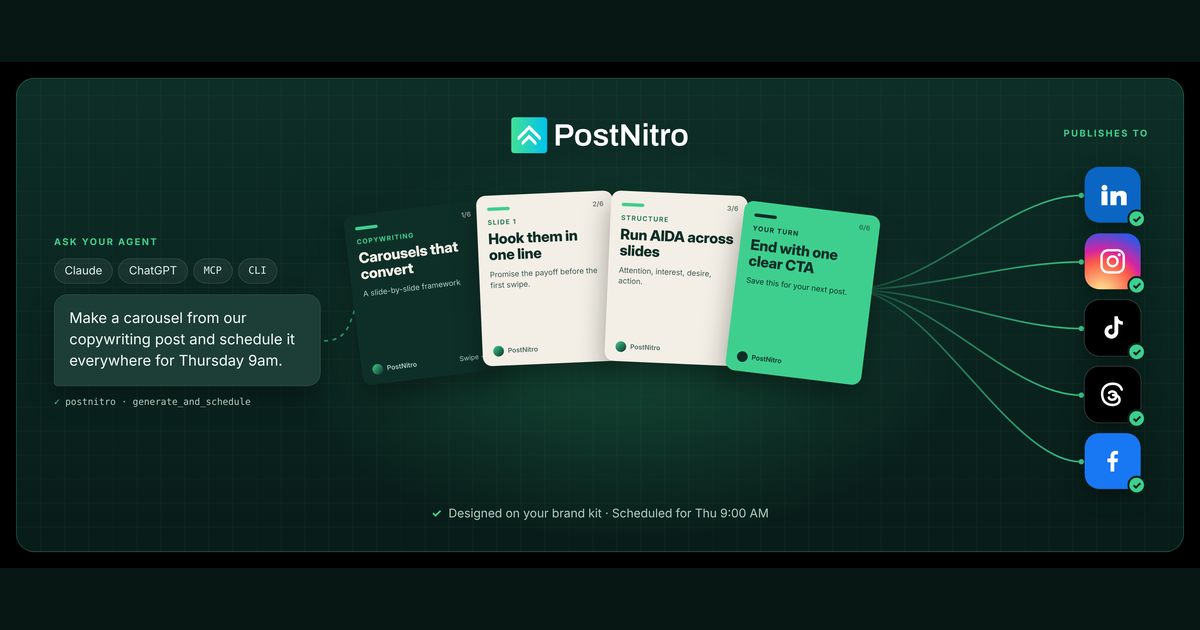
PostNitro for Agents is a social media API for AI agents that designs the post and publishes it, not just writes the caption. It gives an agent a design engine: on-brand carousels, single-image posts and animated video built from over 100 templates and the user's brand kit, then scheduled and published natively to LinkedIn, Instagram, TikTok, Threads, Facebook and Pinterest. The product is aimed at creators, marketing teams and developers who want their AI agent to carry a social post from a raw idea to a finished, on-brand publication in one chain, with no human in the loop unless they want one.
Most social APIs an agent can reach will publish text and pre-made media — they assume the design already exists and that a person made it. That leaves the hardest and most time-consuming part of social publishing untouched: producing the artwork, keeping it on brand, sizing it for each network and turning a long article or thread into a readable visual format. PostNitro addresses that gap by putting the design engine itself behind the API, so an agent can convert a topic, article or X thread into a carousel, image post or video and then schedule it. The company frames this as giving an agent a design engine rather than just a publishing API.
The creation tools cover carousels, single-image posts and short video, generated from a topic, raw text, an article URL or an X post. Agents can also add AI-generated images and bake them straight into slides, so the artwork appears inside the post rather than alongside it. Alongside generation, there is an import path: a user can bring their own slide content and let PostNitro design it, using the same templates and the same brand kit with no AI writing step involved. That distinction matters for teams that already have approved copy and only need a consistent visual treatment applied to it.
Brand is handled through brand kits that agents can list, read, create and update. A brand kit holds fonts, colours, logos and headshots, which means the output stays on-brand without anyone having to describe the brand in a prompt. Because the agent works from the kit rather than from a text description, results are consistent across posts and across sessions. A browsing set of tools rounds this out: agents can list templates, AI presets and audio tracks, then pick deliberately instead of accepting a default. That gives an agent or its operator a way to steer the look and sound of the output before anything is generated.
Scheduling and publishing tools let an agent create, read, update and delete scheduled posts, connect and inspect social accounts, and publish natively to six networks: LinkedIn, Instagram, TikTok, Threads, Facebook and Pinterest. Output can take the form of PNG, PDF, MP4 or an editable design, depending on what the caller asks for. X (Twitter) is supported as a content source and as an export format, but not as a publishing destination. Recently PostNitro added direct publishing to Facebook Pages and Pinterest boards, extending where an agent can deliver without a manual upload step.
Operating the product follows a simple three-step flow. First, connect the agent: add PostNitro to Claude or ChatGPT in one click with no API key, or point any MCP client, the CLI or the REST API at it. Second, ask for a post — for example, turn an article into a six-slide LinkedIn carousel on the brand kit and schedule it for Thursday at 9am. Third, approve it or let it run: the post is designed on the brand kit and then scheduled, or it is saved as a draft on the calendar so a person can review it and hit schedule. That choice between full automation and human review is available on every job.
There are six documented ways into the same engine, all sharing one account, one brand kit and one template library. Claude connects in one click via Claude's Connector Directory using OAuth, so there is no API key to fetch. ChatGPT installs in one click from its plugin directory with the same OAuth sign-in. The MCP server exposes 35 tools at mcp.postnitro.ai for any MCP client. The CLI, installed with npm i -g @postnitro/cli, takes JSON in and returns a designed post out, and is built to be script-safe for CI and automations. The REST API, the layer the others are built on, designs and publishes in one chain. A Skill for OpenClaw and Claude Code lets an agent drive PostNitro end to end.
Long-running work is handled explicitly: every generator has a fire-and-forget form and an and-wait form, plus status and output polling, so an agent can choose between streaming and blocking depending on its own architecture. Authentication is unified across the MCP server, CLI and REST API, which all use the same PostNitro API key, so moving between interfaces needs no new setup. Claude and ChatGPT are the exception and the easier case — they connect through their respective directories with OAuth, so there is no key to fetch at all. The MCP server implements OAuth 2.1 with dynamic client registration, which is what removes the key step.
A distinctive part of the product is the handoff between agent and human. If the caller asks for the DESIGN output, PostNitro returns an editable design instead of a rendered file. An agent can produce the work at 3am, and a person can then open it in the editor, change the headline and publish. PostNitro contrasts this with publish-only APIs, which return something that cannot be edited, describing its own approach as the one place where the human and the agent share a workspace rather than a handover. For teams that want oversight without slowing the agent down, this makes review a matter of light editing rather than rebuilding.
PostNitro is explicit about one boundary: video output is not AI-generated. The video that an agent produces is the carousel slides rendered as an MP4, with animated slide text and audio chosen from the available tracks. It is a design feature rather than a generative video model, and the company notes that this is how carousels reach TikTok, which static-export tools cannot do. Being clear about that distinction helps set expectations for anyone comparing the product with generative video tools, and it keeps the output tied to the brand kit that the slides were built on.
Agent access is priced separately from the broader product. It is included in Creator+ at $30 per month with 200 credits per month, and in Team+ at $60 per month with 500 credits per month. On the Starter plan, agent access is a $10 per month add-on with 250 credits. Credit volume can be increased, and the cost per output is stated plainly: an imported slide costs 1 credit and an AI-generated slide costs 2. There is no free tier for the API, so teams evaluating agent-driven publishing should plan for a paid plan or the Starter add-on from the start.
Typical uses are described through the prompts the product suggests pasting into an agent. A user might ask it to turn a latest blog post into a LinkedIn carousel, which returns a carousel PDF. Another might announce a launch as an Instagram post on the brand kit, producing an image post. A third might request a 20-second TikTok video from five tips, producing an MP4. A planner-style prompt can ask for next week's schedule — three carousels, Monday to Wednesday at 9am — saved as drafts for review. Each of these maps directly onto the create, schedule and publish tools the agent can call.
PostNitro says the product is used by more than 85,000 creators, with its editor embedded in over 200 platforms and a 4.9-star rating on Product Hunt. On the technical side, supported clients include anything that speaks MCP: Claude (Desktop, Code and the web app), Cursor, ChatGPT, VS Code and agent frameworks that support MCP servers. Anything that can run a command works with the CLI, including OpenClaw through the Skill, n8n, Make and CI pipelines, while anything that can make an HTTP request works with the REST API. That breadth means the same engine can be driven from a chat window, a script or a scheduled job.
The core value proposition is a design engine and a publishing pipeline in one chain. Rather than handing an agent a caption it can already write and a media file someone else had to produce, PostNitro lets the agent build the carousel, image post or video on the brand kit and then schedule it natively to six networks — six ways in, 35 MCP tools, editable design output when a human wants to finish the job, and paid agent access that starts with Creator+, Team+ or a Starter add-on.
Publisher
A
admin
Launch Date2026-10-14
Platformweb
Pricingpaid
Tech Stack
#MCP#REST API#CLI#OAuth 2.1