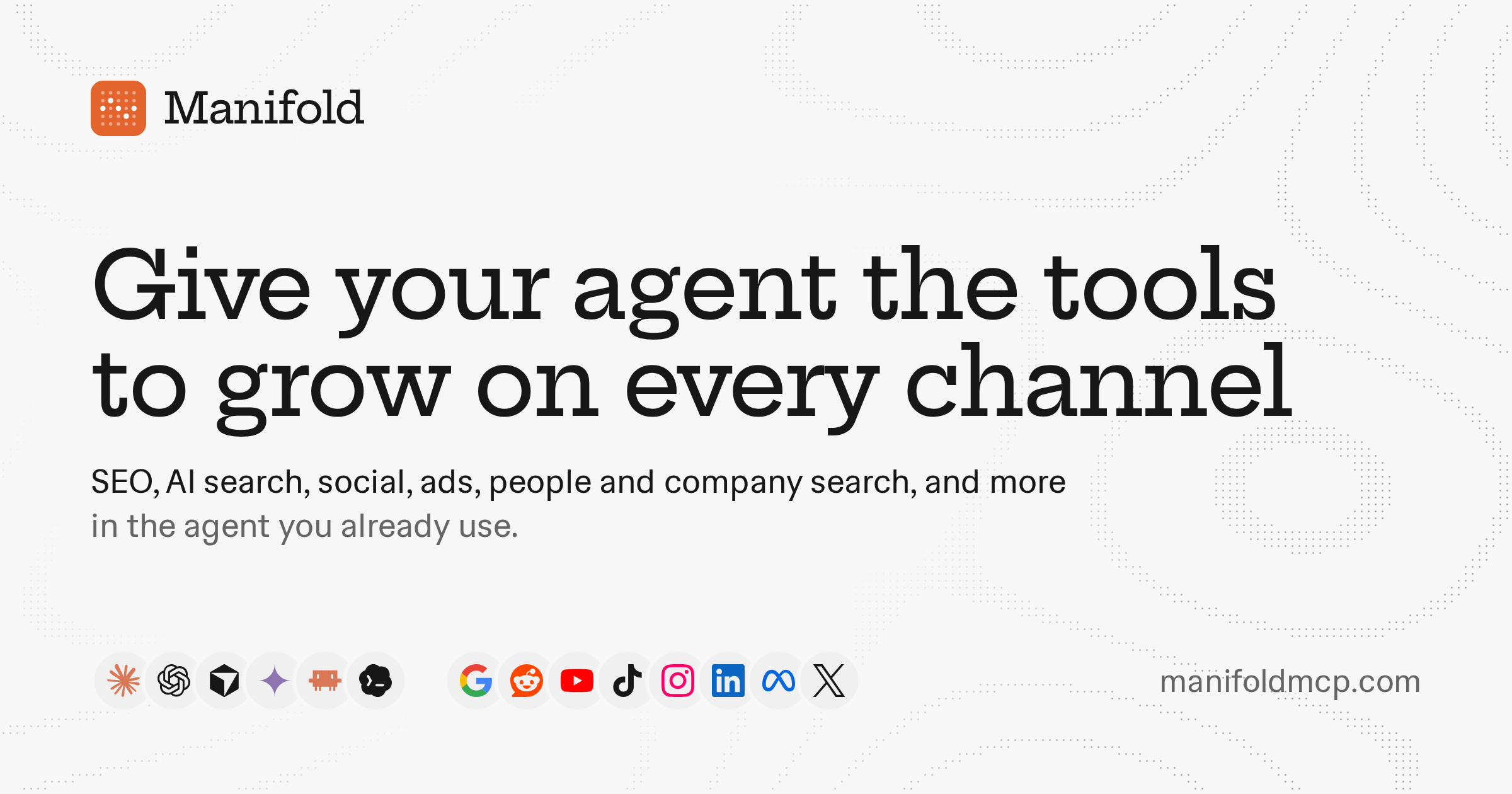
Manifold MCP is a hosted marketing MCP server that gives AI agents live marketing data across SEO, AI answers, social, ads and lead research, inside the AI app the user already works in. According to the website, Manifold "gives your agent the tools to grow on every channel" and covers SEO, AEO, social, ads and lead research in Claude, ChatGPT, Cursor and other MCP apps. Connect it once in a minute and the agent can look things up on every channel whenever it needs to. Every client uses a single URL, https://mcp.manifoldmcp.com/mcp, and a single credit balance, and the product states there are no API keys to set up. New workspaces get 250 free credits, so marketers, growth teams and founders can start asking questions in plain words immediately.
The problem Manifold is built around is channel fragmentation. Marketing research normally means jumping between an SEO tool for rankings, a separate dashboard for AI visibility, another tool for TikTok and YouTube creators, ad libraries for competitor creative, Reddit for community threads, and a data provider for contact emails. The site describes the alternative as "no pile of tabs": instead of opening each tool itself, the user asks their agent a question and the agent picks the right tools and brings back the answer. Manifold is explicitly positioned as the data your agent works from rather than a scheduler or an autoposter, which matters because it lets teams keep using the AI clients they already pay for and trust while gaining live marketing data they would otherwise have to collect by hand.
For SEO, Manifold lets an agent see every keyword a site ranks for, who outranks it and why, and what to fix on the site. The workflow example on the site asks the agent which keywords rank between positions 5 and 15 that could reach page one, with volumes such as "crm for startups" at 72,900 and "simple crm" at 96,600. The underlying tool is exposed as seo_get_ranked_keywords. For AI answers, the aeo_run_ai_answers tool lets an agent ask ChatGPT, Claude, Gemini, Perplexity and Google's AI Overviews any prompt on demand and report which brands each answer names, in what position, and which pages it cites. This is billed per prompt and engine rather than as a monthly fee for tracked prompts, and a free check shows whether a site lets AI crawlers read it, so teams can see whether AI assistants recommend them for the questions their buyers actually ask.
Manifold's social coverage finds the TikTok, YouTube and Instagram creators a brand's buyers watch, their audience, and their top videos with transcripts, so the agent can answer questions like which sales creators on TikTok and YouTube get the most views and what their top videos are. The site shows YouTube Shorts and TikToks from named creators as examples of what the data surfaces, along with view and like counts. Alongside social, the ad libraries capability returns competitors' live ads on Meta and Google, including what each ad says and how long it has run, for example three live Attio ads on Meta, an image ad live 47 days and two creator videos live 76 and 42 days. Being able to see creative that is already running, and for how long, gives teams a factual basis for writing their own ads.
The People capability spots posts on LinkedIn and X about the problem a product solves and then returns each author's verified work email, so an agent can answer questions like who posted about leaving their CRM this week and hand back a contactable list. Reddit coverage finds every thread that asks for what the product makes, reads the replies, and helps draft an answer, with example queries such as finding threads this month asking for a CRM and example communities such as r/CRM and r/CRMSoftware. The site lists tools including reddit_search_posts, linkedin_search_posts and aeo_run_ai_answers to illustrate how the agent calls these capabilities on demand.
Manifold works in three steps. First, the user connects their agent by adding Manifold to the AI app they already use; the site says it takes a minute with no API keys to set up. Second, the user asks for what they need in plain words and the agent picks the tools, with Manifold reading live data from Google, AI answers, Reddit, social, ads and leads. Third, the agent returns answers you can act on, such as what to fix on a page, who to reach out to, or which threads to join, and can take the next steps itself. Because Manifold is hosted, the agent signs in once and uses Manifold's own provider accounts; there is no need for a Reddit API app, a LinkedIn login or a DataForSEO deposit, and clients without OAuth use a Manifold API key instead. Data is fetched live from specialist providers when the agent asks: search, keyword, backlink and AI answer data come from DataForSEO, while Reddit, TikTok, Instagram, YouTube, Facebook, LinkedIn, X and the ad libraries come from the platforms' public data. Results are cached briefly, most for a day to a week, so a repeat question comes back fast and costs less.
The stated outcome is answers built on real data rather than guesses. Your agent writes from Manifold's data, drafting blog posts, Reddit replies, ad copy and outreach emails in the chat with real numbers behind them, and the user checks the drafts and uses them where they want. Cost control is part of the design: every call is paid from one credit balance, each tool states its price before it runs, and the agent can cap what a call spends. A three-step example on the site shows an agent answering what to fix on a /pricing page, namely to put "crm for startups" in the title because the site ranks 7th for it, to answer "is there a free plan?" on the page because ChatGPT gets it wrong, and to link to it from the four best-ranking posts, which illustrates how concrete the output is.
Concrete workflows follow the same pattern of asking in plain words and letting the agent choose the tools. A SEO lead might ask which keywords the site ranks 5 to 15 for that could reach page one, then ask what to fix on a specific page, and finally have the agent draft the changes or an outreach email about them. A growth marketer might check whether ChatGPT and Gemini recommend the brand for "best CRM for startups", then look at what competitors are running on Meta this week, then ask which TikTok and YouTube creators in the niche get the most views. A founder doing outbound might ask who posted on LinkedIn about leaving their CRM this week, request verified work emails for those authors, and then ask the agent to draft the outreach. In each case the agent returns real numbers and drafts the follow-up content in the chat.
Manifold is aimed at marketers, growth teams and founders who already work inside AI clients and want marketing data there rather than in another dashboard. It works with Claude, ChatGPT, Cursor, Claude Code, Codex, Gemini CLI, Grok, OpenCode and any other client that supports remote MCP servers, all through one URL and one credit balance; in Claude you add the URL as a custom connector and sign in, and in Claude Code you run claude mcp add --transport http manifold followed by the URL, with per-client steps in the docs. Pricing is free to start with 250 free credits per new workspace, then a Pro plan from $20 a month for 2,500 credits or a Max plan at a lower rate per credit, with top-ups from $10 between renewals. Manifold is a marketing data MCP server founded in London in September 2026 by Jesse Sibley, and the site notes it is unrelated to Manifold Markets, the prediction market.
Manifold MCP's value proposition is simple: connect your agent once and it can pull live SEO, AI answer, social, ad and lead data on demand, then turn that data into drafts and decisions in the same chat. It replaces a pile of tabs with plain-language questions, keeps costs visible through a single credit balance with per-tool pricing, and gives marketers real numbers to act on rather than estimates. Free credits make it easy to test what the agent can answer before committing to a paid plan.
Publisher
A
admin
Launch Date2026-10-13
Platformweb
Pricingfreemium