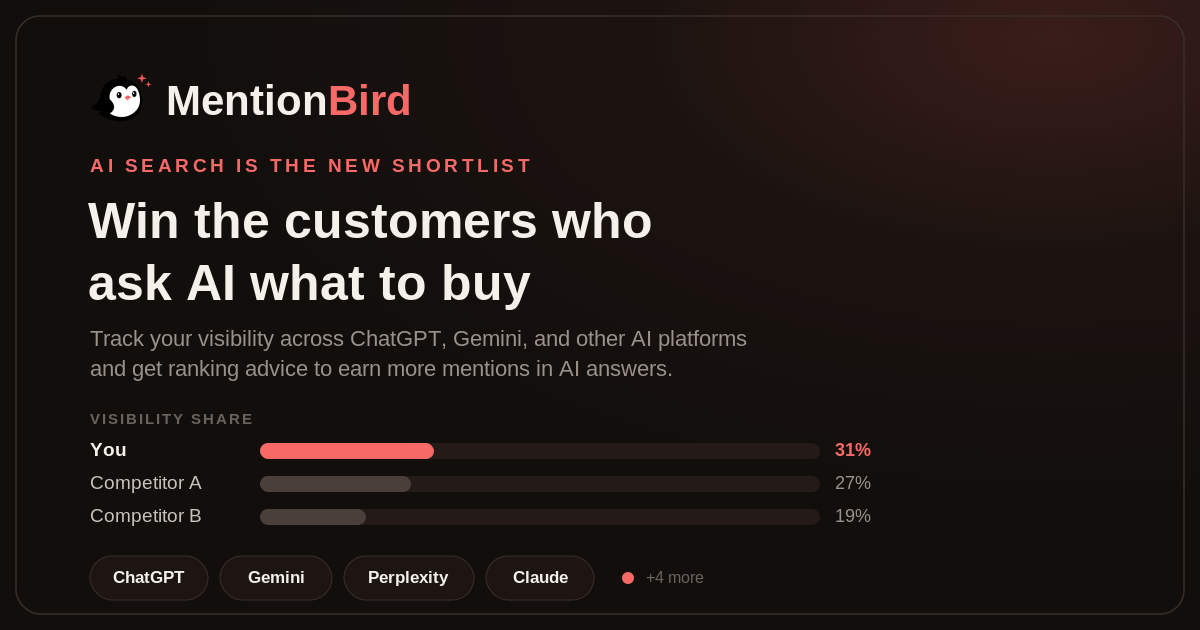
MentionBird is an AI visibility platform that tracks what AI assistants say when buyers ask them what to buy. It monitors the prompts that matter to a business across ChatGPT, Perplexity, Gemini, and Claude, as well as Google AI Overviews, Grok, Microsoft Copilot, and DeepSeek, and shows which sources each model cites when it answers. From there, MentionBird produces a per-prompt plan to get a brand into those sources. The product is aimed at marketing and SEO teams, founders, e-commerce stores, SaaS companies, and agencies that want their brand to be named in AI answers rather than only ranked in Google.
The problem MentionBird addresses is that the shortlist for a purchase now forms inside the AI answer. Buyers no longer start with ten blue links; they ask AI, get two or three brand names, and shop from that list. If AI does not say your name, you were never in the running, and you would never know it. MentionBird's own launch story makes the point bluntly: the team took the top three Product Hunt launches and asked ChatGPT, Gemini and Claude the exact questions their buyers ask, such as 'Best browser for Claude Code?' and 'How do I track agent run costs?'. The result was nine answers and zero mentions, which means AI sent those buyers elsewhere. AI search pulls from pages it trusts, including listicles, Reddit threads, comparisons and YouTube videos, and if a brand is not there, it is not in the answer.
Tracking the right prompts is the starting point. Users add the questions buyers actually ask, such as 'Best running shoes for daily use', 'Best marathon shoes for men', 'Best running shoes for flat feet' and 'Most comfortable shoes for long runs', and MentionBird keeps them in one workspace as prompts ready to track. The product guidance is to start with the prompts customers might use when searching for products or services like yours, which for most brands means tracking 20 to 50 real questions. A focused set of pre-purchase questions is described as more valuable than hundreds of broad prompts, and users can add, label or regroup prompts at any time as they learn what matters.
Once prompts are tracked, MentionBird shows exactly which sources AI cites for each one. For a tracked prompt, the interface lists the sources AI checks and marks each as cited or not cited, covering domains such as runnersworld.com, runrepeat.com, YouTube shoe reviews and zappos.com listings, or verywellfit.com, rei.com expert advice, YouTube channels and fleetfeet.com. This matters because every prompt has its own set of sources: AI answers are built from a small set of pages, reviews and videos that the model trusts for that specific question. Sources decide the shortlist, so getting into them means getting recommended, while staying out means your competitor takes the customer. Seeing per-prompt citation status turns an opaque AI answer into a concrete list of places where a brand must earn a mention.
AI Ranking Advice converts that list into work. Choose any tracked prompt, or customer question, and MentionBird reviews the answers, the named brands and the cited sources, then recommends practical steps while showing the effort required for each one. Advice is rated by impact and effort, for example 'Get featured in trusted running shoe roundups' marked medium effort and high impact because it targets the most-cited sources, 'Publish a guide to daily running shoes' marked medium effort to answer the questions buyers ask before choosing, and 'Add fit and durability details to product pages' marked low effort to give AI clearer product facts to quote. Recommendations may include better product pages, clearer product details, comparison guides, videos, or mentions from trusted websites.
MentionBird also proves whether the plan is working. Every plan a team executes shows up in the numbers through daily checks across the supported AI platforms, with AI visibility data checked and updated once every 24 hours. Tracking is prompt by prompt: cited, not cited, or no brand named yet, and that gap is yours to take. It reports share of AI recommendations against each competitor week over week, and every score change is traced back to the exact prompt, model or citation that caused it. Example reporting shows brands such as Nike at 31 percent visibility share and up four points, Adidas at 27 percent and unchanged, Puma at 19 percent and down three points, and New Balance at 12 percent and up one point.
The methodology is deliberately action-oriented. Other tools chart AI mentions and tell you when you dropped, leaving the 'now what?' to you; MentionBird is built around the question of what to do to get mentioned for a specific prompt. Its three steps are: pick the prompts that bring you customers, track exactly which sources AI cites for each one, and get ranking advice to win those sources. Setup requires no code, plugins or tracking tags: users add their brand, prompts and competitors, and MentionBird then checks AI answers without making any changes to the website, with setup taking only a few minutes. Unlike SEO rank trackers that report a webpage's position in Google search results for keywords, MentionBird tracks brand mentions across AI answers and the sources behind them.
The payoff is visibility that turns into consideration. Because AI answers influence sales by shaping which brands buyers consider, and a buyer may visit only the brands included in the answer, appearing in those answers is directly relevant to revenue. If a brand is missing, a competitor may reach that buyer first. MentionBird's customers report discovering that they win category questions but lose comparison questions, that they were invisible on the exact questions engineering buyers ask about automating environment provisioning, and that AI was recommending an ATS to every buyer who asked while never naming theirs. One customer reports being in 83 percent of 'alternatives to the category leader' answers after MentionBird found the gap and told them exactly what to fix first. Another notes that having 3,300+ reviews was not enough while AI still failed to recommend them.
Concrete use cases include e-commerce and retail brands competing on product-category prompts, such as running shoes or apparel, where being cited in trusted roundups, review sites and YouTube reviews determines whether AI names the brand. Software companies use it to find the questions where they are invisible among engineering or business buyers and then publish content that answers them. Agencies manage several clients in one workspace, while marketing and SEO teams track their brands and products and compare their visibility with competitors. Mentions of AI ranking advice also point to comparison guides and clearer product pages as fixes. Beyond those, MentionBird states it supports e-commerce stores, software companies, healthcare providers, law firms, financial services, real estate, travel and education, as well as home services, automotive companies and local businesses, meaning any business whose customers research online.
MentionBird is designed for teams whose buyers ask AI what to buy, including marketing and SEO teams, founders, and agencies. Competitors can be added so a brand's AI mentions can be compared with theirs, and businesses managing several brands or product lines can keep them in one workspace, using tags to organize prompts by brand, product or project. Subscription plans can be changed at any time, with upgrades applying immediately and downgrades beginning with the next billing period, while saved prompts, labels and past data remain available. During the Product Hunt launch, code PH19 gives Starter at $19/mo for three months, and a free AI visibility report is available to start.
MentionBird's core proposition is simple: AI search is the new shortlist. MentionBird shows which sources AI trusts for the prompts that drive sales, why competitors get recommended, and what to fix to win the mention, then proves the plan worked with daily tracking. For brands that suspect AI is sending their buyers elsewhere, it replaces guesswork with a prompt-by-prompt picture of the gap and a ranked set of actions to close it.
Publisher
A
admin
Launch Date2026-10-14
Platformweb
Pricingpaid