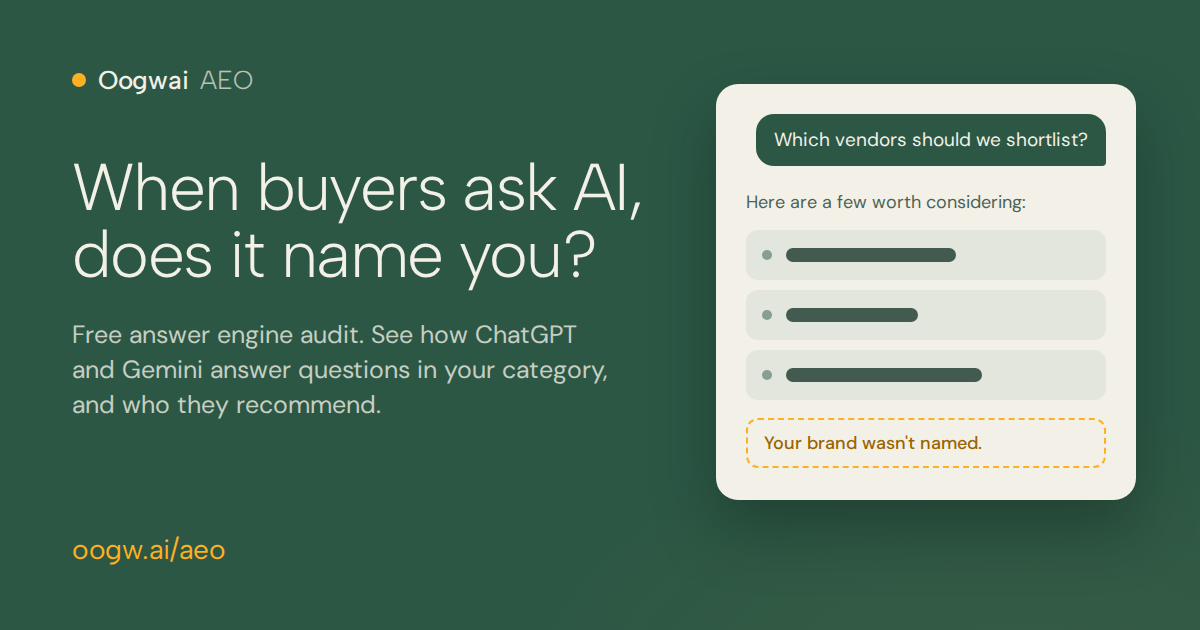
Oogwai Beacon is Oogwai's answer engine optimization audit. It puts 20 real buyer questions about your category to the AI assistants your buyers use — none of them naming you — and records how often each engine names your brand, who it names instead, and which sources it relied on to decide. The free check covers ChatGPT and Gemini, while the paid audit adds Claude, and Perplexity is covered on the managed programme. Beacon measures the two things that determine whether you get recommended: whether AI crawlers can read your site at all, and whether the engines actually cite you when they answer. The first result lands on the page in seconds; the second arrives as a report in your inbox, with a ranked list of the sources worth being on next.
Buyers have stopped searching in the old sense. A buyer evaluating your category used to type a query, scan a page of results and form their own shortlist. Now they ask an assistant, and the assistant hands back a shortlist that is already formed: three names, a sentence each, and a follow-up question. Whoever is not in those three names is not in the evaluation at all. Answer engines do not rank pages the way a search engine does. They assemble a reply from three things — what the model absorbed during training, what it retrieves live from the web at the moment of asking, and which of those sources it trusts enough to lean on. Your own website influences the first two weakly and the third barely at all, because when a buyer asks who the best vendor is, an engine will not settle the question by quoting the vendor. That is the gap answer engine optimisation works in: not keywords and rankings, but presence, corroboration and machine legibility, measured by whether you get named. Most AEO tools score your HTML and call it AI visibility; Beacon actually asks the engines.
AEO has two halves, and only one of them is a technical problem. Most tools sell you a single number, and a single number hides the distinction that matters, so Beacon reports the two halves separately. Half one is readability: can a crawler read you at all? This check is pure HTTP with no engine calls, which is why it lands in seconds, and it answers whether GPTBot, ClaudeBot, PerplexityBot and Google-Extended can reach your pages and find anything on them. It examines robots.txt rules for each named AI crawler, whether pages are server-rendered HTML rather than an empty shell filled in by JavaScript, Organisation, Product and FAQ structured data, llms.txt and a machine-readable summary of what you sell, heading structure, canonical URLs and clean sitemaps, and consistent entity facts — one name, one description. The readability check is free, runs in seconds and requires no sign-up.
Half two is citation: do the engines actually name you? Beacon puts buyer questions about your category to the engines in your tier — ChatGPT and Gemini on the free check, with Claude added on the paid audit — and none of them mention your brand, because a question that names you proves nothing. The report records how often each engine names your brand unprompted, which competitors it names instead and how consistently, the sources each engine cited to get there, what the engines believe you do (correct or not), the question types where you are strong and where you vanish, and a ranked list of the sources worth being on next. The free citation report, showing who ChatGPT and Gemini name instead of you, needs a free business-email account. The full citation report is usually in your inbox within a few minutes, and always within one business day.
Which engines run depends on your tier. The free check queries ChatGPT and Gemini. The paid audit adds Claude, and Perplexity is covered on the managed programme, where Oogwai also tests regional variations and buyer personas. Claude grades markedly harder than the other two, so a two-engine result reads higher than a three-engine result — which is why the AEO score is reported only on the paid audit, where it is measured against the full set. The readability check and the two-engine visibility check are free with no credit card required, while the three-engine audit and the media and content programme sit behind the paid tier.
Beacon's approach is deliberately different from tools that inspect markup and infer visibility. Because it asks the engines themselves, the audit produces two separate answers that can be read independently: can AI crawlers read your site, and do the engines recommend you? Every gap comes with the fix, and technical readability issues are usually a short engineering fix — Oogwai hands over the exact changes whether or not you work with them. A perfect readability score with zero citations is common, and it is the most useful result the audit produces, because it tells you the problem is not on your website. Being readable is not the same as being recommended. Fixing robots.txt takes an afternoon; getting named takes presence on the pages an engine reaches for when it is asked to compare vendors — roundups, review platforms, comparison pages, community threads, editorial coverage and transcripts. Almost never the vendor's own homepage.
That is what the Oogwai media and content team works on, and the audit is the brief: every run records the exact domains each engine cited for your category, so the target list is evidence from your own market rather than a generic media plan. Source mapping starts from the citations in your report — which twenty domains ChatGPT, Claude and Gemini actually pull from when someone asks about your category, and which of them already mention your competitors — and that list becomes the workplan, re-derived every quarter because the sources move. Editorial placement covers contributed articles, expert commentary and product inclusion in the trade publications and roundups that keep appearing in those citations, written to the publication's standard and pitched on a real angle, with no syndicated filler. Review platforms include G2, Capterra, Product Hunt, Clutch, TrustRadius and category directories, with profiles completed properly, categories chosen deliberately and a steady review cadence, because engines lean on these surfaces for being structured, current and third-party. Comparison coverage targets "X vs Y" and "alternatives to X" questions, the highest-intent questions in any category, through honest comparison and alternatives pages on your site and third-party ones that already exist. Community answers cover Reddit, Quora, Stack Overflow, industry Slack and Discord recaps, disclosed as coming from you. Video and audio work turns YouTube descriptions, chapters, transcripts and podcast transcripts into retrievable, indexed text. Quotable owned content — original data, plain definitions, question-shaped headings, clear attribution and schema markup — is written so a model can lift one sentence and credit you for it, and it is the only part of the programme that lives on your domain. Entity consistency keeps one company name, one description and one set of founding and product facts across every profile, directory and press mention, because inconsistency splits you into two half-known entities. Measurement re-runs the same 20 questions monthly against all three engines, showing share of answers over time, which competitors gained or lost ground, and which specific placements moved the number — so the programme is judged on citations, not impressions.
The engagement runs in four stages. Audit: 20 category questions across three engines, plus the readability pass, so you get the baseline before anything is promised — including the possibility that you are already being named and need less work than you thought. Map: the cited domains are turned into a ranked target list, weighted by how often each source is quoted, how hard it is to appear on, and whether your competitors are already there. Place: editorial, review, comparison, community and video work runs in parallel against that list, alongside the technical fixes the readability half surfaced. Measure: monthly re-runs of the identical question set, with share of answers as the metric, and any channel that does not move a number is retired rather than defended.
The outcome Beacon aims at is a measured share of answers in the assistants your buyers actually use. Because retrieval-based mentions can shift within weeks of a placement going live — the engine reads the source at question time — while what the model itself has absorbed moves on the far slower training cycle, Oogwai reports both separately rather than blending them into one flattering number. That separation is what makes the audit actionable: a readability gap is fixed by engineering, a citation gap is fixed by presence on the pages engines trust. The audit is also a baseline you own, and the ranked source list is derived from your own market's citations rather than a generic media plan.
Typical use cases follow the two halves. A marketing lead runs the free readability check with no sign-up to find out in seconds whether GPTBot, ClaudeBot, PerplexityBot and Google-Extended can reach their pages and find anything on them. A founder requests the free citation report to see which competitors ChatGPT and Gemini name instead when buyers ask about their category. An SEO or content team uses the ranked source list to decide where to pitch next. A product marketer builds comparison and alternatives pages for the highest-intent "X vs Y" questions. A brand with a perfect readability score and zero citations learns that the problem is off-site and starts a media and content programme. And a team under pressure to prove ROI re-runs the same 20 questions monthly to track share of answers.
Beacon is built for the teams whose buyers now ask assistants instead of searching: marketing and SEO teams, founders, product marketers and content teams at companies that sell into a category where buyers compare vendors before they talk to sales. The free tier covers the ChatGPT and Gemini visibility check and the instant readability check, with no credit card required, though the free citation report needs a business-email account. The paid audit adds Claude and carries the AEO score measured against the full engine set; Perplexity, Copilot, regional variations and buyer personas are covered on the managed programme.
Oogwai Beacon's value proposition is narrow and testable: instead of scoring your HTML and calling it AI visibility, it asks the answer engines what they say when your buyers ask about your category, shows how often you are named, who is named instead and which sources decided it, and pairs every gap with the fix.
Publisher
A
admin
Launch Date2026-10-06
Platformweb
Pricingfreemium