Category Focus/categories/automation
Automation AI Tools
Discover and compare the best automation AI tools and software. Browse 637+ curated tools with reviews and rankings.
Projects tracked
637
Sort mode
RECENT
Page
11
AutonomyAI is a platform for Autonomous Product Delivery — an approach in which product managers and product designers build directly against a real production codebase instead of handing specifications to engineering. Its delivery layer, Fei Studio, connects to your repository, learns how your team writes code, and turns product ideas into production-ready product updates. The stated purpose is to turn product managers and product designers into product builders: the people who spec a change can also ship it, while engineers stay focused on what only they can build and simply approve the resulting pull request. AutonomyAI describes itself as the OS for building in production and positions Fei Studio as a second lane to production that runs alongside engineering. The company says it is trusted by 170+ product teams, and it offers a Playground where teams can sign up and try the workflow. AutonomyAI frames its product around a single observation: writing code got 10x faster, but shipping stayed the same speed. Every change still goes through engineering, so a product manager can spec a feature in an afternoon and then watch it wait in the backlog for a quarter. AI coding tools make engineers faster, but only engineers can ship, so the backlog keeps growing anyway. Meanwhile, app builders produce demos that cannot touch a real codebase, which means the work either gets redone from scratch or dies. AutonomyAI's contrast is that a coding agent — Claude Code, Cursor or any similar tool — starts from the same place but hands the work back to engineering, whereas Fei Studio hands engineers one click. In its own words, a coding agent writes the code and then waits for an engineer to pick it up, set up the environment, review and fix the code and ship it, and the result may still miss what the PM actually meant, sending round two back through the queue. Codebase ingestion is the first step of the workflow. Fei Studio plugs into your repository and models how your engineers write code — components, standards, design system, APIs, hooks and architecture — so that every task is built the way your team would build it, not from a generic AI template. The site states that you connect your git provider with no manual configuration, and that CSS, API, SSO and DB connections are all ingested. This understanding is described as taking under two minutes, and the model is self-updating as your codebase evolves. This matters because it is the difference between output that matches your product's look and feel automatically and output that needs manual setup; the comparison table lists "your product's look & feel" as auto-ingested and "reuses your existing components" as supported, against competitor tools that require a developer or cannot start from an existing codebase at all. Task execution turns ideas into production-ready product updates. Fei Studio takes raw product ideas — from prompts, PRDs, screenshots, tickets or Figma — and turns them into codebase-aligned variants and testable implementation options before generating production-ready output. It breaks ideas into structured plans based on your infrastructure, then translates those plans into real system changes and pull requests. The website describes the process as 36+ orchestrated steps per task with transparent output. Because the plans are built from your own infrastructure rather than a blank slate, the variants and options it produces are aligned to your codebase from the start, which is what allows the final output to be reviewable by engineering rather than a throwaway prototype. Production grade output is the third pillar. Every task produces production-ready code, a clean PR and full specs, all built to match your codebase, so engineering reviews and merges. Fei Studio generates production quality code to your standards, opens clean pull requests ready for engineering review, and includes full specs and change history for complete context. The comparison against other tools emphasizes the combination: output per task is code plus preview plus PR, and branches, commits and PRs are handled for you. Live preview of changes is included, so a non-technical teammate can see the rendered result before an engineer ever looks at the diff, while the code that reaches review is real production code rather than a prototype. The review step is deliberately lightweight — "your engineer clicks approve. That's the whole path." AutonomyAI's distinctive methodology is running the whole product loop as one system on your real codebase: discover, plan, build, ship, repeat. The newest piece is Discover Mode, which starts the loop before the ticket exists. It researches your analytics, tickets, customer calls and code to find what to build, and then the system plans, builds, verifies and hands your engineers a review-ready PR. After it ships, Fei Studio measures the result and proposes the next build. Critically, the Product Hunt description states that every merge makes it smarter — the system accumulates knowledge from the work that actually lands in production. The website also lists an Agent Knowledge Hub, which appears in the comparison table as something the competing coding tools and app builders do not offer. Fei Studio can also work inside any AI agent: a new MCP Server means Claude Code, Cursor or any MCP client can connect to it, so the delivery layer is available wherever your team already works. The stated outcome is delivery speed that finally matches the speed of code generation. Because product managers and designers have direct access to production, features no longer queue behind engineering capacity, and because output arrives as a clean PR with specs and change history, engineering keeps control of the merge. Engineers stop rebuilding from scratch, stop setting up environments for prototype handoffs and stop chasing misunderstood specs; they review and approve instead. AutonomyAI's own product team is the proof point it offers: the team opened 50+ PRs against its production codebase, writing zero code, and an engineer approved every merge. The headline for this is "Better Delivery, Built with Autonomy" — the promise that the people who spec a change are the people who ship it. AutonomyAI lists a broad set of use cases. Validate Product Ideas covers testing whether an idea is worth building. Improve Existing Features covers enhancing existing screens rather than starting from scratch. Turn Support Feedback Into Changes and Create Stakeholder Demos cover the path from customer signal to a demonstrable result. Accelerate Feature Delivery and Build Enterprise Customizations address delivery throughput and enterprise-specific requirements. Refactor Legacy Interfaces, Redesign Elements and Design System Alignment address modernizing and keeping consistency in existing UI. Prototype With Real Code and Explore UX Improvements cover hands-on experimentation. There are also role-based entry points: PMs can "ship features, not just specs," designers can "design in the real product," and engineers can "stop rebuilding from scratch." AutonomyAI is aimed at product teams — product managers, product designers and engineers working in the same delivery loop — with a separate Enterprise offering. The website names SolarEdge, SolarWinds, Augury, Salt, Taro, Deeto, Scytale, Symtrain, Plantwatchers, Allyable, i4, Midhub, Salesbrick, Commit, Lyncues, Trapica, Samplead, BlueBricks, MalamTeam, DeepSeas, IronVest, Mending, Nielsen, Simpology and Mesh VI among the 170+ product teams it says trust it. Integrations and inputs that are explicitly mentioned include your git provider, CSS, API, SSO and DB connections, plus PRDs, screenshots, tickets, Figma and prompts as task inputs. Fei Studio also connects to AI agents through its MCP Server, naming Claude Code and Cursor. Pricing is stated simply as per task, in contrast to the per seat plus usage, per credit and per subscription or per token models listed for the comparison tools; the comparison notes that competitor capabilities and pricing are as of September 2026. A Playground is available at studio.autonomyai.io/sign-up. In short, AutonomyAI's primary value proposition is that Autonomous Product Delivery closes the gap between fast code generation and slow shipping by running the entire product loop — discover, plan, build, ship, repeat — as one system on your real codebase, so product and design teams can build into production while engineers keep the final approval.
CtrlOps is a local-first desktop application for managing Linux servers from one screen with AI assistance. It brings an AI-assisted terminal, visual file management, real-time infrastructure monitoring, security auditing, access management, and single-click deployments together in a single app. The product is designed for developers, DevOps engineers, technical leads, founders, and non-terminal users who need to run one server or an entire fleet without juggling terminal tabs, remembering IP addresses, or opening separate SFTP clients. Its stated purpose is to give teams full visibility across all their servers in one place, in a tool intuitive enough for a non-terminal person to use, without making the team dependent on a single engineer to keep everything running. The founders built CtrlOps after running an IT service company. They were designers and product people at heart who understood interfaces and users, and every client they worked with had their own server. To check anything, even something as simple as why a server was slow by looking at memory and CPU, someone had to open a terminal, remember the right IP, find the right credentials, and log in separately, every single time, for every client. With a minimum of seven to ten projects and forty-plus servers running each month, there was no unified view and no quick way to know what was happening across the infrastructure without pulling in the one person on the team who knew how to navigate it all. Everything ran through him; if he was unavailable, the team was blind. CtrlOps was built to answer one question: why does managing Linux servers have to feel like this, and why is there no tool that gives full visibility across all servers, feels intuitive for a non-terminal person, and does not create dependency on a single engineer? They built it first for themselves, then made it for everyone. The AI terminal is the centerpiece of the app. Instead of memorizing command syntax, users describe what they need in plain English and CtrlOps translates it into the commands that will run against the selected server. Crucially, it is built as AI with a human in the loop: every command is shown for review and must be approved before it executes. For example, asking to clear disk space on prod-web surfaces a specific command such as sudo apt clean combined with journalctl --vacuum-size=200M, with Run and Edit options available. Web search and MCP servers are built into the terminal, along with one-click saved scripts. Reviewers repeatedly highlight the approval step as the reason they trust the tool: asking in plain English, seeing the exact command before it runs, and approving it is described as the whole game when AI touches live infrastructure. A related scripts feature lets users save, reuse, and run scripts directly from the panel, and one reviewer calls the playbook feature underrated because common fixes can be configured once and then triggered in a single click. The security audit capability runs twenty-five checks over SSH against a server and produces a hardening score. The interface summarizes results in a single line such as seventeen passed, five warnings, and zero failed. Beyond the score, CtrlOps generates a PDF audit report and provides fix commands for every issue found; those fixes wait for user approval before running. Separately, the access management feature scans an entire fleet to show who can log in to which server and who holds sudo privileges. When someone leaves a team, their access can be removed from every server at once rather than being revoked server by server. Any level of roles and access can be assigned without touching the terminal. This directly addresses the question the Product Hunt description opens with: do you actually know who has access to your servers right now? A reviewer in an HR role noted that offboarding, which previously required back-and-forth with the technical team, can now be checked and flagged in about two minutes. Multi-server management keeps the whole fleet in one app so users switch between servers by alias and no longer track IPs by hand. The interface shows entries such as prod-web at ubuntu@54.236.240.26 alongside auth-service and db-01, and reviewers single out named servers instead of IPs as a small but brilliant usability decision. Real-time infrastructure monitoring displays live CPU, memory, disk, and network metrics for every server, giving an at-a-glance view of what each machine is doing. The visual file manager lets users upload, download, and unzip in one click, replacing scp and separate SFTP clients; users can open a config file and edit it directly. Single-click deployment requires no scripts and no CI/CD setup: the user fills one form with a GitHub repository, environment variables, and a domain, and the app goes live with PM2, Nginx, and SSL handled automatically. The product also covers backups that prove they ran and makes every log file findable and searchable without SSH. CtrlOps connects to any server over SSH, so the provider does not matter. It is shown working with AWS, Google Cloud, Azure, DigitalOcean, and any VPS. The architecture is deliberately local-first: CtrlOps speaks SSH directly to your fleet, with no service in between to breach and no vendor lock-in, no cloud bridge, and no telemetry. No agent needs to be installed on the servers themselves, a detail reviewers say sold them immediately. Zero data sharing is the design principle: the app runs entirely on the user's machine, and SSH keys, server IPs, and credentials never touch a cloud. It needs only the user's SSH key, never AWS IAM credentials, a GCP service account, or Azure credentials. Sensitive data and SSH keys are stored only on the device, so servers can be managed without uploading secrets anywhere. The whole flow is human-approved: nothing runs before the user sees and approves it. The stated outcome is that the same servers require far less of the week: the work does not go away, it simply stops taking an afternoon. Users get every server in one window, deployments from GitHub in minutes, CPU, memory, and disk values at a glance, every log found for them, commands expressed in plain English, file movement by dragging, visibility into who can reach every server, faster onboarding of developers, and backups that prove they ran. Reviewers describe the practical results: doing in ten minutes what used to take an hour; catching two issues on a staging environment before they became outages; no longer stressing over deployments; and replacing a mess of SSH tabs and random bash scripts. One commenter argues the plain-English terminal lowers the barrier so developers can own their environment instead of depending on a single DevOps hero, describing it as a shift in team dynamics rather than just tooling. CtrlOps is used across a range of concrete scenarios. A UI/UX designer who does not write code and does not know DevOps used the AI terminal to be walked through deployment step by step and put a website live alone for the first time, after previously waiting on a friend to handle server work. A solo founder building a product used it to manage every deployment personally, eliminating hiring, favors, and waiting on someone else's calendar. A DevOps professional managing multiple client servers reports using the file manager more than the AI features, because editing a config inside one app removes a separate login and window. An HR team member uses SSH management to check and flag access removal within about two minutes of someone leaving. Teams also run it on staging environments before moving production over, and use it to onboard new developers quickly. CtrlOps reports being trusted by more than seven hundred engineers in over one hundred sixty countries and holds a 4.8 out of 5 rating on G2. It installs as a desktop application: a Mac build with separate downloads for Apple Silicon (M1 through M5) and Intel x64 (Core i5, i7, i9), a Windows build distributed through the Microsoft Store, and a Linux option. Pricing starts free, with a one-month free trial that requires no credit card; lifetime subscriptions are also available, as mentioned in a user review. The stack centers on direct SSH connections using ED25519 keys, with PM2, Nginx, and SSL handled during deployments, plus built-in web search and MCP servers in the AI terminal. CtrlOps takes the daily reality of managing Linux servers, logging in, checking resources, reading logs, moving files, controlling access, deploying apps, and hardening machines, and consolidates it into one local-first desktop app driven by an AI terminal that always asks permission first. Its core promise is visibility and control across an entire fleet without sacrificing privacy: your credentials never leave your machine, no agents are installed on your servers, and nothing runs without your approval.
GBrain is an AI memory and workspace product for teams that use several AI tools at once. The website describes it as one workspace the whole team prompts together, with one memory synced to every AI they use. The product is made up of four parts — Memory, Tools, Skills and Workspace — and the team is expected to use all four at once. GBrain is sold per workspace rather than per person, so the whole team can be invited in and share the same conversation and the same memory. It is priced at $99 for the first month and then $199 a month, billed monthly, and it can be stopped any time from the workspace's own billing page. The problem GBrain addresses is that AI tools tend to keep separate memories and separate configuration. The Product Hunt description explains the situation directly: GBrain gives you a memory and a set of connected accounts that every AI can reach. Without that, writing a note in one tool has no effect on another, and connecting an account such as Gmail has to be repeated for each tool, often with a key placed in a config file. GBrain's answer is to hold the memory and the connections in one place so that Claude Code, ChatGPT, Cursor and other AIs can all reach the same context, and so that a team does not have to re-establish the same setup for every assistant it uses. Memory is described as what the workspace knows about the team and the work, kept in files the team owns. The memory is a folder of markdown files that you can read, correct and take with you. Because the files are plain markdown, the team can inspect exactly what the workspace has learned rather than trusting an opaque store, and can correct anything that looks wrong. The company states that leaving takes the notes with you: everything the workspace has learned is plain markdown in a folder you can copy, and the open source parts are free to run yourself. That makes the memory both portable and auditable, which matters for a shared team asset that accumulates over time and is meant to outlive any single tool the team happens to be using. Tools are the accounts the workspace reaches, along with what each AI may do with them. The site says email, calendar and the web are connected once, and the Product Hunt description gives the concrete example that connecting Gmail once lets Cursor search it with no key in a config file. Because the connections live in the workspace rather than in each individual tool's configuration, a new AI does not have to be given its own credentials for services the team already connected. The permission model is part of the Tools concept: the workspace defines what each AI may do with the accounts it can reach, so access is decided once in the workspace rather than separately inside every assistant. Skills are the jobs the workspace knows how to run, on demand or on a schedule. The launch offer lists skills already installed, meaning a new workspace arrives with jobs ready to run rather than requiring the team to build them from scratch. Scheduled work is called out separately in the offer as work that runs while you sleep. This turns the memory and the connected tools into something that acts — a skill can use what the workspace knows and the accounts it can reach to carry out a job at a chosen time, without someone having to trigger it manually. An on-demand skill, by contrast, is run when the team asks for it. Workspace is the room a team works in, and the server underneath it. This is where the multiplayer aspect lives: the whole team is in one workspace, sharing the same conversation and the same memory, and adding the rest of the team costs nothing extra. The workspace also handles model choice — models from Anthropic and OpenAI can be switched any time — and the company states that it can run on your own inference or ours. Because the workspace sits on the company's servers, there is nothing to install: the site says you sign in and the workspace is running in about two minutes. The overall approach is to keep one shared memory and one set of connected accounts, then let every AI the team uses read from and write to that same store. Memory is held as a folder of markdown files; Tools hold the accounts and the permissions over them; Skills hold the jobs that can be run on demand or on a schedule; and the Workspace is the shared room and the server that ties it together. The company supports this with onboarding and support direct from the team, and the offer includes $100 of usage credit a month for AI and metered tools such as web search and page crawling. Practically, the benefits stated on the page are about teamwork, cost and portability. A single price covers the workspace and everyone invited into it, so adding the rest of the team costs nothing extra and no one works in a separate silo. The monthly $100 usage credit pays for the AI models the workspace thinks with and for metered tools such as web search and page crawling, and the workspace tells you before you run out rather than after. Because the memory is a markdown folder, knowledge built up in the workspace can be copied and taken along, and the open source parts can be run yourself. Several concrete workflows are described in the material. Writing a note in Claude Code means ChatGPT knows it, because both reach the same memory. Connecting Gmail once lets Cursor search it without a key in a config file. Scheduled skills run work while the team sleeps. An email, calendar and web connection made once serves every AI in the workspace. A team that signs in gets a running workspace in about two minutes, with onboarding and support direct from the company, and everyone can prompt together in the same room against the same memory while switching between Anthropic and OpenAI models as needed. GBrain is aimed at teams that share AI work rather than individuals working alone. The Product Hunt launch price is $99 for the first month and then $199 a month, billed monthly, and it can be stopped any time from the workspace's billing page. The price is per workspace, not per person, and covers everyone invited into it; it includes $100 of usage credit each month, with more purchasable from the billing page. The launch link stops selling that price on September 29, and a workspace started before then keeps the price it started on. The takeaway is straightforward: GBrain gives a team one place to keep what it knows and one place to connect the accounts it works with, then syncs both to every AI the team uses. The memory stays in markdown files the team owns and can take with it, models can be swapped between Anthropic and OpenAI, skills can run on demand or on a schedule, and the whole team shares one workspace at one price.
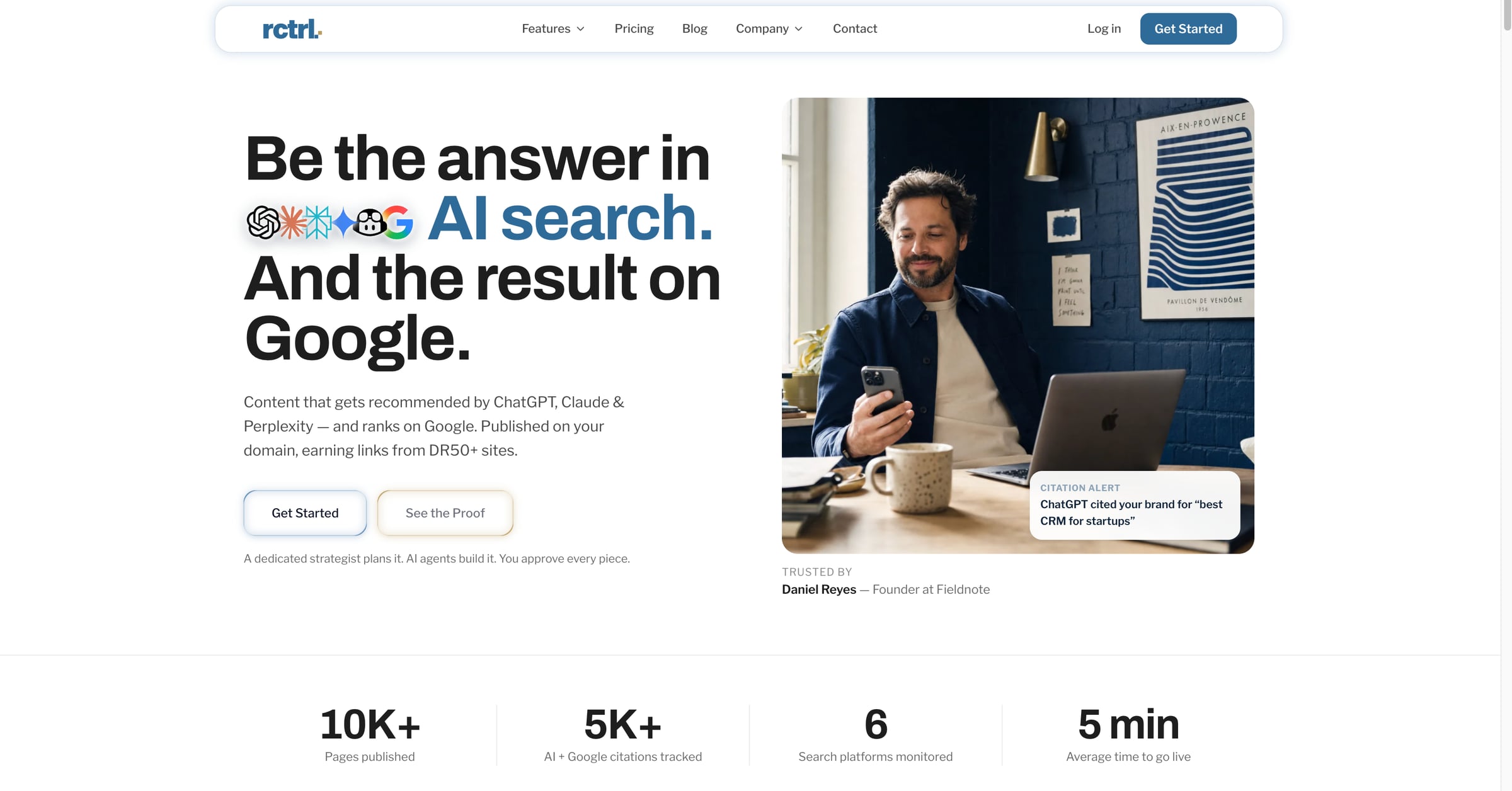
RankControl is an AI SEO platform that produces content designed to be recommended by AI search engines such as ChatGPT, Claude, Perplexity, Gemini and Grok, while also ranking on Google. The articles it creates publish as native posts on the customer's own domain, not on a subdomain, so the site keeps full SEO equity and earns links from high-DR sites. It combines content creation, AI visibility tracking, backlink earning and analytics in a single platform with one flat plan. The goal, as the site puts it, is to be the answer in AI search and the result on Google. Buyers now ask AI before they buy, and most brands are not even in the conversation. RankControl frames this as a gap: your competitors show up in AI answers and on Google, while many brands remain invisible to AI search even when they already rank on Google, because AI systems use different signals such as entity authority, citation patterns and content depth. The platform describes a shift from ten blue links, where ranking number one won the click, to AI answers that replace links, where citations replace rankings. Agencies, the site notes, burn months and thousands of dollars, cited at $5K+ per month, for results that arrive slowly. Discovery and setup are handled by Radar and the tracking layer. RankControl scans your tone, products and competitors so everything it produces reads like your brand, then tracks how ChatGPT, Perplexity, Claude, Gemini, Grok and Google AI Mode answer your market's questions. Radar surfaces every question in your market where AI names someone else, described on the site as answers where a competitor was named instead of you. It tracks up to ten competitors and ranks topics by opportunity, so you can see not only that you are missing from AI answers but why, and which gaps are worth closing first. The brand-learning component, Sounds Like You, learns voice, products and competitors from your site so content matches your brand from day one. Content creation is handled by Forge, which writes content AI trusts: 1,500 to 4,000+ word guides that are brand-matched and citation-optimized, built to answer the questions Radar found. RankControl supports 26 content formats, and sample articles shown on the site span explainers, listicles and statistics posts across travel, software, tech and coffee. Drafts go through an approval workflow where you review, comment and approve with one click; auto-publish is off by default. Articles then go live on your site as native posts through a five-minute plugin setup with no code changes. Content Refresh flags pages when rankings or citations slip and rewrites them on your approval. Visibility monitoring is covered by Sentinel, which runs weekly checks on every tracked query and competitor and sends a notification the moment something changes. Citation Signals tells you when an AI engine cites you or a competitor, turning every mention into something you can act on, and lets you search citations by platform, query or competitor in one click. Brand Perception rates every AI mention as positive, neutral or negative with the wording behind it. Citation Sources shows who the engines cite for your queries, whether that is you, your competitors, Reddit, YouTube or editorial sites. The Google AI Overviews view shows when Google's AI answer appears for your keywords and whether your page is one of its sources, while the AI Crawlers view shows which AI bots read which pages and alerts you the day one of them gets locked out. Analytics ties it together by showing which AI assistant sent each visitor, with traffic, crawls and rankings in one view. Growth is built around backlinks. RankControl drafts outreach emails with AI and supports link exchanges, with managed backlinks available as an add-on at $350 per month. Every new backlink is tracked as it lands, and rankings and citations are reported per published page, so you can see which articles are producing results. The platform also includes Link Control for tracking backlinks and managing outreach opportunities in one place, and Competitor Recon for tracking competitor citations across all AI models to find the gaps. As AI models begin recommending you, you can see exactly which answers name you and which models send the traffic, meaning the right people arrive already convinced. The methodology is a six-step playbook that runs from setup to traffic. In steps one and two you lock in your brand and spot the gaps; in steps three and four you draft, approve and publish on your own domain; in steps five and six you earn backlinks and compound your authority. Seven AI agents plan, build and publish the work, and the Agent Pipeline lets you watch every move with a full audit trail. Because AI models have memory, the more authoritative content you publish, the more they trust your brand. The site illustrates this compounding effect as first citations appearing around month one, trust compounding threefold by month three, and default answer status by month six. The stated outcomes are traffic from two channels at once. The homepage reports 10K+ pages published, 5K+ AI and Google citations tracked, 66 search platforms monitored, and an average time to go live of five minutes, along with a linked case study citing +375% traffic in 90 days. The comparison table positions RankControl at $400 per month all-inclusive against agencies at $5K+ per month and competitors at $800 to $2,200 per month, with time to results of 30 to 90 days, a full review workflow, every agent action logged, content hosted on your own domain, Google AI Overviews shown per keyword, and MCP, CLI and API access included. It positions the platform as saving $55K in year one versus agency retainers. Typical scenarios follow the product's own workflow. A marketing team starts a free trial, connects its CMS with the five-minute plugin, and lets RankControl scan the site to learn voice, products and competitors. Radar then lists market questions where competitors are named instead of the brand, and Forge drafts guides targeting those questions. The team reviews and approves drafts, the articles publish as native posts, and Sentinel plus Citation Signals notify them when an AI engine starts citing them. AI-drafted outreach emails go out to earn backlinks, and analytics show which AI assistant sent each visitor. Teams can also run the whole thing from their own AI agent through MCP, the CLI or the API. RankControl is positioned for marketing and SEO teams, and for brands that want AI visibility without paying agency retainers; the comparison repeatedly contrasts it with agencies and with competitors that are software only. It offers a 7-day free trial, one flat plan at $400 per month all-inclusive, an optional dedicated strategist at $1,500 per month, and managed backlinks at $350 per month. Integrations include Cloudflare, Google Search Console, Bing Webmaster, Gmail, Postiz, Buffer, Zapier, n8n, Make and Google Analytics, plus CMS publishing into WordPress, Shopify, Webflow, Ghost, Framer, Wix, Notion and headless Next.js sites via the Content API. MCP, CLI and API access is included, with 80+ tools and one command to connect. In short, RankControl is built on the premise that citations compound and competitors cannot easily catch up. Rather than stopping at telling you where you are mentioned, it runs the full lifecycle: create content that AI and Google recommend, publish it on your own domain, track visibility across ChatGPT, Perplexity, Claude, Gemini, Grok and Google AI Mode, earn backlinks, and measure what comes back. Being the answer, not just a ranking, is the value proposition it sells.
ToneBird is a socially fluent AI reply assistant for Mac and Windows that helps you answer messages without getting stuck on words. It understands your relationships, what you have already said, and where you left off, then drafts the next reply in your voice directly inside Gmail, Slack, WhatsApp, iMessage, Discord, WeChat, Lark, Google Chat, X, Reddit, LinkedIn, Instagram and other apps you already type in. Instead of leaving the conversation, building a giant prompt, explaining the backstory and bringing the output back, ToneBird works beside the reply box. You open a reply, choose the wording that fits, tweak it if needed, and insert it into the conversation before reviewing and sending it yourself. Replying well sounds simple until context is involved. A client asks for the price you agreed on weeks ago, your manager asks for an update on something that already slipped once, or a customer pushes back on a renewal increase you have discussed before. A good answer depends on the relationship, the history and the commitments, and the apps people type in rarely keep that context available at the moment of writing. Generic AI assistants can produce fluent text, but they start from a blank page, so the person writing has to re-explain who they are talking to and what happened previously. ToneBird is built on the idea that the right reply starts with the context, and that the context already lives in your conversations and your files. Relationship memory is the core of the product. ToneBird uses your earlier conversations when drafting a reply, including the date you promised to confirm or the request a person made after a deadline slipped. It also pulls in facts from your files: when a client asks for the agreed price, ToneBird can find it in your connected proposal and include it in the draft. The interface shows a "Knowledge Recalled" panel, so you can see what the assistant remembered for that specific reply, such as a checkpoint that was requested, a scope change from last quarter, or a previously reported issue. You retain control over what is kept: facts and writing preferences learned from the conversation are surfaced for review, and you choose what to save. ToneBird also adapts wording to the person you are replying to. A client waiting on a deadline needs a different reply from a teammate checking in, and the assistant uses your past conversations with each person to adjust the phrasing. For any message, ToneBird can produce several options so you can compare three replies, then tweak the one you want before inserting it. Tweak controls include More Precise, Warmer and Add Humor, and there are context switches for Internal or external replies plus sliders for Directness, Formality and Warmth. Saved preferences such as "keep replies concise" carry into later conversations, so you skip the introduction and start from your own style. ToneBird is designed to follow you across apps and languages rather than pulling you into another tool. It works beside readable reply fields in apps such as Gmail, Slack, WhatsApp, iMessage, Discord, WeChat, Lark and X. When a message arrives in another language, ToneBird can draft the reply and show a translation, as in the example where a customer writes in Spanish and the assistant produces a Spanish answer with an English translation underneath. Beyond replying, ToneBird turns the conversation into follow-up work: when you and another person agree on a time, it prepares the event in Apple Calendar or Google Calendar from your chat, and a follow-up list gathers promised quotes, unanswered questions and dates to confirm in one place, marked by the app they came from. ToneBird also lists English, Español, 中文 and 日本語 among its available languages. The overall workflow is deliberately short. You click the orb, or press Option twice on Mac or Ctrl twice on Windows, while you are in a reply field. ToneBird reads the thread, recalls relevant context from your relationships and files, and shows suggestions; you click the arrows or use the left and right arrow keys to move between replies, tweak the wording, and then insert it into the reply box. Inserting is not sending. ToneBird does not send messages for you: the draft goes into the reply box, and you review it and use the app's own send button, so the final decision always stays with you. The benefits follow from that approach. You do not have to be stuck on words again, and you do not have to postpone a reply because you cannot face reconstructing the context. Promises, prices and dates that would otherwise require digging through old threads or documents are brought forward automatically, which reduces the risk of contradicting yourself or repeating an issue that was already raised. Because the assistant keeps your voice intact rather than making every reply sound generically "better", the person on the other side of the conversation experiences a consistent version of you, whether they are a customer, a manager or a teammate. Follow-ups that would normally be forgotten become visible tasks, and scheduling happens from the conversation itself instead of in a separate calendar app. Concrete scenarios show how this plays out. In Slack, a manager asks for a launch plan by Friday after a previous slip; ToneBird drafts a reply that commits to a core plan by Friday with a checkpoint later that day. In WhatsApp, a customer says a renewal increase is hard to approve; ToneBird recalls that the scope changed last quarter and drafts a reply that offers to work through the renewal over coffee near the customer's office, with proposed times. In Gmail, a customer writes in Spanish about a repeated export problem; ToneBird drafts a Spanish reply apologising and committing to check workspace permissions and send findings before 4 PM, with an English translation. When the customer later confirms Thursday at 4, ToneBird prepares a 30-minute proposal review event that can be added to Apple Calendar or Google Calendar, and the resulting task list reminds you to send a revised quote or confirm a delivery date. ToneBird is for people whose work happens in email and chat apps, including customer-facing and sales conversations, client renewals, manager and teammate updates, and anyone who needs to reply across several apps and sometimes several languages in the same day. It runs as a downloadable app for Mac and Windows, chosen on the download page, and it works beside readable reply fields in supported apps, though support depends on the app and some fields may not be readable. Your tone profile, person cards, learned corrections and usage counts live on your device, and you can export or delete them any time in Settings. On data handling, the model provider receives the context and instructions needed for your reply: with a managed model ToneBird forwards the request, and with your own model key writing requests go directly to that provider. Pricing starts free, and scales through Standard at $9.90 per month with 100 uses every day and 100 contacts, Pro at $39.90 per month with 1,000 uses every day and 1,000 contacts, and Enterprise with custom pricing for your team; billing is monthly or annual, with about 20 percent saved annually. ToneBird's primary value is that it turns the context you already have into the reply you need next. It remembers your relationships, retrieves relevant facts from past conversations and connected documents, adapts the wording to the person and keeps your voice intact, all inside the apps where the conversation is already happening. You pick a suggestion, tweak it, insert it, and send it yourself. Free to start and with room to grow, ToneBird is aimed at anyone who wants to stop being stuck on words without handing over control of what gets sent.
Naise AI is an AI teammate for marketing. From one brief, it runs social media management, image generation, influencer campaigns, PR media outreach, and market research across every channel, in any language and any market. The website states that the strategy stays with your team while Naise handles the repetitive execution work, so founders and lean teams get the output of a full marketing department without the overhead of building one. Naise AI is headquartered in Singapore and positions itself as going from a cold start to live campaigns quickly, with no waiting on asset approvals or agency onboarding. Much of the site is framed around the cost of doing marketing manually. Naise states that marketing managers spend 80% of their week on execution — drafting, scheduling, outreach, and reporting — leaving little time to drive strategy. Startup founders are described as needing the team they cannot afford to hire, doing the work they do not have time to do. The comparison table sets out the alternatives: human contractors cost $4K–$8K per role, are available business hours only, and take one to two weeks to hire; traditional agencies charge $10K+ monthly retainers and need two to four weeks of onboarding. Naise is listed as available 24/7, immediate to start, at fractional cost, executing in minutes and requiring no management. The site also distinguishes Naise from AI writing tools such as Jasper or Copy.ai, noting that writing tools produce text and hand it back to you, whereas Naise does the whole job: research, copy, visuals, creator outreach, scheduling, press pitching, and reporting. The Social Media Management agent builds data-driven content calendars on top of live market research. Before writing a single caption, Naise researches which formats drive the most engagement in your niche, finds your audience's optimal posting windows, and surfaces trending topics in real time. It then writes the copy, generates visuals, and schedules posts across Instagram, TikTok, Facebook, and LinkedIn, with captions localized per platform and auto-scheduled everywhere. Supporting tools are exposed individually too: trending topics and hooks, image generation, the content calendar and post scheduling, and live performance analytics that track engagement and growth across all channels at once, so a single brief produces both a plan and the assets to execute it. The Image Generation agent produces on-brand visuals at the speed of a prompt, with no designer and no brief-to-agency back-and-forth. It creates campaign key visuals, product shots, and story graphics locked to your brand guidelines — brand colors, fonts, and rules are applied automatically — and generates them at the correct spec for every platform, with multiple style variations per campaign for A/B testing. The Influencer Campaign agent covers the full lifecycle: discovery from a pool of 10M+ verified global creators matched by niche and reach, then automated outreach, negotiation, and contracting, then content approval and scheduled posting, finishing with live ROI tracking on reach, views, and conversions per creator and per campaign. Naise says this removes the agency middleman and the manual spreadsheets, and one testimonial describes checking campaign delivery in about ten minutes instead of going through every creator manually. The PR Media agent handles press coverage in any language and any market. It drafts localized press releases, distributes them to the right outlets without manual pitching, and monitors coverage and sentiment across every region in real time; one brief is said to cover the globe with no agency retainer. Supporting tools include targeted media lists that match outlets and journalists to your story, brand news and media monitoring that tracks every mention of your brand across the web, and hashtag campaign analysis that measures the reach and sentiment of campaign hashtags. The Market Research agent runs company-specific intelligence rather than generic reports: a brand audit that positions you against category leaders and surfaces clear gaps, competitor analysis that maps messaging and content playbooks in real time, and trend signals that feed directly into briefs and content calendars. A free audit reads your last 30 posts, analyses social media presence across channels, identifies competitors, and builds a brand profile, viewable after signing up with a verified email. Naise describes its approach as one brief flowing through different "flavors" of the same agent. The Product Hunt listing describes the setup as locking in brand guidelines with Persistent Memory, selecting a Prompt Playbook, and letting the platform handle the execution. Persistent Memory is highlighted by a customer testimonial as what sets Naise apart from generic AI tools: once guidelines are uploaded, brand voice and aesthetic stay locked in permanently, so large campaigns deploy with consistently on-brand messaging across every platform. Agencies can hold a separate brand voice and memory per client, batch-launch campaigns across all accounts in one session, and send white-label reports directly to clients. A 60-second walkthrough shows Naise taking a single brief and turning it into a live multi-channel campaign in under five minutes. The stated outcomes centre on time and cost. The site reports an average of 97 minutes from first prompt to live campaign, and the Product Hunt listing describes going from a cold start to live campaigns in under 24 hours while saving 40+ hours a week and cutting marketing costs. The comparison table claims total annual savings of up to $150K versus hiring a full in-house team, alongside 24/7 availability, immediate start, minutes-long execution, expert-level cross-channel coverage, and always-consistent output. Marketing managers are promised a full content calendar from a single brief and a live ROI dashboard for every running campaign, while agency clients receive white-label reports. Naise also lists SEO, AEO, GEO (answer engine and generative engine optimization), performance marketing, and predictive modelling as flavors shipping in upcoming releases. Naise publishes four role-based use cases. For marketing agencies, Naise acts as a silent operator for every client account so one team's output is multiplied across ten, with separate brand voice and memory per client, batch-launched campaigns, and white-label reports sent to clients. For marketing managers, it handles drafting, scheduling, outreach, and reporting so time goes to strategy, with a full content calendar from a single brief, captions localized per platform and auto-scheduled everywhere, and a live ROI dashboard. For startup founders, it is positioned as the team they cannot afford to hire: first campaign live in a matter of minutes, no marketing experience needed to start, and scaling as the team and budget grow. For e-commerce brands, every product launch becomes a full go-to-market campaign automatically, from launch-day key visuals to influencer seeding and press outreach, with AI-generated product visuals for every platform size, influencer seeding at scale, and localized product copy for global storefronts. Naise AI runs on the web. Content is written, localized, and scheduled for Instagram, TikTok, Facebook, and LinkedIn, with each caption adapted to the platform it goes out on; influencer discovery covers Instagram and TikTok creators, and PR coverage is tracked across news outlets in every market you target. The site says 1,000+ founders and marketers have joined and lists marketing leaders at 5-hour Energy, BenQ, Elixir Esports, Moonton, SKIN1004, T-Tracing, and ZOWIE. Pricing has three tiers, each running the full agent suite and starting with a 3-day free trial: Entry at $59.90 per month (currently shown at an early-access price of $39.90 for one month) with 2 campaigns; Middle at $119 per month, discounted to $88.80, with 6 campaigns and 3× AI usage capacity; and Advanced at $199 per month, discounted to $150, with 16 campaigns and 8× AI usage capacity. Every plan includes unlimited creator reach, unlimited outreach, AI trained on your brand voice, and PDF reports and exports, with yearly billing offering two months free and enterprise custom pricing on request. Naise AI's core proposition is simple: one AI teammate runs the marketing busywork across social, influencer, and PR in any language and any market, while your team keeps the strategy. For lean teams and founders, that means campaigns live in minutes rather than weeks, brand consistency enforced by persistent memory, and marketing output that scales without scaling headcount.
Solid gives AI agents their own computers, accounts, and budgets so that long-running, complex jobs can be handed over and finished without the user needing to supervise every step. You bring the goal and the ground rules; the agents work out the steps, check the result, and report back. The product is described as being built for complex, long-running work for you and your team, rather than being a personal assistant: agents can build apps, automate workflows, and tackle work you lack the time or expertise for. They pick and set up their own real machines, create accounts, and pay for services, and they use your apps either through APIs or by logging in like a person. Close your laptop, and Solid owns the job from start to finish. The context Solid addresses is the gap between a chat window and a completed piece of work. Conventional assistants stop when the conversation closes, and many agent products depend on prebuilt connectors, which means they only work with tools that someone has already integrated. Solid's premise is that the agent should instead handle the setup and the troubleshooting itself. As the site puts it, agents connect to any tool the job needs, build what is missing, and check the result, with no prebuilt connectors required. That matters because the real friction in delegating work is rarely the initial request — it is the tool access, the account sign-ups, the failed steps, and the loose ends that a person would otherwise have to chase. Solid is designed so that users describe a job in plain language and receive finished work they can review, ready to use or share. The first autonomy area is self-sufficiency. Solid's agents choose the tools and handle the setup, including for software you have never used, on the stated principle that if a person can use it, they can too. They operate their own devices, which the site lists as Windows and macOS computers, Linux servers, iPhones, and Android phones. They maintain their own accounts, such as Google and Apple accounts, and they can sign up for and pay for services within the budget and approval rules you define. Because they do not need a prebuilt connector, you are not limited to a connector list: agents can connect through an API, build a missing integration, or operate a website, desktop application, or phone app directly. This means a job can proceed even when the right tool was never officially integrated. Two further autonomy areas cover failure and learning. Self-healing: if a tool fails or their setup breaks, agents can investigate, make a repair, and check that the job runs again. When they need help, they explain what is blocking progress rather than silently stalling, and users can also talk to a real person on the Solid team. Self-improving: agents keep the fixes that worked and learn from team corrections, and those lessons change how they use tools and approach future jobs. Solid states that agents remember your team's instructions and feedback across jobs, so when you correct how something is done, they keep that lesson and apply it the next time it is relevant. The practical effect is that explanations do not have to be repeated every time, and the agent's approach to shared context improves over time. The fourth autonomy area is self-scaling. Agents can bring in help and manage it: they create more Solid agents or bring in agents such as Codex and Claude Code, divide the work across any tools the job needs, coordinate the team, and return one checked result. For users this means a large job does not have to be decomposed and managed by hand. The agent acts as the coordinator, parceling out portions of the work and collecting the outcomes into a single verified deliverable that a person can review. In one of the site's illustrations, a Solid agent gathers results from other agents working across business tools and hands one checked result to a person, which is the intended pattern for larger workloads. Overall, Solid works as a meta-agent: it can see and manage its own workspace within the access you give it, so you can ask what is running, why it is needed, or how much a job cost at any time, and it can break down the AI usage, machines, and purchases used for the job. The workflow begins with a plain-language description of the job; for example, asking for a dashboard update triggers a sequence in which the agent connects to Gmail and HubSpot, researches on LinkedIn, builds the dashboard, deploys it, and verifies the data. Agents keep working after you close your laptop, then message you with the result, ready to use or share, and they will ask when they need a decision. Boundaries are set by you: you choose what agents can access and which actions require approval, so you might let them research and draft while requiring approval before sending a message, buying a service, or deploying a change. The outcomes described are about delegation with control. Users can hand over work that they lack the time or expertise to do, while retaining oversight through access controls, budgets, approval rules, and the ability to review work along the way. Because agents check their own results and revise from feedback, and because they explain what is blocking progress when they cannot proceed, the user is not required to monitor every step. Because they remember team instructions, the cost of briefing does not have to be paid again for each job. And because the whole monthly payment becomes one balance for AI usage, machines, and purchases, there is no separate platform fee layered on top, which keeps cost accountability inside the budget and approval rules the user defines. Solid publishes a set of example workflows. In sales demos, agents turn customer meeting notes into a tested demo and return the hosted link in your conversation, following steps from reading the notes and mapping the buyer's workflow to building with sample data, hosting and testing the app, and returning the link and test results. In LinkedIn lead generation, agents research accounts using your ideal customer profile, show the evidence, draft outreach for approval, follow up on approved messages, book qualified meetings, and update the CRM. In AI product evaluation, agents build eval scenarios and success criteria, run them after each release or change, simulate users completing real tasks, judge outcomes against expected behavior, and report what passed, failed, and why. In production bug resolution, agents investigate the alert, reproduce the issue, assess impact, write and test a fix, open a pull request for engineer approval, and verify recovery after deployment. In customer support, agents read a stalled ticket, gather the full customer history, find the cause across systems, apply the fix within your policies, and confirm and record the resolution. A customer service resolution workflow is also listed among the finished-job examples. Solid says builders and operators at companies including Revolut, ElevenLabs, EY, British Airways, Stanford, Berkeley, NVIDIA, MIT, Swiggy, NYU, and the Government Digital Service use it, and the product is aimed at individuals and teams with complex, long-running work. Pricing has three monthly subscriptions: Starter at $40 per month for getting started with a focused task, a simple app, or a small workflow; Pro at $160 per month for regular work, active app building, and more room to test and iterate; and Max at $640 per month for heavier workloads, larger apps, and several projects running at once. The full monthly payment becomes one balance for AI usage, machines, and purchases your agents make, with no extra platform fee, and a trial starts with $20 on Solid. For developers, the Solid API lets you deploy always-on agents inside your product or as the product, keeping context, working across approved systems, building missing pieces, and carrying long-running jobs under the controls you set. For enterprises, you can set access, budgets, policies, and approvals across your workspace and run on Solid Cloud, in your own VPC, or on-premises, with availability depending on your setup. Taken together, Solid's proposition is that agents should own a job end to end rather than assist inside a single conversation. By giving agents their own machines, accounts, and budgets — and by adding self-healing, self-improvement, and the ability to scale with additional agents — Solid targets work that is too long-running and too multi-step for a chat-based assistant. The control layer is what makes the delegation practical: you set budgets, access, policies, and approvals, agents report what they used and what they need, and you get finished work delivered back to you.
Fez is a desktop app for Mac where several AI agents work together as members of one workspace, and the room itself does the managing. Each agent is its own member with its own identity, model and skills, and rather than switching between separate assistants you talk in a channel. The room decides who takes a message, whether the work is done, and whether you need to read the reply at all. It is an early-stage app for macOS on Apple silicon, MIT licensed, built on nostr and on Jev, a judgment model created by TypeSafe. Fez is aimed at people who want a team of agents to behave like teammates in a shared room rather than like tools waiting to be dispatched. Most agent apps give you one assistant. Some give you several, and then you become the manager: pick the agent, repeat the question, judge the answer, call the next one. That management work — routing, checking, and deciding whether a message even deserves a response — is exactly the overhead that makes multi-agent setups tiring. Fez takes that job away from the user and hands it to the room. Instead of you choosing which agent should respond, the room reads the message and picks the agent, or nobody. Instead of you checking whether the answer is complete, the room checks it against what you asked. Instead of you deciding whether a thanks needs a full reply, the room decides, and a thanks gets a reaction rather than a paragraph, with no turn and no cost. The routing engine is a judgment model called Jev, built by TypeSafe. Every message in a Fez channel goes to Jev. It does not write; it decides. For each message it produces a calibrated probability in under a second and at a fraction of a cent, which means chat models only run when there is real work to do. The app's own demo surfaces three sequential judgments: who takes it (a probability of 0.95 in the example, with the room picking the agent or nobody), is it done (0.94, where the answer is checked against what you asked and signed off silently), and does it need a reply (0.08, where a small acknowledgement is enough). Fez published routing results from one pass with three agents against frozen fixtures: 96 of 97 routed to the right agent, a 184 ms median decision, and $0.002 for the whole run — figures the app explicitly notes are not a universal guarantee. The roster is where the agents live. Fez ships with @fez, the guide, described as docile and helpful: it knows its way around, and when you mention @fez in a channel it brings in the teammate the work belongs to. The published roster also lists @drift and @quill. Each agent is its own member with its own identity, its own model, and its own skills, so a channel can hold several agents at once without them collapsing into one voice. The recorded demo follows two agents, two models, two keys and one thread over seven minutes. Because each agent is a member with a distinct identity rather than an option in a dropdown, the conversation reads like a room with participants who have their own lanes. Identity in Fez is not an account. On first launch the app generates a keypair, and every agent has one too. Every message is signed by the key that posted it, and because nobody issued the keys, nobody can suspend them. Everything lives on a nostr relay rather than inside the app: you can run one on your laptop or on a server, and Fez is simply a window onto it. The relay, not the client, keeps the record — the app sums up the interaction model as mentioning an agent with @, pressing Enter to have it answer, and pressing Esc while the relay remembers. Fez's approach is to make the room, not the user, the manager. A message arrives, Jev judges it, and based on that judgment the room either assigns it to an agent, marks it done, downgrades it to a reaction, or lets it pass. Chat models are invoked only when the judgment says there is work worth doing, which keeps cost and latency down. The app frames this as three questions asked in sequence: who takes it, is it done, and does it need a reply. The guide agent @fez sits at the front door, so a question can be asked of @fez and the work is handed to whichever teammate owns it. Underneath, keys and signed messages keep authorship clear, and the nostr relay keeps the record outside the app. For users, the benefit is that multi-agent work stops requiring a human dispatcher. You no longer have to pick the agent, repeat the question, judge the answer and call the next one, because the room handles routing, verification and the decision about whether a reply is warranted. Serving the judgment from Jev keeps decisions under a second and at a fraction of a cent, so lightweight messages don't need to spin up a chat model. And because identity is a self-generated keypair stored against a relay you can host yourself, there is no account to create and no central party who can suspend your identity. Concrete use cases follow the app's own framing. You ask a question in a channel and let the room decide which agent, if any, should take it. You mention @fez and it brings in the right teammate for the work. You run several agents with different models in one thread, as in the recorded demo of two agents, two models and two keys in seven minutes. You send a low-stakes message such as a thank-you, and the room answers with a reaction instead of spending a turn. You self-host a nostr relay on a laptop or a server and use Fez as the window onto that shared conversation record. Fez is a Mac app for Apple silicon, downloaded as fez-macos-arm64.dmg from its GitHub releases. It is released under the MIT license with all code on GitHub, and the project tags itself as Mac, open source and artificial intelligence, built on nostr and Jev. Updates are distributed as new releases with notes on what changed. There is no stated pricing beyond the free download of an MIT-licensed app, and no account system — the only setup is a keypair generated on first launch and a nostr relay to point at. The audience the content speaks to is people who want to keep their agent conversations in a shared room on infrastructure they control rather than on a hosted account. Fez's core idea is simple and specific: agents belong in a room, and the room should do the managing. By routing messages through a fast, cheap judgment model, checking whether work is done, and deciding whether a reply is even needed, it removes the dispatcher role from the user. With keypair identities, signed messages and nostr relay storage, the whole conversation stays legible and portable — a chat room where a team of agents works, and the room does the managing.
gg-friggin-ez is a fast, free, drop-in multilingual profanity and toxicity screener for Node.js. It is powered by System 1 models such as TypeSafe AI's Jev and Laya, and it is built to catch leetspeak, ASCII drawings, character spacing, and romanized profanity across all languages, with native support explicitly called out for Kannada, Telugu, Tamil, Hindi, and Bengali. The project targets developers and engineering teams that need to screen user-generated text for profanity and toxicity in real time and at scale, and its stated goal is to be fast and cheap enough to run on every single message rather than only on a sampled fraction of traffic. The product grew out of a moderation problem the maker encountered while working in the real-money gaming industry, where chat moderation never had a good answer because existing options were too slow, too expensive, or too dumb to catch anything past a static keyword list. The maker frames the history simply. Pre-LLM approaches were fast but brittle, and traditional filters and ML/NLP models struggled with Romanized Indic text, slang, ASCII art, and creative evasion. Large language models were smart but too expensive to run at scale. System 1 models such as Jev and Laya changed the trade-off: they are single forward-pass decision engines built for real-time classification, offering sub-500ms end-to-end latency, deterministic output, and costs measured in pennies per million tokens. gg-friggin-ez was built around that shift, and it is designed for teams that need a real moderation answer rather than a keyword list. The headline capability is evasion-proof detection. According to the maker, the screener catches Romanized Indic profanity, leetspeak and ASCII-art evasion, and character-spacing tricks that are designed to slip past a keyword list. That is the genuinely hard version of the problem: not catching a plainly spelled swear word, but catching the many deliberately obfuscated ways people write the same word so that substring or keyword matching will not fire. The product also claims broad multilingual coverage across all languages, and it highlights native Indic support for Kannada, Telugu, Tamil, Hindi, and Bengali, which are languages where romanized and mixed-script input is common in chat and where static filters tend to be weakest. gg-friggin-ez converts its toxicity assessment into deterministic moderation actions: ALLOW, REVIEW, CENSOR, or BAN. Nothing happens silently. Every call returns the probability plus reasoning before a backend acts on anything, AUTO_BAN only fires at high confidence, and ambiguous content is routed to review instead of being instantly banned. Alongside the decision, the screener returns rich telemetry, including confidence scores, evasion detection flags, and a primary language classification, so a team can see not just what was flagged but why and in which language. The maker points to a Scunthorpe-style test case showing that a contextual model returns an ALLOW result for the sentence "I live in Scunthorpe", unlike substring matching, which can trip on innocent words. Performance and cost are central to the pitch. Moderation is described as sub-500ms, and the cost is stated as roughly $0.000042 per message when using Jev at $0.042 per million tokens, or $0 inference cost when self-hosting the open-source models. Those numbers matter at scale: a screener that costs a tiny fraction of a cent per message can be applied to every message in a chat stream rather than to a sample, which is precisely what makes real-time moderation practical in high-volume environments where a single stream may carry thousands of messages. gg-friggin-ez ships with TypeSafe AI's Jev as the default out-of-the-box engine, but the architecture is fully decoupled, so the pipeline can be pointed at your own System 1 models. Under the hood, the approach is to use System 1 models as single forward-pass decision engines, which is what produces the combination of real-time latency, deterministic output, and low inference cost. Instead of matching substrings, the model makes a contextual judgement and returns probability and reasoning that the surrounding application can act on, with the option to send uncertain cases to a human instead of taking an irreversible action. The stated benefits follow from those design choices. Because a false positive may still be routed to review rather than triggering an instant ban, the maker argues that recall matters more than precision for this problem: missing a toxic or profane message that is then viewed by potentially thousands of people on a livestream platform is worse than flagging something for a human to check. The maker also reports early benchmark evidence, 97.6% overall accuracy (41 of 42 cases) and 94.4% accuracy on Indic and romanized text across 14 languages, while noting that the 42-message sample (three per language) should be treated as early evidence rather than a rigorous study. In that set, no benign messages were auto-banned, and the closest thing to a false positive was one Bhojpuri line landing in review instead of an instant allow. Concrete use cases named in the content include chat moderation in real-money gaming, where wrongly muted or banned players carry their own support cost, and livestream platform chat, where a missed toxic message can be seen by thousands of viewers at once. More broadly, because the product is a Node.js package, it fits any backend that receives user-generated text and needs a moderation decision before it acts, with the option to route uncertain cases to human review rather than taking automatic action on ambiguous content. The primary audience is developers building chat or user-generated content systems in Node.js, especially teams operating in multilingual environments that include Indic languages. The package is installed with 'npm i gg-friggin-ez', the source lives on GitHub, and a demo is hosted on GitHub Pages. It is 100% free and open source, and the maker lists GitHub Copilot and Jev among the tools used by the launch team. Because the engine is pluggable, a team can start with the default Jev engine and later point the pipeline at self-hosted open-source models to reach $0 inference cost. In short, gg-friggin-ez packages an evasion-aware, multilingual, context-based profanity and toxicity screener into a free, drop-in Node.js package. Its value proposition is the combination of sub-500ms latency, ultra-low per-message cost, deterministic ALLOW/REVIEW/CENSOR/BAN actions, and telemetry that explains every decision, so that moderation can run on every message instead of a sample.
Hola AI is an AI voicemail app and AI call assistant that answers your missed calls, talks to callers naturally, filters spam, and sends you a clear summary in seconds. It is designed for busy professionals and anyone who cannot pick up every call but still wants to stay reachable. The product records and transcribes conversations, helps you understand why someone called, and gives you the context you need before calling back. Hola AI works with your existing number, so you do not need a new number; your unanswered calls are simply forwarded to Hola AI, which takes over when you cannot pick up. It is available as a mobile app on the App Store and Google Play, and it can send summaries via app, SMS, or email. Traditional voicemail is passive and robotic. It records every cold pitch, robocall, and telemarketer, leaving you to guess who called until you listen through minutes of static audio. As the website puts it, old voicemail “records everything and filters nothing.” That means important calls can be buried under junk, and you waste time replaying unclear audio just to find out whether a message matters. Hola AI was built to change that experience by being proactive and human: it listens and talks like a human, filters the noise, understands intent, and sends you only what is worth your attention. Instead of treating every call the same, it separates real opportunities from spam and gives you an actionable summary you can skim instantly. One core feature group is human-like call answering and automatic spam filtering. Hola AI answers calls like a human, even when your phone is off or in flight mode. It talks to your callers, understands why they called, and makes them feel heard instead of ignored. At the same time, it filters spam automatically, so you no longer waste time on robocalls or cold pitches. Hola AI filters out junk before it reaches you. This combination means you can stay reachable without picking up every call, and you only receive messages that are worth your attention. The comparison table on the website highlights that Hola AI talks like a human while traditional voicemail just records sound, and Hola AI filters junk automatically while traditional voicemail records spam too. Another feature group is instant summaries and call context. You get a concise summary of who called, why, and how important it is. This is actionable text rather than long audio, so you can understand the purpose of a call in seconds. Hola AI can send the summary via app, SMS, or email. It also captures intent and next steps, and it records and transcribes conversations. That means you can read why someone called and what they need before you decide whether to call back. Instead of replaying and guessing, you can skim and act instantly. For professionals who are in meetings, with clients, or otherwise unavailable, this makes it possible to triage calls quickly and respond to the most important ones first. Hola AI also offers multiple personalities and strong privacy controls. You can personalise how it responds and choose how it sounds: sharp for work, warm for friends, or witty with spam. This lets you match the tone to the caller and the context, so callers get an appropriate experience. On the privacy side, all recordings and transcripts are encrypted and stored safely. The website states that recordings and transcripts stay encrypted end-to-end, and you have full control: you can delete any call or wipe everything anytime from the app. Hola AI also works with your existing number. You do not need a new number; your unanswered calls are simply forwarded to Hola AI, which takes over when you cannot pick up. The overall approach is to upgrade voicemail from a passive recording system into an active AI call assistant. When you cannot answer, Hola AI answers like a human, even when your phone is off or in flight mode. It talks to your callers, understands why they called, filters spam, and sends you a short summary via app, SMS, or email. The website’s comparison table contrasts this with traditional voicemail across several dimensions: how it responds, spam filtering, what you receive, tone and personality, your effort, availability, and call context. Hola AI responds by talking like a human; it filters junk automatically; it sends a short text summary; it offers customisable tone based on caller; it lets you skim and act instantly; it works in flight mode or when the phone is off; and it captures intent and next steps. This methodology is what allows Hola AI to be proactive instead of passive. The benefits for users are directly tied to staying reachable without picking up every call. You can skip spam and still catch every opportunity. You never miss an important call again, because Hola AI handles the greeting and sends you a summary instantly. You avoid replaying long, unclear audio and instead get a short summary you can read in seconds. You can filter out robocalls and cold pitches automatically, so your time is spent on real conversations. You can personalise the tone so work calls, friends, and spam are handled differently. You get privacy and security through end-to-end encryption and the ability to delete recordings or transcripts at any time. And because Hola AI works even when your phone is off or in flight mode, your availability is no longer limited by whether your phone is on. Real-world use cases appear throughout the website. A legal partner used to miss urgent calls when in court; now Hola AI handles the greeting and sends a text summary instantly, which the user calls a life-saver. A freelance creative uses the “Witty” personality for spam; it wastes telemarketers’ time while the user focuses on work. A real estate agent showing houses cannot talk, so Hola AI asks the right questions, and the agent can see exactly who is a serious lead by reading the summary. More broadly, Hola AI is for anyone who wants to skip spam and catch opportunities, for people whose phone is off or in flight mode, and for users who want to keep their existing number and simply forward unanswered calls. It also works as an AI call assistant that handles calls for you when you want more than voicemail. Hola AI is trusted by busy professionals, including legal partners, freelance creatives, and real estate agents, according to the testimonials on the website. It is available as an app on the App Store and Google Play, and summaries can arrive via app, SMS, or email. The product works with your existing number, so no new number is required. The website footer notes that it is powered by ElevenLabs Grants. Pricing is subscription-based: new customers get a limited-time 50% off offer at $4.99 per month for the first 6 months, then $9.99 per month. The site also mentions saving 17% more annually, and you can cancel anytime. The offer is described as limited-time, and the website encourages users to install the app, connect their number, and watch it in action. In summary, Hola AI replaces old, passive voicemail with a proactive AI voicemail assistant that answers calls, filters spam, and sends instant summaries. Its primary value proposition is that you never miss an important call again while avoiding the time waste of robocalls, cold pitches, and long audio messages. By talking to callers naturally, capturing context, and delivering actionable text summaries, Hola AI helps busy professionals stay reachable on their own terms, with privacy controls and an existing-number setup that make it easy to adopt.