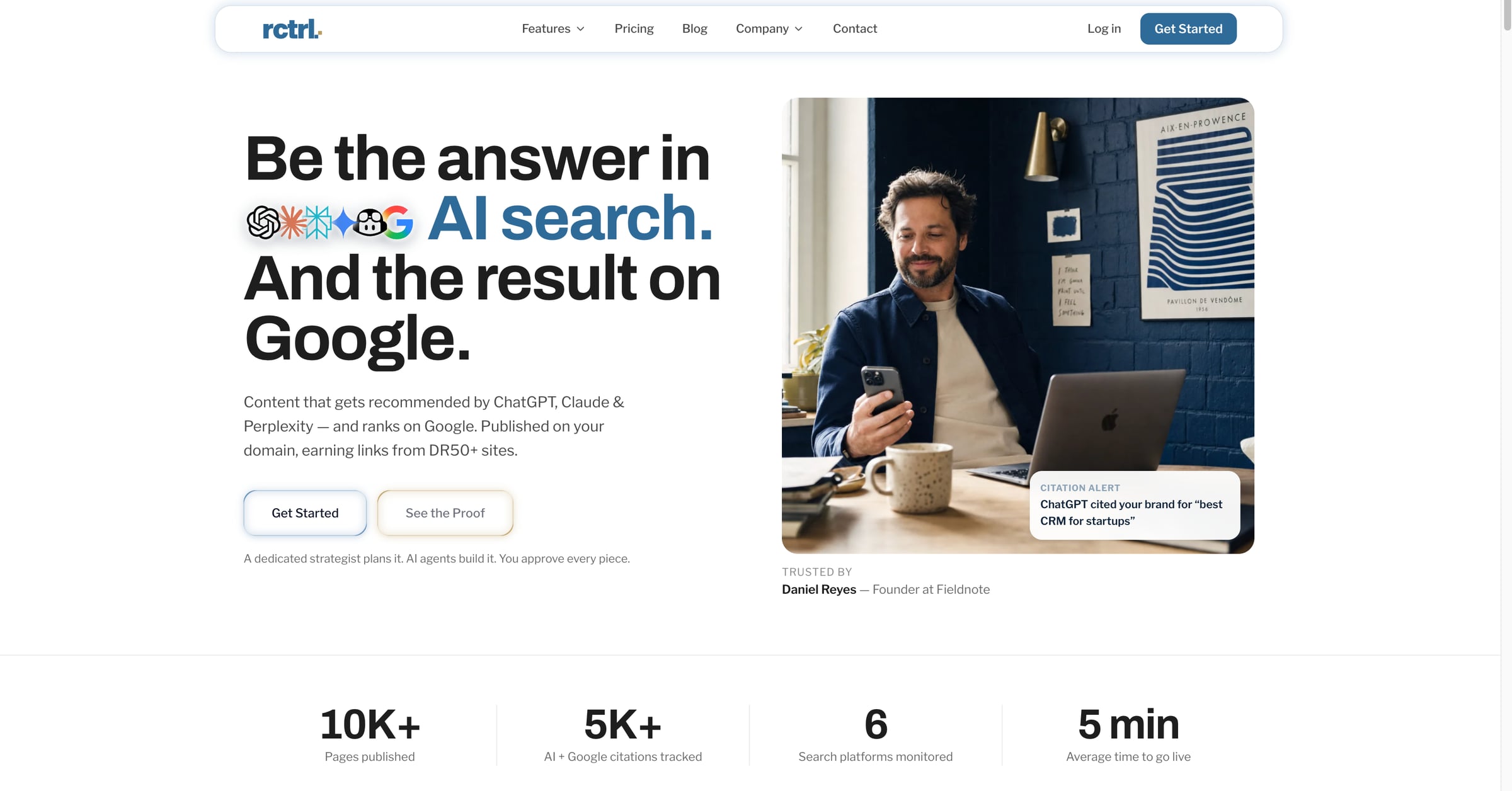
RankControl is an AI SEO platform that produces content designed to be recommended by AI search engines such as ChatGPT, Claude, Perplexity, Gemini and Grok, while also ranking on Google. The articles it creates publish as native posts on the customer's own domain, not on a subdomain, so the site keeps full SEO equity and earns links from high-DR sites. It combines content creation, AI visibility tracking, backlink earning and analytics in a single platform with one flat plan. The goal, as the site puts it, is to be the answer in AI search and the result on Google.
Buyers now ask AI before they buy, and most brands are not even in the conversation. RankControl frames this as a gap: your competitors show up in AI answers and on Google, while many brands remain invisible to AI search even when they already rank on Google, because AI systems use different signals such as entity authority, citation patterns and content depth. The platform describes a shift from ten blue links, where ranking number one won the click, to AI answers that replace links, where citations replace rankings. Agencies, the site notes, burn months and thousands of dollars, cited at $5K+ per month, for results that arrive slowly.
Discovery and setup are handled by Radar and the tracking layer. RankControl scans your tone, products and competitors so everything it produces reads like your brand, then tracks how ChatGPT, Perplexity, Claude, Gemini, Grok and Google AI Mode answer your market's questions. Radar surfaces every question in your market where AI names someone else, described on the site as answers where a competitor was named instead of you. It tracks up to ten competitors and ranks topics by opportunity, so you can see not only that you are missing from AI answers but why, and which gaps are worth closing first. The brand-learning component, Sounds Like You, learns voice, products and competitors from your site so content matches your brand from day one.
Content creation is handled by Forge, which writes content AI trusts: 1,500 to 4,000+ word guides that are brand-matched and citation-optimized, built to answer the questions Radar found. RankControl supports 26 content formats, and sample articles shown on the site span explainers, listicles and statistics posts across travel, software, tech and coffee. Drafts go through an approval workflow where you review, comment and approve with one click; auto-publish is off by default. Articles then go live on your site as native posts through a five-minute plugin setup with no code changes. Content Refresh flags pages when rankings or citations slip and rewrites them on your approval.
Visibility monitoring is covered by Sentinel, which runs weekly checks on every tracked query and competitor and sends a notification the moment something changes. Citation Signals tells you when an AI engine cites you or a competitor, turning every mention into something you can act on, and lets you search citations by platform, query or competitor in one click. Brand Perception rates every AI mention as positive, neutral or negative with the wording behind it. Citation Sources shows who the engines cite for your queries, whether that is you, your competitors, Reddit, YouTube or editorial sites. The Google AI Overviews view shows when Google's AI answer appears for your keywords and whether your page is one of its sources, while the AI Crawlers view shows which AI bots read which pages and alerts you the day one of them gets locked out. Analytics ties it together by showing which AI assistant sent each visitor, with traffic, crawls and rankings in one view.
Growth is built around backlinks. RankControl drafts outreach emails with AI and supports link exchanges, with managed backlinks available as an add-on at $350 per month. Every new backlink is tracked as it lands, and rankings and citations are reported per published page, so you can see which articles are producing results. The platform also includes Link Control for tracking backlinks and managing outreach opportunities in one place, and Competitor Recon for tracking competitor citations across all AI models to find the gaps. As AI models begin recommending you, you can see exactly which answers name you and which models send the traffic, meaning the right people arrive already convinced.
The methodology is a six-step playbook that runs from setup to traffic. In steps one and two you lock in your brand and spot the gaps; in steps three and four you draft, approve and publish on your own domain; in steps five and six you earn backlinks and compound your authority. Seven AI agents plan, build and publish the work, and the Agent Pipeline lets you watch every move with a full audit trail. Because AI models have memory, the more authoritative content you publish, the more they trust your brand. The site illustrates this compounding effect as first citations appearing around month one, trust compounding threefold by month three, and default answer status by month six.
The stated outcomes are traffic from two channels at once. The homepage reports 10K+ pages published, 5K+ AI and Google citations tracked, 66 search platforms monitored, and an average time to go live of five minutes, along with a linked case study citing +375% traffic in 90 days. The comparison table positions RankControl at $400 per month all-inclusive against agencies at $5K+ per month and competitors at $800 to $2,200 per month, with time to results of 30 to 90 days, a full review workflow, every agent action logged, content hosted on your own domain, Google AI Overviews shown per keyword, and MCP, CLI and API access included. It positions the platform as saving $55K in year one versus agency retainers.
Typical scenarios follow the product's own workflow. A marketing team starts a free trial, connects its CMS with the five-minute plugin, and lets RankControl scan the site to learn voice, products and competitors. Radar then lists market questions where competitors are named instead of the brand, and Forge drafts guides targeting those questions. The team reviews and approves drafts, the articles publish as native posts, and Sentinel plus Citation Signals notify them when an AI engine starts citing them. AI-drafted outreach emails go out to earn backlinks, and analytics show which AI assistant sent each visitor. Teams can also run the whole thing from their own AI agent through MCP, the CLI or the API.
RankControl is positioned for marketing and SEO teams, and for brands that want AI visibility without paying agency retainers; the comparison repeatedly contrasts it with agencies and with competitors that are software only. It offers a 7-day free trial, one flat plan at $400 per month all-inclusive, an optional dedicated strategist at $1,500 per month, and managed backlinks at $350 per month. Integrations include Cloudflare, Google Search Console, Bing Webmaster, Gmail, Postiz, Buffer, Zapier, n8n, Make and Google Analytics, plus CMS publishing into WordPress, Shopify, Webflow, Ghost, Framer, Wix, Notion and headless Next.js sites via the Content API. MCP, CLI and API access is included, with 80+ tools and one command to connect.
In short, RankControl is built on the premise that citations compound and competitors cannot easily catch up. Rather than stopping at telling you where you are mentioned, it runs the full lifecycle: create content that AI and Google recommend, publish it on your own domain, track visibility across ChatGPT, Perplexity, Claude, Gemini, Grok and Google AI Mode, earn backlinks, and measure what comes back. Being the answer, not just a ranking, is the value proposition it sells.
Publisher
A
admin
Launch Date2026-09-24
Platformweb
Pricingpaid