Category Focus/categories/analytics
Analytics AI Tools
Discover and compare the best analytics AI tools and software. Browse 101+ curated tools with reviews and rankings.
Projects tracked
101
Sort mode
RECENT
Page
1
Discover and compare the best analytics AI tools and software. Browse 101+ curated tools with reviews and rankings.
Projects tracked
101
Sort mode
RECENT
Page
1
Drive is a vehicle telemetry app that turns the phone already in your car into a telemetry rig. Its maker describes it as capturing g-force, braking and cornering data — "the whole trace" of a drive — and as flagging license plate reader cameras as you approach them. The product is aimed at people who want driving data from an old weekend car rather than through professional motorsport equipment, and it is delivered as an iOS app available on the App Store. There is no wiring loom, no dongle and no laptop involved, and no sign up is required to use it. The maker summarises the intent simply as "Just driving fun." Drive came out of a personal gap described by its maker, Andy Kim, who says he spent a few years as a design lead on autonomous driving for Android Auto — "the work of making a car drive itself well" — and then spent his weekends in a 27-year-old car doing precisely the opposite, badly, for fun. Drive is what came out of that gap. The problem the product targets is stated explicitly in the maker's own framing: the category it competes against costs $800 to $3,000 and involves a wiring loom, while the phone in a driver's pocket has had an accelerometer, a gyroscope and GPS built into it for a decade. The maker calls that gap "most of the product." In other words, much of what a basic vehicle telemetry setup needs already exists in the device most drivers carry with them every day, which is the observation the entire product is built around. The core of Drive is telemetry capture. According to the product description, Drive records g-force, braking and cornering, described as "the whole trace." These are the elements the maker calls out consistently: what the car is doing under load through corners, what is happening under braking, and the g-forces involved. Rather than requiring a wiring loom or a dongle to read data from the vehicle's own systems, Drive uses the sensors already present in the phone that is in the car. For a driver running a weekend car on a favourite road, that means the trace information associated with a dedicated logger, captured without installing anything in the vehicle. The maker frames the product around exactly this idea: the instrumented drive without the instrumented car. Drive also flags license plate reader cameras as you come up on them. The maker explains that this feature started as a personal itch, having noticed Flock cameras everywhere. Within the app, the result is an alert as the driver approaches a license plate reader (LPR) location. This is a privacy-oriented capability rather than a performance one, and it sits alongside the telemetry features rather than replacing them, which makes it an unusual combination: a driving and telemetry product that also provides awareness of automated plate reading within the same experience. In the Product Hunt discussion, one commenter called the LPR flagging "the surprise here" and asked where the camera locations come from — whether from a source such as DeFlock's OpenStreetMap layer or the maker's own dataset — but the maker's published description does not state where that data comes from. The setup described is deliberately minimal: no wiring loom, no dongle, no laptop, and no sign up. Each omission corresponds to something the maker identifies as friction in the existing telemetry category. A wiring loom is part of what makes dedicated systems expensive and permanently installed; a dongle is extra hardware to buy, carry and pair; a laptop is part of many data logging workflows; and a sign-up wall adds account creation before the driver can do anything. Drive's stated approach removes all four. The maker's summary — "Just driving fun" — makes the intended experience clear: get in the car, use the phone that is already there, and drive. The overall approach is to treat the phone as the telemetry device. The maker points out that the phone in your pocket has had an accelerometer, a gyroscope and GPS in it for a decade, and positions that existing hardware as the basis for the product, saying "That gap is most of the product." Drive therefore derives its driving data from the phone's own sensors rather than from dedicated hardware reading the vehicle's systems. The maker, who worked on autonomous driving interfaces for Android Auto, describes the product as coming out of the contrast between that professional work and weekend driving in an old car for fun. Drive is distributed as an iOS app, listed on the App Store under the name Drive: G-Force Telemetry. The stated benefit is access to vehicle telemetry without the cost and installation burden of the existing category, which the maker says runs from $800 to $3,000 and involves a wiring loom. Because Drive uses the phone already in the car, there is nothing to wire in, no dongle to plug in, and no laptop required at any point in the described workflow. A second benefit is privacy awareness: the LPR alert gives the driver notice as they approach license plate reader cameras, a feature the maker created after noticing Flock cameras everywhere. The maker also frames Drive as being about enjoyment — "Just driving fun" — rather than a professional engineering workflow, which suggests the intended benefit is quick, low-friction access to driving data. The primary scenario named in the product is the weekend drive. The maker's own story is of spending weekends in a 27-year-old car, and Drive is described as turning the phone already in that car into a telemetry rig capturing g-force, braking and cornering. A second scenario is the driver who is curious about professional-grade data logging: the maker explicitly addresses people who have run a real data logger — AiM, VBOX or Racelogic — and asks what they would miss most going to a phone, saying that list is what he is building from. A third scenario is privacy-oriented driving, where a driver approaching a license plate reader camera gets flagged as they come up on it. All three scenarios share the same setup: a phone, a car, and no additional hardware. Drive is aimed at driving enthusiasts — the maker's own reference point is a 27-year-old car driven for fun on weekends — and at drivers who want telemetry data without the $800–$3,000 spend and wiring loom associated with the existing category. It also speaks to people already familiar with data loggers such as AiM, VBOX and Racelogic, whom the maker invites to describe what they would miss moving to a phone. Privacy-conscious drivers are a further audience, given the license plate reader alerting built in after the maker noticed Flock cameras everywhere. Pricing is free to start, and the product is an iOS app available on the App Store. On Product Hunt it is tagged iOS, Cars and Privacy, and sits in the Maps and GPS category. Drive's proposition is straightforward: the phone already in your car has the accelerometer, gyroscope and GPS needed to record g-force, braking and cornering, so it can serve as a telemetry rig without a wiring loom, a dongle, a laptop or a sign up — while also flagging license plate reader cameras as you approach them. The maker, who designed autonomous driving interfaces for Android Auto, built it out of the contrast between that work and weekend driving in an old car. Free to start and available on iOS, Drive targets the gap between expensive professional data logging and simply enjoying a drive.
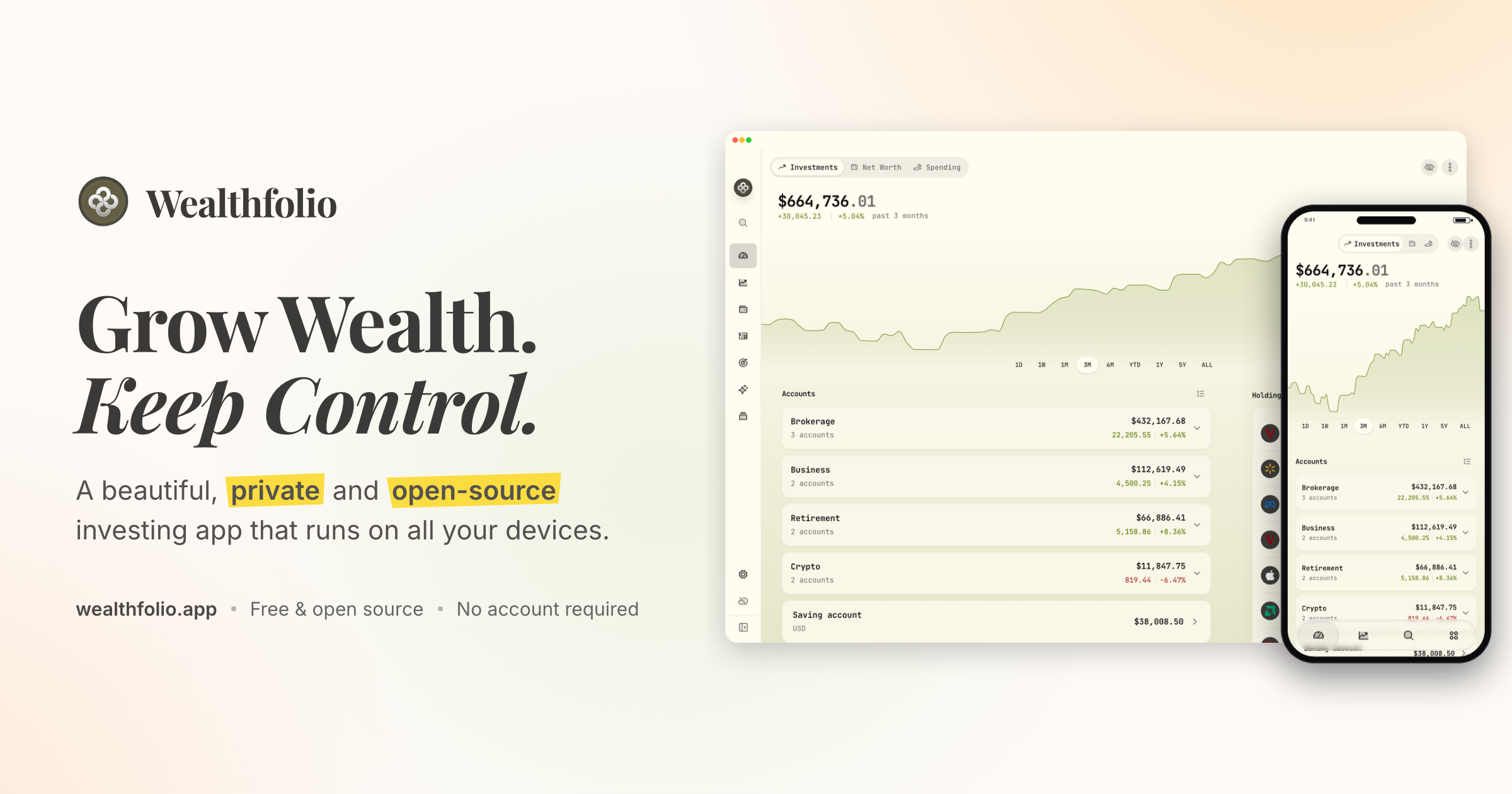
Wealthfolio is a beautiful, private and open-source investing and personal finance app that runs locally on all your devices. It is designed to help you grow wealth while keeping control of your financial data. The app brings together investments, net worth, spending and planning in one place, and it works without an account or subscription. It is built for individuals who want a clear view of their finances, including holdings, performance, allocation and income across their accounts, without handing their financial history to a cloud platform. Wealthfolio is available as a standalone install for macOS, Windows, Linux, iPhone and iPad, and it can also be self-hosted so you can access it through a web browser on infrastructure you control. Most personal finance and investing tools ask you to store your financial history in their cloud, which makes you dependent on another platform and its continued availability. Wealthfolio takes a local-first approach instead: it runs locally, works without an account and keeps your financial history under your control. Your financial history stays on your devices rather than becoming dependent on another cloud platform, and the code is open source, available to inspect, contribute to and run on infrastructure you control. Because no account is required, you can start using Wealthfolio without creating an account or committing to a subscription. The project is built in the open and shaped by its users, with an active community, a public GitHub repository, documentation and add-ons that extend the app around the way people manage money. The project has drawn a community around it: its GitHub repository has more than 8,000 stars, it was ranked the number one repository of the day on GitHub Trending, it earned 924 points on a Hacker News Show HN launch, and its Discord community has more than 800 members. The core tracking tools cover what you own, what you owe and where your money goes. Investments tracking puts all your brokers and banks in one view and lets you import CSV statements from anywhere, so accounts held at different institutions can be reviewed together instead of across separate portals. Net worth tracking follows all your assets and liabilities to show your complete financial picture over time. Spending and budgets track cash flow, auto-categorize transactions and let you build budgets that fit you. Used together, these features connect portfolio performance to real-world cash flow, which makes it easier to see how day-to-day decisions affect the bigger picture, and they give you a single place to review holdings, performance, allocation and income across your accounts. Deeper investment analysis is handled by portfolio insights, the performance dashboard, income tracking and allocation targets. Portfolio insights help you understand your asset allocation, sector exposure and geographic distribution, so concentration or gaps are visible. The performance dashboard lets you compare accounts and benchmark against the S&P 500 or any ETF, giving results a relevant point of reference. Income tracking follows dividends and interest income across your entire portfolio, showing the cash your investments generate. Allocation targets and rebalance tools let you set target weights, see how far your portfolio has drifted, and get a clear rebalance plan to bring it back toward your chosen allocations, which makes it easier to keep a chosen strategy rather than reacting to whatever the market does. Planning features look forward rather than backward. The retirement and FIRE planner provides a year-by-year simulation with a Monte Carlo Risk Lab and FIRE mode, so you can explore how different assumptions shape a long-term trajectory. The goals and save-up planner projects savings to a target with a milestone glide path and on-track status, helping you judge whether current contributions are enough. Contribution limits help you stay on top of IRA, 401(k) and TFSA contribution room so allowances are not missed. An AI assistant lets you ask questions about your portfolio and get AI-powered insights. Add-ons such as the Investment Fees Tracker, Goal Progress Tracker and Stock Trading Tracker extend Wealthfolio with focused tools, and custom price feeds bring pricing data for assets and markets not covered by the default providers. Wealthfolio is built around a local database. Accounts, transactions and history are stored right on your device, which is what makes the local-first model possible. You can install Wealthfolio directly on your devices as a standalone app, with no server or account required, or run it on your own infrastructure and access it through a web browser. The self-hosted option uses Docker deployment and is suitable for an always-available personal instance, with your infrastructure under your control. If manual upkeep no longer makes sense, Wealthfolio Connect adds an optional layer on top of a standalone or self-hosted setup. Connect syncs your brokerages and keeps your Wealthfolio database in sync across devices, connecting through aggregators such as SnapTrade to reach brokerages, banks and crypto accounts. Connect is not a third deployment option; it adds automation and synchronization on top of a standalone or self-hosted setup. The primary benefit is ownership: your financial history stays on your devices instead of becoming dependent on another cloud platform, and the core app works without an account or subscription. Beyond privacy, the local-first model gives you deployment flexibility, because you can run Wealthfolio standalone or self-host it on infrastructure you control. The open-source code can be inspected, contributed to and extended, with add-ons, custom price feeds and supported AI and agent integrations that keep financial context close to your data. Automation is optional: Connect removes repetitive work such as importing brokerage data and keeping devices in sync, so users who want less manual upkeep can add it only when it helps. A quick demo is available for the investment tracking experience, and the app covers investments, net worth, spending and planning in a single interface. In practice, people use Wealthfolio to consolidate accounts from multiple brokers and banks into one investment view by importing CSV statements; to track net worth by recording assets and liabilities together; to understand spending through cash flow tracking, auto-categorization and budgets; to benchmark portfolio performance against the S&P 500 or a chosen ETF; to project retirement outcomes with a year-by-year simulation, Monte Carlo Risk Lab and FIRE mode; to follow progress toward savings goals with a milestone glide path; to monitor dividend and interest income; to keep an eye on IRA, 401(k) or TFSA contribution room; and to ask an AI assistant questions about their portfolio. With Connect, those workflows can run with automatic brokerage imports, encrypted device sync, household sharing and background updates, so the database stays current across devices without manual entry. Wealthfolio is aimed at individuals and households who want a private, open-source way to manage investing and personal finances without an account or subscription. The Wealthfolio app is free and fully usable, with manual accounts and transactions, CSV imports, investment tracking and performance, net worth and spending, goals and retirement planning, local data ownership, and standalone and self-hosted options. Wealthfolio Connect is an optional subscription that adds automatic brokerage imports, encrypted device sync, household sharing, background updates and connection management. Deployment choices include standalone apps for macOS, Windows, Linux, iPhone and iPad and self-hosted Docker deployment with browser access. The project lives on GitHub, has an active Discord community, and its documentation covers self-hosting, custom providers, add-ons and MCP server integrations. In summary, Wealthfolio pairs a free, open-source, local-first finance app with optional automation when you need it. It lets you track investments, net worth, spending and plans while keeping your financial history under your own control, with no forced account and a clear path from manual tracking to automated updates.
Viso Now is a self-building AI vision platform that turns images, video, and camera feeds into working computer vision applications. Rather than assembling a machine learning pipeline from scratch, users describe in plain language what they want to understand in their footage, and Viso Now builds the agentic vision logic and the custom live dashboards to go with it. The website positions the product around a single promise: bring a new AI vision application to life. It is designed for anyone who can describe a problem, from individuals who want a vision agent running in minutes to enterprises that need governed vision intelligence across many sites and cameras. The problem Viso Now addresses is the cost and complexity that traditionally surrounds computer vision. Building a vision application normally means model training, image annotation, ML engineering and ongoing model maintenance, which puts bespoke vision projects out of reach for most operational teams. Viso's own messaging states that isolated solutions are no longer enough and that not all computer vision is equal: single-purpose tools lease one outcome for one use case, while Viso positions its platform around multiple use cases across multiple locations. The site argues for flexible solutions with a lower total cost of ownership, complete control of your data, and the ability to customise outcomes and hit KPIs, and for handling today's challenges while preparing for tomorrow's opportunities. The core of Viso Now is prompt-driven building. A user describes the real-world situation they want AI to solve in plain language, with no model training and no annotation needed, and watches as Viso builds the application with them in real time. The site describes this as starting from a prompt, testing instantly, and turning ideas into vision agents. An 'Ask Viso to create a camera agent' flow sits directly in the product interface, where users work alongside the builder and refine the application until they are happy with the finished solution. Viso describes the underlying capability as visual general intelligence that applies to any use case, which is why the same engine can be pointed at very different operational questions without rebuilding anything from the ground up. Supporting that building process is a template gallery. Viso Now shows ready-made templates including Task-Aware PPE Check, Excavator Near-Miss Monitor, Hot Work Safety Check, Work-at-Height Safety Check, Clinical PPE Protocol Check, GMP Hygiene Check, Loading Dock Exclusion Zone, Front Desk Wait Tracking, Restricted Site Vehicle Alert, Hazardous Area PPE Check, Pipeline Integrity Scout, Visible Release Detection, Robot Cell Intrusion Detection, Production Area Access Check, 5S Shop Floor Audit, Emergency Exit Clearance, Reversing Vehicle Danger Zone and MEWP Fall Protection Check. Further templates cover Dock Turnaround Intelligence, Check-in Queue Orchestrator, HSE Workplace Audit, Commercial Vehicle Safety Screening, Dump Zone Safety Inspector, Abandoned Luggage Response, Handling Risk Assessment and Service Queue Pressure Analysis. Users can also feed the system their own media by clicking to upload or dragging a video in, with MP4, MOV, MKV, PNG and JPG supported, by capturing a photo, or by recording video, and they can choose between Fast, Balanced and In-Depth analysis modes depending on how much detail the task needs. Once an application behaves as intended, the workflow moves to deployment. Users iterate on the app until they are satisfied with the finished solution, then connect cameras or upload connectors to start using it immediately. Viso handles the end-to-end infrastructure behind the scenes, covering compute, visual analysis, governance, authentication and integrations, so teams do not have to stitch those layers together themselves. The platform produces custom live dashboards as part of the build, which turn what the camera agent observes into something an operator can actually monitor and act on rather than raw detections. Viso Now's distinctive approach is that the application builds itself. The website frames this as 'Your idea, the vision app builds itself' and 'If you can describe it, you can build it.' Instead of choosing from a fixed catalogue of detection types, users state the outcome they want and the platform constructs the agentic vision logic around that outcome. Build, refine, go live is the entire loop, and the security and infrastructure concerns are handled by the platform rather than by the user. The site summarises the free tier as dropping any video, describing what to build, and getting a working vision application in minutes, with no labelling, no training and no big team required. Viso reports concrete outcomes on its website. A customer story from a global manufacturer states that the company replaced four point solutions with one Viso deployment and that, by month three, near-miss incidents were down 54%, with the safety team spending zero hours rebuilding models. The same page cites 24/7 eyes on every camera that never blink and never tire, 10x faster AI vision versus other methods, and 90% less ML engineering effort with no labelling and maintenance. Elsewhere the site claims a 10x faster understanding of visual data to drive efficiency, automation and innovation, and an 85% reduction in time-to-value of computer vision applications. For teams, the practical benefit is speed: ideas become running vision agents without a dedicated ML function, and the same deployment keeps working as requirements change. The template library also shows the concrete scenarios the product is used for. In construction, Task-Aware PPE Check, Excavator Near-Miss Monitor, Hot Work Safety Check, Work-at-Height Safety Check and MEWP Fall Protection Check address worker safety and site hazards. In oil, gas and energy, Pipeline Integrity Scout, Visible Release Detection, Restricted Site Vehicle Alert and Hazardous Area PPE Check cover asset inspection and restricted zones. In manufacturing, Robot Cell Intrusion Detection, Production Area Access Check and 5S Shop Floor Audit support safety, access control and lean audits. In logistics and warehousing, Loading Dock Exclusion Zone, Dock Turnaround Intelligence, Dump Zone Safety Inspector and HSE Workplace Audit assess dock performance and workplace safety. Healthcare, food and beverage templates such as Clinical PPE Protocol Check and GMP Hygiene Check cover protocol and hygiene compliance, while Front Desk Wait Tracking, Service Queue Pressure Analysis, Check-in Queue Orchestrator, Abandoned Luggage Response and Commercial Vehicle Safety Screening serve hospitality, public venues and transport environments. Two products sit on one platform. Viso Now is the free entry point, marked 'Free · No Credit Card', offering a free forever tier with the ability to invite your team, prompt-to-agent building in minutes, visual general intelligence for any use case, and seamless connection to other systems. Viso Suite is the enterprise option, described as the complete operating system for enterprise vision intelligence: connect every camera across every site, build governed applications, and operate agentic workflows at scale, with support for 10,000+ cameras and hundreds of sites, full lifecycle from build to deploy to govern to scale, edge AI with on-prem or cloud support, and compliance with SOC 2, ISO 27001, GDPR and CCPA. Viso also states it is trusted by Fortune 500 companies and lists 136+ applications tuned for every industry. Viso Now's value proposition is straightforward: describe the real-world situation you want AI to solve, and the platform builds, refines and runs the vision application for you. No model training, no annotation, no code writing, and no large team, but with the same platform able to scale into governed enterprise deployments across thousands of cameras. It turns any camera into an analyst that can detect, inspect, alert and understand what is happening in the physical world.
FreeScan.app is a free website audit tool that runs 40 focused checks against any public URL and returns a prioritized report. You paste a page address, the audit runs without signup or private access, and the result covers SEO / AEO / GEO, website security, accessibility fundamentals, and conversion-focused design. Four category scores are shown side by side — SEO / AEO / GEO, security, accessibility, and design — so you can see at a glance where a page stands. The report is built for builders, marketers, and site owners who want to know what to improve first rather than guess. Every finding comes with supporting evidence, an explanation of why it matters, and the concrete fix to make. The problem FreeScan addresses is that checking a website usually means piecing together several separate tools. One tool looks at SEO, another at performance, another at accessibility, another at security headers, and each produces its own vocabulary of scores with little guidance on priority. FreeScan's own framing of its Pro plan is to stop piecing together separate tools and instead monitor SEO / AEO, AI visibility, security, accessibility, and design across a site's key pages in one private dashboard. A page that is not crawlable, not secure, not accessible, or not clearly designed costs visibility, trust, and conversions. Rather than stopping at a single number, FreeScan turns the evidence it collects into prioritized fixes, opportunities, and insights that can be shared with a team. The first category, technical SEO and answer-engine readiness, reviews the elements that determine whether a page can be found and understood. The audit inspects titles, meta descriptions, headings, canonical tags, robots.txt, sitemap.xml, structured data, Open Graph tags, and internal links. It also checks llms.txt and answer-ready page structure, which is the part of the scan aimed at AEO (answer engine optimization) and GEO (generative engine optimization). The stated purpose is to see whether a site is structured for search engines and AI answer systems to understand. For Pro users, site-wide AI visibility scanning also looks for crawler blocks, content gaps, and citation-readiness issues across scanned pages. Together these checks show whether the page is crawlable, indexable, meaningfully described, and formatted so that search engines and AI answer systems can extract answers from it. The security category looks at public website security signals visible from the outside: HTTPS, mixed-content indicators, common public security headers, insecure forms, sensitive file exposure, and cookie flags. These are the things a visitor's browser and a passing security reviewer can see, so they bear directly on user trust. FreeScan is explicit that this is a focused public-page audit and not a replacement for penetration testing or a full security audit. Accessibility checks find missing alt text, missing form labels, heading-order problems, landmark gaps, unclear controls, language issues, contrast risks, small tap targets, and rendered accessibility errors. FreeScan notes that this is not WCAG certification, yet the list closely mirrors the fundamentals that block real users, and the site's own testimonials describe running the audit, handing the results to a coding agent, and taking accessibility scores from 72 to 100. The design category evaluates conversion-focused page qualities: hero and CTA clarity, content density, trust signals, mobile viewport setup, readability, spacing, visual hierarchy, runtime health, performance, and layout stability. In practice this means the audit comments on whether a page says what it does, whether the main action is obvious, and whether the layout holds up on a mobile screen. The report itself is organized into three action-ready views. Fixes show what is costing points, why it matters, and what to change first, ordered by impact. Opportunities surface high-leverage ways to improve visibility, trust, usability, and conversion beyond failed checks. Insights explain what the page already does well, backed by rendered checks, schema, previews, and page signals. The result is a shareable audit report with scores, evidence, prioritized fixes, and insights rather than a bare total. FreeScan Pro is positioned as the layer above the free single-page scan, priced at $19 per month with cancel-anytime terms. Pro runs automated site-wide audits, groups findings across a site into one prioritized fix board that shows affected pages and lets you track each fix, and organizes results into SEO, AI Visibility, and Fixes workspaces. Pro also provides private scan history, automatically audits the site's key pages each week and emails reports so progress and regressions can be compared, and monitors uptime with downtime alerts and an optional shareable status page. Agent workspaces and MCP let you export the full SEO, AI Visibility, and Fixes workspaces as Markdown, connect through Pro MCP to read private findings and request rescans, and thereby give a coding agent the evidence it needs to act. The stated plan limits are 5 sites, 5 manual scans per week per site, and up to 60 baseline / 25 recurring pages. The stated outcome is knowing what to improve first. FreeScan offers prioritized fixes to improve search rankings, AI visibility, user trust, and conversions, and it frames the free scan as the starting point for improving the whole site. Because every failed check arrives with evidence, severity, and an actual fix, the output can be worked through like a sprint backlog rather than interpreted as a mystery score. Testimonials shown on the site describe exactly this pattern: EverList reported crawler visibility, accessibility, mobile layout, and metadata issues, fixed them, and reached 100 for SEO / AEO and 100 for security with clean real-browser accessibility. Another user took hackyard.tech from 40 to 86 by working through the list, and Wysera reported going from an initial 80 to 100 across SEO / AEO, security, accessibility, and design. The site recommends running a free website audit before a launch, campaign, or SEO push so you do not guess whether the page is crawlable, secure, accessible, clearly designed, or ready to convert. Because any public page can be scanned without an account, it also works as a quick pre-flight check for a landing page, a new marketing page, or a site that has just been redeployed. For teams using coding agents, the workflow described in testimonials is to scan the site, hand the agent the results URL or the generated prompts, review the pull request, then ship. One user reported accessibility going from 72 to 100 after typing a sentence and doing a PR review. Pro extends this into ongoing monitoring with weekly audits, email reports, comparison of progress, uptime monitoring, and downtime alerts. FreeScan is aimed at builders, founders, marketers, and site owners who need to know whether a public page is ready. The testimonials come from people shipping SaaS products, healthcare platforms, personal sites, and side projects. The free tier covers a single-URL audit with 40 checks and requires no signup or private access. Pro is a single $19/month plan with cancel-anytime terms, described on the site as one focused Pro plan rather than a tier matrix. FreeScan also states plainly what it is not: a focused public-page audit, not a replacement for expert SEO strategy, penetration testing, accessibility certification, or analytics. A public leaderboard ranks the highest scoring Pro homepages by each website's latest homepage audit, and the site's recent activity feed shows 2,447 audits. FreeScan.app's value proposition is simple: one URL, 40 checks, and a prioritized plan. Instead of assembling a stack of single-purpose scanners and reconciling their numbers, you get one report covering SEO / AEO / GEO, security, accessibility, and design, with the evidence and the fix attached to every finding. The free scan tells you where a page stands today; Pro turns that into an ongoing, private, site-wide practice with weekly audits, a prioritized fix board, agent-ready workspace exports and MCP access, private history, and uptime monitoring. For anyone about to launch, run a campaign, or push on SEO, it is a fast way to know what to improve first.
AdScope is a read-only reporting dashboard that unifies Meta Ads and Google Ads into one live view, and it shows every live Meta ad sitting right next to what that ad actually cost. It pulls Meta and Google Ads into one dashboard simple enough to read on your phone, covering what you spent, what it got you, and every live Meta ad shown alongside its own numbers. It is designed for business owners and marketers running their own ad accounts as well as agencies and freelancers running client accounts, and its main purpose is to let you understand your ad performance in seconds rather than decoding rows of exported data. The problem AdScope addresses is the everyday reality of running paid ads across two platforms. The site describes the alternative as the manual way: two ad managers and a spreadsheet. In that world you see the numbers, but not the ad that made them; Facebook sits in one tab and Google in another, and the math happens in your head. What you are working from is yesterday's export, built by hand and already out of date by the time you look at it, and there are hours of setup before you see a single number. AdScope's answer is the same data you already paid for, presented in one place, by platform, by campaign, by ad, so that transparency replaces guesswork and you stop managing in the dark. The flagship capability is seeing the creative instead of a row of numbers. AdScope displays every live Meta image and video ad you are running next to what it spent and what each result cost. Instead of decoding a row called final-3-copy, you recognise the winner visually. That matters because a spreadsheet export cannot show you the image or the video that produced a given cost per result, so the ad doing the work stays hidden behind its metrics. AdScope also lists a Visual Ad Gallery and a Platform Data Breakdown among its dashboard capabilities, so the creative view and the data view are presented together rather than in separate tools. AdScope then answers the two questions every advertiser asks first. The Bottom Line stops you from doing math in your head by combining your Total Daily Spend and Results, whether those results are leads or sales, across platforms into one single view: one total for spend, one total for results, both platforms combined. Track Every Dollar Across Meta and Google lets you break down performance by campaign or by ad in one click, so you can see exactly where your budget shines rather than guessing what works. Full date range control lets you select the period that matters to you, and campaign metrics adjust dynamically based on campaign type, so the numbers shown match the kind of campaign you are actually running. Setup is deliberately minimal. You log in with your existing Meta and Google accounts, the same way you log into Facebook, and your dashboard builds itself in seconds after you connect. There is no pixel, no code, and no data mapping, and the site describes the arrangement as two logins with read-only access, so nothing can be changed. AdScope is a mobile-first responsive web app with nothing to install. You can open it in your browser at 7am and see what yesterday cost you before you open the laptop, and the Business Plan also lists mobile app access. Instant Lead Access complements this by letting you see who is interested in real time, access your leads instantly, and trace them back to the exact ad that captured them. How AdScope works overall comes down to access and adaptation. It connects through the official, verified APIs from Meta and Google, and that access is read-only: AdScope can display your ad data, but it can never edit, pause, or change a live campaign, and it cannot spend any of your budget. During onboarding you define your business type, for example ecommerce or lead generation, and your main overview adapts instantly, while campaign metrics adjust dynamically based on campaign type. That is the methodology that separates it from a generic connector: the same underlying data is framed around the kind of ads you actually run, so the first screen you see is already relevant instead of something you have to configure from scratch. The benefits described are total transparency for business owners and peace of mind for marketers, and AdScope states that this creates instant trust. Because live sync replaces the hand-built export, the numbers you are looking at are current rather than yesterday's, and you no longer do math in your head to combine two platforms. You recognise winners by their creative rather than by row names, and you can check what yesterday cost you from your phone before your first coffee. There is no pixel to maintain and no developer needed to set it up, and because access is read-only, there is no risk of a reporting tool accidentally changing or pausing a campaign or spending any budget. AdScope reports on whatever your campaigns optimise for, including leads, calls, messages, form fills, or purchases. Concrete scenarios where AdScope fits include a business owner checking total daily spend and results across Meta and Google on a phone before starting the day; a marketer breaking down performance by campaign or by ad in one click to decide where budget should go; an agency or freelancer reviewing live creatives next to their own cost per result when reporting to a client; a lead generation advertiser tracing every new lead back to the exact ad that captured it; and an ecommerce advertiser monitoring purchases, spend and results in the same combined view. AdScope is explicitly not an ecommerce attribution engine and it does not do blended ROAS modeling, so it is best understood as a reporting layer over the ad platforms' own data rather than an attribution product. AdScope is aimed at two groups: businesses and marketers running their own ad accounts, and agencies and freelancers running client accounts. The integrations available today are Meta Ads, covering Facebook and Instagram, and Google Ads; TikTok Ads is planned and is not available yet, with spend and performance alongside Meta and Google described as coming next. Pricing begins with a 10-day trial and no card is required until your dashboard is built. Launch pricing is $9.99 per month, locked for 12 months from the day you sign up, after which the rate goes to $39.99 per month on your renewal date, with an email sent before that happens and cancellation available at any time. Annual billing is offered at $99.90 per year for the first year, then $288 per year. The Business Plan includes one user per workspace, connection to all major platforms, a unified real-time dashboard, real-time tracking, the visual ad gallery, platform data breakdown, mobile app access, full date range control, and standard support by email only. An Agency Plan with client workspaces, white-label reports and client dashboard access is in design and not available yet; AdScope is shaping it with a small group of agencies, invites agencies running ads for five or more clients to give input as design partners, and says design partners keep launch pricing when it ships. Launch pricing is available for a limited time, and activating a paid plan during the launch window locks the discounted rate for a full year. In short, AdScope takes the ad data you have already paid for and puts it in one place, by platform, by campaign and by ad, with the live creative shown next to its own cost per result. Read-only access, two logins, no pixel and no code keep setup to seconds, while a mobile-first dashboard, a 10-day trial and no card until the dashboard is built make it easy to find out whether it fits the way you run ads.
GoModel is an open-source AI gateway written in Go that puts a single OpenAI- and Anthropic-compatible endpoint in front of 31 AI model providers. Applications keep using the OpenAI or Anthropic SDK and simply change the base URL, while GoModel handles authentication, workflow resolution, guardrails, caching, budgets, rate limits, provider routing, and failover behind that endpoint. It ships as one self-contained binary with an embedded admin dashboard, released under the MIT license, and is positioned as a self-hosted alternative to OpenRouter and LiteLLM. Its stated purpose is to move provider switching, debugging, and usage tracking out of application code and into one gateway layer. The GoModel site frames the problems it solves around what happens when AI integrations mature. Teams become coupled to one provider, so switching vendors turns into a code project instead of a configuration change. A single runtime behavior rarely fits every team or application: one path needs caching, another needs audit logging, and another needs guardrails. Identical prompts burn budget twice because nothing intercepts duplicates. Provider dashboards show one aggregate total, so costs cannot be attributed to teams, tenants, or features. When a fallback fires during an incident, nobody can reconstruct why. And the gateway itself can become its own project if it needs a separate deployment, admin tooling, and database to operate. GoModel answers each of these by moving that logic into one gateway layer. In routing and provider coverage, GoModel places 31 providers behind one endpoint, including OpenAI, Anthropic, Google Gemini and Vertex AI, Azure OpenAI, Amazon Bedrock, OpenRouter, Cohere, Groq, xAI, DeepSeek, Fireworks AI, Alibaba Bailian, MiniMax, Kimi Code, Z.ai, Xiaomi MiMo, Meta Muse Spark, Kilo AI, OpenCode Go, Oracle GenAI, ElevenLabs, Ollama, and vLLM, each configured through environment variables such as OPENAI_API_KEY or OLLAMA_BASE_URL. Hundreds of models are read from live provider catalogs, and model counts are approximate. Multiple API keys per provider rotate round-robin, and suffixed environment variables register extra instances of the same provider type, so any OpenAI-compatible backend can join as its own provider instance. Aliases and virtual models let teams publish stable names such as smart-chat and remap the real provider and model behind them with a config change rather than an application change. Load balancing spreads a virtual model across targets with weighted round-robin, or lets cost-based routing pick the cheapest capable model for each request. Automatic failover sends availability errors to the next model or provider, with retries, backoff, and a circuit breaker to absorb flaky upstreams. Provider passthrough lets you call any provider's native API through /p/:provider/* while keeping GoModel's auth, usage tracking, and audit on the way through. Control and safety features decide how each request behaves. Scoped workflows toggle cache, audit, usage, budgets, guardrails, and failover per provider, model, or user path, with versioned definitions where the most specific scope wins, so one gateway runs different runtime policies for different workloads. Guardrails inject system prompts or rewrite messages with an LLM before dispatch, running in ordered steps that execute as parallel groups. Virtual API keys give teams managed keys bound to a user path and labels instead of raw provider credentials, and they can be revoked and rotated from the admin UI. Rate limits cap request rate and concurrency per user path, provider, or model; saturated routes are routed around when alternatives exist, and return 429 with Retry-After when they do not. Cost controls are built around tracked usage. Budgets set hard spend limits per user path or label, evaluated from tracked usage cost and enforced before a request is dispatched, so the run stops at the cap rather than at the invoice. Response caching works in two ways: exact-match caching returns identical non-streaming requests straight from the gateway with no provider call and no cost, while semantic caching matches similar prompts and is backed by Qdrant, pgvector, Pinecone, or Weaviate. Cache lookups run after alias and workflow resolution so policy decisions still apply, and cache hits are visible in the dashboard. Usage and cost tracking performs token and dollar accounting per request, user path, and label, with per-model pricing overrides when list prices do not match your contract. On the site's example, a repeated prompt that took 1.9 seconds and cost $0.42 on a cache miss returned in 38 milliseconds at no cost on the second call. Observability covers what happened on every request. Audit logs record each request with its resolved route, workflow, cache result, and provider attempts, with bodies and headers logged only when explicitly enabled. The admin dashboard is an embedded UI for live request logs, usage breakdowns, keys, budgets, workflows, and provider status, so there is no separate deployment to run. Request tagging flows labels from headers or key metadata into usage and audit so spend and incidents map to teams, tenants, and features. Prometheus metrics are exposed at /metrics with request, provider, and circuit-breaker gauges, alongside health endpoints and optional pprof profiling. OpenTelemetry traces and metrics cover every inbound request and provider call on the GenAI semantic conventions, and Jaeger, Tempo, Honeycomb, or Datadog read them as they are. Beyond chat completions, GoModel serves the fuller OpenAI surface including embeddings, the Responses API with gateway-managed conversations, files, and batches, plus the Anthropic Messages API at /v1/messages with token counting, so the Anthropic SDK can be pointed at GoModel and routed to any provider behind it. Audio and realtime coverage includes text-to-speech, transcription, and realtime speech over WebSocket and WebRTC through the same gateway pipeline. An MCP gateway aggregates MCP servers behind one endpoint with namespaced tools, and every tool call gets usage tracking and audit like any other request. A built-in playground sends a real request from the dashboard against any model or alias, streaming or not, and shows the exact JSON both ways while routing, logging, and metering it like any client call. Deployment is a single Go binary with Docker, Compose, and Helm recipes and an embedded admin UI. Storage starts on SQLite with zero setup and moves to PostgreSQL or MongoDB when traffic and retention demand it, using the same binary with a different config. Session keeping pins requests from one conversation or agent task to the target and key that served the first, warming provider prompt caches and keeping audit logs threaded. Streaming is first-class: SSE responses record usage and audit from the stream itself, with no buffering. GoModel authenticates each request, applies the matching workflow covering guardrails, cache, budgets, and rate limits, and routes it to the right provider with automatic failover, all behind OpenAI- and Anthropic-compatible APIs. Requests arrive from the OpenAI SDK, the Anthropic SDK, or plain HTTP and curl against endpoints such as POST /v1/chat/completions, POST /v1/responses, and POST /v1/messages. Cache hits are returned instantly without a provider call. Every response records usage and cost, an audit trail, a cache write, and a live dashboard entry. Provider attempts are protected by retries, backoff, and a circuit breaker. The stated benefits map directly to those mechanisms: provider choice is decoupled from the application so models can be swapped with a configuration change; caching and cost-based routing cut spend without code changes; budgets prevent end-of-month surprises; per-request tracking attributes spend to teams, tenants, and features; audit logs let compliance reviews replay any request including the resolved route, guardrail versions, and provider attempts; and failover turns a provider incident into a routing event rather than a customer-facing one. Local models served by Ollama or vLLM can sit behind the same endpoint the cloud providers use in production, so moving from a laptop to production is configuration, not code. The site lists six concrete jobs teams use the gateway for. A multi-tenant SaaS issues a virtual key per customer, tracks usage by user path, and enforces per-tenant budgets, so invoices come from the dashboard rather than guesswork. A platform team publishes aliases such as smart-chat with scoped workflows behind them, letting product teams ship features without ever holding provider keys. Production traffic rides failover chains with retries and circuit breakers to stay up through provider outages. Caching absorbs duplicate prompts, cost-based routing picks the cheapest capable model, and budgets stop end-of-month surprises. Compliance reviews replay any request with its resolved route, guardrail versions, provider attempts, and full bodies where logging is explicitly enabled. Developers run Ollama or vLLM locally behind the same endpoint the cloud providers serve in production. GoModel targets engineering and platform teams, multi-tenant SaaS operators, and developers who want a self-hosted layer between their applications and AI providers, since the content describes platform teams publishing internal endpoints, product teams shipping without provider keys, and compliance reviewers replaying requests. It integrates with the OpenAI SDK, the Anthropic SDK, plain HTTP clients, MCP servers, and monitoring stacks through Prometheus and OpenTelemetry, with storage on SQLite, PostgreSQL, or MongoDB and semantic cache backends including Qdrant, pgvector, Pinecone, and Weaviate. It runs on macOS, Linux, and Windows, in Docker, Docker Compose, or Kubernetes with a Helm chart. The core gateway is MIT licensed and free; GoModel Pro is the commercial distribution at $4,999 per year or $499 per month, flat per company, backed by a 30-day money-back guarantee and an offline signed license token. Pro adds prompt compression, OIDC single sign-on, per-child quota templates, and intelligent routing in beta. GoModel's value proposition is consolidation: one small, self-hosted Go binary that replaces per-provider integration code with a single OpenAI- and Anthropic-compatible endpoint, then adds the caching, budgets, guardrails, failover, audit, and usage tracking that teams would otherwise build themselves. The benchmark figures in the content, 2.35 ms median latency overhead versus 42.4 ms, 3,610 versus 250 requests per second, 42.7 MB versus 2,173 MB of RAM under load, and a 0.58 second cold start versus 31.25 seconds, illustrate why that consolidation is practical rather than theoretical.
Ass Auction is an advertising network with exactly one placement: a pair of boxers. Brands outbid one another to get their logo onto that single spot, competing on one public leaderboard where every position is bought with real money. The product is aimed at companies, makers and marketing teams that want an unusual, highly visible way to put a logo, a link and a short product pitch in front of an audience, and it is built to be used without creating an account. Only the top 22 bidders actually make it onto the boxers, while every other entry stays visible on the leaderboard beneath them. The premise is deliberately narrow. Instead of spreading a budget across many ad slots, formats and campaign settings, Ass Auction collapses advertising into a single ranked list, described on the site as one leaderboard, real money, no accounts. Rank is driven purely by how much has been paid, so a brand's position is a direct, public statement of what it was willing to spend. That transparency is the whole mechanic: the site even lists the price of overtaking the person above you, so every competitor can see exactly what the next position costs. The model is stated without apology in the how-it-works section, where the third step reads simply that money is never refunded, and that this is the whole business model. Joining the board is a single transaction. A participant pays at least $5, and the link joins the leaderboard at whatever rank that money buys, going live the moment payment lands — there is no approval step described anywhere on the site. From then on, the entry is exposed to being outbid: anyone can pay more and push it down the list. Because the ranking is based on total spend rather than a separate bid, climbing back up only costs the difference between the current total and the amount needed to overtake the entry above. The live board makes this concrete with steal-the-spot prices: the number one entry displayed a steal price of $15, and the entries beneath it each showed a steal price of $10, which tells a visitor at a glance how much it would take to leapfrog the next competitor. The physical element is what gives the product its name and its novelty. The top 22 entries get their logos worn on a pair of boxers, illustrated on the homepage as an image of boxers carrying the top 22 logos. The page leads with the promise that the operator will tattoo your logo on my ass, while the boxers artwork is described in the same breath as the place where the top 22 logos end up. Every entry is presented as more than a name: it pairs a logo with a short product description, a click count and a domain link, so the leaderboard reads like a ranked directory of the brands currently competing for the spot. Ass Auction is designed to be used without signing up. There are no accounts to create; a participant supplies only a URL or an X handle, and payment is handled through Stripe. Around the leaderboard, the site layers several live elements. Click counts update live and show how many clicks have been sent to each product, turning the board into a running measure of attention rather than a static list of prices. Each entry has a share card, so a brand can point people at its position elsewhere. An email notification arrives when an entry gets knocked down by another bidder, which means a participant does not have to keep refreshing the page to find out it has lost ground. And a gossip bar runs alongside the auction, a space where the crowd talks about what is happening on the board. Taken together, these details give the auction a sense of motion and give entrants feedback on how their placement is performing. The site documents the workflow in three steps. First, pay at least $5 and your link joins the board at whatever rank your money buys, going live the moment payment lands. Second, anyone can pay more and push you down; because your total spend is your rank, climbing back only costs the difference, and the top 22 get worn on the boxers. Third, money is never refunded, which the site describes as the whole business model and now, in its words, on the ass too. That structure produces a fully transparent auction: no hidden bidding, no ranking algorithm, no negotiations. Every position has a visible price, every competitor can see what it would cost to take the next spot, and the ranking simply reflects who has spent the most at any given moment. The most immediate outcome for a brand is placement on an ad surface that a conventional campaign cannot buy, plus a permanent, public link to its site from the board. The board reports the results openly: at the time captured, six claimed entries had sent a combined 158 clicks to their products, and individual click counts were shown next to each listing, from seventeen clicks for the top entry down to smaller numbers further down the list. That gives an entrant something measurable to watch. Live click counts and a share card make the entry easy to monitor and easy to show to other people. Because rank equals total spend, the cost of moving up is predictable rather than speculative: an entrant pays the difference needed to climb, not a fresh fee. The knock-down email keeps participants informed without requiring constant attention, and the gossip bar turns the audience into part of the show. The board itself illustrates who uses the product. In the captured listing, AnonRouter — described as a private, open-source alternative to OpenRouter whose prompts are encrypted and processed inside secure hardware — sat at number one with a $10 spend and a $15 steal price. Activepieces, a platform for building a self-driven AI culture across HR, finance, marketing and sales under the supervision of IT teams, held second place at $5 with a $10 steal price. Peeko, a cookieless first-party web analytics tool that shows who visits your site and which AI crawlers read it, was third at $5. Further down, the board listed market management software for farmers markets and craft fairs, a product called Vetypro, and Dokus, which keeps passport, ID and driver's licence in one wallet across iPhone, iPad and Mac. Across these examples the pattern is the same: a short pitch, a logo, a link and a price that decides the position. Pricing begins at $5, the stated minimum to join the board. Above that, the amount paid determines rank, and the steal-the-spot figure shown against each entry indicates what it would cost to overtake the entry above. Ass Auction runs on the web at ass.auction and uses Stripe for payments. The identity requirement is minimal — a URL or an X handle — which keeps the barrier low for indie makers, small teams and side projects, while the novelty of the placement gives larger brands a reason to take part as well. Ass Auction is a single-placement ad network built on a model it states plainly: one leaderboard, real money, no accounts, and the top 22 logos worn on a pair of boxers. Brands bid by spending, ranks are public and priced, outbidding is always possible, and nothing is refunded. For anyone who wants an offbeat, self-contained ad placement with visible clicks and a permanently public link, the auction is the entire product — and that is exactly the point.
Viral Sonar scans Instagram every morning and surfaces the Reels that are blowing up in your niche right now. Not the ones with the biggest view counts — our own algorithm detects the ones that are actually taking off, before everyone else piles in. Each reel comes with a breakdown of its format: hook, structure, pacing and why it works, so you can replicate it the same day. It also tracks the audio waves moving between accounts in your niche before they saturate. One scan every morning. No agency, no guessing.
Build or Skip is a product research and market validation tool for builders, indie hackers, and SaaS teams. It helps users compare product ideas with estimated monthly orders, growth, and repeat activity before committing to a build. Instead of relying only on inspiration, builders can watch demand signals, spot products with momentum, and decide what to build, what to monitor, and what to skip.
AudienceCue helps creators, marketers, researchers, and agencies download public YouTube comments and turn them into cited AI reports. Paste a supported video, Short, live-video page, channel, playlist, or list of URLs. Keep the returned comments and available public replies in CSV, JSON, TXT, or XLSX, then generate a report whose findings stay tied to source evidence. Share a read-only report or export it as HTML, Markdown, or JSON. AudienceCue does not post replies, moderate comments, or take actions on a YouTube channel.