Category Focus/categories/no-code
No-Code AI Tools
Discover and compare the best no-code AI tools and software. Browse 88+ curated tools with reviews and rankings.
Projects tracked
88
Sort mode
RECENT
Page
2
Discover and compare the best no-code AI tools and software. Browse 88+ curated tools with reviews and rankings.
Projects tracked
88
Sort mode
RECENT
Page
2
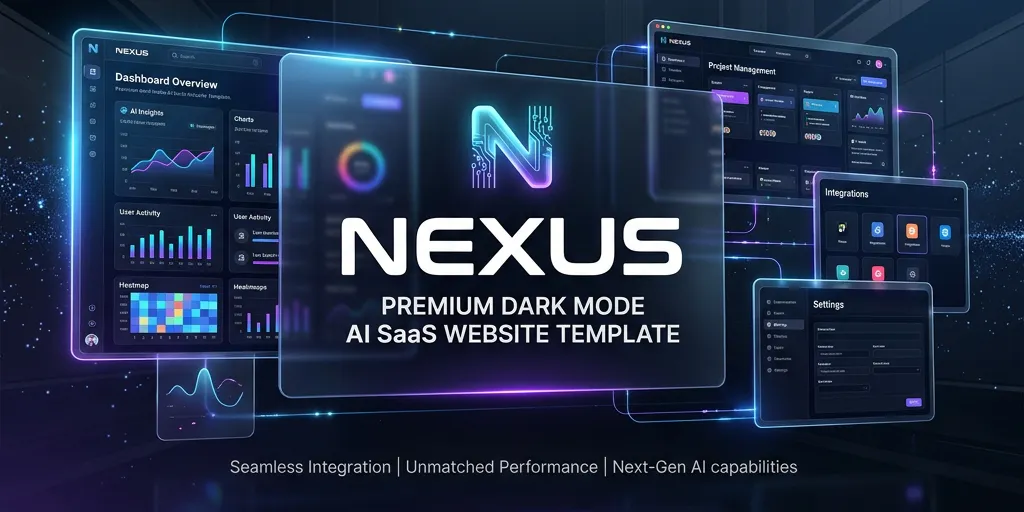
Nexus is an ultra-premium, multi-page HTML/CSS template kit designed specifically for AI and SaaS companies. It aims to provide startups with a high-end website appearance that rivals expensive custom agency builds, featuring modern design elements and interactive effects. The template kit includes 8 fully responsive pages covering essential sections like Home, About, Blog, and Auth. It incorporates custom glowing cursor that tracks interactions, magnetic CTAs that pull toward the user's mouse, mouse-tracking glow effects on feature cards, and infinite CSS marquee for social proof. The design emphasizes a dark mode aesthetic with glassmorphism elements. Built using pure, clean HTML/CSS/JS with zero heavy framework bloat, Nexus focuses on high-end micro-interactions typically reserved for expensive custom websites. The template avoids the flat, boring appearance common in overused frameworks, instead offering cutting-edge visual effects that create a "WOW" factor for modern AI startups and SaaS companies. The template works by implementing custom CSS and JavaScript interactions that respond to user mouse movements and interactions. The magnetic buttons physically appear to pull toward the cursor, while glow effects follow mouse position across feature cards. These micro-interactions are designed to create an engaging user experience without requiring complex framework dependencies. Nexus addresses the need for AI startups and SaaS companies to have websites that reflect their cutting-edge nature. By providing agency-level design quality in a template format, it allows startups to achieve a premium online presence without the cost of custom development. The glassmorphism aesthetic and dark mode design cater specifically to modern tech company preferences. The template is targeted at developers and founders building AI startups and SaaS companies who want their websites to stand out from typical template-based designs. It appeals to those seeking high-end visual effects and interactions without the complexity of heavy frameworks, offering a lightweight solution that maintains performance while delivering premium aesthetics.
Recus.app is a server-driven onboarding platform for React Native applications that eliminates the need for App Store releases when updating user onboarding experiences. The product addresses the common pain point where product managers must create Jira tickets and wait weeks for app store approval just to make simple changes like adding a field, modifying a screen, or making something mandatory. The platform includes a React Native SDK that developers install once and wrap their app with the RecusAppProvider component. This SDK connects to a dashboard where product teams can build and modify onboarding flows using a visual flow builder. The system uses a server-driven schema approach, meaning all onboarding logic and UI configurations are controlled remotely rather than being hardcoded in the app. Key capabilities include customizable UI components that can be styled to match the app's design system, a flow builder dashboard for creating multi-step onboarding sequences, and instant publishing that pushes changes to live apps within 60 seconds. The platform supports adding fields, changing screens, making elements mandatory, and other common onboarding modifications without requiring code changes or new releases. The technical implementation centers around a server-driven architecture where onboarding schemas are fetched and rendered dynamically by the React Native SDK. This approach enables real-time updates while maintaining native performance and user experience. The customizable UI system ensures that remotely-controlled onboarding flows maintain the app's visual consistency and brand identity. Benefits include dramatically reduced time-to-market for onboarding changes, elimination of app store review delays, reduced development overhead, and increased agility for product teams. Teams can iterate on onboarding experiences based on user feedback or analytics without the traditional bottlenecks of mobile app deployment cycles. The product is designed for React Native development teams, product managers, and mobile app companies who need to frequently update their onboarding experiences. Built with modern technologies including Vercel, Cursor, and Next.js, Recus.app offers a free tier and is particularly suited for teams following agile development practices.
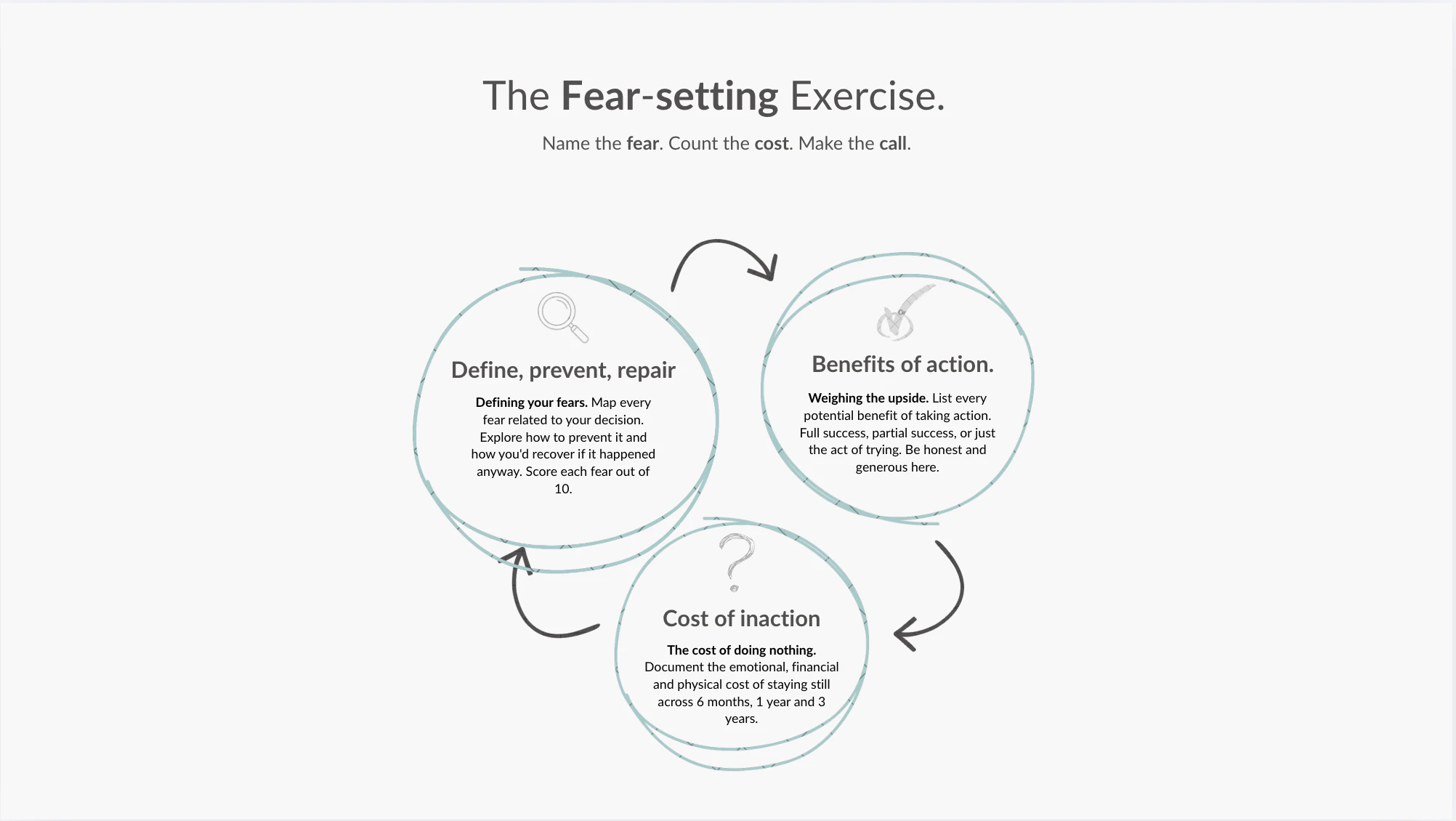
Fear-Setting is a free Notion template that implements Tim Ferriss's fear-setting exercise, designed as an antidote to overthinking big decisions. Rather than avoiding fear, the template provides a structured approach to map fears clearly by defining worst-case scenarios, identifying prevention strategies, and planning repair actions if those scenarios occur. The template guides users through three core steps: defining the worst-case scenario, determining how to prevent it, and outlining how to repair the situation if it happens anyway. Additionally, it incorporates weighing the potential upside of taking action and calculating the cost of maintaining the status quo and doing nothing. This Notion template is designed to be reusable for every significant decision users face, providing a consistent framework for decision-making. The template can be duplicated into a user's Notion workspace with a single click, making it immediately accessible for implementation. The creator developed this tool based on personal experience with sitting on big decisions longer than necessary, finding that fear-setting provided a structure for clear thinking rather than quiet worrying. The template has been embedded into the creator's annual review process and is now offered as a standalone free resource for others facing similar decision-making challenges.

Content Anchor is a collection of 40+ free tools designed for creators and teams, eliminating the need to search for individual utilities online. The platform provides instant access to various tools that run directly in the browser without requiring any sign-up, installation, or file uploads, ensuring complete privacy as all processing happens locally. The platform includes two premium products alongside its free offerings. ContentLinks enables users to create bento-style link-in-bio pages featuring draggable blocks, custom styling options, and shareable URLs. ProductXP transforms product knowledge into a chat-based AI system that teams can query, complete with citations and gap tracking capabilities. All free tools operate instantly within the browser environment, maintaining user privacy by keeping data local rather than processing it on external servers. This approach ensures that sensitive information never leaves the user's device while providing immediate functionality for everyday tasks. The platform serves creators and teams looking for efficient solutions without the typical barriers of account creation or software installation. By combining free utilities with premium specialized products, Content Anchor positions itself as a comprehensive toolkit for both casual users and professional teams requiring advanced features.

Kodda is a no-code AI chatbot widget designed specifically for customer support. The platform enables businesses to create intelligent chatbots by simply uploading their existing documents, eliminating the need for complex programming or technical setup. The core functionality centers around document-based AI training. Users upload their support documents, FAQs, knowledge base articles, or any relevant documentation, and Kodda transforms this content into an intelligent chatbot capable of answering customer questions accurately. The system operates 24/7, ensuring customers receive immediate assistance regardless of time zones or business hours. Key capabilities include instant chatbot deployment through a simple embed code that works on any website. The no-code approach means support teams can set up and manage the chatbot without involving developers or IT departments. The platform uses advanced RAG (Retrieval-Augmented Generation) and embedding technologies to ensure responses are accurate and contextually relevant to the uploaded documents. The implementation process is straightforward: upload documents, customize the chatbot appearance if desired, and embed the provided widget code on your website. The entire setup can be completed in minutes rather than days or weeks typically required for traditional chatbot development. Benefits include significant reduction in support ticket volume, improved customer satisfaction through instant responses, and cost savings compared to hiring additional support staff. The 24/7 availability ensures global customers always have access to assistance, while the document-based approach guarantees consistent, accurate information delivery. Kodda offers a free plan with no credit card requirement, making it accessible for businesses to test and implement immediately. The platform is particularly suited for small to medium businesses, startups, and any organization looking to automate customer support without technical complexity or significant investment.

Groop is a free scheduling tool designed to help teams and friends find a time that works for everyone. The platform eliminates the need for back-and-forth messaging when trying to coordinate schedules by providing a simple, shareable interface where participants can indicate their availability. The tool allows users to create a Groop and share a link with participants, who can then vote on dates or mark their availability. No account is required for participants to use the service. The platform supports various types of gatherings including team meetings, client workshops, study groups, group trips, birthday parties, family reunions, sports sessions, and hobby meetups. Groop operates on a simple principle: create a scheduling event, share the link with all participants, and let them indicate their availability. This approach removes the friction typically associated with scheduling tools that require account creation or complex setup processes. The tool is particularly useful for coordinating schedules among groups where not everyone may be part of the same organization or use the same calendar system. The platform addresses the common pain point of schedule coordination by providing a centralized location where all participants can view available dates and make their selections. This eliminates lengthy email chains, group chat confusion, and the challenge of finding mutually convenient times across different schedules and time zones. Groop is suitable for anyone who needs to coordinate schedules with multiple people, whether for professional or personal purposes. The tool is especially valuable for informal groups, friends planning social events, teams without shared calendar systems, and anyone organizing events where participants may not want to create accounts or download apps.

Kanvly is a collaborative workspace designed around kanban boards that teams actually want to use. It integrates project management, note-taking, document creation, calendar scheduling, AI-assisted actions, and internal operations into a single unified platform. The product emphasizes creating a calm work environment that helps teams execute projects while maintaining durable context across all their work. The platform combines multiple essential team tools into one workspace. Teams can manage projects using kanban boards while simultaneously handling notes, documents, and calendar events. The inclusion of AI-assisted actions suggests automation capabilities to streamline workflows. All these features are built around the concept of providing durable context, meaning information and decisions remain accessible and meaningful over time. Kanvly's approach centers on creating a workspace that teams find engaging and useful enough to open regularly. By consolidating projects, notes, docs, calendar work, and internal operations, it eliminates the need to switch between multiple applications. The AI-assisted actions component indicates smart automation features that help teams work more efficiently within the platform. The product is particularly focused on execution, suggesting it's designed for teams that need to get work done rather than just plan or discuss. The emphasis on durable context implies that information architecture and knowledge retention are key priorities, helping teams maintain continuity and understanding across long-term projects and operations. Kanvly appears to target teams who struggle with tool fragmentation and context switching. By bringing together kanban project management with essential team collaboration tools like notes, documents, and calendars, it serves organizations looking for a more integrated approach to team productivity. The platform is currently offered for free, making it accessible to teams of various sizes.

SUPER PRINT is a browser-native desktop-publishing application that enables users to create professional print layouts directly in their web browser. The software provides a complete alternative to traditional paid desktop publishing tools like Adobe InDesign, allowing users to design multi-page documents without requiring installation, user accounts or cloud uploads. The application features multi-page layout capabilities with a real pageboard interface, master pages with automatic page numbering, and professional typography controls including kerning, tracking, leading and OpenType features. Users can export print-ready PDF/X-1a CMYK files with ICC profiles, complete with imposition, trim marks and bleed settings. The software includes vector drawing tools with a pen tool, vector shapes, image effects, layers, guides and snapping functionality. SUPER PRINT operates entirely within the browser using IndexedDB for local storage, ensuring all files remain on the user's machine. The collaboration feature enables real-time co-editing through WebRTC peer-to-peer connections with end-to-end DTLS encryption, requiring no intermediary servers. Documents auto-save to IndexedDB with full undo/redo functionality. The software supports multiple languages including French and Japanese. The application is particularly suited for users who need occasional desktop publishing capabilities without committing to expensive monthly subscriptions. It serves as part of a broader suite of 25+ free browser-native creative applications available at app.zigmoon.com, maintaining the philosophy that modern browsers can deliver functionality equivalent to expensive proprietary software. Target users include freelance designers, small businesses, students and anyone requiring professional print layout capabilities without the cost barrier of traditional software. The tool is especially valuable for creating brochures, flyers, posters, magazines and other multi-page print materials that require CMYK output and professional typography controls.

Yvori is an agentic business operating system designed specifically for contractors. The platform serves as a comprehensive solution that brings together all essential business functions into a single integrated environment, allowing contractors to manage their operations without the complexity of maintaining multiple separate tools. The platform includes core features such as booking management, scheduling capabilities, quote generation, invoice creation, payment processing, website hosting, customer conversation management, and SEO/growth guidance. These integrated tools work together to provide contractors with a complete business management solution that handles both operational and growth-oriented tasks. Yvori operates on the principle of simplifying business operations for contractors who monetize their skills. The system provides dedicated business phone numbers through Twilio integration, allowing contractors to separate personal and business communications. Each booking creates an organized conversation thread that includes quotes, forms, invoices, and reviews, keeping all job-related information in one accessible location. The platform addresses common pain points faced by contractors, including missed call text-back functionality, client communication management, and the administrative burden of running a business. By consolidating these functions, Yvori aims to help new operators establish proper business structure while providing mature operators with a cleaner way to scale their operations without increasing administrative overhead. Yvori is currently in closed beta and targets contractors and skilled professionals who need to manage client relationships, bookings, and business operations. The platform is designed to be user-friendly for non-technical users while providing the comprehensive functionality needed to run a service-based business effectively.
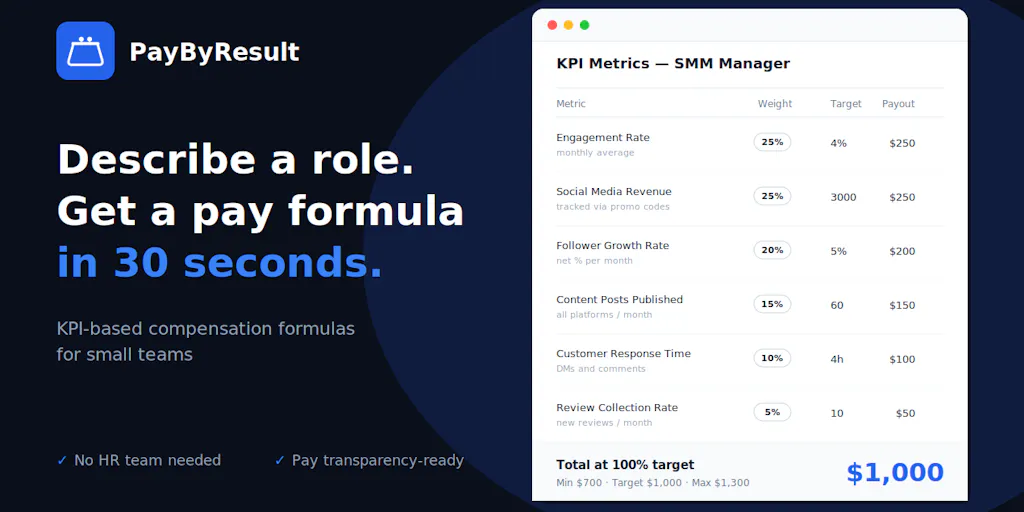
PayByResult is a web tool that generates KPI-based compensation formulas for small businesses. Users describe any role in plain language and receive a complete pay structure—including performance metrics, weightings, scenarios, and salary calculation logic—within 30 seconds. The product is explicitly designed for owners of retail stores, small agencies, service teams, and content teams who employ 1–20 people and want transparent, results-linked pay without investing in full HR software. The core feature set is minimal and focused: role description input, automatic generation of KPIs with assigned weights, multiple performance scenarios, and the underlying salary calculation logic. Every formula is delivered instantly and can be implemented immediately; no account creation is required for the first formula. The interface is intentionally simple so that non-HR specialists can obtain a practical compensation plan in under a minute. PayByResult works by prompting the user to type a short, natural-language description of the role (for example, “social media manager who grows Instagram and drives online sales”). The system then applies an AI model to translate that description into a concise set of measurable KPIs, assigns percentage weights to each KPI, outlines at least three performance tiers, and outputs the exact arithmetic that turns performance into pay. The entire pipeline runs server-side and returns a formatted formula ready for spreadsheet or payroll use. Benefits highlighted by the maker include immediate clarity for both employer and employee on what drives pay, the ability to scale earnings with results, and the elimination of lengthy Excel modeling. Use cases mentioned are sales staff on daily rate plus revenue share, store managers with fixed salary plus sales bonus, freelancers paid per completed task, and social media managers on multi-metric KPI systems. The target audience is small business owners who do not have dedicated HR teams and who need a lightweight, fast alternative to enterprise payroll platforms. Integrations and technical stack are not disclosed; the service is offered as a free first formula with no signup, implying a freemium model.