Category Focus/categories/developer-tools
Developer Tools AI Tools
Discover and compare the best developer tools AI tools and software. Browse 622+ curated tools with reviews and rankings.
Projects tracked
622
Sort mode
RECENT
Page
14
Plane Agents are AI teammates that join your Plane workspace as members. Instead of prompting a chatbot for a one-off answer, teams give an Agent a job: they assign it work items, mention it in conversations, trigger it when work changes, or run it on a schedule. Plane Agents take on repetitive, context-heavy workflows 24/7, responding to changes, coordinating next steps, and acting across Plane and the connected tools a team already uses. They triage requests, draft specs, run standups, flag delivery risks, and handle a lot more of the recurring work that keeps coming back across planning, delivery, reporting, and operations. Plane Agents are designed for the work that keeps coming back. Across planning, delivery, reporting, and operations, teams repeatedly collect progress, chase blockers, write specs, sort incoming requests, and watch for slipping timelines. That work is context-heavy: it depends on what changed, who is involved, and what the current state of a project is. Because it repeats, it is easy to let slide, and because it is context-heavy, it is expensive to do well by hand. Plane Agents take on that recurring load so the same coordination work does not have to be redone manually week after week. As Plane frames it, the work keeps coming, so put an Agent on it. Agents are built around four decisions. First, define what it owns: teams start from a template or create an Agent from scratch, giving it a name, a clear responsibility, and the outcome it should work toward. Second, give it a playbook: describe how the work should be done, what a good result looks like, and which boundaries it should follow, then add the right skills and choose the model behind it. Third, choose when it starts: an Agent can be brought into work through an assignment or a mention, or it can start automatically when work-item changes occur or on a schedule, with filters that decide exactly when it should run. Fourth, connect its working context: choose the Plane projects, trusted web sources, and connected tools the Agent can use, and decide which connected account it should work through. Plane also ships ready-made Agents for the work that keeps coming back across planning, delivery, reporting, and operations, which teams can then adapt to their own triggers and context. The Standup Agent collects progress, blockers, and next steps from the team and turns them into a concise update that highlights what matters most; it works on Slack, Gmail, and Projects, with skills in progress tracking and team summarization. The Delivery Risk Agent monitors work for stalls, blockers, dependencies, and slipping timelines so teams can identify and address delivery risks early; it works on Github, Slack, and Projects, with skills in risk detection and dependency tracking. The Spec Agent turns rough ideas and requests into structured requirements, identifies gaps, and asks the right questions to make the scope clear; it works on Figma, Wiki, and Pages, with skills in PRD writing and product clarity. The Request Triage Agent reviews incoming work, identifies duplicates, adds relevant context, and routes each request to the right team or workflow; it works on Slack, Projects, and Intake, with skills in request analysis and duplicate detection. The Customer Feedback Agent groups customer feedback into meaningful themes, surfaces recurring insights, and connects them to relevant issues, projects, or ongoing work; it works on Slack, Projects, and Wiki, with skills in feedback analysis and theme clustering. Agents show up when the work does. A team member can assign an Agent to a work item, and it receives the relevant context and starts working on the job. An Agent can be mentioned inside a work item conversation to ask for information, prepare, or take the next step. It can also be triggered from change: an Agent starts when work is created, updated, changes state, gets reassigned, or removed. Agents can connect work across tools, using selected connected tools and trusted work sources to get context. And recurring work can be put on a schedule, so reviews, reports, checks, and follow-ups run automatically on a fixed or custom schedule. In every case the Agent acts with context and returns the result in Plane. Control and visibility are part of the model rather than an afterthought. Teams set the boundaries: they choose each Agent's reach by selecting the Plane projects, trusted work sources, and connected tools available to it. They choose whose access it uses, giving connected tools access through a person's account or through a service account managed by the team. They can also see where credits go, tracking adoption, response and completion rate, average time to complete, and consumption by Agent. That means a team can see when an Agent starts, what it returns, and when it needs human input, which keeps automated work accountable and observable instead of opaque. The payoff is that recurring, context-heavy coordination stops consuming human attention. Standups become concise updates instead of a manual chase for status. Delivery risks surface early because stalls, blockers, dependencies, and slipping timelines are monitored continuously. Rough ideas turn into structured requirements with gaps identified before work begins. Incoming requests are deduplicated, enriched with context, and routed to the right team or workflow. Customer feedback is clustered into themes and connected to the issues and projects it relates to. Because Agents respond to changes and can run on schedules around the clock, they keep pace with work as it evolves rather than waiting for the next meeting to catch up. Concrete scenarios follow directly from the available Agents. A team can schedule a Standup Agent to collect progress, blockers, and next steps and publish a concise update highlighting what matters most. A Delivery Risk Agent can watch work for stalls, blockers, dependencies, and slipping timelines so a delivery lead sees risk early. A Spec Agent can take a rough request in Figma, a Wiki, or Pages and turn it into a structured spec, asking the right questions where scope is unclear. A Request Triage Agent can sit on intake and Slack, deduplicate incoming requests, add relevant context, and route each one. A Customer Feedback Agent can cluster feedback from Slack, Projects, and Wiki and connect recurring themes to existing issues and projects. More broadly, any review, report, check, or follow-up that repeats can be placed on a fixed or custom schedule. Plane Agents are aimed at teams that already run their work in Plane and want recurring coordination handled automatically. Plane states that more than 50,000 teams use the product, and the site names customers including Sony, Accenture, SSI, Texelis, Stark Bank, Aramco, Dolby, Mirador Therapeutics, Amazon, République Française, Government of Lithuania, and Power Integrations. Agents work with connected tools such as Slack, Gmail, Github, and Figma, alongside Plane Projects, Wiki, Pages, and Intake. Plane is available on the web, with downloads for Mac, Windows, iOS, and Android, and the site lists compliance with GDPR, HIPAA, ISO 27001, and SOC 2. Agents run on the AI credits included in every paid plan, and teams can get started free or book a demo. Plane Agents turn repetitive, context-heavy coordination into always-on teammate work. Rather than prompting for a one-off answer, you give an Agent a job: assign it work, mention it, trigger it when work changes, or put it on a schedule. It then acts with context across Plane and your connected tools, within boundaries and with visibility that the team controls.
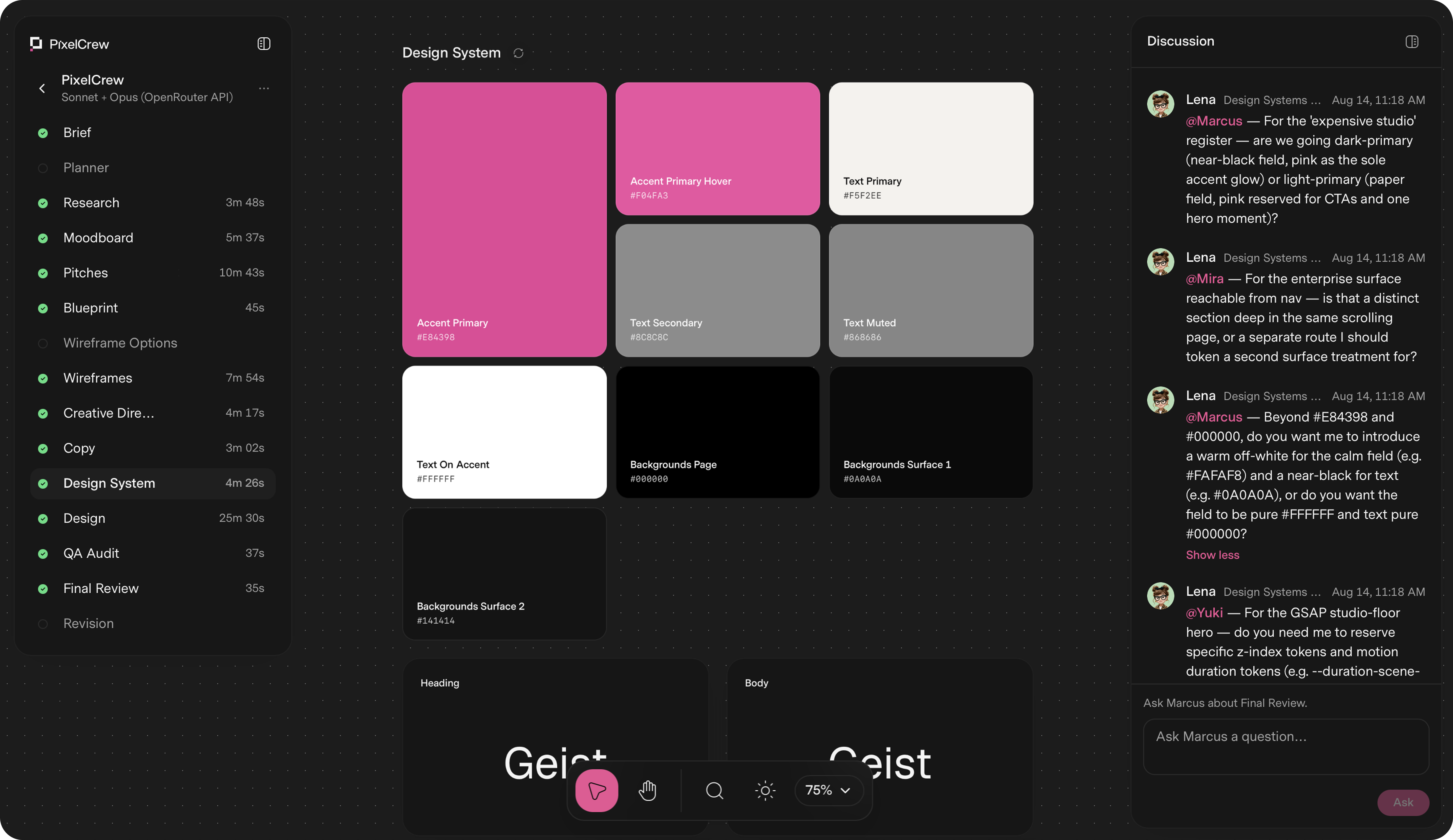
PixelCrew is a design platform built around a crew of specialized AI agents. You write a brief in free text — a landing page, a product dashboard, a design system, or a pitch deck — and the crew coordinates on it to ship production-quality design. Each agent has a named specialization, a defined scope, and a clear handoff, and together they work sequentially and with context, the way a real team does. What comes back is production-ready HTML and Tailwind, a complete design system, and the documentation your engineering team needs to ship or hand to any developer. The average delivery is 25–45 minutes. Most teams face the same trade-off: generic templates that look like everyone else's product, or bespoke design that takes weeks of studio time. PixelCrew's stated bigger picture is an internet where nothing feels generic, because bespoke costs minutes instead of weeks. Instead of prompting a single model for a one-shot page, a structured crew runs structured discovery, makes creative decisions, and builds the deliverable in a defined sequence. That means design decisions are grounded in research rather than assumptions, and every screen and edge case is resolved before anything reaches you. The crew is made up of named specialists. Elena is the Researcher and Strategy agent, and she is the first to run: she reads your brief and executes structured discovery, producing audience personas, a competitive analysis and gap mapping, jobs-to-be-done mapping, and an information architecture recommendation. She hands Marcus a validated research foundation, not assumptions, in the form of a research-brief output file. Marcus is the Director for Art Direction and runs second. He takes Elena's research and makes creative decisions about visual direction, brand language, and layout approach. He writes three distinct visual pitches, selects the strongest, and produces a full creative brief with palette, typography, layout direction, and section-by-section composition guidance, delivered as a creative brief document and moodboard. Mira is the Designer for UX Architecture and runs third. She takes Marcus's creative brief and builds the blueprint: wireframes, user flows, information architecture, and a section-by-section spec, output as wireframes.html, ux-flow.json, and a nav-spec. Every screen and every edge case is resolved, with all states resolved, and the build crew then turns that blueprint into production HTML. Because the handoffs are explicit and each agent works from the previous agent's document, the brief carries context forward instead of being reinterpreted at every step. After Mira, the build crew takes over. Copy and the design system take shape together: the crew writes the copy and assembles the design system — tokens, type scale, color, and components — so that design happens inside the system, not around it. Then every screen goes through a QA audit and a final review pass; issues get flagged, revised, and rechecked before anything reaches you. The documented final outputs include landing-page.html, design-system.json, tokens, components, and docs, alongside the research, creative brief, wireframe, copy, and QA report files generated along the way. PixelCrew's approach is best understood as a pipeline with a visible cast of agents: brief in, deliverable out. The crew runs in sequence, you provide context, the agents coordinate, and you receive production-quality output you can ship or hand to a developer. While it runs, you can watch the agents discuss decisions. The workflow is documented as seven steps: submit your brief, Elena maps the research, Marcus sets creative direction, Mira builds the wireframe, copy and the design system take shape, QA audit and final review, and finally you receive production output. That structure is what separates it from a single prompt-to-page tool: research, art direction, UX architecture, copy, design system, and QA are handled as distinct, connected stages. The benefits follow from that structure. You do not need to know how to prompt a model step by step, and you do not need a template — you describe what you need in free text and the agents read your intent. The outputs are files engineers can use directly, such as landing-page.html, design-system.json, tokens, components, and documentation, so the work can be shipped as-is or handed to any developer. Because research and creative decisions are validated and documented, and because a QA audit and review pass happen before delivery, you receive production-quality design rather than a rough draft. Concrete scenarios where PixelCrew is used come from the demonstration projects produced from written briefs. After Dark is a neighborhood coffee shop site for a business with no marketing team, briefed to feel like the room — dark, warm, unhurried — with menu, hours, and atmosphere shipped as production HTML. Modena Coupé is a luxury automotive landing page in an editorial register with full-bleed photography, serif display type, performance stats, and a request-information flow. MicroProject is a working task manager UI for small teams with list views, a project sidebar, shared lists, and overdue states, built on directly by the team. Geisha Porto is a coffee roastery and jazz listening lounge site with a product catalog including harvest data, a vinyl audio archive, and a rooftop terrace section in a Swiss editorial layout. The site notes that the business names and brands shown are illustrative and are not clients or endorsements. The stated brief types are landing pages, product dashboards, design systems, and pitch decks. PixelCrew is free while in alpha. You bring your own key: you create a key at openrouter.ai, paste it into PixelCrew once, and set your own spend limit. OpenRouter is the recommended path, and Anthropic and Google Gemini keys work too. A typical brief costs a few dollars in model usage, billed by your key provider rather than by PixelCrew, with no subscription, no markup, and no card on file. The alpha plan includes the full agent crew, unlimited briefs during alpha, HTML and Tailwind output, and support for landing pages, dashboards, and design systems. A Pro plan is coming soon with hosted keys, zero setup, no API key required, model costs included in one bill, a priority processing queue, brief history and versioning, and team seats. An Enterprise tier for teams that ship at scale is described with custom agent configuration, your design system baked in, SSO and security review, and invoice billing. PixelCrew's core value proposition is that a written brief becomes a production-quality deliverable in minutes, produced by a crew of specialized agents that research, decide, build, and review in sequence. You get production-ready HTML and Tailwind, a complete design system, and documentation you can hand to any developer, without templates, without a subscription during alpha, and without paying a markup on model usage.
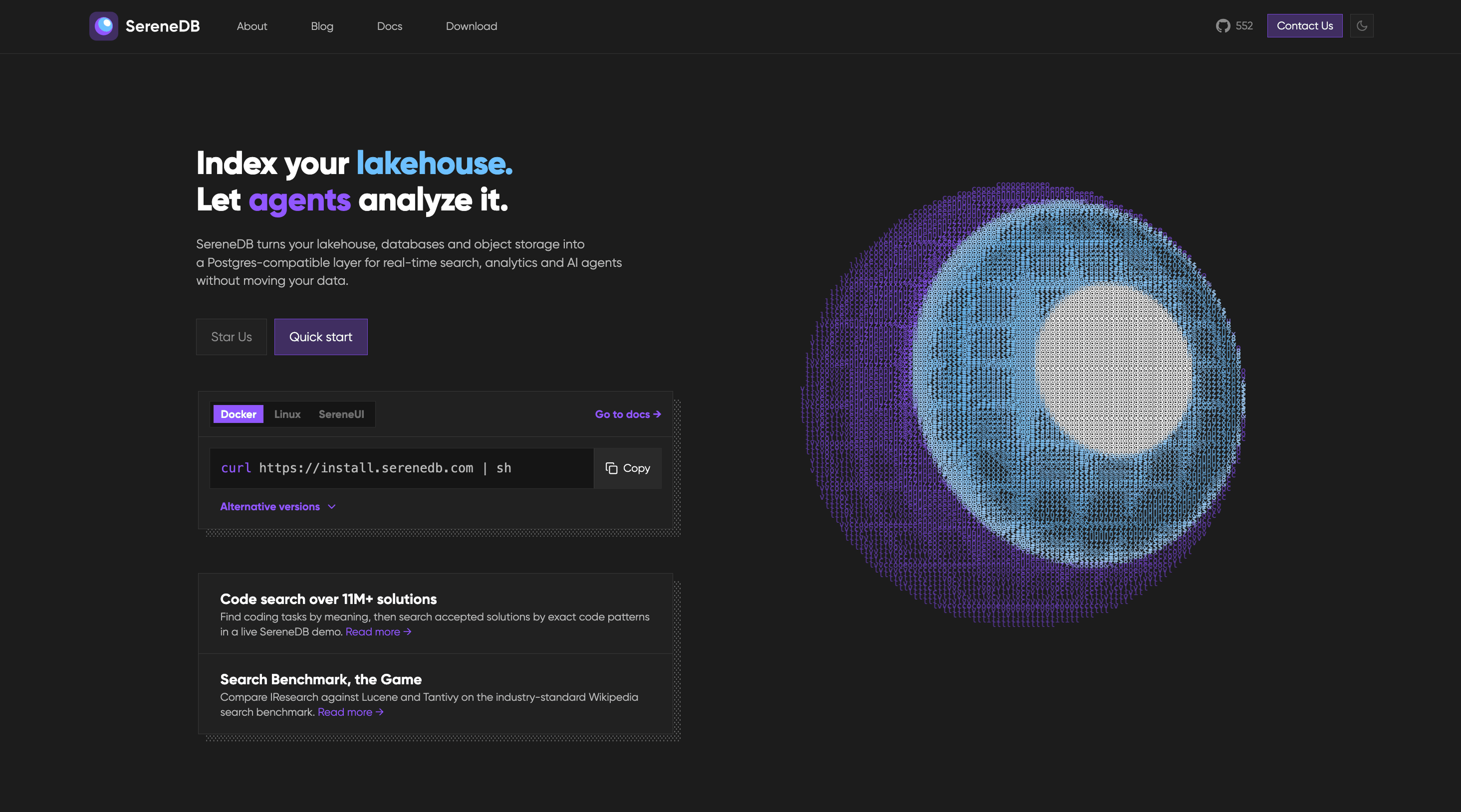
SereneDB is an open-source, real-time search analytics database that combines ultra-fast full-text search and fast analytics in a single engine. It is built for teams that need to search and analyze large volumes of data — such as logs, tables, files, and object storage — without running separate systems for search and analytics. The product offers a PostgreSQL-compatible frontend, so users can keep their existing SQL, drivers, and Elastic clients while working with full-text, vector, and hybrid search alongside relational data. According to the product's own description, it is the result of 12 years of development and is released under the Apache 2.0 license. The stated positioning is straightforward: one database that does ultra-fast full-text search and fast analytics in one engine, aimed at teams who would otherwise operate two systems. Traditionally, teams that need both search and analytics run two separate systems — for example, a search engine such as Elasticsearch alongside an analytical database such as ClickHouse — and move data between them with ETL pipelines. SereneDB's stated purpose is to remove that second system and the ETL between them by doing ultra-fast full-text search and fast analytics in one engine. The Product Hunt description says the company's public benchmark shows it outperforming Elasticsearch, ClickHouse, and Postgres search extensions, and indexing 1 billion logs in under 8 minutes at roughly 10x less disk usage. Apache 2.0 licensing, methodology, and raw results are public, so teams can evaluate those claims directly rather than taking them on faith. On the search side, SereneDB offers four related capabilities. Full-text search provides BM25 ranking over both tables and files, the classic relevance-ranking approach used for keyword search. Vector search is supported through ANN (approximate nearest neighbor) indexes that sit beside relational data, so semantic similarity lookups can live in the same database as structured records. Hybrid search combines BM25 and vector scores in a single query, letting teams blend keyword relevance and semantic similarity instead of choosing one or the other. Finally, Postgres search support means teams keep their existing drivers and their SQL rather than rewriting queries for a new search system. For analytics and data, SereneDB is designed to work on fresh data rather than overnight snapshots. Real-time analytics let users aggregate fresh data with no nightly job, which matters for dashboards and monitoring that need current numbers. As an OLAP database it performs columnar scans over billions of rows, the access pattern typical of large-scale analytical queries. Search over a data lake lets users index object storage in place instead of copying it into another system. And zero-ETL search lets queries run against remote sources where they live, further reducing the need to duplicate data or build synchronization pipelines. SereneDB also positions itself for AI and agent workloads. It is described as a database for AI agents, offering agent-ready SQL over every source, so agents can query data through SQL rather than through bespoke connectors. As a RAG database, it acts as the retrieval layer for grounded answers, supplying the context an AI application needs. Documentation search lets teams search over docs and knowledge bases, and the company's own blog describes how documentation content can be turned into tools for agents. Architecturally, SereneDB unifies search and analytics with a columnar engine, vectorized SQL execution, and hybrid storage behind a PostgreSQL-compatible frontend. That combination is what allows full-text, vector, and hybrid search to run next to analytical queries inside one engine. Compatibility is central to the approach: the database is Postgres- and Elastic-compatible, so teams keep their SQL, their drivers, and their Elastic clients. Installation is presented as straightforward — the quick-start command is a curl script — and the site lists Docker, Linux, and SereneUI as options, with documentation covering quick start, indexes, query syntax, statements, and clients. The stated benefits follow from that single-engine design. Teams can drop a second system and the ETL between it and their primary database, which simplifies the architecture and removes a class of data-synchronization problems. Because compatibility is preserved, there is no rewrite: existing SQL, drivers, and Elastic clients continue to work. The performance claims are significant — outperforming Elasticsearch, ClickHouse, and Postgres search extensions in the company's public benchmark, indexing 1 billion logs in under 8 minutes, and using roughly 10x less disk — which, if it holds for a given workload, translates into faster indexing and lower storage cost. Apache 2.0 licensing, together with public methodology and raw results, gives teams a way to verify the claims before committing. Aggregating fresh data without nightly jobs also means analytics reflect the current state rather than yesterday's snapshot. Concrete scenarios described by the product include both search workloads and analytics workloads over very large datasets. The company's published comparisons run 92 search and analytics queries over 100M, 1B, and 10B OpenTelemetry logs on a single instance, both against ClickHouse and against the Lucene world (Elasticsearch, OpenSearch, CrateDB) — clearly a log search-and-analytics scenario. Other described scenarios include building retrieval layers for RAG pipelines where an AI application needs grounded context; powering documentation and knowledge base search that can also be exposed to agents as tools; running real-time analytics on fresh data without waiting for a nightly batch job; searching over a data lake by indexing object storage in place; and querying remote data sources where they live instead of copying them first. SereneDB targets developers, data engineers, and platform teams who operate search and analytical infrastructure, as well as teams building AI agents that need SQL access to data. Integrations mentioned in the content include PostgreSQL drivers and Elastic clients, plus a documented LangChain integration for RAG. Because the database is Postgres- and Elastic-compatible, existing client libraries continue to work. The site lists Docker, Linux, and SereneUI as installation options, the quick start is a single curl command, and the documentation covers quick start, indexes, query syntax, statements, and clients. The project is open source under the Apache 2.0 license, with a public GitHub repository listed at 806 stars and public benchmarks; no commercial pricing plans are stated in the provided content. SereneDB's primary value proposition is consolidation: one database that performs ultra-fast full-text and vector search together with fast, real-time analytics behind a PostgreSQL-compatible frontend, so teams can eliminate a second system and the ETL between them. It is open source under Apache 2.0, and its benchmark methodology and raw results are public.
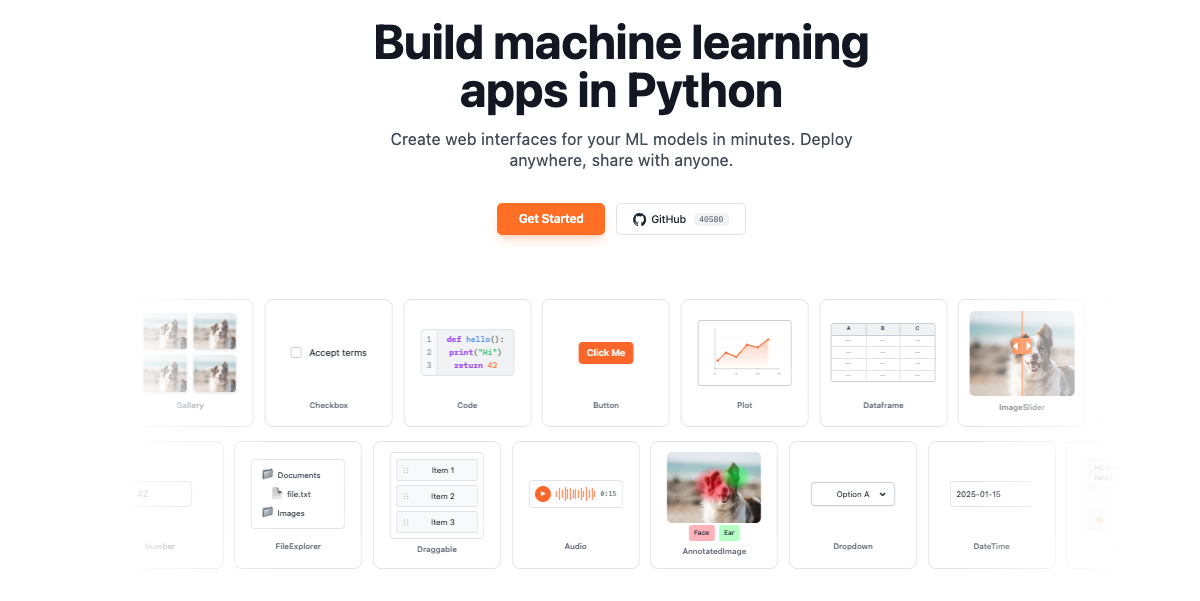
gr.Workflow is a visual, node-based AI pipeline builder built into Gradio. It lets you chain together Hugging Face Spaces, models, datasets, and your own Python functions on a drag-and-drop canvas. The simplest possible Workflow app is a single line of code: gr.Workflow().launch(). You then open the app, drag Spaces, models, and datasets from the sidebar onto the canvas, connect their ports, and hit Run. The guide describes gr.Workflow as already being a complete Gradio app that must be created at the top level and cannot be nested inside a gr.Blocks context. It is designed for people who want to assemble multi-step AI pipelines visually while keeping their own Python code available as callable nodes on the same canvas. Building an AI pipeline has traditionally meant writing glue code to move data between models and services, downloading weights, and rebuilding the entire pipeline whenever a better model appears. Gradio Workflow is presented as a way around that: pipelines are assembled from nodes on a visual canvas, intermediate inputs and outputs can be inspected, and better models can be swapped in without rebuilding the workflow. Because the nodes call hosted Spaces, models, and datasets, nothing has to be downloaded. The finished pipeline is not locked inside a private session either. It can be shared with a URL or run via a REST API, and its topology is stored in a portable workflow.json file that a coding agent can write or edit, which means workflows can also be created programmatically. On the canvas, a workflow is organized into three node collections, which the guide defines precisely. References are the inputs: uploaded files, editable text, and literal values. Operators are the processing steps: Spaces, models, datasets, and Python functions. Subjects are the outputs, the results being created. As you add, remove, or change nodes and edges, a workflow.json file is automatically created next to the Python script that created the Workflow; you can pass graph= if you want to save it somewhere else. That autosave behavior means the canvas and the file stay in sync without manual export. Node geometry is optional too: include x and y on every node to control how the graph is arranged the first time someone opens it, or leave them out and the canvas auto-arranges the layout instead. Your own Python code becomes part of the pipeline through bind=. Functions passed via bind= appear as callable nodes on the canvas, and Gradio inspects the function signature to auto-generate input and output ports. The guide gives the example of a summarize function that takes a string and returns a string; using a dictionary, for example bind={"My Summarizer": summarize}, gives the node an explicit name. Signature inference is intentionally simple. Parameters annotated as int or float become number ports, bool becomes boolean, and strings, unannotated parameters, and other annotations default to text. Gradio initially generates one output port for each bound function, and any media ports or multiple outputs must be defined explicitly in the workflow JSON. Bound functions can also be wired together in code with edges, a list of (from_fn, to_fn) tuples referring to functions in bind=, using fn_name.port_label to target a specific port when a node has multiple inputs or outputs. The guide notes that edges= only connects bound Python functions while generating a new workflow: it cannot create edges to Space, model, or dataset nodes, it is ignored when the workflow file already exists, and the file must be deleted to regenerate the initial topology. Workflows can also be loaded from disk. Passing a graph= path such as graph="workflow.json" loads a saved workflow topology; the canvas reads from that file on each page load and autosaves back to it whenever nodes or edges change, and if the file does not exist yet it is created on the first authorized edit. The guide is explicit that bind= does not automatically add or wire functions into an existing graph: to combine an existing graph with bound functions you either add the functions from the canvas Functions menu, or include an operator with "kind": "fn" whose "fn" value exactly matches a key passed through bind=. Layout remains flexible for viewers: the file's arrangement is only a starting point, each visitor is free to drag and resize cards, that arrangement is saved in the visitor's own browser rather than in the file, and workflow.json is never rewritten with it. Height is measured from the rendered card, and width is the default every viewer starts from, with a writer's resize becoming the new default the next time an edit is saved. Under the hood, the workflow JSON defines a schema_version, a name, the three node collections, and a list of edges that connect node IDs and port IDs with a stated type. Operators come in four kinds. A space node calls a Gradio Space on the Hub via gradio_client, configured with space_id and endpoint. A model node calls a Hugging Face model via InferenceClient, configured with model_id and a supported endpoint such as text_to_image, while pipeline_tag is also stored for discovery and compatibility with older graphs. A dataset node pulls one row from a Hub dataset per run, selected by the row_index input, configured with dataset_id, dataset_config, and dataset_split. An fn node calls a Python function whose fn value matches a key passed via bind=. Ports are typed so the canvas can validate connections, with support for image, audio, video, text, number, boolean, gallery, file, json, model3d, and any; any is a compatibility fallback that can connect to every port type, and file and any usually come from API schema inference rather than being offered as reference or subject templates in the canvas picker. Pipelines can also fan out: one reference can feed multiple operators simultaneously, and when you run the workflow in the interactive canvas, operators at the same dependency depth run in parallel. The guide adds that when the same workflow is invoked through its generated Gradio API, the server currently executes those branches sequentially. The benefits described in the guide follow directly from this design. Because nodes are wired on a canvas rather than buried in code, intermediate inputs and outputs can be inspected while a pipeline runs, which makes multi-step AI systems easier to debug and reason about. Because each operator is a separate node, a better model can be swapped in without rebuilding the workflow. Nothing needs to be downloaded, since the operators call hosted Spaces, models, and datasets. Shipping is flexible: share links and the ordinary local URL are run-only, while launch() also prints a private write-access URL for editing and saving the workflow, which the guide advises keeping private because edits affect the workflow seen by every visitor. Finally, the workflow.json file is both an autosave artifact and a programmable surface, so the same topology can be authored by hand, by a coding agent, or by bind= and edges= declarations in Python. The guide's fan-out example is a concrete, described workflow: a single product photo reference is fed into four FLUX Kontext branches, showing how one input can drive multiple image transforms at once. Text pipelines are demonstrated in the edges example, where a clean function that strips and lowercases text is wired into a tag function that prefixes the processed text. Model nodes such as black-forest-labs/FLUX.1-schnell with the text_to_image endpoint illustrate text-to-image generation inside a workflow, while dataset nodes make it possible to run a pipeline over a specific row of a Hub dataset, controlled by row_index. Because the same app can be shared with a URL or invoked through a generated Gradio API, the guide frames Workflows both as an interactive canvas for building and inspecting a pipeline and as a deployable app that others can run without editing it. The product is aimed at people building AI pipelines in Python: the guide's code samples are Python throughout, and the canvas is an extension of the Gradio app that the function nodes live in. Integrations called out in the content are the Hugging Face ecosystem, including Spaces on the Hub through gradio_client, models through InferenceClient, and Hub datasets, together with your own Python functions and the generated Gradio API. The relevant technology stack therefore includes Python, Gradio itself, gradio_client, InferenceClient, and REST access to the running app. The guide positions gr.Workflow as part of Gradio's Additional Features, sitting alongside the library's other tutorials and guides, and it must be created at the top level as its own app. No pricing or plan details are stated in the material reviewed here. In short, gr.Workflow brings a visual, node-based editing experience to AI pipelines without taking developers out of Python. You drag Spaces, models, datasets, and your own functions onto a canvas, connect typed ports, and run the result as a Gradio app that can be shared with a URL or called through a REST API. The topology is portable in workflow.json, editable by hand or by a coding agent, and free of downloads because the heavy lifting happens on hosted Hugging Face resources. The primary value proposition is straightforward: build, inspect, and iterate on multi-step AI pipelines visually, and swap in better models without rebuilding the workflow.
slop-grader is a rule-based command line tool that evaluates documents against custom rulesets and produces document scores and line-by-line flags to guide auto-fixing with an AI agent. It is built for anyone who writes, edits, or reviews text and wants that work checked against an explicit, repeatable standard rather than a vague impression. The tool is open source, runs locally in a terminal, and is designed around the idea that you curate a ruleset for your own use case and then reuse it as a powerful way to grade text consistently. Rather than rewriting a document for you, slop-grader grades it, tells you which lines failed which rules, and hands off instructions that an AI agent can act on to produce sharper copy. The context behind slop-grader is the flood of AI-generated writing. Text produced quickly by large language models tends to be padded with filler, stacked with buzzwords, and vague about what it actually promises. Reviewing that text by hand is slow, subjective, and inconsistent: two readers can disagree about whether the same paragraph is clear, and nobody notices a slow drift in tone across a long document until a reader finally complains. slop-grader takes a different position by making each check explicit. Instead of asking whether a document reads well, you express what you care about as a rule, and the tool answers that rule for every line it reviews. The result is a score plus a list of specific lines that need attention, which makes the standard applied to a document visible and repeatable. The heart of the product is the ruleset. Rules are written in plain language and can be anything you are able to phrase as a question. Some rules are evaluated line by line, such as "Does this line make a promise that requires a legal disclaimer?" Others are evaluated across the entire document, such as "Does the opening earn the reader's next 30 seconds?" That flexibility means the same tool can cover very different jobs: SEO checks on a page, legal clause review, tone of address, or keeping a formal or informal register consistent. A concrete example given by the maker is German address: keeping "Du" versus "Sie" consistent throughout a document. Because rules are yours to define, words that are buzzwords in one industry but completely normal in another are handled by simply writing the rule that fits your use case. slop-grader also ships with built-in rules, so you do not have to start from nothing. The included checks cover English grammar, German grammar, and AI filler detection. The maker notes that once you have built a curated ruleset for your use case, the tool becomes very powerful, and there is a built-in skill in the repository for creating custom rules, published as a SKILL markdown file on GitHub. That skill is intended to help you author the plain-language rules your workflow needs, whether they concern promises and disclaimers, openings that hold attention, SEO conditions, legal clauses, or tone of address. The output format is deliberately practical. slop-grader produces document scores and a list of flagged lines together with instructions that you can paste directly into an AI agent to fix the document. The tool flags its outputs as prompts so that agents can draft the fixes. This matters because a line-level flag makes it much easier to see exactly what needs fixing instead of rewriting an entire document from scratch. One product detail worth knowing is that when a rule fires on a line, the tool does not explain why it thinks the rule was violated. The maker's suggested workaround is to create separate rules for each check; the AI agent receiving the output is then very good at inferring the underlying problem from the flagged lines. Under the hood, slop-grader runs on Jev, available at typesafe.ai, which is described as a new AI model that is different from an LLM. Jev is a so-called System One model specialized in answering structured questions. That specialization is what makes the rule-by-rule approach practical: every rule is matched against every line separately, and because of the model's design that evaluation stays both cheap and fast. Checking a document takes seconds and costs less than a cent. Because evaluation happens on a remote model, the maker notes that text is evaluated on an external AI server, which is a relevant consideration when you decide what to run through the tool. The practical benefits follow directly from that design. Grading is consistent because the same rules are applied to every document and every line, so the standard does not drift between reviewers or between sessions. Feedback is precise because it arrives as flagged lines rather than a general verdict, which narrows the editing work to the specific places that broke a rule. The pipeline is fast and inexpensive enough that running a full check on a document takes seconds and costs less than a cent, so it can be part of a regular workflow rather than an occasional deep review. And because the output is written as instructions for an agent, the handoff from "this line is wrong" to "here is a sharper version" is automated rather than manual. Day-to-day, the maker describes using slop-grader to catch AI filler in launch copy, to strip buzzwords from landing pages, and to score narrative flow in launch emails. Those examples show the range: launch copy is checked for filler, landing pages are checked for buzzword density, and launch emails are graded on whether the narrative flows. Beyond those, the ruleset model supports SEO checks on content, review of legal clauses and disclaimers, and tone-of-address enforcement such as keeping German "Du" versus "Sie" consistent across a document. In each case the workflow is the same: run the document through your ruleset, read the score and the flagged lines, then paste the flagged output and instructions into an AI agent so it can draft the fixes. Getting started has a few stated requirements. You need Node.js installed on your machine, and you need an account with either TypeSafe or OpenRouter, since the evaluation runs on Jev. The tool is open source and is distributed as a CLI, and it is listed as free. The project lives on GitHub, and the maker has also published a skill for creating custom rules in the repository. It was launched on Product Hunt and is categorized as a command line tool, with topics covering writing, advertising, artificial intelligence, and GitHub. Text is evaluated on an external AI server, which users should factor into what documents they submit. The takeaway is that slop-grader reframes text review as a linting problem for prose. By turning what you care about into plain-language questions, evaluating them line by line and document-wide with a fast, low-cost structured-question model, and emitting flagged lines alongside agent-ready instructions, it replaces subjective rewriting with a score, a precise list of problem lines, and a clear path to an automated fix.
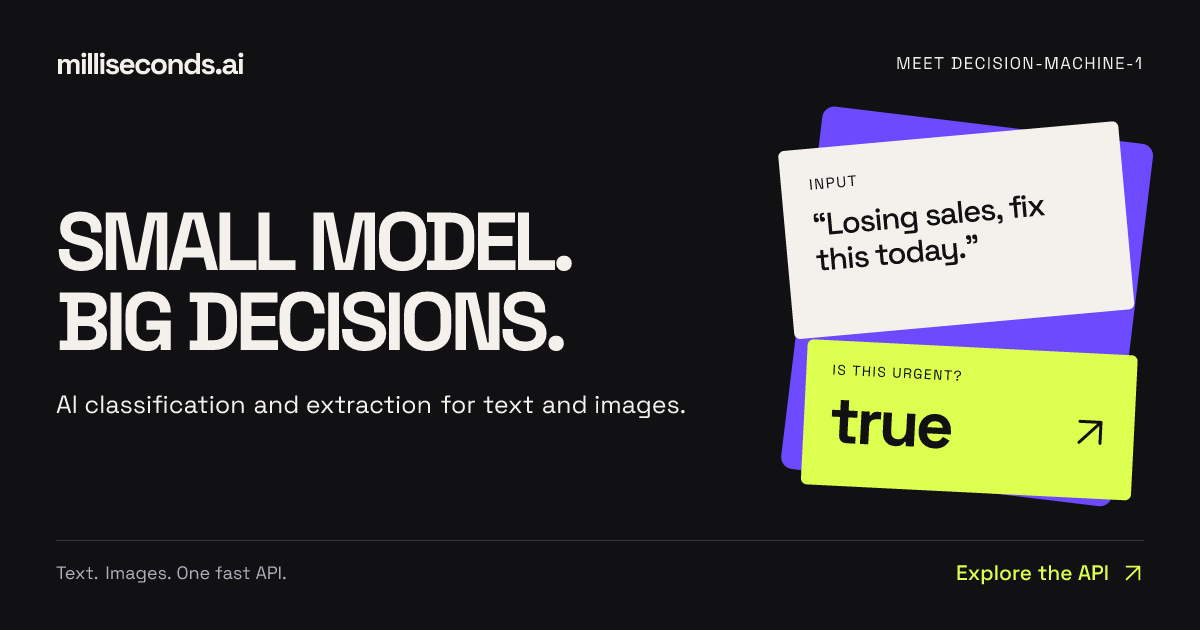
Milliseconds.ai is an API that turns text and images into decisions. You send text or an image, and the platform returns labels, fields, scores, or yes/no answers as structured data. The product is built around a small model the team calls decision-machine-1, and it is designed specifically for the parts of an application that need an answer rather than a conversation. The company describes the service as delivering "AI decisions, classification and extraction via a simple API." It is available through REST endpoints, SDKs, and a CLI, so developers can call it from TypeScript, Python, or the terminal and receive typed responses. Typical jobs described on the site include routing emails, reading invoice fields, and checking returns against a policy, as well as more playful applications such as building a hot-dog identification empire. The landing page frames the product with the line "Small model. Big decisions." and the supporting idea "Enough words. Try it, stat!" — the emphasis being on delivering the decision itself rather than a long piece of generated prose. The problem Milliseconds.ai addresses is the gap between general language models and the small, concrete decisions applications need to make on every request. The website contrasts a typical verbose model reply — "Certainly! Let's delve into a comprehensive overview of this invoice and its many fascinating details…" — with what a system actually needs: just the fields, invoice number, vendor, total, and currency, ready for the next step. The product exists for "the parts of your app that need an answer," where the goal is not open-ended conversation but a label, a score, a boolean, or a set of validated fields. The framing "Less blah. More done." captures this directly: instead of parsing free-form text after the fact, an application can receive structured data it can immediately act on. This matters because routing, prioritization, validation, and record writing all depend on machine-readable outputs rather than paragraphs of explanation. The site summarizes this as "Very small decisions. Very real work." The platform exposes a set of purpose-built decision endpoints. The yes/no endpoint answers a boolean question about a piece of text — for example, flagging messages that need a faster response — and returns both the boolean answer and a probability of urgency, so an application can raise a ticket's priority. The classify endpoint assigns a label from a set of choices: given support queues, it can return a label such as "billing" along with a probability (0.74 in the recorded example) and a confidence value, plus scores for the other candidate labels such as shipping, technical, and other. The rate endpoint turns subjective input like customer frustration into a sortable score on a defined scale; the example returns a reported score of 1.998 on a 0–3 scale, a level, a confidence figure, and per-level scores across calm, annoyed, angry, and furious. The answer endpoint locates a specific span of text in response to a question — for example, finding the shipment destination in a status update — and returns the answer text together with a probability and start and end source offsets, so an application can show where the answer came from. Extraction and entity recognition form a second group of capabilities. The extract endpoint maps unstructured text to the fields in your records. In the recorded invoice example, it returns a structured object with invoice_number, vendor, total, and currency — four fields described as ready for validation before writing a record. The entities endpoint identifies people, organizations, and references in a document; the claim-note example returns four typed entities (a person name, an organization, a claim id, and a date), each with a type, the matched text, and a probability score, described on the site as "typed values for search and record matching." Together these endpoints cover two of the most common document-intake needs: pulling out defined fields, and recognizing the named things inside free text. A third capability is verification. The verify endpoint checks a proposed value against source text. In the documented example it compares a proposed deductible against policy text and returns matches: false with a probability of 0.00, because the source says $500 while the proposed value is $1,000, and it returns the found value ["$500"]. This lets a workflow confirm that a value is actually supported by the source document before it is accepted — the kind of check required in insurance or finance processes where an extracted number must be traceable back to the text it came from. Overall, the product follows a simple INPUT → DECISION → ACTION model. Text or an image goes in; the model produces a decision in the form of a label, a score, a boolean, a text span, a set of fields, or a list of entities; the application then acts on that structured output. Every response is designed to be consumed by code: boolean answers with probabilities, labels with probability and confidence, scores with per-level breakdowns, answers with source offsets, extracted fields as key-value data, and entities with type, text, and probability. The site notes that uncertainty is surfaced rather than hidden — for instance, "nearly tied levels signal uncertainty," so a queue-ranking system can keep that ambiguity visible. Developers integrate through REST endpoints, TypeScript or Python SDKs, or the CLI and receive typed responses. There is also a path for coding agents: installing skills that teach an agent which API to call and how to evaluate results. The benefits described on the site centre on speed, structure, and cost. Because the model is small and purpose-built, responses arrive as data rather than prose, removing the parsing step between a model call and an application action. Because outputs are structured and include probabilities and confidence, applications can make ranking, routing, and validation decisions with a stated level of certainty. Cost is a headline benefit: production usage is priced at $0.04 per million input tokens, with no charge for output tokens, and free test keys include 125M free input tokens per month with no card required. The website frames the economics as "Big ideas. Small bill." and repeats the free allowance as "Free free free — yours to build with." The site presents several concrete scenarios. Support triage combines the pieces: "A label selects the queue. A score sets priority. A boolean flags urgency." Document intake works as a pipeline: "Extract fields, check values against the source, then validate before writing a record." In the Invoice Desk demo, invoice text is turned into a vendor, invoice number, and total, which are then compared with the purchase order so a team can see what needs attention — the example record matches PO-208. In the Sales Intake demo, an inbound message is separated from support tickets and vendor pitches, given a suggested destination of Sales because it is a demo request with budget stated and a near-term start, and the budget, timing, and need are surfaced for follow-up. In the Private Share demo, names and emails are found in a transcript so personal details can be redacted while the bug report stays useful — detected details are reviewed before sharing, with a toggle between the original and the redacted version. Other stated examples include checking returns against a policy, routing emails, and identifying hot dogs. Milliseconds.ai is aimed at developers and teams building applications that need classification, extraction, and decisions at the point of request — the people who would otherwise wire a general-purpose model into a workflow and then parse its output. The website addresses them directly: "You bring the idea. Build something fast." Integration options explicitly named are the REST API, the TypeScript SDK, the Python SDK, the CLI, and skills for coding agents. Pricing is split between a free tier of 125M free input tokens per month on test keys with no card required, and production at $0.04 per million input tokens with output tokens free. Demos let visitors try working apps and inspect their results, token usage, and inference cost, and visitors can try requests on the site without an API key. In summary, Milliseconds.ai takes the small, repetitive decisions that applications make — is this urgent, which queue does this belong to, how frustrated is this customer, where is the shipment going, what are the invoice fields, who and what are mentioned here, does this value match the source — and returns them as structured, probability-bearing data through one fast API. The combination of a small purpose-built model, typed structured outputs, built-in verification, coding-agent skills, and a free tier with inexpensive production pricing is what the product offers to teams that need answers rather than conversation.
Cronhq is a distributed cron scheduler that fires webhooks on a schedule. You point Cronhq at a webhook URL, and it calls it at the times you define, retries it when it fails, and pages you when something breaks — and again the moment it recovers. It is designed for developers and engineering teams who need scheduled tasks to run exactly once, even when more than one server or worker is running the same schedule. Rather than maintaining crontab entries by hand across machines, you create a job through the API or the dashboard, and Cronhq takes care of execution, retries, logging, and alerting. The product's own promise is simple and direct: cron jobs that actually run. The problem Cronhq addresses is that cron jobs fail in silence. If two servers run the same crontab, the same billing job can fire twice, which means duplicate charges or duplicate records. If a job dies, nobody notices for weeks, because a missing run produces no error message, no alert, and no trace — there is simply nothing to see. Standard crontabs provide no coordination between workers that could prevent double execution, no retry logic, no durable execution history, and no alerting when a run stops happening. Teams are left to write their own locking, their own backoff, and their own monitoring, or to accept that some scheduled work will quietly stop running. Cronhq is built around one guarantee — exactly-once execution, enforced by Postgres locks rather than best-effort behavior — and then wraps the surrounding operational needs, such as retries, signed webhook delivery, heartbeat monitoring, and deduplicated alerts, into the same system. Cronhq's first capability area covers the integrity and observability of the calls it makes. Every request Cronhq sends carries an X-Cronhq-Signature header, computed as an HMAC-SHA256 over timestamp.body, along with an X-Cronhq-Timestamp header. Each job gets its own secret, and you can rotate that secret at any time with no downtime, so a leaked key does not force you to tear down and recreate the job. On the receiving end, this lets you verify that a scheduled call genuinely came from Cronhq before acting on it, which matters for anything that touches money, data, or infrastructure. Running alongside that is the heartbeat monitor: you ping a URL on every run, and if the expected window — the period plus a grace interval — is missed, Cronhq flips the monitor to DOWN and pages you once. Cronhq describes this as cron's inverse: proof of absence rather than proof of presence. The second capability group is about managing schedules as part of your codebase rather than as clicks in a UI. The Cronhq CLI installs with npm i -g cronhq, or runs directly with npx cronhq --help. Running npx cronhq sync reconciles a cronhq.yaml file in your repository — it creates, updates, and prunes jobs so your schedules live in version control and move through review like any other change. Running npx cronhq tail live-streams executions straight to your terminal, so you can watch a job's output without leaving your editor or shell. Inside the dashboard, a ⌘K command palette lets you type schedules in plain English: writing "every weekday at 9am" returns the valid cron expression 0 9 * * 1-5, with a plain-English preview so you can confirm the schedule is right before saving it. The third group covers what happens after a run fails. Retries are built in with backoff, configured as a max retry count and delay per job, so a transient failure gets a few more attempts at increasing intervals instead of being written off immediately. The terminal status and the last error always land in the job's history, which means the postmortem writes itself. Every execution is logged with its status, duration, HTTP code, and response body, newest first, searchable, and retained — the job's history belongs to you and stays available. Alerts are deduplicated to avoid noise: a failure alert fires on the third bad run in an hour, not on the first, and the recovery alert fires on the first success after a streak. That is a deliberate design choice illustrated in Cronhq's own diagrams, where repeated failures after an alert stay silent, and a recovery message such as "nightly-rollup recovered after 3 failures. Last 6 runs: all 2xx." closes the loop. Alerts can be wired to email or Slack. The mechanism behind Cronhq's central guarantee is a Postgres lock. Two workers can never fire the same scheduled execution: each run is claimed through a database lock before it proceeds, so a duplicate worker simply loses the race and does nothing. If a worker crashes mid-job, the lock expires and another worker picks the execution up. This is what makes the exactly-once claim structural rather than aspirational — the coordination lives in the database that both workers already trust, not in a best-effort in-memory flag. Around that core, Cronhq schedules, delivers, retries, records, and alerts, and the whole system is built in Rust on Postgres. It is MIT-licensed and self-hostable, running the same image Cronhq runs in production. For teams that rely on scheduled work, the outcome is that jobs stop disappearing without anyone noticing. Duplicate executions from racing workers are eliminated by the lock-based claim, so a nightly billing job fires once instead of twice. Transient failures are absorbed by retries with backoff, while permanent failures surface in a searchable execution history complete with HTTP codes and response bodies. Alerting is deliberately quiet: one page on the third failure in an hour and one on recovery, so the signal is that something is actually wrong rather than that a single run flaked. Heartbeat monitors extend the same coverage to jobs Cronhq does not run itself, turning a silent absence into a page. And because schedules can live in a cronhq.yaml file and reconcile through the CLI, they become reviewable artifacts in the repository rather than configuration that only exists in a dashboard. Scheduled webhooks are the core workflow: a nightly rollup job, a nightly digest, a metrics refresh, a queue drain, a cache warm, a cleanup job, or a health poll, each configured with a name, a cron schedule, a webhook URL, and a timezone such as America/New_York. Jobs that run elsewhere — on your own infrastructure or another provider — can still be covered by pointing a heartbeat monitor at an endpoint you ping on every run, so if the ping window is missed, you are paged. Teams that want their schedules under version control use npx cronhq sync against a cronhq.yaml file, and teams that prefer watching from a terminal use npx cronhq tail to live-stream executions. Anyone who needs to sanity-check a schedule quickly can type the schedule in English into the ⌘K command palette and get the cron expression back with a plain-English preview. Cronhq is aimed at developers, engineering teams, and anyone running scheduled work in a distributed system, and it is listed among Developer Tools, Open Source, SaaS, and GitHub topics. Delivery is by webhook, so it integrates with any HTTP endpoint, including your own API; alerts go to email or Slack. The stack is Rust on Postgres. Cronhq is MIT-licensed and self-hostable using the same image the hosted service runs, and it offers a free tier covering 5 jobs. Getting started takes four steps on one screen: sign up with an email to receive a one-time link that mints a 36-character API key starting with chq_, create a job with a schedule and URL, watch executions arrive in the log, and wire up email or Slack alerts. In short, Cronhq exists to make one promise true: cron jobs that actually run. It enforces exactly-once execution with Postgres locks, retries failures with backoff, signs every webhook with HMAC-SHA256, monitors jobs it does not run via heartbeat pings, and alerts once on failure and once on recovery. Built in Rust on Postgres, MIT-licensed and self-hostable, with a free tier of 5 jobs, it gives teams a scheduler that treats reliability as the starting point rather than an afterthought.
Jev is a frontier model from TypeSafe AI's System One family that takes unstructured state as input and returns typed probabilistic decisions as output. Instead of generating text the way a conventional language model does, Jev answers with Choice, Score, and Noul results that carry calibrated probabilities your code can act on directly. That makes it a decision engine rather than a writing engine: the output is meant to be consumed by a program, not read by a person. The product is positioned for software automation, and it is described as being available to everyone at console.typesafe.ai with no waitlist. The problem Jev addresses is the mismatch between text generation and software decision-making. When an application needs an answer inside a code path, a generated paragraph of prose is not directly usable: something has to read it, interpret it, and convert it into something a program can branch on. That interpretation layer adds latency, cost, and ambiguity. Jev sidesteps it by returning typed answers and calibrated probabilities instead of text, so the result arrives in a shape that software can consume immediately. For teams already running comparable LLM workflows, the described gains are considerable: roughly 20-200x faster responses and 40-400x lower cost, with output tokens free. That combination matters most where decisions have to happen repeatedly, at volume, and inside automated systems where waiting on a text response is impractical. The core output formats named in the product description are Choice, Score, and Noul answers. These are the typed conclusions Jev returns in place of prose. A Choice answer is one of the explicitly named result types; a Score answer is another; and a Noul answer is the third. Because these results arrive as types rather than free-form sentences, the calling code does not have to guess at structure or parse language before it can use the result. This is the central design idea behind the product: the model's answer is already in a format that software automation can act on, so the integration between model and program is direct rather than mediated by an interpretation step. Alongside the typed answers, Jev returns calibrated probabilities. Calibration is what makes a probabilistic result useful in code: the probability attached to an answer is meant to reflect how likely that answer actually is, so a caller can use the probability rather than treating every model output as equally trustworthy. The description emphasises that these are probabilities your code can act on, which puts the decision about thresholds and behaviour in the application's hands. Instead of asking a language model a question and hoping the phrasing is stable enough to parse, a system can receive a typed answer with a probability attached and handle it programmatically as part of its normal logic. Performance comes from parallel sampling, the mechanism the description credits for Jev's response times of roughly 70-500ms. That latency band is the practical difference between a decision that can sit inside an interactive or high-throughput workflow and one that cannot. The same description quantifies the comparison against comparable LLM workflows: about 20-200x faster and 40-400x cheaper, with output tokens free. Those figures describe a different operating regime for the same class of decision task. Workloads that were previously constrained by per-call latency or per-token cost can be run more often, in more places, and closer to the moment the decision is actually needed. Overall, Jev's approach can be summarised as unstructured state in, typed probabilistic decisions out. It is a System One frontier model from TypeSafe AI, and the interface it offers is deliberately narrower than general text generation: it produces conclusions rather than commentary. That narrower contract is what allows the surrounding software to treat Jev as a component rather than a conversational partner. The model absorbs messy, unstructured input state and resolves it into one of the named answer forms, carrying a calibrated probability, delivered quickly enough and cheaply enough to be embedded in automated decision loops. The benefits described for users follow directly from those design choices. Speed means decisions can be made inside time-sensitive paths. Lower cost per decision means automation can be applied more broadly without the economics breaking down. Free output tokens remove a line item that scales with usage. Typed outputs with calibrated probabilities reduce the engineering work of interpreting model responses and make it practical to wire a decision directly into application logic. And availability without a waitlist means a team can evaluate the model by going to console.typesafe.ai and signing in rather than joining a queue. The use cases that follow from the description centre on software automation. Any workflow where a program needs to reach a decision from unstructured state and then act on that decision is a candidate: the caller supplies the state, Jev returns a typed Choice, Score, or Noul answer with a calibrated probability, and the surrounding code responds. The stated comparison class is comparable LLM workflows, which suggests the intended fit is where teams currently route decisions through a text-generating model and then interpret the output. Where a decision has to be made repeatedly at volume, the described latency and cost profile makes Jev a practical alternative to that pattern. Access is through the console at console.typesafe.ai, which is the official website for the product. The console supports signing in with Google, or alternatively requesting an email code instead of using a Google account, and continued use is governed by TypeSafe AI's terms of use and privacy policy. The target users are developers and engineering teams building software automation that depends on structured, probabilistic decisions rather than generated text. No pricing plan details, technology stack, or third-party integrations are stated in the available content. In summary, Jev is best understood as a decision model rather than a text model. It takes unstructured state and returns typed Choice, Score, and Noul answers with calibrated probabilities, uses parallel sampling to deliver responses in roughly 70-500ms, and is described as about 20-200x faster and 40-400x cheaper than comparable LLM workflows, with output tokens free. For software automation that needs decisions in a form code can act on, that combination of structure, calibration, speed, and cost is the primary value proposition.
Termphin is an SSH client for phones whose central promise is simple: never lose an SSH session again. Your shell stays alive on the server through locked screens and network drops, so instead of watching a connection die you reconnect and pick up right where you left off. Around that idea it bundles a full remote-work toolbox — an integrated SFTP client with a syntax-highlighted editor and remote image previews, an SSH key manager, a snippet runner, port forwarding, ProxyJump bastion chains and multi-tab sessions — plus a terminal renderer that draws htop, vim and other full-screen programs cleanly. It is built for people who manage remote servers from a phone, including those who run long AI coding agents such as Claude Code, Codex and OpenCode, and it is free with no ads and no in-app purchases. The problem Termphin addresses is structural to mobile SSH. When an app is suspended — the screen locks, the phone goes in a pocket, signal is lost, or you switch from Wi-Fi to mobile data — the connection drops, and with it the remote shell and anything running inside it. A deploy three quarters of the way through, a database migration, a build, a long-running task started by an AI coding agent: all of it dies with the socket. Because most clients run the terminal entirely inside the app, being scheduled out of the foreground is enough to kill the session. On top of that, full-screen terminal programs frequently render badly on mobile clients, showing broken box characters, mangled spinners and unreadable diff views, which makes tools like htop and vim impractical to use. Termphin attacks both problems at once: the shell lives on the server rather than in the app, and the renderer is written to draw terminal output properly. The core mechanism is a lightweight server helper. Termphin describes a tiny open-source Rust agent that runs on the server and holds the remote shell open. The shell runs on the server, not in the app — that is the phrasing the site uses to describe the approach — so even if you lock your phone or lose signal, your jobs keep running. When you come back, the agent reattaches you to the same screen instead of leaving you at a fresh prompt. Termphin also maintains the connection while the app is backgrounded or locked, and if the connection does drop or you switch networks, the agent keeps the remote shell alive and reattaches you seamlessly on reconnect. For basic sessions, shell detection is automatic and no helper is required. Rendering is handled directly by Flutter rather than in a web view, which the site presents as the reason htop, vim and other TUIs render without broken box characters. Spinners, progress bars and diff views render cleanly without mangled characters — the detail that makes AI agent output readable on a small screen. Appearance is configurable too: Termphin ships with 14 color schemes and lets you fine-tune font size, line height and padding against a live terminal preview, so you can size text comfortably for a phone screen without guessing. The toolbox covers the everyday work around a shell. Integrated SFTP puts a complete file client beside the terminal: browse remote files, edit them in a syntax-highlighted editor, preview images one tab away, and transfer files with resumable transfers. One-tap SFTP upload lets you upload a file from your phone and paste its remote server path straight into your prompt. Snippets let you save recurring commands once and trigger them instantly across your infrastructure, through a search-and-run palette, execution history with exit codes, and a customizable action dock. Machines are organized by saving host, user and credentials once, then tagging, searching and connecting in one tap, with fast search and tags, ProxyJump bastion chains and multi-tab concurrent sessions. SSH tunnels let you open local and remote port forwards per session or save them with profiles. Security is built around a device-bound key vault. SSH keys and profiles are sealed with AES-256-GCM on your phone and protected behind your phone's PIN or fingerprint. You can generate ed25519 and RSA keys, lock the app with biometric PIN and fingerprint, and use host key pinning on connect. Connections go directly to your server with host key verification, and the only data ever sent is opt-in anonymous crash analytics. Interactive keyboard prompts for two-factor authentication codes (TOTP) and PAM passwords are fully supported. Overall the product works as a split between phone and server. The client handles presentation, configuration and local secrets; the server-side agent handles continuity. That division is what makes reattachment possible: when the app is suspended the remote shell simply keeps running under the agent, and returning to the app is a reattach rather than a new login. The benefits follow from that design. Long jobs finish even when the phone is locked, so you can start something and pocket the phone instead of babysitting a progress bar. Sessions resume on the same screen, which preserves scrollback, running processes and the state of an interactive program. Clean TUI rendering means command-line tools that assume a real terminal are actually usable from a phone. And because keys and profiles live in an encrypted, biometric-gated vault on the device, that convenience does not come at the cost of exposing credentials. It is free — no ads, no in-app purchases. Concrete scenarios the content describes include starting a 10-minute Claude Code or OpenCode task and pocketing your phone while the agent runs on your server and the session never aborts; running deploys, image builds, registry pushes and database migrations where the output stream matters and the process must not be interrupted; reaching a server behind a bastion by pointing a profile at a jump host so traffic remains encrypted end-to-end between the phone and the target server; uploading a file from the phone over SFTP and pasting its remote path into a prompt; running saved snippets across infrastructure from a search-and-run palette; and using full-screen tools like htop and vim on a phone with correct character rendering. Termphin runs on Android and is available on Google Play. The download section states that Termphin is free to use, with no ads and no in-app purchases. It works with any server reachable over standard SSH — Linux, macOS, BSD and Windows — with automatic shell detection. Both the terminal renderer (terminal_view) and the server helper (termphin-agent) are open source on GitHub, and an engineering blog documents how it is built and why, covering topics such as SFTP throughput and why SSH sessions die when the screen locks. The takeaway is that Termphin reframes mobile SSH around continuity rather than connectivity: the shell belongs on the server, the phone is just a window onto it, and a small open-source agent keeps that window's contents alive. Combined with a proper TUI renderer, an SFTP client, snippets, tunnels and a device-bound key vault, it turns a phone into something you can genuinely run long remote work from — and it does so for free.
Harbor is a private notes app and second brain built as a genuine Evernote alternative: one place to capture notes, documents, scans, and recordings, keep them searchable, and own them for life. It is aimed at anyone who wants a single private home for everything they capture, on every device they use. Harbor describes itself as "Anchored • Private • Yours," and the product is organised around three ideas — save anything in any form, find anything even inside your files, and decide what stays private with optional zero-knowledge encryption. Everything you save syncs the moment you save it, across every device you own. Harbor is positioned as a direct response to a broken promise. In its own words, "Evernote promised to be your second brain. Then it broke the promise." Prices doubled, the free plan was gutted, the app got slow, and data got harder to leave with. Harbor picks up the original idea — one private place for everything, forever — and commits to it in writing. That commitment shows up as promises on the page: no price increase for three years, then capped at 10% a year, and a policy of never holding your data hostage, so that if you stop paying your account goes read-only and you can still export and delete everything. Capture is the first pillar. Harbor lets you save anything, in any form: notes, scans, photos, audio, handwriting, and web clips. The content illustrates this with a couple sorting mail and scanning documents together at a sunlit table, with the scanned document then captured and saved in Harbor. The point is that whether what you want to keep arrives as a typed note, a photographed page, a scanned PDF, a recording, or a handwritten sheet, Harbor gives it a home. Because capture lives in the same place as everything else, you are not scattering memories across separate apps for scanning, recording, and writing. Find is the second pillar, and it is what makes that captured material useful. Harbor reads the words inside your photos, scanned PDFs, and even your handwriting, so a two-word search surfaces the exact page. Your recordings become searchable transcripts, too. The page shows a worked example: searching the word "receipt" returns seven results, including a Monroe County business tax receipt stored as county_tax_receipt_2026.pdf and an OCR-indexed F-250 brake job scan stored as f250_brake_invoice_2023.pdf. That means the search box reaches material that would normally be invisible — text baked into images, invoices, and scanned paperwork — instead of stopping at filenames and typed titles. Privacy is the third pillar. Harbor lets you decide what is private. You can turn on zero-knowledge encryption for any note or notebook, and only you hold the key. The guidance is to lock down the sensitive stuff and keep everything else fully searchable and AI-ready. On the security side, Harbor lists zero-knowledge encryption and privacy by principle, and states plainly that your data is never sold, mined, or shared: "Your brain, not a company's." Optional rather than all-or-nothing encryption matters because it lets you protect documents such as tax records or personal notes without giving up search and AI features on the rest of your library. Harbor also runs everywhere you are, even offline. The apps are described as genuinely native — fast and light, "not a web page in a wrapper." Everything works with no signal and syncs the moment you're back. The platforms listed are Mac, Windows, iPhone, iPad, Android, and Web. Independently, Harbor offers the Web Clipper: you can clip an article, a full page, a bookmark, or a screenshot, mark it up, and then drop it straight into the right notebook without ever leaving the page. The clipper supports Simplified article, Full page, Bookmark, and Screenshot capture modes and runs in Chrome, Edge, Firefox, and Safari. The bring-your-own-AI approach is a defining feature rather than an add-on. Harbor points out that you already pay for ChatGPT or Claude, so you can connect one to Harbor to search, add, and organize your notes — instead of paying Harbor for a weaker AI baked in. The connection is opened through API, CLI, and MCP, and your keys and data stay yours, with the ability to revoke access anytime. In Harbor's framing: "We don't build AI into Harbor — we open the door to yours." Beyond capture and search, Harbor gathers the rest of a second brain in one place. Notes and notebooks are simple — no Markdown, no clever-tag gymnastics. Tasks and reminders sit right next to your notes, with due dates, recurrence, and priority. Templates let you start faster with ready-made note structures you build once. Version history saves every change, with one-click restore, so you never lose an edit. Public links let you share any note read-only, with no account needed to view it. Passkeys and 2FA let you sign in your way — passkeys, Apple, Google, and full device control. Import and export bring Evernote in and let you take everything out anytime, in the open. And security is treated as a principle: zero-knowledge encryption and privacy that never sells your data. The "Own it for life" promise is central to how Harbor is sold. Stop paying and your memories don't vanish — your account goes read-only and you can still export everything. A real API, MCP, and one-click export mean you can leave anytime, because Harbor says it wants you to stay because Harbor is great, not because you're stuck. The written promises are: price locked (no increase for 3 years, then capped at 10% a year), never held hostage, yours to leave with, and personal — never enterprise. Harbor also states there is no gutted free tier and no surprise doubling, and that its price is one it promises to keep fair. Switching from Evernote is handled with one-step import that brings your notebooks, tags, checklists, attachments, and clips — nothing left behind. Pricing is deliberately simple: one plan, one fair price, plus a free plan to start with no credit card. Harbor Unlimited costs $8.25 per month on annual billing ($99 billed yearly, cancel anytime), and monthly and annual options are offered with an annual discount of 17%. The plan includes unlimited notes, notebooks and devices; OCR search, all apps and the Web Clipper; optional zero-knowledge encryption; API, CLI and MCP to bring your own AI; and import and export anytime. Harbor's unique approach is to open the door to the AI you already use rather than build a weaker one in. You connect ChatGPT, Claude, Cursor and your tools to Harbor through API, CLI and MCP, and those tools can search, add, and organize your notes. Because your keys and data stay yours and access can be revoked anytime, the AI connection does not compromise the privacy model — and because only the content you choose to encrypt is locked, everything else remains fully searchable and AI-ready. Harbor is downloadable for Mac (Universal .dmg), Windows (Installer .exe), iPhone and iPad (App Store), Android (Google Play), and the Web Clipper (Chrome, Firefox and more). The benefits follow directly from those choices. You get one private library where scanned paperwork, recordings, photos and handwritten pages are all searchable by their contents, so you can retrieve the exact page with a two-word search. You get the ability to encrypt individual notes or notebooks while leaving the rest searchable and AI-ready, rather than choosing between privacy and convenience. You get native apps that keep working offline and sync when you are back, so you can capture on a phone in the field and find it on a desktop later. And you get the freedom to leave — full export on every plan, plus a real API, CLI and MCP. Concrete workflows described in the content include capturing a scanned business or tax receipt and later finding it by searching for "receipt," along with an OCR-indexed invoice for a brake job stored next to it. Another is clipping a news article — such as a Bloomberg article on China's GDP growth — annotating it and dropping it into the right notebook from the page itself. A third is connecting ChatGPT or Claude to Harbor so it can search, add and organize notes. A fourth is locking sensitive notes and notebooks behind zero-knowledge encryption while keeping the rest of the library open to search. A fifth is switching from Evernote in one step, carrying notebooks, tags, checklists, attachments and clips across, and exporting everything later if you choose to leave. Harbor is for people who want a private, cross-platform second brain and are wary of subscription apps that raise prices, gut free tiers, or trap their data. It is explicitly personal, not enterprise: your data is never sold, mined, or shared. It supports Mac, Windows, iPhone, iPad, Android and web, with a CLI, API and MCP for connecting the AI tools you already have. Pricing starts on a free plan with no credit card, and Harbor Unlimited is $8.25 per month billed yearly at $99, cancel anytime, with unlimited notes, notebooks and devices, OCR search, all apps and the Web Clipper, optional zero-knowledge encryption, API, CLI and MCP, and import and export anytime. The takeaway is that Harbor's primary value is ownership. It is a private notes app and Evernote alternative you own for life: capture anything in any form, find anything even inside your files with OCR and transcripts, encrypt only what needs encrypting, work natively offline across every device, connect the AI you already pay for, and export everything whenever you like — all backed by promises put in writing, including a price locked for three years and then capped at 10% a year.