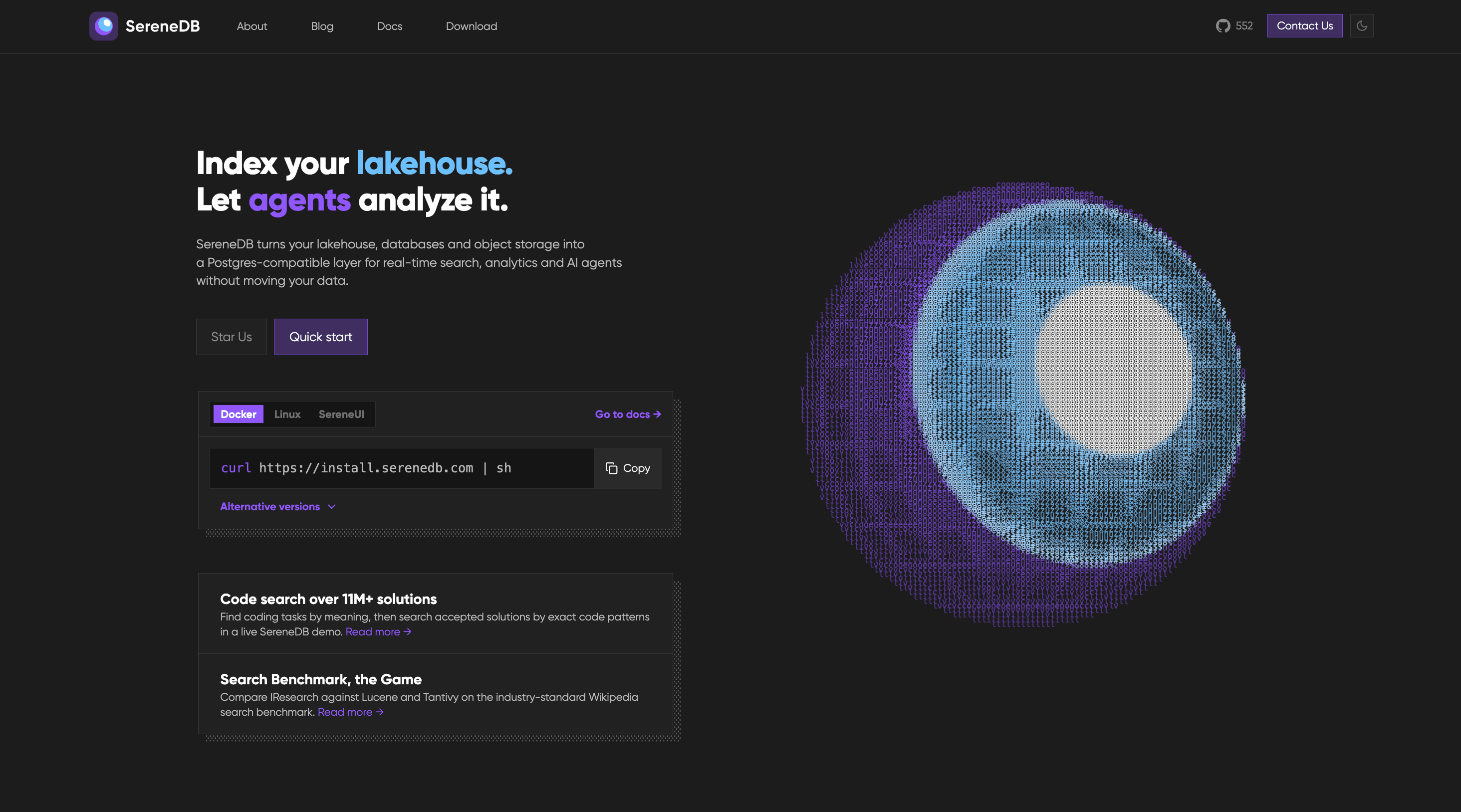
SereneDB is an open-source, real-time search analytics database that combines ultra-fast full-text search and fast analytics in a single engine. It is built for teams that need to search and analyze large volumes of data — such as logs, tables, files, and object storage — without running separate systems for search and analytics. The product offers a PostgreSQL-compatible frontend, so users can keep their existing SQL, drivers, and Elastic clients while working with full-text, vector, and hybrid search alongside relational data. According to the product's own description, it is the result of 12 years of development and is released under the Apache 2.0 license. The stated positioning is straightforward: one database that does ultra-fast full-text search and fast analytics in one engine, aimed at teams who would otherwise operate two systems.
Traditionally, teams that need both search and analytics run two separate systems — for example, a search engine such as Elasticsearch alongside an analytical database such as ClickHouse — and move data between them with ETL pipelines. SereneDB's stated purpose is to remove that second system and the ETL between them by doing ultra-fast full-text search and fast analytics in one engine. The Product Hunt description says the company's public benchmark shows it outperforming Elasticsearch, ClickHouse, and Postgres search extensions, and indexing 1 billion logs in under 8 minutes at roughly 10x less disk usage. Apache 2.0 licensing, methodology, and raw results are public, so teams can evaluate those claims directly rather than taking them on faith.
On the search side, SereneDB offers four related capabilities. Full-text search provides BM25 ranking over both tables and files, the classic relevance-ranking approach used for keyword search. Vector search is supported through ANN (approximate nearest neighbor) indexes that sit beside relational data, so semantic similarity lookups can live in the same database as structured records. Hybrid search combines BM25 and vector scores in a single query, letting teams blend keyword relevance and semantic similarity instead of choosing one or the other. Finally, Postgres search support means teams keep their existing drivers and their SQL rather than rewriting queries for a new search system.
For analytics and data, SereneDB is designed to work on fresh data rather than overnight snapshots. Real-time analytics let users aggregate fresh data with no nightly job, which matters for dashboards and monitoring that need current numbers. As an OLAP database it performs columnar scans over billions of rows, the access pattern typical of large-scale analytical queries. Search over a data lake lets users index object storage in place instead of copying it into another system. And zero-ETL search lets queries run against remote sources where they live, further reducing the need to duplicate data or build synchronization pipelines.
SereneDB also positions itself for AI and agent workloads. It is described as a database for AI agents, offering agent-ready SQL over every source, so agents can query data through SQL rather than through bespoke connectors. As a RAG database, it acts as the retrieval layer for grounded answers, supplying the context an AI application needs. Documentation search lets teams search over docs and knowledge bases, and the company's own blog describes how documentation content can be turned into tools for agents.
Architecturally, SereneDB unifies search and analytics with a columnar engine, vectorized SQL execution, and hybrid storage behind a PostgreSQL-compatible frontend. That combination is what allows full-text, vector, and hybrid search to run next to analytical queries inside one engine. Compatibility is central to the approach: the database is Postgres- and Elastic-compatible, so teams keep their SQL, their drivers, and their Elastic clients. Installation is presented as straightforward — the quick-start command is a curl script — and the site lists Docker, Linux, and SereneUI as options, with documentation covering quick start, indexes, query syntax, statements, and clients.
The stated benefits follow from that single-engine design. Teams can drop a second system and the ETL between it and their primary database, which simplifies the architecture and removes a class of data-synchronization problems. Because compatibility is preserved, there is no rewrite: existing SQL, drivers, and Elastic clients continue to work. The performance claims are significant — outperforming Elasticsearch, ClickHouse, and Postgres search extensions in the company's public benchmark, indexing 1 billion logs in under 8 minutes, and using roughly 10x less disk — which, if it holds for a given workload, translates into faster indexing and lower storage cost. Apache 2.0 licensing, together with public methodology and raw results, gives teams a way to verify the claims before committing. Aggregating fresh data without nightly jobs also means analytics reflect the current state rather than yesterday's snapshot.
Concrete scenarios described by the product include both search workloads and analytics workloads over very large datasets. The company's published comparisons run 92 search and analytics queries over 100M, 1B, and 10B OpenTelemetry logs on a single instance, both against ClickHouse and against the Lucene world (Elasticsearch, OpenSearch, CrateDB) — clearly a log search-and-analytics scenario. Other described scenarios include building retrieval layers for RAG pipelines where an AI application needs grounded context; powering documentation and knowledge base search that can also be exposed to agents as tools; running real-time analytics on fresh data without waiting for a nightly batch job; searching over a data lake by indexing object storage in place; and querying remote data sources where they live instead of copying them first.
SereneDB targets developers, data engineers, and platform teams who operate search and analytical infrastructure, as well as teams building AI agents that need SQL access to data. Integrations mentioned in the content include PostgreSQL drivers and Elastic clients, plus a documented LangChain integration for RAG. Because the database is Postgres- and Elastic-compatible, existing client libraries continue to work. The site lists Docker, Linux, and SereneUI as installation options, the quick start is a single curl command, and the documentation covers quick start, indexes, query syntax, statements, and clients. The project is open source under the Apache 2.0 license, with a public GitHub repository listed at 806 stars and public benchmarks; no commercial pricing plans are stated in the provided content.
SereneDB's primary value proposition is consolidation: one database that performs ultra-fast full-text and vector search together with fast, real-time analytics behind a PostgreSQL-compatible frontend, so teams can eliminate a second system and the ETL between them. It is open source under Apache 2.0, and its benchmark methodology and raw results are public.
Publisher
A
admin
Launch Date2026-09-23
Platformapi
Pricingfree
Tech Stack
#PostgreSQL#SQL#BM25#ANN#Docker#Linux