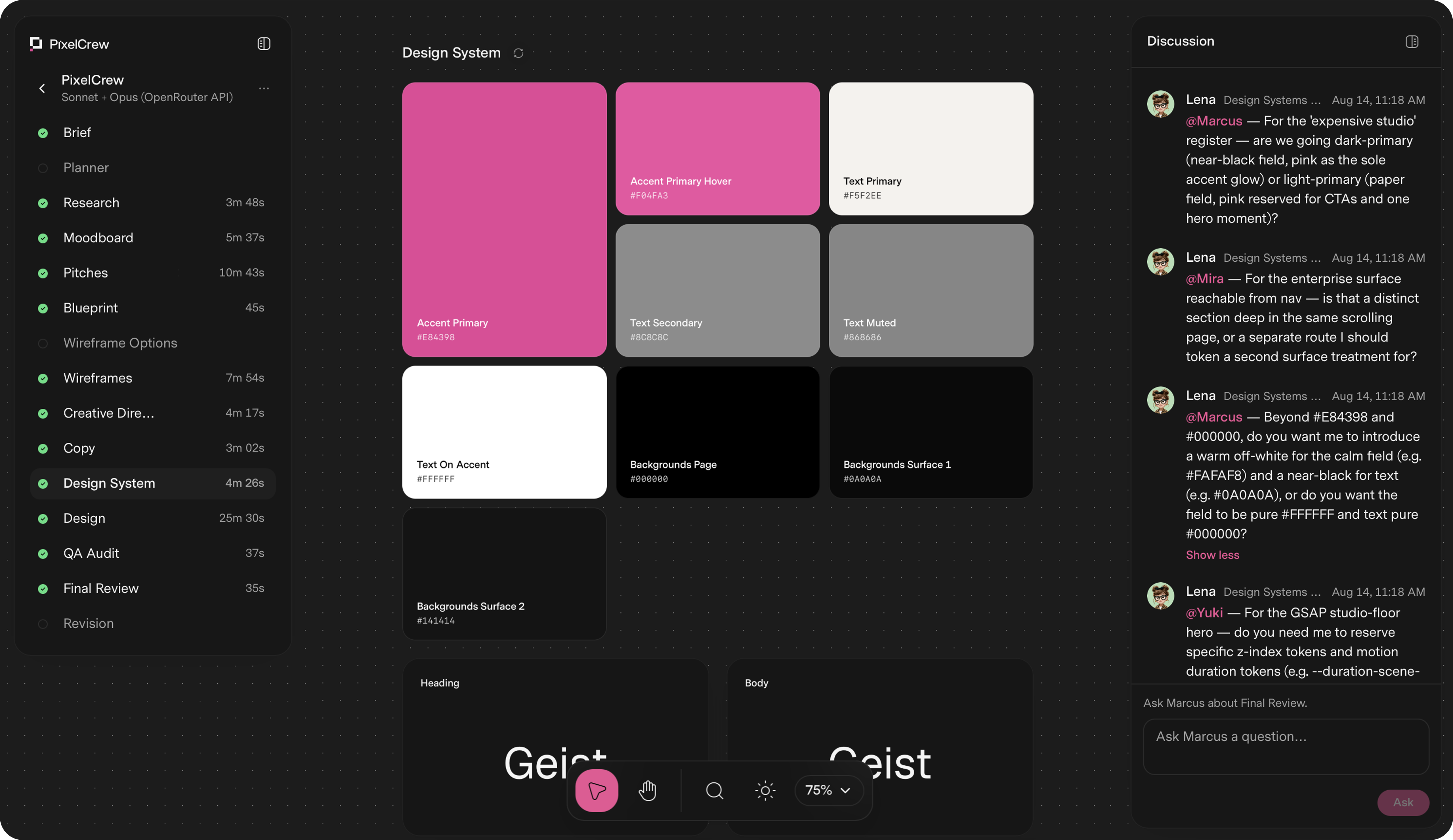
PixelCrew is a design platform built around a crew of specialized AI agents. You write a brief in free text — a landing page, a product dashboard, a design system, or a pitch deck — and the crew coordinates on it to ship production-quality design. Each agent has a named specialization, a defined scope, and a clear handoff, and together they work sequentially and with context, the way a real team does. What comes back is production-ready HTML and Tailwind, a complete design system, and the documentation your engineering team needs to ship or hand to any developer. The average delivery is 25–45 minutes.
Most teams face the same trade-off: generic templates that look like everyone else's product, or bespoke design that takes weeks of studio time. PixelCrew's stated bigger picture is an internet where nothing feels generic, because bespoke costs minutes instead of weeks. Instead of prompting a single model for a one-shot page, a structured crew runs structured discovery, makes creative decisions, and builds the deliverable in a defined sequence. That means design decisions are grounded in research rather than assumptions, and every screen and edge case is resolved before anything reaches you.
The crew is made up of named specialists. Elena is the Researcher and Strategy agent, and she is the first to run: she reads your brief and executes structured discovery, producing audience personas, a competitive analysis and gap mapping, jobs-to-be-done mapping, and an information architecture recommendation. She hands Marcus a validated research foundation, not assumptions, in the form of a research-brief output file. Marcus is the Director for Art Direction and runs second. He takes Elena's research and makes creative decisions about visual direction, brand language, and layout approach. He writes three distinct visual pitches, selects the strongest, and produces a full creative brief with palette, typography, layout direction, and section-by-section composition guidance, delivered as a creative brief document and moodboard.
Mira is the Designer for UX Architecture and runs third. She takes Marcus's creative brief and builds the blueprint: wireframes, user flows, information architecture, and a section-by-section spec, output as wireframes.html, ux-flow.json, and a nav-spec. Every screen and every edge case is resolved, with all states resolved, and the build crew then turns that blueprint into production HTML. Because the handoffs are explicit and each agent works from the previous agent's document, the brief carries context forward instead of being reinterpreted at every step.
After Mira, the build crew takes over. Copy and the design system take shape together: the crew writes the copy and assembles the design system — tokens, type scale, color, and components — so that design happens inside the system, not around it. Then every screen goes through a QA audit and a final review pass; issues get flagged, revised, and rechecked before anything reaches you. The documented final outputs include landing-page.html, design-system.json, tokens, components, and docs, alongside the research, creative brief, wireframe, copy, and QA report files generated along the way.
PixelCrew's approach is best understood as a pipeline with a visible cast of agents: brief in, deliverable out. The crew runs in sequence, you provide context, the agents coordinate, and you receive production-quality output you can ship or hand to a developer. While it runs, you can watch the agents discuss decisions. The workflow is documented as seven steps: submit your brief, Elena maps the research, Marcus sets creative direction, Mira builds the wireframe, copy and the design system take shape, QA audit and final review, and finally you receive production output. That structure is what separates it from a single prompt-to-page tool: research, art direction, UX architecture, copy, design system, and QA are handled as distinct, connected stages.
The benefits follow from that structure. You do not need to know how to prompt a model step by step, and you do not need a template — you describe what you need in free text and the agents read your intent. The outputs are files engineers can use directly, such as landing-page.html, design-system.json, tokens, components, and documentation, so the work can be shipped as-is or handed to any developer. Because research and creative decisions are validated and documented, and because a QA audit and review pass happen before delivery, you receive production-quality design rather than a rough draft.
Concrete scenarios where PixelCrew is used come from the demonstration projects produced from written briefs. After Dark is a neighborhood coffee shop site for a business with no marketing team, briefed to feel like the room — dark, warm, unhurried — with menu, hours, and atmosphere shipped as production HTML. Modena Coupé is a luxury automotive landing page in an editorial register with full-bleed photography, serif display type, performance stats, and a request-information flow. MicroProject is a working task manager UI for small teams with list views, a project sidebar, shared lists, and overdue states, built on directly by the team. Geisha Porto is a coffee roastery and jazz listening lounge site with a product catalog including harvest data, a vinyl audio archive, and a rooftop terrace section in a Swiss editorial layout. The site notes that the business names and brands shown are illustrative and are not clients or endorsements. The stated brief types are landing pages, product dashboards, design systems, and pitch decks.
PixelCrew is free while in alpha. You bring your own key: you create a key at openrouter.ai, paste it into PixelCrew once, and set your own spend limit. OpenRouter is the recommended path, and Anthropic and Google Gemini keys work too. A typical brief costs a few dollars in model usage, billed by your key provider rather than by PixelCrew, with no subscription, no markup, and no card on file. The alpha plan includes the full agent crew, unlimited briefs during alpha, HTML and Tailwind output, and support for landing pages, dashboards, and design systems. A Pro plan is coming soon with hosted keys, zero setup, no API key required, model costs included in one bill, a priority processing queue, brief history and versioning, and team seats. An Enterprise tier for teams that ship at scale is described with custom agent configuration, your design system baked in, SSO and security review, and invoice billing.
PixelCrew's core value proposition is that a written brief becomes a production-quality deliverable in minutes, produced by a crew of specialized agents that research, decide, build, and review in sequence. You get production-ready HTML and Tailwind, a complete design system, and documentation you can hand to any developer, without templates, without a subscription during alpha, and without paying a markup on model usage.
Publisher
A
admin
Launch Date2026-09-23
Platformweb
Pricingfree
Tech Stack
#HTML#Tailwind#OpenRouter#Anthropic#Google Gemini