Category Focus/categories/writing
Writing AI Tools
Discover and compare the best writing AI tools and software. Browse 103+ curated tools with reviews and rankings.
Projects tracked
103
Sort mode
RECENT
Page
1
Discover and compare the best writing AI tools and software. Browse 103+ curated tools with reviews and rankings.
Projects tracked
103
Sort mode
RECENT
Page
1
Moji is a desktop application that opens Markdown files the way you would open a PDF. The project describes itself simply: double-click a Markdown file and start reading. Moji displays your document with clear typography, tables and diagrams, and keeps editing and export ready for when you need them. It runs on Windows, macOS and Linux, is free and open source, and requires no account. The product positions itself as a fast, clean and distraction-free way to read Markdown, with the stated purpose of making a Markdown file open the way a PDF does: with a double-click, instantly readable and with no setup required. On the project's site, the creator explains the motivation directly under the heading "why I built Moji": the goal was for a Markdown file to open the way a PDF does, with a double-click, instantly readable, with clean typography and no setup. The site adds that usability came first from day one, that Moji is lightweight and comfortable for long-form reading, and that it is simple enough to disappear while you read. Editing and export were added without losing that focus. The entire design intent is captured in the line "Less interface. More document." The problem being addressed is the friction between raw Markdown text and a comfortable reading experience: instead of configuring a toolchain or an authoring environment simply to look at a document, the user opens the file and reads it, and the more advanced capabilities only appear when they are actually needed. Opening and reading a document in Moji is deliberately flexible. The site lists four ways to open a file: a standard file dialog, drag and drop, file associations, and a multi-tab workspace. File associations mean a Markdown file can be opened by double-clicking it in the operating system, which is the behaviour the product is built around. The multi-tab workspace lets several documents stay open at once, so readers can move between files without returning to a file picker each time. Once a document is open, Moji renders a rich, secure preview that includes tables, task lists, footnotes, LaTeX, code highlighting, emoji and outline navigation. A synced outline keeps the document structure visible alongside the content, and a dark theme is available for focused reading. The interface uses subtle chrome and compact controls so that the content itself stays in the foreground. Editing is available but stays secondary to reading. Moji's editor is built on CodeMirror 6 and adds Markdown shortcuts, line numbers, history, and search and replace. The site describes this as precise editing covering code, shortcuts and search. The intent is that a user who opened a file to read it can switch into editing without leaving the reader or losing the distraction-free layout, then return to reading. Markdown shortcuts speed up common formatting tasks, line numbers help when working with code-heavy documents, history provides a record of changes within the session, and search and replace supports navigating and updating longer documents. Moji renders Mermaid diagrams without leaving the document. Valid Mermaid blocks in a file become responsive diagrams inline, and the site states that flowcharts, sequence diagrams, Gantt charts, class diagrams, ER diagrams and more are supported. Diagrams can be zoomed from 10% to 1000%, panned freely, or fit to view, and a minimap plus a dedicated diagram viewer help navigate larger charts. Each image can be exported individually as PNG. The rendered diagrams are described as self-contained SVG in HTML, PDF and PNG output. The site summarises this as turning code into diagrams instantly, which means a document that describes a system in Mermaid syntax can be read and understood visually in the same window. Exports are described as predictable. Moji can export to PDF for precise layouts, to HTML for web-ready output, and to PNG, which the site presents as suited to long documents. Exports preserve typography, diagrams and very long documents. The export dialog is intentionally simple: the user chooses a format and a layout. Because Mermaid output is embedded as self-contained SVG, diagrams that appear in the reader also appear correctly in the exported PDF, HTML or PNG file. Moji is a desktop application rather than a web service. Official installers for Windows, macOS and Linux are published directly through GitHub Releases. For Windows, an NSIS installer is provided for Windows x64 with automatic updates. For macOS, a universal DMG supports both Apple Silicon and Intel, with manual updates. For Linux, users can choose an AppImage with automatic updates or a DEB package for manual installation. The version referenced on the site is 1.0.7. Moji is free, distributed under the MIT license, and requires no account, so no sign-in or subscription stands between the user and their document. The stated benefits follow from that design. Because Markdown files open with a double-click, the tool fits into the same habit as opening a PDF. Because the interface is lightweight and uses subtle chrome, it is described as comfortable for long-form reading and simple enough to disappear while you read. Because the preview supports tables, tasks, footnotes, LaTeX, code highlighting, emoji and diagrams, technical and structured documents render correctly rather than as raw text. Because editing and export are built in, a single application covers reading, light authoring and sharing. And because the interface is available in Portuguese, English, Spanish, Japanese, Chinese and Russian, readers can use the product in their own language. Several concrete scenarios follow from the features the site describes. A developer who receives a README or technical document can double-click the file and read it immediately with code highlighting and correctly rendered tables. A writer or note-taker can open a long Markdown document in the multi-tab workspace, follow the synced outline, and use the dark theme for extended reading sessions. Anyone working with technical documentation can embed Mermaid blocks and view flowcharts, sequence diagrams, Gantt charts, class diagrams or ER diagrams inline, zoom into a detail and export a single diagram as PNG. A user who needs to distribute a document can export it to PDF with precise layouts, to HTML for the web, or to PNG for long documents, with typography and diagrams preserved. Someone who needs to make a small correction can switch into the CodeMirror-based editor, use Markdown shortcuts and search and replace, then return to reading. And because Windows, macOS and Linux builds are all available, the same reader can be used across different machines. Moji is aimed at people who read Markdown on a desktop and want it to behave like a document rather than source code: developers reading repository documentation, writers and note-takers working in Markdown, and anyone who deals with technical documentation that contains diagrams. It is explicitly free, open source under the MIT license, and requires no account. The site states that the source can be explored, development followed, issues reported, and the project's next chapter shaped through the public repository. Technically, the site names CodeMirror 6 as the editor foundation and Mermaid for diagram rendering. Moji runs on Windows, macOS and Linux, with distribution handled through GitHub Releases, and the interface is localised into six languages. Moji's primary value proposition is stated on its own homepage: opening Markdown should be as simple as opening a PDF. It delivers that by pairing a focused, lightweight desktop reader with the editing, diagram rendering and export tools needed when reading is not enough, and it does so free of charge, as open source, across Windows, macOS and Linux.
Loqua is context-aware voice typing and dictation software built for Mac and Windows. It converts natural speech into polished, ready-to-use writing, understands what is on your screen, offers read-aloud when you would rather listen than read, and lets you trigger everyday actions by voice. Its stated purpose is to help people move from thoughts to being done — less typing, less context switching, and more time in flow. Loqua is aimed at anyone who would rather think than type: professionals who write all day, developers and engineers, product managers, designers, marketers, founders, writers, researchers and students. The keyboard has long been the bottleneck between having an idea and getting it written down. Traditional keyboard typing runs at roughly 45 words per minute, while Loqua's dictation runs at 220 words per minute — a difference the company presents as saving up to 3 hours per day. Raw speech, however, is rarely usable as written text: it is full of filler words, repetition and half-finished sentences. Loqua removes filler words, cuts repetition and refines phrasing in real time so that what lands on screen is ready to send. A second problem Loqua targets is context switching: stopping work to open another app, look something up, translate it or rewrite it breaks concentration. Loqua aims to keep people inside the app they are already working in. The core of Loqua is dictation with real-time cleanup. When you speak, Loqua strips out filler words, trims repetition and refines your phrasing, so the sentence that appears on screen reads as if it had been carefully written rather than spoken. This happens in real time, which means you do not have to go back and re-read everything you just said. Loqua also recognises structure in speech and builds it automatically: if you think in bullets but speak in blocks, Loqua derives lists, headings and hierarchy on its own, so you do not have to dictate formatting out loud. For anyone who writes long documents, meeting notes or structured updates, this removes the tedious formatting pass that normally follows dictation. Capture to Ask addresses the moments when the answer is on your screen but you cannot figure it out. Using a shortcut, you select any part of the screen — a table, a chart or anything else — then speak your question. Loqua returns an answer, an analysis, a translation or a summary without you having to switch apps. It is a three-step flow the company describes as Capture, Ask, Know. Related to this is Ask and Edit: highlight anything, whether it is a product description, a draft or a note, speak your instruction, and Loqua rewrites it on the spot. There is also a simpler ask-anything path — hit a shortcut, ask a question out loud, and get an instant answer without leaving your current app, which is useful when you are stuck mid-task. Translation lets you speak in your own language and deliver in someone else's, with native phrasing in nearly 100 languages, returned instantly. That makes it practical for international teams, multilingual correspondence and anyone writing in a second language. Command to Go turns your voice into a hands-free command hub: with a shortcut you can set reminders, open apps, search routes, place calls and send texts, so you can manage small tasks without jumping between applications. AI Podcast read-aloud works in the opposite direction — select text and Loqua reads it aloud, which the company suggests for morning news and multitasking, effectively giving you a hands-free text-to-speech assistant. Loqua's approach is to sit globally on top of your existing workflow rather than replace it. You invoke it with one shortcut in any text field, so it works in tools like Terminal, Slack, Notion, email, Google Docs, Microsoft Word, VS Code, Teams, Figma, Obsidian, GitHub and many more, with your voice landing right where your cursor is. The company describes the experience as no switching and no waiting, with a zero-latency feel that makes the tool easy to forget about. Loqua is built by a dedicated voice AI team with full model iteration capabilities, and the roadmap includes meeting transcription, multimodal capabilities and a Skill Market. Users report that Loqua adapts tone automatically — shifting register between, for example, a message to a CEO and a Slack message to a team — by understanding the context it is typing into. The benefits the company and its users describe are time and flow. Because dictation runs at 220 words per minute rather than 45, and because cleanup and formatting happen automatically, people report writing that used to take an hour finishing in minutes — one user summarises 30-minute writing sessions becoming 5-minute speaking sessions, and another says PRDs written by voice save at least an hour a day. Beyond speed, Loqua reduces the proofreading burden: users report they have stopped going back to check output, even when dictating framework names, library names and acronyms. For people with repetitive strain injury, Loqua is described as making work possible again rather than merely faster. Non-native English speakers say it makes their writing sound native, and international users say translation is instant and natural. Concrete use cases appear throughout the site. Product managers write PRDs, standup notes, sprint recaps and stakeholder updates by speaking. Engineers dictate coding notes, documentation and terminal input, and use it in Slack, Notion and their IDE. Designers keep their hands on Figma and narrate case studies and design processes. Content strategists and marketers draft LinkedIn posts, email campaigns, blog outlines and ad copy by voice and then polish from there. Founders and executives who context-switch all day speak thoughts into whatever app is open, and heavy email users cut correspondence time. Consultants talk through client debriefs to get clean summaries, UX researchers dictate research notes between interviews, and PhD candidates use the cleanup and formatting for academic writing. Sales teams use translation to send emails in a different language from the one they speak. Loqua runs on Mac and Windows as a desktop application you download from the site, with a 14-day free trial. It advertises support for a very broad set of applications — among them Google Docs, Word, Notion, Slack, Gmail, Figma, VS Code, Teams, Obsidian, Google Sheets, Zoom, Excel, GitHub, Terminal, Discord, Outlook, IntelliJ IDEA, PowerPoint, GitLab, WhatsApp, Telegram, Stack Overflow, OneNote, Canva, Photoshop, LinkedIn, Google Slides, X, Sketch, Reddit, Illustrator, Confluence, Evernote, Facebook, Adobe XD and Google Keep. There is also a developer programme: maintainers of public open-source projects can apply for a Developer Grant giving free access. The site states that thousands of professionals use Loqua every day. Loqua's core promise is that your thoughts should not have to slow down for a keyboard. By combining high-speed context-aware dictation, automatic cleanup and structure, screen understanding, translation, voice editing and voice-triggered actions in one shortcut-driven tool, it turns rough ideas into ready-to-use writing and keeps work moving inside the apps you already use.
Kraflio is a multi-platform AI content engine that learns your writing voice and generates publication-ready posts for LinkedIn, X, Instagram, Bluesky, YouTube and TikTok. AutoPost publishes to LinkedIn (personal profile and Company Page), X, Instagram and Bluesky via official APIs. It keeps a separate voice per platform, learns from your own writing samples, and nothing publishes without your approval. On-brand AI images, Instagram carousels, YouTube/TikTok link import, scheduling, analytics and a full Brand Kit are included on every plan — plans differ only in volume. Available on web, Telegram and Android.

Loova Ads Studio is an all-in-one AI creative workspace designed for marketers, creators, and brands. Its primary function is to generate a wide array of advertising assets, including UGC videos, product commercials, avatar videos, and static creatives. The platform aims to produce high-performing ads efficiently, enabling users to test more variations and angles to discover what resonates best with their target audience. The core problem Loova Ads Studio addresses is the time and cost associated with producing a sufficient volume of ad creatives for effective A/B testing. Traditionally, creating numerous ad variations requires significant manual effort and expense, often limiting brands to a few options. This bottleneck hinders the ability to optimize campaigns and find the most effective messaging and visuals, leading to missed opportunities and suboptimal marketing performance. One key feature is the generation of UGC videos and product commercials. Users can input product details, and the AI will create engaging video content that mimics user-generated styles or professional product showcases. This allows for rapid creation of diverse video assets without the need for extensive filming or editing. Another significant capability is the creation of avatar videos. Loova Ads Studio can generate videos featuring AI avatars, providing a way to create dynamic content with consistent presenters or characters, which can be particularly useful for explainer videos or brand messaging. The platform also excels at generating static creatives. This includes product images and other visual assets suitable for various advertising platforms. Users can generate unlimited product images within their workflow, ensuring a constant supply of fresh visuals for campaigns. A core functionality is the "Viral Ad Clone" feature. This allows users to replicate the structure and pacing of successful ad formats, adapting them to their own products and brand style. The system analyzes the grammar of viral ads—hook, pacing, scene structure, and product reveal—and rebuilds these elements around the user's specific product, brand assets, and audience, ensuring the cloned ad feels fresh and not a direct copy. Loova Ads Studio operates by analyzing product information, identifying strong selling angles, and suggesting video hooks. It pairs these with viral avatars and proven templates to create ready-to-test creatives. Users can build a reusable "Product Kit" containing product images, descriptions, selling points, and brand assets, which the AI uses to maintain consistency across generations. The platform leverages a combination of leading AI models, including Seedance, Kling, and Veo, along with proprietary creative context and shot-planning systems. The benefits for users include the ability to create high-performing ads at a low cost, often under $2 per ad. It significantly speeds up the creative process, allowing for more extensive A/B testing and quicker identification of winning campaigns. By automating much of the creative production, Loova Ads Studio frees up marketers to focus on strategy and analysis. Specific use cases include rapidly generating multiple ad variations for e-commerce products to test different hooks and visuals, creating avatar-led explainer videos for new features, producing diverse UGC-style ads to increase authenticity, and cloning successful ad formats to quickly adapt them for new product launches or seasonal campaigns. Loova Ads Studio is targeted at marketers, creators, and brands, particularly those in e-commerce. While specific pricing tiers are not detailed, the content suggests a focus on cost-effectiveness, with ads costing under $2. The platform is web-based, and direct integrations with ad platforms like Meta and TikTok are planned for the future, though currently users export their finished ads. In summary, Loova Ads Studio acts as an AI-powered creative engine, empowering marketers to produce a high volume of diverse, high-converting ad creatives efficiently and affordably, thereby accelerating testing and optimizing campaign performance.
An AI marketing optimization system based on Andrej Karpathy's autoresearch method. 12 fill-in-the-blank program.md templates cover cold email subject lines, landing page copy, pricing tiers, ad creative, and onboarding. Each template defines a change proposal, scoring rubric, and keep-or-revert decision rule with a hard cost-stop parameter. Compatible with Claude Code, Cursor, or any AI coding agent. Runs at $0 on local models via Ollama, ~$6/session hybrid, or ~$15/session at full API rates.
MemoryVerse is a web application that transforms personal memories into custom 12-line poems. Users describe a real memory they share with someone, and the platform generates a poem written around that specific moment rather than generic themes. The platform creates custom 12-line poems based on user-submitted memories. After entering a memory description, users receive a poem crafted around their specific moment plus three curated gift ideas that match the emotional tone of the memory. The service generates poems in 60 seconds and offers a printable card format. MemoryVerse uses Claude Haiku as its core technology to extract emotional metadata from memories and create human-sounding poetry. The platform is built with React for the frontend interface and Stripe for payment processing. Users can try the service for free to generate poems, with payment required only to unlock the full printable card and gift suggestions. The pricing model charges $4.99 to unlock the complete experience including the full poem, printable card format, and curated gift ideas. The free tier allows users to generate poems without payment, providing a preview of the service before committing to purchase. MemoryVerse targets anyone seeking personal, meaningful gifts rather than generic options. The platform is particularly suited for creating sentimental presents that capture shared memories and emotional connections between people.
The Do Words Good copywriting swipe file is a free resource containing over 100 pieces of copy and messaging examples specifically curated from e-commerce and FMCG challenger brands. Each example includes detailed notes explaining the strategic thinking behind the copy, allowing users to understand and adapt successful messaging approaches for their own brands. The swipe file focuses on challenger brands in the e-commerce and FMCG sectors, providing real-world examples of effective copywriting that has been used by successful companies. Each piece of copy in the collection comes with detailed annotations that break down the messaging strategy, helping users understand not just what the copy says, but why it works and how they can apply similar thinking to their own brand communications. This resource is designed to be practical and actionable, offering marketers and copywriters a comprehensive collection of proven messaging examples. The detailed notes accompanying each example provide insights into the strategic decisions behind the copy, making it easier for users to adapt successful approaches rather than simply copying content verbatim. The swipe file is available completely free of charge, making it accessible to businesses and marketers regardless of budget constraints. By providing this resource at no cost, Do Words Good aims to democratize access to high-quality copywriting examples and strategic insights that can help brands improve their messaging and communication effectiveness. The collection covers various types of copy and messaging used by challenger brands, giving users a broad spectrum of examples to learn from. Whether users are looking for inspiration for product descriptions, brand messaging, advertising copy, or other marketing communications, the swipe file provides concrete examples from successful brands in the e-commerce and FMCG space.
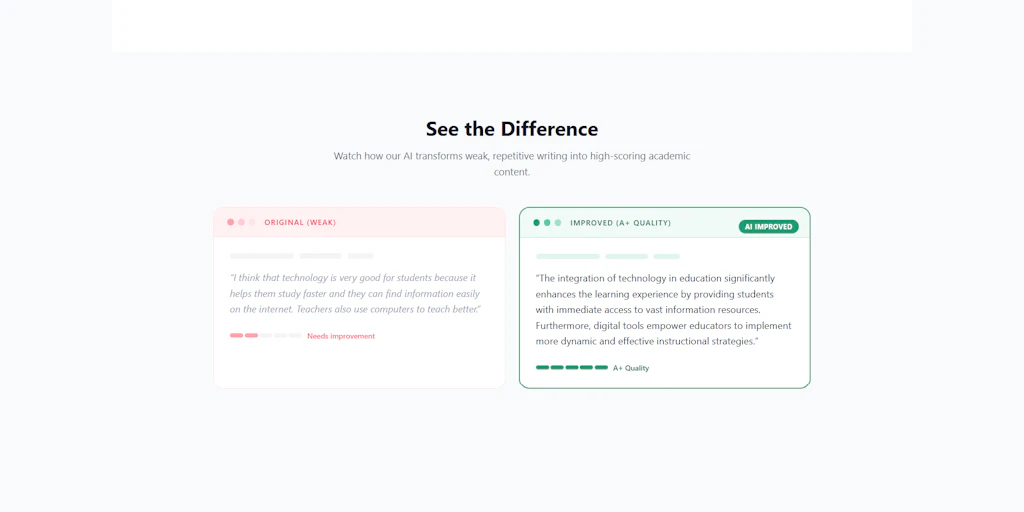
WritlifyAI is a free AI writing toolkit specifically built for students. The platform provides a collection of writing tools designed to help students improve their academic writing without any cost or registration requirements. The toolkit includes an Essay Rewriter for restructuring essays, a Text Humanizer to make AI-generated content sound more natural, a Paraphrase Tool for rewording text, a Grammar Fixer for correcting grammatical errors, a Plagiarism Remover to help create original content, a Text Summarizer for condensing long texts, and Word & Character Counter tools for tracking writing metrics. The platform operates on a completely free model with no sign-up required. Students can access all tools immediately through a clean, simple interface designed with their needs in mind. The service is web-based and accessible from any device with an internet connection. WritlifyAI addresses the challenge of expensive AI writing tools that are often out of reach for students. By providing these tools at no cost, the platform aims to democratize access to AI-powered writing assistance for academic purposes. The service is built using Next.js and hosted on Cloudflare Pages, with Groq Chat integration powering the AI capabilities. The platform targets students who need help with various aspects of academic writing, from essay composition to grammar correction and content optimization.
PostPolish is a Chrome extension that instantly converts rough social media replies into fluent, natural English. Designed for non-native English speakers, it allows users to write in their native language or mixed English and then polish their text into clear, ready-to-post messages without leaving the social platform. The extension offers three core features: Polish Reply transforms any draft into smooth English via right-click; Expand Reply naturally lengthens short drafts to make responses more thoughtful; Auto Generate Reply creates fitting replies by highlighting any post on Twitter or LinkedIn. All actions happen within the same window, eliminating the need to switch tabs or apps. Users simply drag their draft text, right-click, and select the desired option. The tool works directly on LinkedIn, X (Twitter), Reddit, and other social sites. It preserves the user’s original voice while ensuring grammatical accuracy and natural phrasing, making global engagement effortless. PostPolish is ideal for non-native English speakers who want to participate confidently in English-language social media conversations. It removes the friction of manual translation and proofreading, enabling faster, more authentic engagement across professional networks and online communities. The extension is built as a lightweight Chrome add-on and integrates seamlessly with existing social platforms. A one-month free coupon (FORPH01) is available at checkout, allowing new users to test the full feature set before committing.
use.fo puts AI voice typing directly inside your iPhone keyboard. Speak naturally, choose modes like Email, Work, Translate, Social, or Proofread, and insert polished text back into the app where you were already typing.