NoteWorthy is a notes app for iPhone, iPad and Mac that finishes the note after you have written it. You jot anything down — a messy line, a quick capture, a scraped list — and NoteWorthy writes a title, summarizes what you wrote, cleans up the formatting and files the note into the right place. Its purpose is captured in its own headline: You write the note. It does the rest. The app is built for people who capture quickly and organize slowly, and it is designed from the ground up to run entirely on the device it is installed on, without an account, without a subscription and without any note leaving the machine it was written on.
The app aims at a familiar problem. Note-taking tools are easy to start and hard to keep. Notes arrive without titles, without structure and without a home, and the fixing-up work — naming, tidying, filing — is exactly the work people skip. At the same time, most modern notes apps ask for an account, hold content on remote servers and charge a subscription for the privilege. NoteWorthy's answer is to put the clerical part of note-taking on the device itself, so that titling, summarizing, formatting and filing happen automatically and privately, with nothing to trust beyond the hardware in your hand.
Writing in NoteWorthy is rich text with real Markdown underneath. Checkboxes, headings, bold and italic, tables and images all work the way you would expect, and the note is stored as Markdown you can take anywhere. Six paper colors let you separate the look of different notes, you can scan text straight out of a photo, and any note can be exported as Markdown that opens in any other editor. The Markdown foundation matters because it makes the library portable by default: if you ever want to leave, you take your notes with you rather than leaving them behind inside a proprietary format.
Two on-device writing tools do the tidying. AI Format turns a scrappy line into headings, bullets and checkboxes without changing your wording — it restructures, it does not rewrite. AI Summarize pulls a page of thinking down to a single sentence. In both cases you see the result before it touches the note, and you can then copy it, insert it, or replace the original with it. Both run on the device with no network in either direction, and on older hardware they fall back to fast built-in heuristics so the feature still works.
AI Organize handles placement. Every note gets a title and files itself into Tasks, Ideas, Info or Personal, and you can make your own labels with your own icon and color and pin the ones you use most to the tab bar. A single tap on AI Organize tidies the whole library. The filing is deliberately deterministic: run it twice and nothing moves, because filing reads what is already stored on the note rather than asking a model to guess a second time. That detail is what makes automatic filing safe to rely on — the library does not reshuffle itself every time you press the button.
Capture and retrieval extend the app beyond its own window. You can select something in Safari, share it, and it becomes a note; Siri and Shortcuts do the rest. There are five Shortcuts actions, and Summarize and Format work on text from any app. Widgets come in four sizes and include checkboxes you can tick without opening anything. Search works both inside the app and from the Home Screen: keyword search with highlighted matches that can be filtered by color, and every note indexed with Spotlight so the system search finds it without opening NoteWorthy, with Spotlight results opening the note directly. Indexing happens on device, like everything else. Notes also know what they contain: a date becomes a calendar event, a name links to your contacts, an address opens in Maps, and writing "remind me before Friday" prompts the note to offer to set a reminder. All of that detection happens on device and is never uploaded, nothing happens until you tap it, and reminders arrive as a local notification.
Privacy here is presented as a property of the build rather than a promise. There is no server to trust because the app makes no network requests at all. There is no account to create and no connection required, so airplane mode changes nothing. The app can be locked with Face ID, notes are written to disk with file protection on iPhone and iPad and stay inside the app's sandbox on a Mac, and nothing is collected and nothing is tracked — no analytics, no advertising and no crash reporter of the developer's own. You can verify the claim rather than believe it: on a Mac the app is sandboxed without the network entitlement, so macOS itself would refuse any connection, and the entitlement list can be printed with a codesign command. On iPhone and iPad you can turn on App Privacy Report, and NoteWorthy never shows up under network activity.
Underneath, two models run on the device. Apple's Foundation Models, part of Apple Intelligence running on the Neural Engine, write the words: note titles, summaries and the Markdown rewrite. Google's EmbeddingGemma 300M — a 300-million-parameter embedding model, quantized to 4-bit, bundled inside the app and run through MLX — decides where things go. Because it is an embedding model, it matches a note to a label by meaning rather than by keyword, and it can also conclude that none of the labels fit. It is loaded lazily and never downloads; the weights ship inside the app. As the site puts it, one writes and the other decides where things go, and neither can reach the internet because the app cannot.
NoteWorthy is universal for iPhone, iPad and Mac and is a single Universal Purchase covering all three. It needs iOS or iPadOS 26 or later, or a Mac with Apple silicon running macOS 26 or later. Apple Intelligence is required only for the writing features — AI Format, AI Summarize and generated titles — and the app falls back to built-in heuristics without it, with writing, filing and search still working. Everything the app does today is free, with no ads and no subscription. iCloud Sync and Shared Notes are announced but not shipped; when they arrive they will go through your own iCloud account rather than a server of the developer's, and they will be a single one-time unlock. Until sync ships, each device keeps its own notes and you can move one across by exporting it as Markdown. The Mac version is in review for the Mac App Store; until it clears, it can be installed from a DMG or with a Homebrew cask.
The intended audience is people who already live on Apple devices and want the convenience of AI assistance without handing their writing to a server. That includes anyone who captures thoughts in a hurry and never gets around to filing them, and anyone for whom privacy is a requirement rather than a preference. Because the app works offline and asks for no account, it also suits people taking notes in places where a connection is unavailable or unwanted, and people who simply do not want another subscription.
The outcome for a user is a library that stays organized without a filing session. Notes arrive titled, structured and classified, which means search and Spotlight can find them later and the labels remain meaningful instead of becoming a junk drawer. Because there is no network path at all, notes carry no exposure: nothing to leak, nothing synced to a third party, nothing collected. And because the format is Markdown, the library is not a commitment — it is a set of plain text notes you can carry elsewhere.
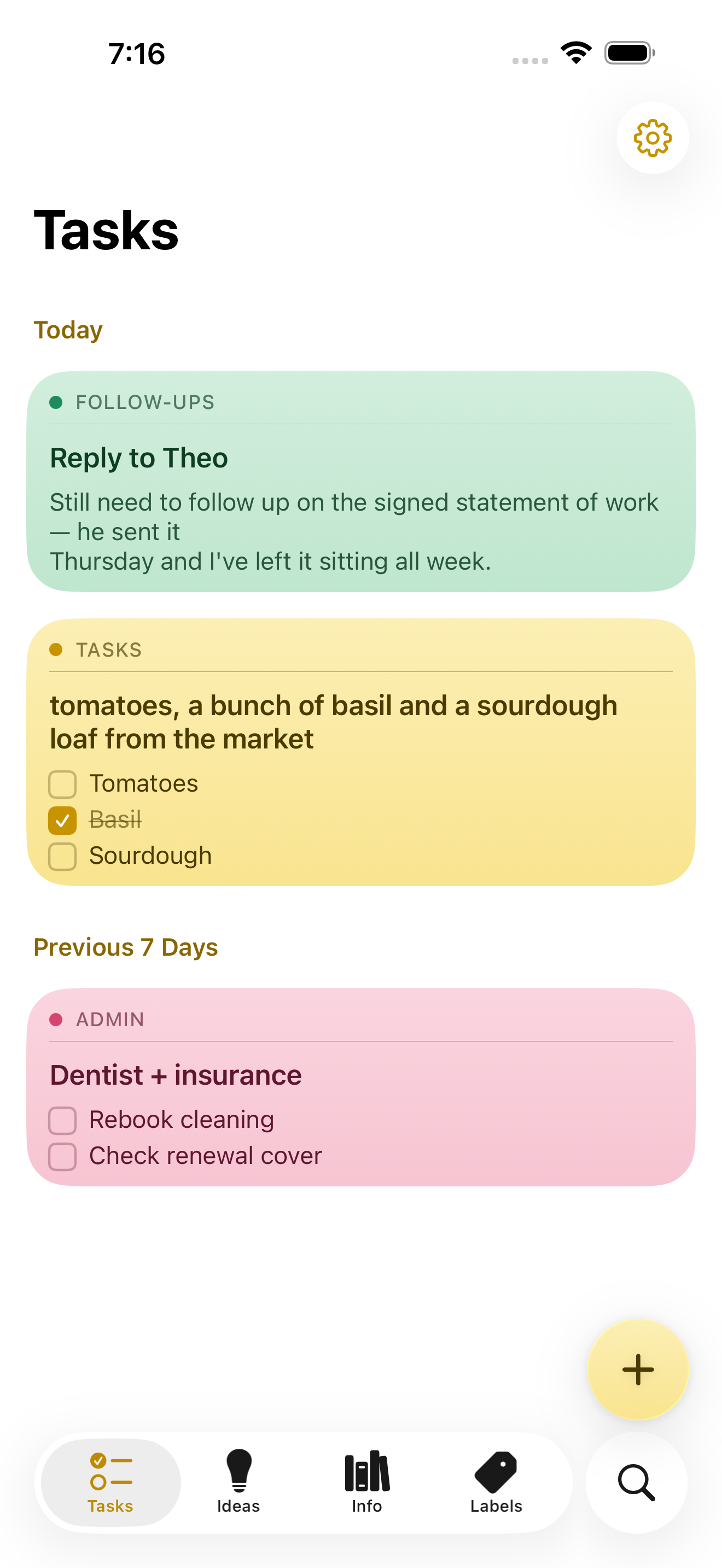
That plays out in ordinary workflows. You are reading something in Safari and a paragraph is worth keeping, so you select it, share it to NoteWorthy and it becomes a note; later a single tap on AI Organize titles it and puts it under Ideas. You dictate a messy list of errands; AI Format turns it into checkboxes without touching the wording, and the items can be ticked from a widget without opening the app. You have written a long page of thinking about a decision and want the gist, so AI Summarize offers a sentence you can insert while keeping the original underneath. You write "remind me before Friday" in a note about a signed statement of work, and the note offers to set a reminder that arrives as a local notification. The website's own sample notes show exactly this shape of use: a follow-up about a reply, a market list with items already ticked, a dentist and insurance note, a packing list for Lisbon and a sourdough starter idea, each one titled and filed under its own label.
NoteWorthy's core proposition is narrow and firm: the AI help in a notes app does not have to travel. Titles, summaries, Markdown cleanup and semantic filing all happen on the iPhone, iPad or Mac you are already holding, the library is stored as Markdown you can export, and every feature the app ships today is free. For anyone who wants smart notes without a smart server, that combination — automatic organization plus an app that makes no network requests at all — is the whole point.
Publisher
A
admin
Launch Date2026-10-07
Platformmobile
Pricingfree
Tech Stack
#Apple Intelligence Foundation Models#EmbeddingGemma 300M#MLX#Neural Engine#Markdown