Category Focus/categories/api
API AI Tools
Discover and compare the best api AI tools and software. Browse 120+ curated tools with reviews and rankings.
Projects tracked
120
Sort mode
RECENT
Page
3
Discover and compare the best api AI tools and software. Browse 120+ curated tools with reviews and rankings.
Projects tracked
120
Sort mode
RECENT
Page
3
FastRouter.ai is a unified AI gateway and control plane for developers and enterprise teams building with large language models. It routes every request to the right model across more than 200 LLMs through a single OpenAI-compatible API, optimizing for cost, latency, quality, and reliability. The product gives organizations one consistent way to reach leading models including Claude Fable 5, Gemini 3.1 Pro, GPT-5.5, Grok 4.3, Veo 3.1, Nano Banana, and Claude 4.8 Opus, without integrating with each provider separately. Teams point their existing OpenAI SDK at FastRouter's base URL and immediately gain intelligent routing, automatic failover, built-in governance, and observability from a single high-performance gateway. It is positioned as the fastest gateway for every model, covering text, image, video, embeddings, and speech, and it lets teams add or swap models without code changes. Building with LLMs has become a multi-provider problem. New models arrive every few weeks, and benchmark results rarely tell the full story for a specific application, so the best model for a given task changes frequently. Teams that hard-code a single provider run into vendor lock-in, unpredictable spend, and outages they cannot control. One FastRouter user, Dr. Rishabh Bhandari of Medisha, explains that with new LLMs coming out every few weeks and benchmarks not giving the full picture, they rely on FastRouter.ai to optimize the cost-versus-quality balance. Another user, Sainath Gupta of Knit Finance, highlights that reliable access to models across providers removes the worry about outages or vendor lock-in. FastRouter addresses this by sitting between applications and model providers, giving teams a single point of access where they can compare models, control spend, and keep applications running when a provider degrades. The stated goal is to let teams scale AI apps without vendor lock-in or code changes. The foundation of the product is unified access. FastRouter provides an OpenAI-compatible API across different providers, so existing OpenAI SDK code keeps working while gaining access to many models. The gateway covers text, image, video, embeddings, and speech workloads, and it allows teams to add or swap models without code changes. Enterprises get access to top models such as Claude Fable 5, Gemini 3.1 Pro, GPT-5.5, Grok 4.3, Veo 3.1, Nano Banana, and Claude 4.8 Opus from a single API. This matters because it removes the need to maintain separate integrations, keys, and code paths for each provider, and it means a model change is a configuration change rather than an engineering project. Smart routing is the mechanism that keeps quality high while controlling spend. FastRouter routes every request to the best LLM based on cost, latency, and output quality with no manual tuning required. Its Auto Router chooses models that deliver the highest accuracy and relevance for the request under a cost-optimized policy. A low-latency policy selects the quickest model available to keep experiences smooth and responsive, while a high-throughput policy prioritizes models that handle high request volumes at scale. Intelligent cost optimization adds smart routing to cost-efficient models, prevention of unnecessary premium model usage, and batch processing for high-volume workloads. Together these capabilities help teams reduce AI spend while still matching each request to an appropriate model. Reliability and governance are built in. FastRouter provides automatic retries across providers, fallback models when failures occur, and virtual model lists for seamless failover. Instant failover automatically reroutes requests to other healthy providers for the chosen models, fallback lists let teams define prioritized fallback models so requests continue seamlessly, and aggregated capacity across providers supports higher rate limits. On the governance side, the platform offers project and API key limits, member roles and access controls, and protections designed to prevent spend shocks and bill spikes. Consolidated dashboards and alerts give complete visibility across every model, provider, and project, with powerful filters for cost, latency, and errors, plus alerts for usage and spikes. Observability and model comparison round out the platform. FastRouter tracks usage, latency, errors, and costs across all models with real-time metrics and detailed logs. Unified metrics monitor performance, latency, and error rates across models and providers; an activity log gives clear visibility into usage and performance for each request; and ongoing evaluations monitor model outputs to ensure consistent quality and performance. The Model Council and Playground let teams compare latency, output quality, and cost across models in interactive playgrounds, combine multiple models to cross-check outputs and reduce errors for stronger reasoning, and use the strengths of each model to deliver consistently better results. Insights adds a weekly read-only pass over the traffic you already route, producing a ranked list of changes, each with the sampled requests, the savings math, and the exact screen where you make the change. FastRouter's overall approach is one API for every model, production ready. Developers point the OpenAI SDK or a direct API call at the FastRouter base URL, https://api.fastrouter.ai/api/v1, supply a FastRouter API key, and select a model ID, so the integration looks like a standard OpenAI chat completions call in Python or TypeScript. Virtual model lists let teams mix providers and models into a unified model alias with policy-driven selection. Beyond routing, the platform covers evaluations, guardrails, alerts, and virtual model lists. For organizations with stricter requirements, FastRouter can be self-hosted in your own cloud so that prompts, responses, logs, and provider keys never leave your network, available on the Enterprise plan with the team helping on deployment and upgrades. The benefits follow directly from that architecture. Teams reduce AI spend through intelligent routing, batching, and model controls; they protect against spend shocks and bill spikes with limits and access controls; and they keep AI applications running with automatic failover, multi-provider redundancy, and intelligent traffic routing. Because the API is OpenAI-compatible, developers get drop-in integration with fast routing and built-in failover, while engineering leaders control costs without compromising reliability or scale. Product teams gain actionable insights to power faster, smarter AI product development. Crucially, users report that reliable access to models across providers removes the worry about outages or vendor lock-in, which is the central promise of the platform. Concrete use cases appear throughout the product. A team unsure which LLM suits its use case can play with models in the playground, compare them against each other, and then call normal OpenAI-compatible APIs to use the chosen model. A high-volume workload can be routed to cost-efficient models and batch processed to lower spend. An application that depends on a model which becomes slow or unavailable can rely on instant failover and fallback lists to keep serving requests. An engineering leader can set project and API key limits plus member roles and access controls to prevent spend shocks across teams. Teams can run evaluations and guardrails to validate and monitor inputs and outputs for safety, compliance, and consistency. Finally, an organization with strict data requirements can self-host the gateway so prompts, responses, logs, and provider keys never leave its network. FastRouter is aimed at developers, engineering leaders, and product teams inside organizations that build with LLMs. Developers get drop-in OpenAI-compatible APIs with fast routing and built-in failover; engineering leaders get cost control without compromising reliability or scale; product teams get actionable insights for faster, smarter AI product development. The site states that FastRouter is trusted by teams at Media.net, Amazon, Optum, GlobalFoundries, Verticurl, and Supaboard, and describes it as forged from the insights of high-performance engineering organizations. Getting started requires no set-up fees, no monthly minimums, and no credit card: new users receive millions of tokens in free credits to build, test, and explore the unified API, and a self-hosted deployment is available on the Enterprise plan. In summary, FastRouter.ai turns the messy reality of many model providers into one coherent gateway. It combines a single OpenAI-compatible API across 200+ models with smart routing for cost, latency, quality, and throughput; automatic failover and fallback lists for uptime; governance controls for spend; and dashboards, logs, evaluations, and weekly Insights for visibility. The primary value proposition is straightforward: route faster, scale smarter, and build better AI apps by sending every request to the right model without vendor lock-in or code changes.
Octri.dev is a platform that takes an OpenAPI specification as its single input and generates four connected products: a documentation site, client SDKs in ten programming languages, an MCP server that exposes your API as tools for AI agents, and production monitoring that reports errors from wherever those SDKs run. It is built for developers and teams who publish APIs and want documentation, client libraries, agent integrations, and observability to stay in sync without manual effort. The problem Octri addresses is what happens after an SDK leaves your control. As the site puts it, "Everyone else stops at 'here's your SDK.' That's the moment your code leaves your visibility. It runs on someone else's machine, fails on someone else's machine, and you hear about it in a support ticket three days later." Without Octri, an API team may spend three days with something still broken in production, receiving angry support tickets. With Octri, the same team can ship a fix in nine minutes with zero support tickets because the SDKs themselves report errors back. This visibility gap is the core motivation behind the monitoring that is built into every generated SDK. The first product is API Studio, a documentation generator. Octri reads your OpenAPI spec and AI writes a first draft for every endpoint. You then edit the documentation like a document, so nobody on the team has to open the YAML. The generated docs include three-column endpoint pages with schema trees that open a level at a time, a live "try it" playground on every endpoint, MDX guides alongside the generated reference, and your own domain on every tier including the free plan. You can rename methods, exclude endpoints, and publish when it reads right. Docs changes are stored per page, so a new spec revision only disturbs the endpoints that actually changed. The second product is SDK Studio, which generates idiomatic client libraries in ten languages: TypeScript, Python, Go, Java, Dart, Ruby, PHP, Rust, Swift, and Kotlin. Each SDK is generated from the same OpenAPI document and published to the registry its users already install from: npm for TypeScript, PyPI for Python, Maven Central for Java and Kotlin, crates.io for Rust, RubyGems for Ruby, Packagist for PHP, pub.dev for Dart, and git tags for Go and Swift. SDK Studio provides per-language configuration for namespaces, pagination, idempotency, and code style. You can rename methods, exclude endpoints, pick your HTTP engine (fetch or axios for TypeScript, OkHttp or Ktor for Kotlin, standard library HTTP for Go), and choose folder structure. Custom hooks you write are compiled into the client. Auto-publish handles releases, and build history shows exactly what shipped and when. The SDKs are "configured, not forked," meaning you tune them to your house style without maintaining separate versions. The third product is Monitoring, which offers two ways to get visibility. You can flip it on and the telemetry compiles into your generated SDKs, so every client reports its own production errors back to you. Alternatively, you can drop the standalone package straight into your backend. Either way, there is no agent to deploy and nothing to instrument. Monitoring includes several capabilities: Logs, which let you query structured events directly by level, route, status code, or release; Issues, which group errors by fingerprint, each with the function and file that threw it; Traces, which show one request end to end across client, server, cache, database, and queue, with the slow span called out; a Service map that shows every service, the calls between them, and the error rate on each edge; N+1 query detection that finds the same query fired in a loop and counts it across traces; Uptime synthetic probes on a schedule with run history; and Alerts that fire on burn rate and regressions, so a single stray 500 never wakes anyone. Security is built in: credentials and identifiers are redacted client side before an event leaves your process, then again at ingest, and personal context waits on your app's consent under a pre-signed GDPR Article 28 DPA. Monitoring is off by default and switches on from the dashboard. The fourth product is the MCP server. MCP is described as "how an agent reaches something it was never trained on." Without it, Claude or Cursor might integrate your API from memory, hallucinating endpoints and parameters. With Octri's MCP server, one command turns your project into a server that these agents connect to. The agent can then list your real endpoints and call them. The MCP server includes seven documentation tools to search, read, and navigate your docs, and one callable tool per endpoint so the agent can hit your API for real. It is curated by SDK Studio, so your exclusion list becomes the agent's permission list. Installation is one line: npx @octri/mcp, with nothing to host. Octri also offers an OpenAPI audit tool. You paste your OpenAPI URL or upload a spec file in JSON or YAML, and you get a score out of ten on the same rules the SDK Studio runs. The audit checks fourteen rules, showing every missing schema, undeclared path parameter, and awkward method name before anyone generates a client from it. Example check results include operationIds being unique, every path placeholder having a parameter, a server URL being declared, authentication being described, shared models living in components and being referenced, request bodies being documented, and successful responses declaring a schema. The audit runs across operations and returns a readiness score, helping teams prepare their spec for code generation. How does Octri work overall? The platform is built on one source underneath all four products. According to the site, "Change one. All four follow." If you deprecate an endpoint in API Studio, the SDKs mark the method, the agent tools stop offering it, and monitoring shows you who still calls it. Add a language, cut a release, or push a new spec: the same synchronization happens. There is never a second place to go and update. The workflow from spec to shipped can be done in an afternoon: connect your spec by uploading a file or linking a GitHub repo (Postman and AsyncAPI are translated), review the AI-written draft for every endpoint and edit anything, pick your languages and configure the SDKs while flipping on monitoring, then push to repository. Every spec change reruns the whole pipeline, keeping docs, SDKs, agent tools, and monitoring in sync. GitHub sync regenerates everything on every merge. Benefits for users center on speed and visibility. The site contrasts a three-day cycle where something is still broken in production and support tickets pile up with a nine-minute cycle where a fix is shipped and nobody notices. Because every SDK reports its own production errors, integration failures reach the API team before users file tickets. The monitoring traces errors to a commit, so teams can see what broke and why. The MCP server stops agents from hallucinating your API and lets them call real endpoints. The docs site gives readers a polished reference they actually finish. SDKs ship in ten languages and publish themselves to registries, reducing maintenance burden. The migration importer reads existing config and brings it across, including navigation, custom pages, SDK settings, endpoint overrides, and theme, so teams do not start from a blank project. The platform aims to keep everything in sync from one spec, eliminating the need to update multiple places when the API changes. Use cases for Octri include: API-first teams who want to generate and maintain client SDKs across multiple languages from a single OpenAPI spec; developer documentation teams who need polished reference docs with editing, guides, and a playground; platform teams who want to give AI agents like Claude and Cursor reliable access to their API via MCP; backend teams who need production observability for SDKs and APIs, including error grouping, tracing, and alerts; teams preparing their OpenAPI spec for code generation who use the audit to find missing schemas and other issues; and teams migrating from another docs or SDK tool who want to bring their configuration with them. Target users range from indie developers shipping real APIs on the Starter plan, to growing teams shipping fast on Growth, to scaling products that need more on Business, and enterprises needing unlimited scale with SLA guarantees. Pricing is combined for docs, SDKs, and monitoring, with extra SDK languages as a flat add-on. The Free plan costs $0/mo and includes 1 SDK language, 50 API endpoints, 100 one-time AI credits, 100 MB monitoring ingress per month, GitHub sync, custom domain, and registry auto-publish. Starter is $49/mo plus tax with 2 SDK languages, 100 endpoints, 1,000 AI credits per month, and 1 GB monitoring ingress. Growth is $99/mo plus tax with 4 SDK languages, 300 endpoints, 2,500 AI credits, 5 GB ingress, versioning, and custom code and components. Business is $249/mo plus tax with all 10 SDK languages, 600 endpoints, 5,000 AI credits, 20 GB ingress, white-label, and SDK CDN hosting. Enterprise offers custom pricing with unlimited scale, SLA guarantees, SSO/SAML, dedicated support, and the option to run the generator and docs renderer in your own infrastructure. Additional SDK languages are $50/mo each on plans where they are not included, and annual billing saves 15%. In summary, Octri.dev turns one OpenAPI spec into a complete ecosystem: documentation, SDKs in ten languages, an MCP server for AI agents, and production monitoring that reports errors from the SDKs themselves. It is designed for any team that ships an API and wants to keep docs, clients, agent tools, and observability synchronized from a single source of truth, reducing the time from spec change to shipped update to an afternoon.
opensend.cc is an open source email platform that runs on your own server. It is described as the self-hosted Resend alternative: a platform you deploy yourself, that sends email through your own AWS account, so your domain, your data and your sender reputation stay yours. The project is built by Kamal Panara and released under the Apache-2.0 license. Instead of renting an email API, you get the whole platform on your infrastructure: a REST API and SDK, SMTP, React templates, broadcasts, automations, audiences, webhooks and logs. One command installs it, and there is no per-email pricing and no feature gates. The product is aimed at developers and teams who want to send transactional and broadcast email without handing their sending infrastructure, contact data or reputation to a hosted vendor. The project grew out of a practical problem. Kamal Panara runs Panara Studios, an app agency that has shipped products for clients in more than 10 countries since 2021. Every app the agency built needed transactional email, and hosted email APIs charged per send while hiding the stack behind them. That combination — metered pricing plus an opaque, rented dependency at the centre of every application — is what opensend.cc was created to replace. The site sums the philosophy up directly: you send through your own AWS account, you pay Amazon to send, and you pay opensend.cc nothing. The result is that the infrastructure behind your email — the domain you send from, the database of contacts, the suppression list and the sending reputation — remains on hardware you control rather than inside a third-party service. On the sending side, opensend.cc exposes an API that is compatible with Resend. You can point a Resend-style SDK at your own opensend.cc URL and keep your application code, and the site notes that teams already on Resend only need to change two lines. A single POST request sends an email and returns a message identifier such as em_9f2, as shown in the landing page example that posts to /emails and receives a 201 response. The API supports scoped keys, batch send and idempotent retries, all with requests going to your own server rather than a hosted endpoint. Because the API surface mirrors the one developers already know, adopting it does not require rewriting an existing email integration; it requires changing where the requests are pointed. Delivery is handled through AWS SES by default, and plain SMTP is available for frameworks and plugins that already use it. opensend.cc can send through AWS SES or any SMTP relay, and the product shows you the DKIM, SPF and DMARC records you need to publish for your domain, with guided deliverability setup in the dashboard. Because sending runs through your own SES account, your SES reputation stays yours and is not shared with other customers — a meaningful difference from hosted providers where many senders share infrastructure. The site frames this as one of the core questions people ask before leaving Resend: whether their emails will actually reach the inbox. The answer offered is ownership of the sending reputation and guided DNS configuration for the domain you send from. Templates are written in React. You build emails as React components, preview them in the dashboard and send them by name, so email markup lives alongside the rest of an application's code. Contacts and audiences are first-class objects: you store contacts, group them into audiences and keep consent in your own Convex database rather than a vendor's. Broadcasts let you send product updates and newsletters to an audience, and they use the same SES pipeline as transactional mail, so there is one sending path for both kinds of email rather than two separate systems to configure and monitor. Together these features cover the common lifecycle of application email: a template defines the message, an audience defines the recipients, and a broadcast sends it. Webhooks deliver signed events for deliveries, bounces and complaints, and opensend.cc posts them to your endpoints with retries, so your application can react to what actually happened to a message. Logs and analytics make every message, event and error searchable from the dashboard, and bounces and complaints feed the suppression list automatically — the underlying data model includes domains, api_keys, emails and suppression. Test mode provides keys that accept everything and deliver nothing, which lets you wire up CI and staging environments without emailing real users. These capabilities are listed on the landing page alongside the surfaces they ship on, so you can see at a glance whether a feature is available on the API, on SMTP or in the dashboard. The overall approach is a self-hosted stack with nothing rented. opensend.cc is one Docker Compose file, running Next.js for the dashboard and API, self-hosted Convex as the database, Better Auth for accounts and AWS SES or any SMTP relay for delivery. The one-line installer pulls prebuilt images and starts Next.js, Convex and Better Auth with Docker Compose. From there the flow is four steps: run one command on your server, sign in on your instance with Better Auth, add your domain and connect AWS SES, then create an API key and send your first email. A shorter three-step framing describes the same journey as deploy, connect SES and send. Detailed documentation covers Docker Compose, AWS SES, Convex and Better Auth step by step. The outcome for a user is straightforward ownership. Your domains, data and accounts stay on your infrastructure, which the site describes as running your email API on your own server and paying Amazon rather than the vendor. Costs become the VPS and AWS SES usage, plus optional sponsorship tiers, instead of per-email pricing. Because there are no feature gates, every capability — templates, audiences, broadcasts, webhooks, logs — is available in the free self-hosted build. Sender reputation is not shared with other customers, and contacts and consent records remain in your own Convex database. For teams that have been billed per send by a hosted API, the result is predictable infrastructure cost and a stack they can inspect, modify and self-manage. Several concrete scenarios follow from the feature set. Transactional email is the primary one: any application that needs to send password resets, receipts or notifications can POST to the API with curl, a Resend SDK or plain SMTP and see the message in the logs. Newsletters and product updates are handled through broadcasts, which send to an audience over the same SES pipeline used for transactional mail. CI and staging workflows use test-mode keys that accept everything and deliver nothing, so automated pipelines never email real users. Teams migrating from Resend change the base URL on their SDK and keep their existing code. Finally, new installs use the guided DKIM, SPF and DMARC records to set up deliverability for their sending domain. opensend.cc is built for developers and technical teams who own their application infrastructure and want their email layer to match. The stack it runs on is explicit — Next.js, Convex, Better Auth, AWS SES and Docker Compose — and the documentation is written for people comfortable running a server and deploying containers. Pricing has two tracks. Self-host is open source and free forever under Apache-2.0: you get the full source code, the Next.js dashboard and API, self-hosted Convex and Better Auth, AWS SES or any SMTP relay, the Resend-compatible REST API and SMTP, templates, audiences, broadcasts, webhooks and logs, plus community support on GitHub — and you cover your own server and AWS SES costs. Cloud is a managed option, described as the same API with the servers run for you, currently marked coming soon with a waitlist. Sponsorship tiers, including Gold at $249/mo, are also offered; sponsors decide what ships next, get their issues fixed first and keep the project free. The primary value proposition is simple: send like Resend, own the stack. opensend.cc gives you a Resend-compatible REST API and SMTP, React templates, audiences, broadcasts, webhooks and searchable logs, deployed with one Docker Compose command onto infrastructure you control, with AWS SES or any SMTP relay doing the delivery. You pay Amazon to send and opensend.cc nothing, while your domains, contacts and sender reputation stay yours.
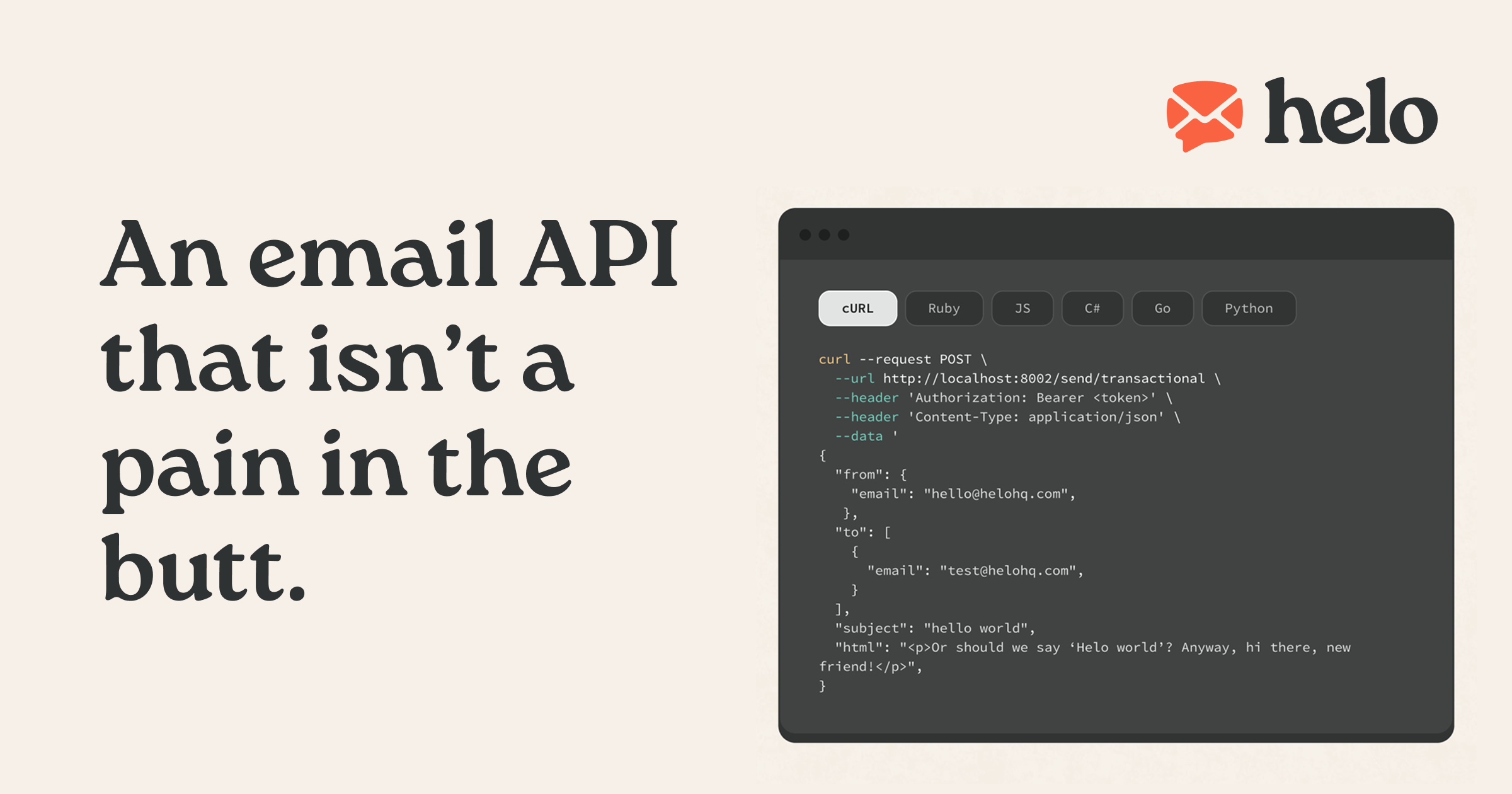
Helo is an email delivery service offering an email API and SMTP for sending email, positioned as "an email API that actually delivers." It is built for developers and for platforms that send email on behalf of their own customers. The core purpose is simple and stated plainly: Helo obsesses over getting your emails to the inbox so you don't have to. It is created by a team of self-described email nerds with years of experience in the industry, who describe themselves as intentionally lean, independent by conviction, and focused on one thing: building a modern email API you'll genuinely enjoy using, and that is affordable too. Email delivery is framed as the product's central concern rather than a side feature of a larger platform. On the surface, sending email looks simple: you send an email and the recipient receives it. Helo's own framing is that the deeper you dig, the more you realize it is a complicated thing to do well, and most people didn't get into building products to think about email. Helo positions itself against an industry it describes as full of giant corporations chasing revenue targets and startups eyeing their exit strategy, where being a customer isn't always fun. The company states that it is independent, has no investors, holds no board meetings, and has no outside influences other than what its customers want. It explicitly rejects growth-at-all-costs playbooks in favor of a product people love and a sustainable company built to last. The first stated reason to choose Helo is deliverability. Deliverability is described as the number one priority, and the team says it does everything it can to ensure emails reach inboxes as fast as possible. For anyone whose product depends on messages arriving — password resets, receipts, notifications, or marketing sends — inbox placement is the difference between a working workflow and a broken one, so Helo treats reliable, fast inbox reach as the foundation of the service rather than one feature among many. The second stated reason is speed of integration. Whether you call the powerful API or send with SMTP, Helo says you will be up and running in no time, and the product includes SDKs in popular languages. This matters because switching or adding an email provider usually means touching authentication, message construction, and error handling in application code. By offering both REST API and SMTP paths plus SDKs, Helo aims to let developers integrate email sending in minutes rather than weeks. The third stated reason is isolation for optimized deliverability. Helo's example is direct: your password reset email shouldn't suffer because you just sent a newsletter. Helo makes separation of transactional and promotional email a piece of cake, and multi-tenant environments are fully supported. In practice this means different categories of mail don't share a single reputation context, and tenants can be kept apart from one another, protecting the important, time-sensitive messages from the consequences of high-volume sends. Helo also addresses a specific and harder case: platforms that send email on behalf of their users. The company notes that when you run such a platform, email sending gets a whole lot more complicated, because one spammy customer can tank your sender reputation — you fix it, and another problem appears. Helo is built to keep that "email sending hydra" from growing back. It provides fully isolated email sending for each of your customers, catches spammers before they can ruin your sender reputation, and makes it easy for your customers to send email using their own domains. The platform documentation is available for sending for platforms. On the fundamentals, Helo covers what a developer-facing email service is expected to cover. It offers a REST API and SMTP, SDKs in popular languages, and separate transactional and broadcast infrastructure. For platforms, it keeps stats, unsubscribes, and credentials separate per tenant, which supports clean reporting and correct handling of preferences and access for each customer. Pricing is usage-based and starts at just $0.00035 per email with all features included. The pricing philosophy is stated as a benefit in itself: you pay for what you use, you don't pay for the things you don't use, and that's it — with outstanding support always included. Because all features are included under usage-based pricing, users are not pushed into higher tiers to unlock capabilities, which is a meaningful contrast with the tiered plans common in the email space. The primary benefit Helo claims for users is inbox delivery that is fast and reliable, achieved through a deliverability-first approach, isolation of sending streams, and multi-tenant support. A second benefit is fast time to value: with an API, SMTP, and SDKs, you can integrate sending in minutes. A third benefit is protection of sender reputation, so that bad senders are contained before they drag down deliverability and one customer's behavior doesn't damage the platform as a whole. A fourth benefit is cost predictability and fairness — you pay only for what you use, at a per-email rate starting at $0.00035, with all features and outstanding support included. Concrete scenarios follow directly from the described capabilities. A developer needs to send a password reset email and does not want it to suffer because a newsletter was just sent, so transactional and promotional sending are separated. A platform wants each of its customers to send email using their own domains, with fully isolated sending per customer. A multi-tenant product needs stats, unsubscribes, and credentials kept separate per tenant so each customer's activity and preferences are handled independently. A team wants to send a broadcast while keeping transactional infrastructure distinct. And a developer who wants to get started quickly can call the API or use SMTP with SDKs in popular languages. The target users are developers and platforms that send email on behalf of their customers, along with teams that care about deliverability and affordable, fair pricing. The technical surface includes a REST API, SMTP, and SDKs in popular languages, via a web application at app.helohq.com with documentation at docs.helohq.com. Pricing is usage-based and starts at $0.00035 per email, with all features included and no payment for what you don't use. Helo is presented as independent, with no investors or board meetings. Taken together, Helo's value proposition is an email API and SMTP service that treats inbox delivery as the product. It combines deliverability focus, fast integration through API, SMTP, and SDKs, isolated sending for transactional and promotional mail and for multi-tenant platforms, and usage-based pricing starting at $0.00035 per email with all features included. For developers and platforms that send on behalf of their customers, that combination is the reason Helo says it is an email API that actually delivers.
Monospace from Directus is a governed API layer positioned between enterprise data and everyone who builds on it. Its core promise is captured in two lines from the product itself: it is the governed API layer for every app, person, and agent, and it brings all your data into one space. The product lets you connect any data source, after which your developers, business teams, and AI agents receive live, read-write access to that data. Critically, this access is delivered without copying or moving any of the underlying data, so the systems of record stay exactly where they are while the people and tools that need them gain a single, governed way in. The problem Monospace addresses is rooted in legacy infrastructure. As the product explains, your oldest databases were not built with AI or modern applications in mind. Those systems hold valuable data, but they were designed for a different era of software and a different set of consumers. Exposing them to contemporary applications, to business users who want self-service access, or to AI agents that expect programmatic, read-write interaction has traditionally meant rebuilding, migrating, or duplicating those databases. Monospace avoids that entire class of work by generating interfaces directly from the databases as they are. That approach matters because it preserves existing investments in data infrastructure while unlocking the data for modern consumers. The first capability is broad connectivity. Monospace connects to any data source, which means the value of the product is not limited to a single database technology or a single vendor's ecosystem. Rather than forcing organizations to standardize or migrate before they can build on their data, Monospace meets the data where it already lives. This is useful because real enterprises run on a patchwork of systems accumulated over years or decades, and the cost of consolidating them is often prohibitive. By accepting any data source as a starting point, Monospace lowers the barrier to giving modern applications, teams, and agents access to data that would otherwise remain locked inside the systems that hold it. The second capability is live, read-write access. Once a data source is connected, the people and tools that build on it are not limited to read-only reporting or exports. Developers, business teams, and AI agents all get read-write access to the connected data. Read-write access is what makes the layer useful for real workloads rather than just observation: applications can create and update records, business teams can work with data directly, and AI agents can act on the data rather than merely describe it. The emphasis on live access reinforces that Monospace is not a snapshot or a sync engine; it reflects the state of the underlying data source as it changes. The third capability is the governance layer itself. All of these consumers — developers, business teams, and AI agents — operate under the same granular permissions model. That single model is what makes Monospace a governed API layer rather than simply an access layer. Granular permissions mean access can be scoped precisely to what each consumer needs, and because every consumer class is governed by the same model, organizations do not have to maintain separate access regimes for their human users and their automated agents. Combined with the fact that no data is copied or moved, this means governance is applied at the point of access rather than through duplicated datasets that each carry their own risk of drift, staleness, and inconsistent permissions. Monospace's distinctive approach is real-time introspection. Instead of requiring a data model to be redefined, exported, or rebuilt in a new system, Monospace generates interfaces directly from existing databases, as they are. It does this by introspecting the schema and queries in real time. In practical terms, that means the structure of the database — its tables, fields, relationships, and the queries used against it — is read by Monospace and used to produce the interface that developers, business teams, and AI agents then use. Because the introspection happens in real time, the generated interface stays aligned with the database rather than drifting from it as the schema evolves. This is the mechanism behind the product's central claim: your oldest databases do not need to be rebuilt, because Monospace generates the interface on top of them instead. The benefits follow directly from those capabilities. First, organizations avoid the cost, risk, and downtime of rebuilding legacy databases for modern applications or AI. Second, because no data is copied or moved, there is no duplicated dataset to keep in sync, and the system of record remains the single source of truth. Third, a single granular permissions model simplifies governance across every class of consumer — human and automated alike. Fourth, the combination of connecting any data source with live read-write access means the data an organization already owns becomes immediately usable by the applications, teams, and agents that need it, rather than being trapped behind a migration project. Together these outcomes turn existing, sometimes aging data infrastructure into a foundation that modern consumers can build on. Concrete scenarios follow from how the product describes itself. One is giving AI agents live, read-write access to enterprise data: rather than working from copies or stale extracts, an agent can operate against the real data under the same permissions model as everyone else. Another is enabling business teams to work directly with data that lives in systems they would otherwise need engineering help to reach, with granular permissions keeping that access appropriately scoped. A third is equipping developers to build modern applications on top of databases that were never designed for them, without a rebuild, generating interfaces straight from the existing schema and queries. A fourth is unifying access across multiple data sources: because Monospace connects any data source, organizations that run several systems can expose them through one governed layer, in one space, rather than building a separate integration for each. Monospace is explicitly built for three audiences: developers, business teams, and AI agents. The mention of enterprise data and of governance indicates the product is aimed at organizations, and it comes from Directus, an established name in data and developer tooling. Its positioning as an API layer confirms that it is consumed programmatically. The website lists no pricing tiers in the available content, and no technology stack or integration list is stated, so those details should be confirmed directly with the vendor. What is stated is the shape of the product: an API layer, governed, connecting any data source, serving developers, business teams, and agents alike. Monospace from Directus takes a clear position on a common enterprise problem: the data you already have should be usable by the apps, people, and agents of today without being rebuilt for them. By sitting between enterprise data and everyone who builds on it, connecting any data source, granting live read-write access under one granular permissions model, and generating interfaces by introspecting schemas and queries in real time — all without copying or moving data — Monospace turns existing databases into a governed foundation for modern development, self-service access, and AI. All your data. One space.
Imejis.io is a design studio built for AI agents. It connects Claude, ChatGPT, Cursor, or any Model Context Protocol (MCP) client to a remote MCP endpoint, letting the agent create, edit, preview, and export real designs on its own. The website describes it simply: your agent already writes the copy — with Imejis, it renders the image too. That means Open Graph images, social cards, marketing graphics, charts, certificates, QR codes, and more can be produced inside the agent workflow, with no screenshots and no separate design tool. The gap Imejis fills sits at the end of an AI workflow. An agent can write the copy for a post, a campaign, or a product launch, but shipping the accompanying visual has traditionally meant switching to a design tool or handing the request to someone else. Generative image models are one alternative, but they are not deterministic: the same input can produce different pixels each time, which makes it difficult to keep brand, layout, typography, and data consistent across a set of assets. Imejis takes a different approach. It gives the agent structured design components and templates that render the same way every time, so a design built once can be reused at scale while the brand stays intact. The first of three MCP tool families is Discover. Before designing anything, the agent reads get_design_guide and list_component_types, which together form a live catalog of all 27 components with their properties, defaults, and ready-made styles. According to the site, this catalog is generated from the same registry the renderer validates against, so the agent's understanding of what it can build can never drift from what the renderer will actually accept. That matters because the agent is designing blind otherwise — it needs an accurate, current description of every component before it writes any structured JSON. The Design family handles creation and editing. The agent calls create_design or create_design_from_template, then uses update_design to place text, images, charts, QR codes, tables, and shapes as structured JSON. Crucially, preview_design lets the agent check its own work before shipping, so it can iterate on a layout inside the conversation rather than producing a final asset blind. Because the design is expressed as structured JSON rather than as pixels, every element stays addressable — the agent can move a logo, retitle a chart, or swap a text field without rebuilding the whole composition. The Render family turns a finished design into a real file. export_design returns a completed image in a single call, selectable as PNG, JPEG, WebP, or single-page PDF. get_render_url goes further: it returns a permanent, signed URL that renders fresh on every request and accepts field overrides, so the agent can wire a template once and have every row or recipient render on demand. Alongside these, list_templates helps the agent find a starting point, upload_file and upload_font bring in custom assets, and get_credit_balance provides a read-only check of the plan's remaining credits. What the agent can actually build spans a broad component library. The content lists text, images, QR codes, barcodes, tables, ratings, progress indicators, and shapes, plus 22 chart types including bar, line, pie, radar, sankey, treemap, funnel, and candlestick. Each one is fully described to the agent with properties, defaults, and ready-to-render sample JSON. The site notes that the agent sees exactly the same 27 component types and 75+ styles as the editor, so output created through MCP matches what a person would build by hand in the Imejis editor or component library. Under the hood, Imejis runs a remote MCP server as a Streamable HTTP endpoint at https://api.imejis.io/api/mcp. It advertises a discovery card at a well-known server-card URL so compatible clients can find and connect to it automatically. Setup is described as taking about 60 seconds: add the single remote MCP server and authorize once over OAuth 2.0, after which the agent acts as the user. Because the system is deterministic, the same input produces the same pixels — an unusual property in this category, and the foundation for brand-safe, repeatable output. The benefit for users is continuity. The agent that drafts the copy also produces the visual, so a marketing task that once required two tools and a handoff happens in one conversation. Deterministic rendering keeps brand, layout, typography, and data consistent across an entire series of images, which is exactly what generative models struggle with. And because renders are metered the same way as the API — discovery, designing, and previews are cheap, while each finished export or render-URL request draws from a plan's render quota or credits — cost scales with actual output. The site offers concrete prompts that show the workflow in practice. A user might ask for a 1200×630 Open Graph image for a blog post titled "How MCP works," with a logo top-left and a subtle blue-to-purple gradient, exported as PNG. Another prompt generates a QR code linking to a URL, dark navy on white with rounded modules. A third builds a bar chart for "Q1 signups" from inline data with brand-blue bars. A fourth creates a reusable certificate of completion template with a name field and today's date, then returns a permanent render URL to call per recipient. Imejis also works without an agent. The same render endpoint powers no-code automations: wire a template once, then feed it data from anywhere. With n8n, a render can be triggered from any workflow node — a new row, a webhook, or a schedule — and the returned image dropped into email, Slack, or storage. With Zapier, a Zap connects a CRM, sheet, or form to a single render call, so every new lead, sale, or signup becomes a branded image automatically. With Make or a cron script, one endpoint call with a JSON body of overrides returns the image inline, with no webhooks and no polling. Any MCP-enabled client can connect, which the content spells out as Claude (Desktop and Code), ChatGPT's MCP connectors, Cursor, and custom agents built on the MCP SDK. Imejis is free to start, with 100 free renders per month and no credit card required. Renders are metered the same way as the API, and the balance can be checked from inside the agent with get_credit_balance. For teams that prefer automation platforms, the documented integrations are n8n, Zapier, and Make, all pointed at the same single render endpoint. Imejis.io is best understood as giving an AI agent a design studio rather than a picture generator. It supplies discovery, design, preview, and render tools over MCP, backed by 27 components and 75+ styles that match the editor exactly. The result is deterministic, brand-consistent imagery produced inside the agent's own workflow — no screenshots, no separate design tool, and a free tier to try it.
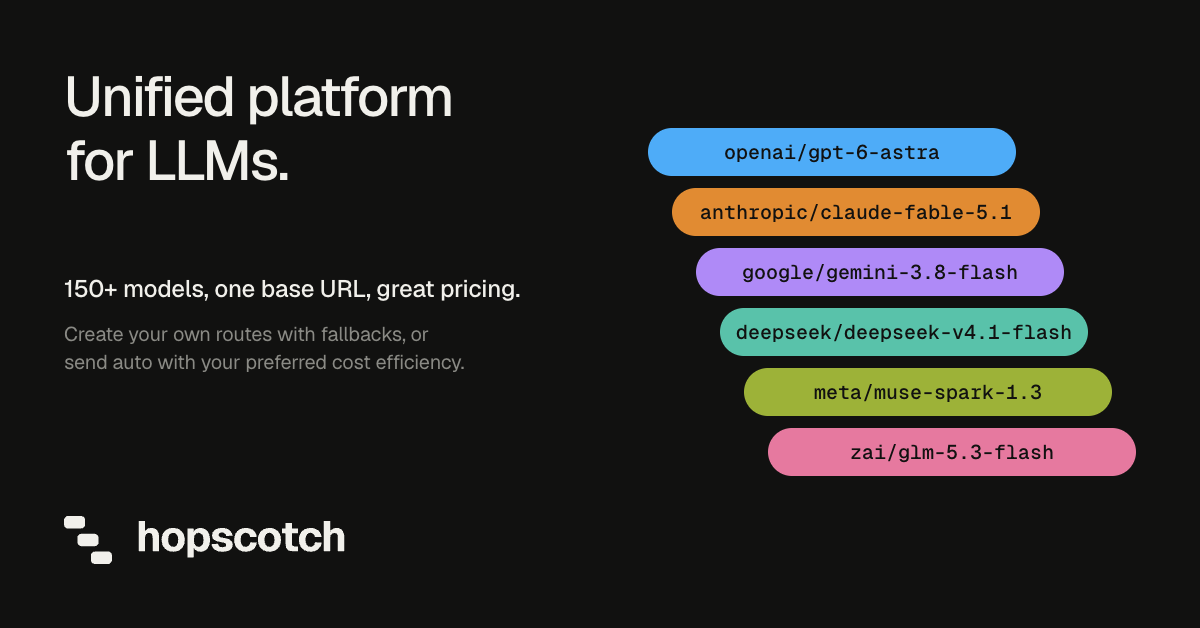
Hopscotch AI is a developer platform that provides access to more than 500 AI models from providers including Anthropic, OpenAI, Google, DeepSeek, Moonshot AI, Qwen, and Meta through a single API. Rather than maintaining a separate integration, account, and bill for every provider, developers send requests to one base URL with one key and one balance. The platform is aimed at developers and engineering teams building applications on top of large language models who also need to understand and control what those applications spend. Its stated purpose is simple: control AI costs and access top models through one API. The problem Hopscotch addresses is operational sprawl. A team that wants to use several model providers usually ends up managing a different SDK, a different set of credentials, a different dashboard, and a different invoice for each one. Model quality, speed, and price change constantly, so teams want to move between Claude, GPT, Gemini, and open-weight models as their needs shift, but every switch means more integration work. Hopscotch describes itself as the intelligence layer for AI and has raised $7.5m to build it. It consolidates provider access into one connection so that choosing a model becomes a configuration change instead of a project. The core of the product is a single API that aggregates provider access. You set a new base URL and key in the OpenAI SDK you already use, and after that switching models means changing the model name, with no new SDK to install. Model names are provider-prefixed, such as anthropic/claude-sonnet-5, and Hopscotch guarantees that the model you name is the model that runs; the Activity log shows which provider served it. Supported endpoints include chat completions and the Responses API, plus a models endpoint that lists every model you can call. A curl example and a Python quickstart are provided in the documentation. Routing profiles let you define backups. In the example shown on the site, Sonnet runs first, then GPT, then Gemini if the earlier attempts fail. Resilience works in layers: if a provider returns a 429 rate-limit response, Hopscotch moves the request to another of its keys for that provider, then to the next model in your routing profile. During an outage, Hopscotch retries your request first, then moves to the next model on your list if you use a routing profile, and for chat requests a final attempt runs your model through a backup provider. If every attempt fails, you receive an error. The Upstreams view shows how requests are distributed across providers, such as 40% Anthropic, 19% OpenAI, 15% Google, 13% DeepSeek, and 8% Moonshot AI in the example given. Spending controls are the other half of the product. You can give each key a credit limit that resets daily, weekly, or monthly, set monthly limits for individual teammates and for the whole workspace, and cap how fast the account can spend, $50 per minute by default. A request that would cross a limit is refused before it reaches the provider, which the Activity log records with a rejected outcome, zero attempts, and no upstream fetch. An owner can also pause all spending at once. This matters most for agents: if an automated loop runs unattended, the limits stop it from draining the balance. Visibility comes from three connected views. Keys show who may call, Requests show what happened, and Usage shows what it cost. The Activity log lists every request with the model, the provider that served it, the outcome, the number of attempts, total tokens, cost, and latency, and it exports to CSV. Usage breaks spend down by model, provider, key, and teammate, so costs can be attributed. Your code can also look up any request's tokens and cost through the API. Logged outcomes include successful calls, client aborts, truncated responses, and requests rejected before fetch. The playground lets you run one prompt on up to three models side by side, billed through your key like any other request, so you can compare answers and the cost of each before changing your code. The model catalog is the reference behind that comparison: each of the 500+ models lists its context window and its price per million tokens, and where several providers serve the same open-weight model, the catalog shows each provider and its price. Example entries include anthropic/claude-sonnet-5 at 2.00 in and 10.00 out per million tokens, openai/gpt-5.6 at 4.00 in and 20.00 out, and deepseek/deepseek-v4-flash at 0.44 in and 1.32 out with four upstreams. Hopscotch does not alter your requests. Prompts reach the model as written and answers come back unchanged, and by default the platform never stores your prompts or the model's responses. Some features that providers run on their own servers, such as web search, audio, and hosted tools, are not supported through Hopscotch's provider accounts, and the docs list them. You can also bring your own provider keys: add an OpenAI key, and Hopscotch sends that provider's requests on your key, with the provider billing you directly and Hopscotch charging nothing for those requests. If your key fails, Hopscotch does not silently switch to its own key. Taken together, the design keeps every part of multi-provider work, including access, routing, budgeting, and reporting, inside one connection. Your application speaks the OpenAI-compatible chat completions API it already uses; behind that endpoint Hopscotch holds the provider relationships, applies your routing profile, enforces your limits before a request is forwarded, and records the result. Because billing is pass-through, you pay each provider's list price per token with no markup and no added fees, and providers that bill you directly through your own keys cost nothing on the Hopscotch side. The result is that the model can change without the code, the budget, or the reporting changing with it. The practical benefit is less integration work and more predictability. Moving between any models in the catalog, from any provider, keeps your key, balance, and limits the same, so experimenting with a new model costs one line of code rather than a new integration. Spend limits refuse over-budget requests before they reach a provider, which protects prepaid balances from runaway agents and unexpected usage. Because the Activity log and Usage views record the model, provider, tokens, cost, and speed of every request, cost questions can be answered with data rather than estimates, and CSV export makes that data usable in spreadsheets and reports. Concrete workflows follow from those capabilities. A team evaluating a cheaper model can run a prompt on three candidates in the playground, compare answers and per-request cost, then change one line to move production traffic. A team worried about provider outages can define a routing profile, with Sonnet first and GPT then Gemini if it fails, and let Hopscotch handle retries, rate limits, and backup providers automatically. A platform owner can issue a key per environment or teammate with a monthly credit limit, set a workspace ceiling, and watch spend broken down by model and provider. A team with existing provider contracts can attach its own keys and keep paying those providers directly while still using one endpoint and one log. Hopscotch is built for developers and engineering teams, and its Product Hunt listing appears under Developer Tools and Artificial Intelligence. Integration is deliberately minimal: any client that can point at https://api.hopscotchlabs.ai/v1 and send a bearer token works, including the OpenAI SDK for Python and curl. There are no plans or subscriptions; you add prepaid credit by card starting at $5, and auto top-up can refill your balance when it drops below an amount you choose. As a Product Hunt launch offer, the first 250 Product Hunt users to sign up receive $50 in free model credits by redeeming code HOPSCOTCH50OFF in the Billing tab. The takeaway is a single connection that replaces many. Hopscotch AI turns 500+ models from Anthropic, OpenAI, Google, DeepSeek, Moonshot AI, and others into one OpenAI-compatible API, adds routing profiles and retries so a bad provider does not become a bad user experience, and enforces per-key, per-teammate, and workspace spend limits before requests are forwarded. You pay provider rates with no token markup, you can bring your own keys, and every request is logged with its model, provider, tokens, cost, and speed. For teams that want model choice without provider sprawl or surprise bills, that combination is the whole point.
QuotaMint is a backend service for managing customer plans, feature access, usage limits, and credits inside SaaS applications. According to its website and documentation, it answers one question from your backend — can this user do this, and what does it cost? — and then writes the ledger. It is built for SaaS, AI, and API products that need to meter what customers can access and consume, and the company describes its audience as developers building SaaS, AI applications, APIs, or any software with plan-based access, credits, or usage limits. The problem QuotaMint targets is a familiar one: every usage-based SaaS eventually ends up maintaining the same infrastructure, and QuotaMint turns that infrastructure into a small API. The pieces it replaces include a credits table, usage counters, monthly resets, plan checks, feature access rules, usage limits, usage history, retry protection, and upgrade and downgrade handling. As the site puts it, a usage counter is easy, but maintaining everything around it is not. Without a service like this, plan logic becomes scattered across code, counters and credit resets have to be written by hand, retry handling is difficult, usage history is difficult to reconstruct, and the implementation becomes tied to whatever billing provider is in use. The core of the product is plan configuration. You create plans — the example on the site shows a Starter plan with 500 credits per month and a Pro plan with 2,000 credits per month — and then define what each feature costs. In the documented example, generate_text costs 1 credit, generate_image costs 10 credits, and generate_video costs 50 credits. Plans can also differ in the features they enable: you can enable or disable features for each plan, so a lower tier might have AI text and images enabled while video is disabled. Plans can define different monthly credit amounts and recurring credit allocations such as monthly credits, and the site notes that initial plans can reset on a billing cycle while more advanced rollover rules are planned. At runtime, your backend calls a single endpoint: POST /v1/consume. The request body carries a customerId, which can be any identifier you already use, a feature name, and an idempotencyKey. Every call checks the plan, the feature, and the balance, then answers allow or deny. Denied calls are described as normal answers rather than errors, so when a customer runs out of credits, consume() returns allowed: false and your application decides what to show, such as an upgrade or top-up message. QuotaMint is deliberately simple to integrate: it is plain HTTPS with no SDK and no client library required, and it works from any backend language that can make an HTTPS POST, including TypeScript, Go, Python, and Ruby. It is not a gateway: your application calls QuotaMint from the backend, and you do not need to proxy all of your traffic through it. The company states that it will not slow down your application, because it is one HTTPS POST from your backend sized to run inside your request path. Retry safety is a first-class feature. You pass an idempotency key with consume(); if the same request is retried, QuotaMint returns the original result instead of consuming again. The documented example uses a job's own identifier — never a fresh UUID per attempt — so that when a network dies, a worker crashes, or a queue redelivers a message, sending the same key returns the first answer and the customer is charged exactly once. The site illustrates this with a first request consuming 10 credits and a retry consuming 0 additional credits. Related to this, all plans include atomic credit deduction and idempotency, and every consumption creates an immutable usage record with identifiers and timestamps, making usage data auditable. Visibility is handled through the dashboard. Plans, feature costs, balances, and usage history stay visible without digging through application logs. A detailed customer view shows, for example, a customer marked ACTIVE on the Pro plan, credits remaining at 740 out of 1,000, usage this month broken down into image generations, text generations, and video generations, feature access toggles showing AI Text and Images enabled and Video disabled, and a recent usage list showing entries such as generate_image -10 and generate_text -1. Usage history answers questions about when, where, and which feature consumed credits. Plans differ in how much of this data is retained: visible usage history and audit history run 3 days on Free, 30 days on Pro, and 90 days on Scale, and usage exports are dashboard only on Free, CSV on Pro, and CSV plus JSON on Scale. QuotaMint deliberately does not replace billing. It does not process cards or collect payments, and it does not need customer passwords or card details. It works alongside Stripe, Paddle, Razorpay, Lemon Squeezy, or your existing billing setup, and it is payment-provider independent. Your application tells QuotaMint which plan a customer has — assigned, upgraded, downgraded, or removed — and the plan rules then apply. If a subscription changes, you set the customer's plan in the QuotaMint dashboard, and balances and history carry over untouched. Native billing integrations are planned, but the first release focuses on usage, credits, plans, and feature access. The company frames the boundary clearly: billing providers collect money, and QuotaMint decides what a customer can use inside your application and how much they have used. Compared with API gateways that handle routing, rate limiting, and API traffic, QuotaMint focuses on application-level usage and feature access, plans, consumption history, and allow-or-deny decisions. The overall approach is to define the rules once and call one API. The documented workflow has three steps: create your plans, define feature costs, and call consume(). This keeps product access logic in one place instead of scattered across the backend. QuotaMint sits between your billing provider and your application: payment stays with the billing provider, and runtime access decisions stay with QuotaMint. Because the check happens before the work is done, your code can ask once, and if the answer is no, nothing is charged and the application can show an upgrade prompt instead. For users, the stated outcomes are a single consume() API instead of bespoke counter code, central plan configuration, consistent feature access, credit tracking, a usage audit trail, and independence from any particular billing provider. The features people commonly rebuild — credits table, usage counters, monthly resets, plan checks, feature access rules, usage limits, usage history, retry protection, and upgrade and downgrade handling — are handled by the service, and all plans include customer plans, feature entitlements, atomic credit deduction, idempotency, API authentication, monthly grants, manual credit changes, and separate Test and Live data. QuotaMint is positioned for usage-based products and meters in the units your customers already understand: images, tokens, minutes, documents, or agent runs. Its listed use cases include AI SaaS that charges credits for images, text, video, tokens, documents, or agent runs; API products that track API usage, set usage limits, and control feature access; B2B SaaS that enables features based on plans without hard-coding plan logic everywhere; and credit-based apps that manage monthly credits, top-ups, and rollovers. It can also be used for AI token usage, tracking arbitrary units such as tokens, images, API calls, documents, storage, minutes, or custom credits. Customers can buy extra credits through credit grants or top-ups, where the billing provider handles payment and your application or a future integration updates the balance. It can even be used without credits, purely for feature access or usage limits. Pricing is per workspace and usage resets on the first day of each UTC month. The Free plan costs $0 per workspace per month and includes 5,000 events each month, one project, 60 runtime requests per minute, three days of usage history, two Test and two Live API keys per project, and one team member. Pro costs $29 per workspace per month with 2,000,000 events each month, five projects, 600 runtime requests per minute, 30 days of usage history, 10 Test and 10 Live API keys per project, and five team members. Scale costs $79 per workspace per month with 10,000,000 events each month, no project cap, 3,000 runtime requests per minute, 90 days of usage history, unlimited Test and Live API keys, and 20 team members. Every plan runs the same checks, consumption, credits, idempotency, and Test/Live isolation; upgrades only add capacity. An early-bird offer, code LAUNCH50, gives 50% off the first paid billing period, with renewals billed at the listed monthly price. Every project ships with separate Test and Live environments, so teams develop against Test keys and then flip to Live keys in production. Metadata limits per event (2 KB on Free, 8 KB on Pro, 32 KB on Scale) and metadata keys (10, 30, and 100) also vary by plan. When QuotaMint is temporarily unavailable, the backend decides: retry with the same idempotency key, which is safe, or fail open or closed for critical checks, with retry and caching guidance in the API documentation. Taken together, QuotaMint's value proposition is straightforward: stop maintaining usage logic yourself and add credits, plans, feature access, and usage limits to your SaaS with one API, while keeping your existing billing provider and the customer identifiers you already use.
Gemini 3.8 Flash TTS and Gemini 3.8 Flash-Lite TTS are two new text-to-speech models added to the Gemini family, described by Google as its most expressive audio generation models yet. The models generate custom character voices and direct scene dialogue across Google AI Studio, the Gemini API, Gemini Enterprise, Gemini Notebook, and Google Vids. Gemini 3.8 Flash TTS is built for deep creative direction and character design, while Gemini 3.8 Flash-Lite TTS is built for high-volume, cost-efficient scale. Google frames the release as a shift that transforms voice generation from static presets into a dynamic creative studio, serving creators, developers, and enterprises who want to produce richer, more expressive audio experiences. The models complement the fast-growing Gemini Audio family, which already includes 3.5 Live Translate, 3.5 Transcribe, 3.8 Live, and 3.8 Live Extended Thinking. The problem the announcement frames is that voice generation has traditionally been locked to static presets, which limits how much a creator can shape a character, a narrator, or an agent's personality. Google states these models enable richer, more expressive audio experiences while also improving user experiences in products such as Gemini Notebook and Google Vids. The intended outcomes are high-quality audiobooks, podcasts, and real-time voice agents at scale, plus global dubbing and media localization with nuanced regional accents. Creating and customizing voices is the first pillar of the release. Google says the models let teams scale up from 30 original voices to an infinite library, so an entirely original character voice or a consistent brand ambassador can be produced as needed. Generative voice design in Gemini 3.8 Flash TTS lets users create bespoke voices from scratch by customizing role, accent, and voice characteristics across more than 100 languages and dialects using natural language prompting; Google's examples include bringing a dramatic, fire-breathing dragon to life or crafting a charismatic narrator with a distinct regional cadence. Beyond generated voices, an expansive voice library offers 2,000+ production-ready voices with broad language coverage, including regional varieties such as Mexican Spanish, Quebec French, and Scots English. Voice replication lets users recreate consistent vocal profiles from just a 30-second audio sample of their own voice or a voice they have the rights to use, backed by built-in consent verification, SynthID watermarking, and C2PA credentials intended to protect both developers and their vocal talent. A save-and-scale capability lets users save and manage the custom voices they designed, ensuring consistent performance and minimal drift across ongoing projects. Voice remixing is listed as coming soon: users will be able to pick a voice from the voice library and fine-tune timbre, pitch, pace, and accent, using prompts such as "add subtle Southern US accent" or "soften the delivery" to dial in specific characteristics. Once a voice is chosen, both models provide precise control over how each line is delivered. Users can direct performance line by line by writing their own stage directions or letting Gemini steer delivery with natural script cues, covering everything from a calm customer service agent to a whispered suspense scene. Long-form generation maintains high voice quality, natural pacing, and character timbre across hours of continuous audio with minimal speaker drift, which Google calls ideal for podcasts and audiobooks. Native two-speaker scene staging directs multi-turn conversations seamlessly from a single script, whether for a podcast or dramatic storytelling, while keeping both voices distinctly separated with natural conversational turn-taking. Scripted vocal bursts and backchanneling add realistic conversational texture through non-verbal cues such as , , and , plus active-listening interjections like |mhm| or |yeah|, enabling precise comedic timing and reaction beats. The overall approach is prompt-driven and script-driven: natural language prompts turn descriptions of role, accent, and character into vocal personas from scratch, and written scripts become fully performed dialogue scenes with directable delivery. Google positions these models as delivering expressive, high-quality speech generation built for global scale. Gemini 3.8 Flash TTS secured the number one overall spot on Hume AI's Voice Design Benchmark with a score of 71.4 and also led in accent modeling at 60.8. Gemini 3.8 Flash TTS and Gemini 3.8 Flash-Lite TTS took the number one and number two spots respectively on Hume AI's Overall Quality Index, and Google reports major improvements on use cases such as long-form content and dual-speaker screenplay control compared with Gemini 3.1 Flash TTS. In blind human preference evaluations on Voice Arena, the models secured top positions among competitors in key global languages including Japanese, Brazilian Portuguese, Vietnamese, Modern Standard Arabic, Mexican Spanish, and Hindi, with support for over 100 languages. For users, the stated benefits center on expressive, natural-sounding output that can be produced at scale without sacrificing reliability or consistency. Creators get granular creative control instead of preset-bound voices; developers get speech generation they can deploy into voice interfaces and voice agents; enterprises get multilingual reach and cost-efficient volume. Because the models maintain quality across hours of audio and keep two speakers clearly separated, teams can produce long-form and conversational content that holds together from beginning to end. Built-in safety tooling, including watermarking, is presented as a way to keep generated audio secure and to help prevent misinformation while still allowing ambitious creative work. Concrete scenarios described in the announcement include high-quality audiobooks, podcasts, games, immersive audiobooks, interactive media, and real-time voice agents at scale. Developers can experience the speech generation capabilities in the Google AI Studio audio playground, which is built like a voice design workspace where they can prompt entirely new vocal identities from scratch or replicate their own voice and then bring them into a dual-speaker screenplay editor to direct line-by-line delivery. Google's partners are integrating the models to accelerate global dubbing, localize media with nuanced regional accents, and power conversational voice agents at scale. Example voices demonstrated in the announcement include a high-energy DJ voice from Melbourne, a super-tinny monotone robot voice, and a Japanese dragon brought to life. Gemini 3.8 Flash TTS is rolling out for developers in the Gemini API and Google AI Studio, for enterprises coming soon via API in Gemini Enterprise, and for everyone in Gemini Notebook. Gemini 3.8 Flash-Lite TTS rolls out starting the same day for developers in the Gemini API and Google AI Studio, for enterprises coming soon via API in Gemini Enterprise, and for everyone in Google Vids. Through the Gemini API, developer platforms such as Agora, LiveKit, Pipecat, and Vercel enable developers to build and deploy high-performance speech generation experiences with ease. Google is also partnering with companies including Figma, HeyGen, Linguana, Wondercraft, 99.co, and Ollang. Voice replication through AI Studio is not available in Illinois, Texas, EEA, UK, Switzerland, and India. No pricing details are given in the announcement. Gemini 3.8 Flash TTS and Gemini 3.8 Flash-Lite TTS take text-to-speech beyond static presets by pairing natural-language voice design and voice replication with line-by-line performance direction, long-form stability, native two-speaker staging, and availability through Google AI Studio, the Gemini API, Gemini Notebook, and Google Vids. For anyone producing audio at any scale, the promise is expressive, natural-sounding speech with the control of a director and the safeguards of an enterprise platform.
Maximem Synap is a memory and context management layer for AI agents, shipped as a developer SDK, a REST API, and a hosted MCP endpoint. You send Synap the conversation as it happens, and before your agent replies you ask what is known about this person; Synap returns a short, ranked set of facts, formatted and ready for the prompt. The product is aimed at teams building agents for customer support, sales, voice, healthcare, and multi-agent workflows, so that every conversation does not start from zero. Synap handles entity resolution, temporal reasoning, and multi-level scoping automatically, and the company states there is no vector database to run, no extraction pipeline to build, no retrieval ranker to tune, and no scoping logic to get right - those are the product. Reported accuracy is 92% on LongMemEval and 93.2% on LoCoMo, with in-conversation retrieval under 15ms at P75. Synap exists because agents forget, and the site treats that as an architecture problem rather than an interface nitpick. The listed symptoms are concrete: the agent re-asks for information the user already gave, recommends what the user already rejected, contradicts itself across sessions, or compensates by stuffing everything into the prompt, which produces slow replies and a blown token budget. The company frames these failures as tickets, refunds, and churn. It also argues that every alternative has been tried and each one stops short. A bigger context window runs into U-shaped attention, so models lose the middle; quality falls as the window fills and cost grows quadratically because history is replayed every turn. A vector database and RAG finds text that looks alike but has no view of what is current, no record of where a fact came from, and no idea that 'Acme' and 'Acme Corp' are one company. Agent skills steady a procedure but do not supply a fact - across 528 matched runs, the skill was steadying the procedure 65.7% of the time and supplying a missing fact 4.5% of the time. Summarising as you go compounds losses, and doing it properly means entity extraction, temporal reasoning, contradiction handling and validation, at which point you have built a memory system. Building it in-house is possible, but retrieval is the easy part; the months go into deciding what to keep, resolving entities, handling contradictions, and keeping tenants apart, then maintaining all of it forever. Every one of these workarounds is described as a stand-in for a missing layer. Synap treats memory as three layers rather than one bucket. Short-term memory is the current session, the working memory that most memory tools provide. Long-term memory persists across sessions, per person - the layer a user means when they say an agent remembers them. Organisational memory is shared across users and tenants: policies, product facts, and pricing, meaning company knowledge rather than personal knowledge. The company states that most memory tools give you the session and that the value sits in the two layers above it. Scoping enforces that structure: a request sees its own level and every level above it, never below and never sideways. The out-of-the-box hierarchy is Client, Customer, User - shared product knowledge visible to everyone, tenant-level policies, teams and shared projects, and the facts, preferences and episodes private to one person. One person's memory does not reach another person's session and one tenant's does not reach another tenant's. When three levels is not the right shape, teams can define a custom hierarchy at any depth with the names they already use, such as Hospital, Department, Clinician, Patient. On the read side, Synap focuses on anticipatory retrieval. Context is pre-fetched while the conversation is still going, so it is ready before the agent asks, at under 15ms at P75 in-conversation. That matters most for voice agents, which stay conversational instead of pausing mid-turn. Retrieval is also described as resilient: a bad day for one part of the system is not an outage, and retrieval nets across all stores. Agentic compaction keeps context lean as conversations grow, so cost does not balloon and quality does not rot; it keeps the signal, drops the noise, and tells you when it worked. Validation is part of the pitch, since compaction is reported rather than assumed. Together, these read-side capabilities are what the company presents as the difference between storing memory and actively managing context, and they are the reason a growing conversation does not automatically mean a growing prompt. On the write side, a conversation turn does not land in a database. It runs through a pipeline that turns raw dialogue into structured, scoped memory: asynchronous ingest, extraction of structure rather than raw text, and storage across vector, graph, and file stores - vectors for semantic similarity, a graph for entity relationships, and files for documents and raw material. The write call returns before any of that happens, so it never blocks the agent. What governs the pipeline is a custom context architecture generated for each agent, controlling extraction, scoping, retention and more, rather than a one-size schema. Structured capture and entity resolution mean that 'Sarah', 'Sarah Chen' and 'SC' resolve to one person automatically, and references such as 'my manager' are linked across sessions. Temporal awareness weights recent context higher than stale context. Conscious forgetting processes retractions and contradictions, and because a change never destroys the previous version, every memory can be traced back through provenance. Consolidation runs as background cycles on the stores in three tiers - meditation, a light pass every few hours; nap, a deeper pass once a day; and sleep during quiet hours for deep consolidation and conscious forgetting. Synap's distinctive approach is that it treats memory as an active context-management problem layered on top of storage, rather than a storage problem alone. It works in two calls: you record the conversation as it happens, and before your agent replies you fetch what is known, receiving formatted context ready for the prompt. Everything the pipeline does behind that write call is invisible to the agent - extraction, scoping, retention, and consolidation run behind it. The memory architecture itself is generated for your specific agent instead of being fitted to a universal memory model, which the company contrasts with approaches built on extracted facts plus embeddings or on a temporal knowledge graph. Reads mostly never leave your process because context is pre-fetched while the conversation is still going. The framework is described as native across 23 agent frameworks, with adapters that let developers install the SDK, configure an API key, and start managing context in a few lines of code. The stated outcomes are reliability, cost control, and speed. Agents remember every user across sessions, channels, and months rather than the last twenty turns, so they stop re-asking for information and stop recommending what was already rejected. They remember the organisation through shared policies, product knowledge, and team context made visible to the agents that should see them and isolated from the users and tenants that should not. Context stays lean as conversations grow, which means the token bill does not balloon and quality does not rot; compaction keeps signal over noise and reports when it worked. Context arriving before the agent asks keeps voice agents conversational. Accuracy is reported at 92% on LongMemEval - the benchmark that tests whether a memory system retrieves the right fact from a long conversation and holds that accuracy as the conversation grows - and 93.2% on LoCoMo, with the methodology published and the eval harness open source so teams can run it against any system they are evaluating. Synap is not limited to a fixed list of applications. The site names customer support and sales agents, voice concierges, healthcare assistants, and multi-agent workflows among the places teams run it today, with dedicated use-case pages for healthcare, customer support, sales, voice AI, and multi-agent systems. In support and sales, the relevant value is recall of what a customer said in earlier sessions so an agent does not reopen a resolved issue or contradict a previous answer. In voice, the value is latency: sub-15ms P75 in-conversation retrieval keeps a voice agent conversational instead of pausing to think. In healthcare, the scoping model and custom hierarchy matter - the site illustrates a Hospital, Department, Clinician, Patient shape. In multi-agent workflows, shared organisational context reaches the agents that should see it while per-user and per-tenant memories stay isolated. The primary audience is developers and teams building AI agents who need production-grade memory without building it themselves. Synap provides Python and TypeScript SDKs, a REST API usable from any language, a hosted MCP endpoint for no-code platforms, and a CLI. The documentation states that most developers are up and running in under five minutes. Native integrations cover 23 agent frameworks, including LangChain, LangGraph, LlamaIndex, OpenAI Agents, Pydantic AI, CrewAI, AutoGen, Google ADK, Haystack, Agno, Semantic Kernel, Microsoft Agent Framework, NeMo Agent Toolkit, LiveKit Agents, Pipecat, Claude Agent SDK, Mastra, Vercel AI SDK, Vercel eve, Strands Agents, CAMEL-AI, Smolagents, and deepagents. Security includes encryption in transit and at rest, strict tenant isolation, BYOK for model providers, and on-premise, self-hosted, and air-gapped options, with PII posture applied per kind of data and down to what an individual API key may see. Enterprise plans add VPC and private deployment, SSO and SAML, configurable RBAC, and custom SLAs. The free tier requires no credit card and supports Google or GitHub sign-in, and the SDK plus the benchmark eval harnesses are open source on GitHub. For teams whose agents need to remember, Maximem Synap packages the whole problem - what to keep, how to scope it, when to retrieve it, and when to let it go - into a memory and context layer with reported benchmark accuracy of 92% on LongMemEval and 93.2% on LoCoMo, in-conversation retrieval under 15ms at P75, and native coverage of 23 agent frameworks. It replaces the workarounds teams currently reach for, including larger context windows, vector RAG, agent skills, rolling summaries, or a homegrown system, with a two-call interface and background consolidation, so that every conversation no longer starts from zero.