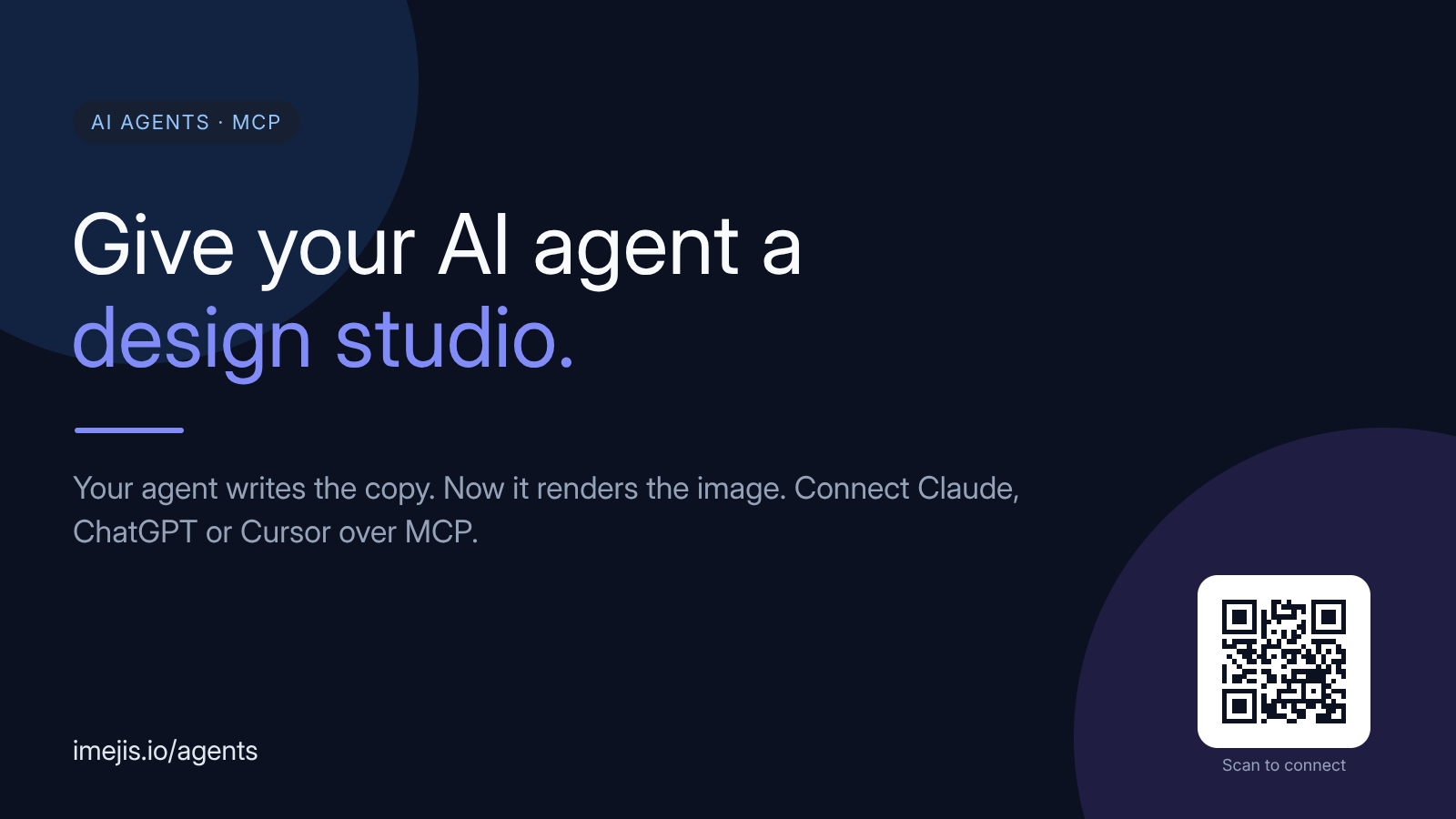
Imejis.io is a design studio built for AI agents. It connects Claude, ChatGPT, Cursor, or any Model Context Protocol (MCP) client to a remote MCP endpoint, letting the agent create, edit, preview, and export real designs on its own. The website describes it simply: your agent already writes the copy — with Imejis, it renders the image too. That means Open Graph images, social cards, marketing graphics, charts, certificates, QR codes, and more can be produced inside the agent workflow, with no screenshots and no separate design tool.
The gap Imejis fills sits at the end of an AI workflow. An agent can write the copy for a post, a campaign, or a product launch, but shipping the accompanying visual has traditionally meant switching to a design tool or handing the request to someone else. Generative image models are one alternative, but they are not deterministic: the same input can produce different pixels each time, which makes it difficult to keep brand, layout, typography, and data consistent across a set of assets. Imejis takes a different approach. It gives the agent structured design components and templates that render the same way every time, so a design built once can be reused at scale while the brand stays intact.
The first of three MCP tool families is Discover. Before designing anything, the agent reads get_design_guide and list_component_types, which together form a live catalog of all 27 components with their properties, defaults, and ready-made styles. According to the site, this catalog is generated from the same registry the renderer validates against, so the agent's understanding of what it can build can never drift from what the renderer will actually accept. That matters because the agent is designing blind otherwise — it needs an accurate, current description of every component before it writes any structured JSON.
The Design family handles creation and editing. The agent calls create_design or create_design_from_template, then uses update_design to place text, images, charts, QR codes, tables, and shapes as structured JSON. Crucially, preview_design lets the agent check its own work before shipping, so it can iterate on a layout inside the conversation rather than producing a final asset blind. Because the design is expressed as structured JSON rather than as pixels, every element stays addressable — the agent can move a logo, retitle a chart, or swap a text field without rebuilding the whole composition.
The Render family turns a finished design into a real file. export_design returns a completed image in a single call, selectable as PNG, JPEG, WebP, or single-page PDF. get_render_url goes further: it returns a permanent, signed URL that renders fresh on every request and accepts field overrides, so the agent can wire a template once and have every row or recipient render on demand. Alongside these, list_templates helps the agent find a starting point, upload_file and upload_font bring in custom assets, and get_credit_balance provides a read-only check of the plan's remaining credits.
What the agent can actually build spans a broad component library. The content lists text, images, QR codes, barcodes, tables, ratings, progress indicators, and shapes, plus 22 chart types including bar, line, pie, radar, sankey, treemap, funnel, and candlestick. Each one is fully described to the agent with properties, defaults, and ready-to-render sample JSON. The site notes that the agent sees exactly the same 27 component types and 75+ styles as the editor, so output created through MCP matches what a person would build by hand in the Imejis editor or component library.
Under the hood, Imejis runs a remote MCP server as a Streamable HTTP endpoint at https://api.imejis.io/api/mcp. It advertises a discovery card at a well-known server-card URL so compatible clients can find and connect to it automatically. Setup is described as taking about 60 seconds: add the single remote MCP server and authorize once over OAuth 2.0, after which the agent acts as the user. Because the system is deterministic, the same input produces the same pixels — an unusual property in this category, and the foundation for brand-safe, repeatable output.
The benefit for users is continuity. The agent that drafts the copy also produces the visual, so a marketing task that once required two tools and a handoff happens in one conversation. Deterministic rendering keeps brand, layout, typography, and data consistent across an entire series of images, which is exactly what generative models struggle with. And because renders are metered the same way as the API — discovery, designing, and previews are cheap, while each finished export or render-URL request draws from a plan's render quota or credits — cost scales with actual output.
The site offers concrete prompts that show the workflow in practice. A user might ask for a 1200×630 Open Graph image for a blog post titled "How MCP works," with a logo top-left and a subtle blue-to-purple gradient, exported as PNG. Another prompt generates a QR code linking to a URL, dark navy on white with rounded modules. A third builds a bar chart for "Q1 signups" from inline data with brand-blue bars. A fourth creates a reusable certificate of completion template with a name field and today's date, then returns a permanent render URL to call per recipient.
Imejis also works without an agent. The same render endpoint powers no-code automations: wire a template once, then feed it data from anywhere. With n8n, a render can be triggered from any workflow node — a new row, a webhook, or a schedule — and the returned image dropped into email, Slack, or storage. With Zapier, a Zap connects a CRM, sheet, or form to a single render call, so every new lead, sale, or signup becomes a branded image automatically. With Make or a cron script, one endpoint call with a JSON body of overrides returns the image inline, with no webhooks and no polling.
Any MCP-enabled client can connect, which the content spells out as Claude (Desktop and Code), ChatGPT's MCP connectors, Cursor, and custom agents built on the MCP SDK. Imejis is free to start, with 100 free renders per month and no credit card required. Renders are metered the same way as the API, and the balance can be checked from inside the agent with get_credit_balance. For teams that prefer automation platforms, the documented integrations are n8n, Zapier, and Make, all pointed at the same single render endpoint.
Imejis.io is best understood as giving an AI agent a design studio rather than a picture generator. It supplies discovery, design, preview, and render tools over MCP, backed by 27 components and 75+ styles that match the editor exactly. The result is deterministic, brand-consistent imagery produced inside the agent's own workflow — no screenshots, no separate design tool, and a free tier to try it.
Publisher
A
admin
Launch Date2026-09-30
Platformweb
Pricingfreemium
Tech Stack
#Model Context Protocol (MCP)#OAuth 2.0#Streamable HTTP