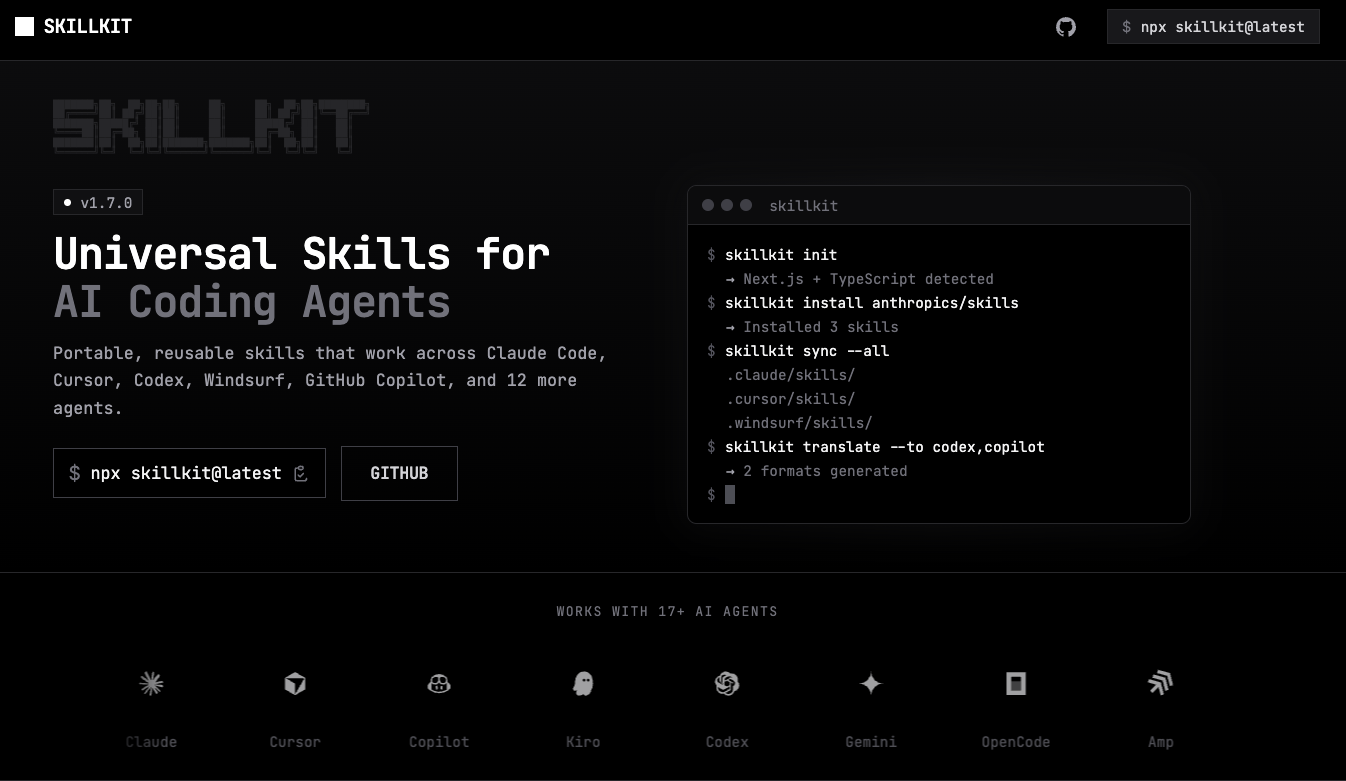

SkillKit is a comprehensive, open-source package manager and infrastructure platform specifically designed for AI coding agents, enabling developers to write skills once and deploy them across 46 different AI agents. It serves as a universal skill platform that aggregates content from over 34 sources, scans more than 400,000 skills from various registries, and provides auto-translation capabilities to ensure compatibility with a vast ecosystem of AI assistants like Claude, Cursor, Copilot, and Gemini. The platform is built for developers, team leads, and enterprise architects who need to manage, share, and orchestrate AI agent capabilities efficiently across projects and teams, offering a complete local workflow with advanced features for skill generation, testing, and team synchronization.
Developers face significant challenges when working with multiple AI coding agents, as each platform typically requires skills to be written in a specific, proprietary format, leading to duplication of effort and fragmented knowledge. Teams struggle with inconsistent skill sets across developers, making onboarding difficult and reducing collaborative efficiency. Furthermore, configuring AI agents for new projects is often tedious, and managing skills across different machines or ensuring security and best practices becomes a complex, error-prone process without a centralized, intelligent system to handle translation, discovery, and deployment.
One of SkillKit's major feature groups is its extensive aggregation and auto-translation engine, which pulls skills from 35 official and community sources, including repositories from Anthropic, Vercel Labs, Expo, and Supabase. The system automatically translates skills between 46 different AI agent formats, functioning as an 'npm for agent skills' where developers can write a skill once and have it work everywhere. This translation capability is comprehensive, covering agents from Claude and Cursor to more niche tools, and is detailed in a compatibility matrix that shows support across categories like skill translation, hooks, MCP tools, and context window management.
A second major feature group revolves around persistent intelligence and advanced workflows, including session memory that allows AI learnings to persist across sessions and projects. The platform includes a Primer feature that auto-generates optimized agent instructions for all 46 agents by analyzing a user's codebase. It also provides a Skill Tree for browsing the 400,000+ skills in a hierarchical taxonomy with 12 categories, and Workflows for composing multi-step automated skill sequences, enabling complex task automation and error handling directly within the SkillKit environment.
admin
Additional capabilities include robust team and security features, such as Git-based team synchronization using a .skills manifest to ensure consistency across developers. A built-in security scanner with 46 rules detects prompt injection, secrets, and malicious patterns in skills. The platform also offers a built-in test framework with assertions for validating skills, CI/CD integration for GitHub Actions and GitLab CI, and slash command auto-generation for agents like Claude and Cursor, making it a full-stack tool for skill development and deployment.
Technically, SkillKit operates as a command-line interface (CLI) tool that runs entirely locally, ensuring zero telemetry and maximum privacy. It aggregates skill data from numerous open-source registries and repositories, processes them through its translation engine, and manages them via a local database. The system supports REST and MCP (Model Context Protocol) APIs for runtime skill discovery, along with a Python client, and can even establish a mesh network for encrypted peer-to-peer communication and inter-agent messaging across multiple machines in enterprise setups.
Users benefit from measurable outcomes such as drastically reduced time spent configuring AI agents for different platforms, consistent skill sets across development teams leading to faster onboarding, and improved security posture through automated scanning. The ability to 'write once, deploy everywhere' eliminates redundant work, while features like AI-generated skills from natural language and smart codebase analysis accelerate the initial setup and optimization of AI assistants for any new project or codebase.
Concrete use cases include a multi-agent developer who has built skills for Claude Code but needs them to work for Cursor and Windsurf, using SkillKit's translate command. A team lead can initialize a shared .skills manifest to ensure all developers have identical capabilities, synced via Git. A new project starter can run the primer command to auto-configure best-practice instructions for all agents based on their codebase. An enterprise architect can set up a mesh network to keep AI agents in sync across multiple servers with encrypted P2P communication.
The target users are developers, engineering team leads, and enterprise architects working with AI coding agents. It integrates with 46 AI agents, sources from 34+ repositories, and supports a tech stack including CLI, REST APIs, MCP, and Python. The platform is open-source, with no mentioned pricing plans, emphasizing community contribution and local execution. It is built for real workflows, from solo developers to large infrastructure management.
In summary, SkillKit provides a foundational infrastructure for intelligent, distributed AI agent orchestration, moving beyond simple installation to offer a complete ecosystem for skill management. It solves critical fragmentation problems in the AI coding assistant space by unifying skill formats, enabling persistent learning, and providing enterprise-grade tools for teams, security, and automation, all while maintaining user privacy through local execution.
SkillKit targets developers, engineering team leads, and enterprise architects who utilize AI coding assistants like Claude, Cursor, or GitHub Copilot. It is for technical users who need to manage, share, and deploy skills across multiple AI agent platforms, seeking to avoid vendor lock-in and redundant work. The tool serves both solo developers wanting to enhance their personal workflow and larger teams requiring consistency, security, and scalable infrastructure for AI agent orchestration. Its open-source, local-first approach appeals to privacy-focused users and organizations integrating AI into their development lifecycle.