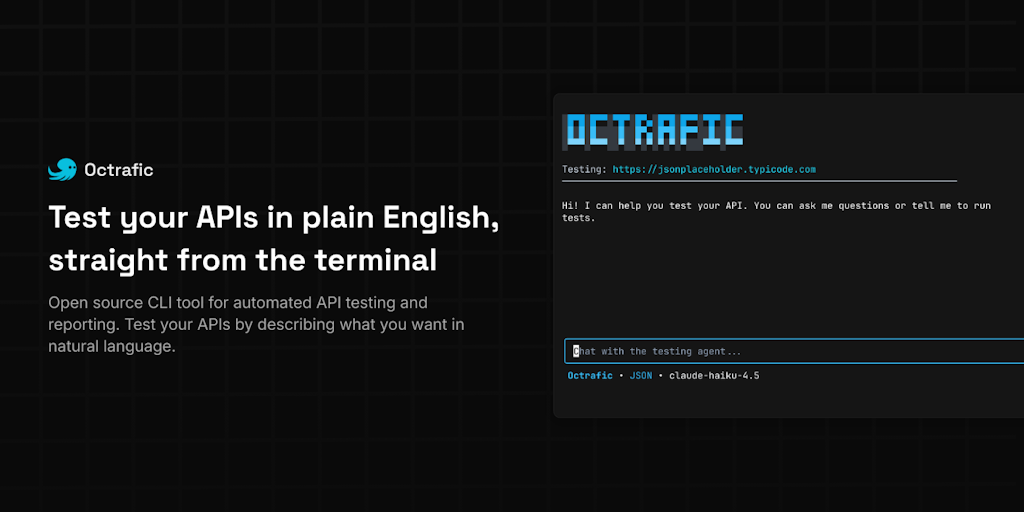
Octrafic is an open-source CLI for API testing that lets you describe tests in plain English. It handles everything from generating requests to validating responses and exporting PDF reports.
Octrafic is an open-source CLI tool that enables plain English API testing directly from the terminal. Designed for backend developers, DevOps engineers, and QA teams, it transforms how APIs are tested by removing the need to write code. Users describe what they want to test in natural language, and the AI agent interprets the request, plans test scenarios, executes real HTTP calls, validates responses, and generates professional PDF reports. This core value proposition—speed, simplicity, and accessibility—makes API testing accessible to technical and non-technical team members alike.
Traditional API testing often relies on complex test frameworks like Jest or Pytest, which require writing and maintaining substantial test code, or heavyweight GUI tools like Postman that introduce performance overhead. These approaches create friction: developers spend more time wrestling with test scripts than actually validating endpoints. Octrafic solves this pain point by accepting plain English instructions that eliminate boilerplate and learning curves. Instead of debugging test code, users focus on what matters—ensuring their API behaves correctly. This shift accelerates development cycles, reduces maintenance burden, and empowers team members who lack coding expertise to contribute to API quality.
The first major feature group is Natural Language API Testing and the integrated AI Agent. Users simply type commands like “test /users endpoint” or “check if /users returns paginated results.” The AI agent breaks the request into concrete test scenarios, determines which HTTP methods to use, executes real requests against the live API, and validates status codes and response bodies. This feature is immensely useful during rapid development cycles—developers can quickly verify new endpoints without switching contexts or writing test code. It also allows non-technical QA engineers to run comprehensive tests by describing expected behavior in plain English, significantly lowering the barrier to thorough API validation.
The second major feature group includes One-Command PDF Reports and Headless Mode. After executing tests, users can export results to a styled PDF with a single command, perfect for sharing with stakeholders or archiving test outcomes. The PDF includes detailed test results, durations, and pass/fail statuses. Headless Mode enables running tests in CI/CD pipelines without any interactive TUI—it accepts a URL and test specification, executes tests, and returns exit codes for integration with tools like GitHub Actions, GitLab CI, or Jenkins. This allows teams to automate regression testing on every commit, catching issues before they reach production, and generating auditable reports automatically.
Publisher
A
admin
Launch Date2026-03-01
Platformdesktop
Pricingfree
Domain Authority
Ahrefs DR3/100
Traffic Insights
Month2026-01
Estimated Visits0
MoM Visits GrowthN/A(+0)
Avg Time on Site0s