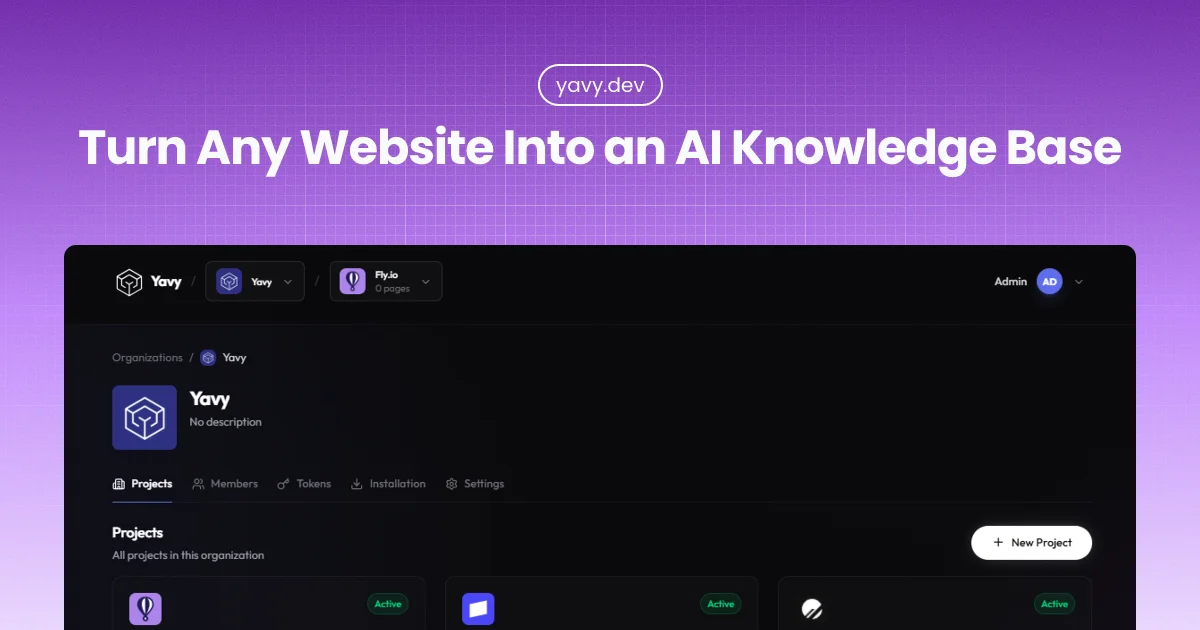
Yavy turns any public website into an MCP server that provides AI-searchable knowledge bases. It crawls, indexes, and serves content to AI tools like Claude and Cursor for accurate, up-to-date information.
Yavy is an AI knowledge platform designed to transform any public website, documentation portal, or content repository into a structured, searchable knowledge base that AI assistants and development tools can query directly. It serves developers, technical teams, and organizations that rely on accurate, up-to-date information from their documentation, help centers, API references, and internal wikis, ensuring that AI-powered workflows are always grounded in the latest factual content. The primary purpose is to bridge the gap between static online content and dynamic AI interactions, providing a reliable source of truth that prevents AI hallucinations and outdated responses by continuously syncing and indexing source material.
Traditional web scraping and manual documentation lookup are fragile, noisy, and time-consuming processes that often lead to AI tools providing incorrect or deprecated information. Developers waste valuable debugging time when AI suggests outdated APIs, and customer support chatbots might confidently invent policies not found in actual help articles. This creates significant pain points around reliability, accuracy, and workflow efficiency, as teams struggle to keep AI assistants informed with current, verified content from their ever-evolving documentation, product guides, and internal knowledge bases.
The platform's first major feature group revolves around intelligent content ingestion and semantic indexing. Yavy crawls specified content sources such as websites, GitHub repositories, Notion workspaces, or Confluence spaces, extracting meaningful content from every page. It then employs AI-enhanced indexing and semantic search with vector embeddings, which allows AI agents to find relevant information based on conceptual meaning rather than just keyword matching. This ensures that queries return the most contextually appropriate chunks of documentation, even when the exact terminology differs, providing signal instead of noise.
A second core capability is the provision of multiple integration paths for delivering this indexed knowledge directly into AI workflows. Users can choose between a CLI-first approach with portable Skills packages or a real-time MCP server connection. The CLI allows searching documentation from the terminal and generating offline skill packages that AI tools load as local knowledge, while the MCP server enables AI assistants to query content in real-time with always-fresh data. This flexibility ensures the knowledge base fits seamlessly into existing developer environments and AI toolchains.
Publisher
A
admin
Launch Date2026-02-03
Platformweb
Pricingfreemium
Domain Authority
Ahrefs DR4/100
Traffic Insights
Month2026-01
Estimated Visits0
MoM Visits GrowthN/A(+0)
Avg Time on Site0s