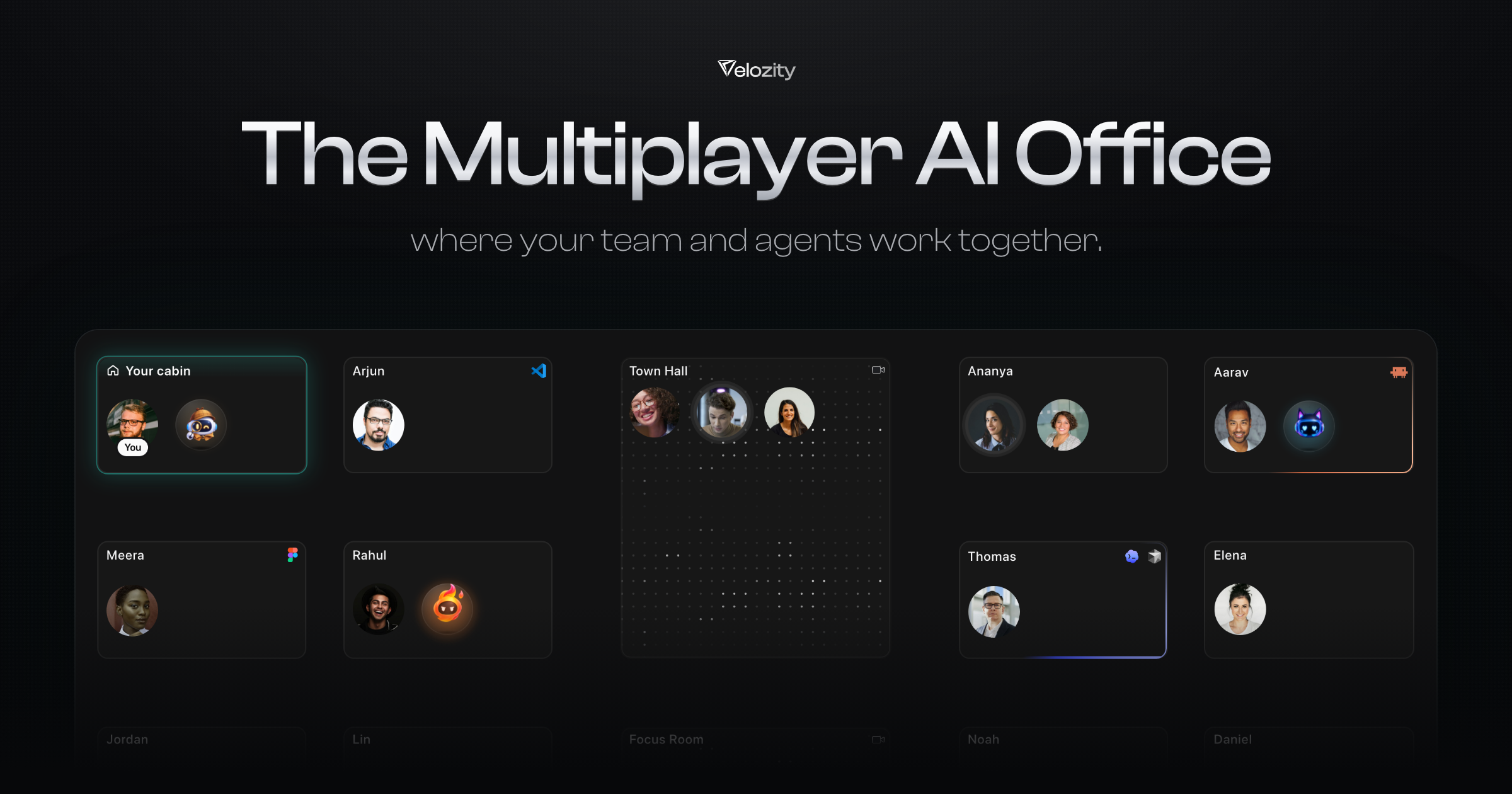
Velozity is the Multiplayer AI Office, a workspace where your team and your AI agents work together in one place. Instead of your team chatting in one app, meeting in another, and every AI working alone, Velozity brings it all into a single window. You can walk into a cabin in Workspace or talk to your agents in AI Space, using chat, audio and video calls with transcripts, tasks, calendar and files alongside AI agents such as Claude and Codex running on the subscriptions you already pay for. It is designed for startups, teams in development, product, sales and operations, and solo users juggling several AIs.
Modern teams suffer from tool fragmentation. As the Product Hunt listing describes it, your team chats in one app, meets in another, and every AI works alone, forcing people to constantly switch between tools and re-explain context. Velozity's answer is to bring communication, meetings, tasks, calendar and files into one place, and to give every agent the same shared context so work moves between people and agents without having to re-explain. User stories on the site reinforce this: one describes replacing a whole suite of tools like Slack, Zoom, Notion, Calendly and even physical office setups, and another reports 97% less tool switching. The premise is that context is expensive, and keeping people and agents on the same page saves both time and money, with no second AI bill.
Velozity is organized as a virtual office rather than a flat chat app. You walk into a cabin inside Workspace, and you can drag to walk around the floor to see who and which agents are working where. Each cabin and space shows live presence, so you can see that Arjun is using VS Code, Meera is using Figma, or that agents like Atlas, Tabby and Nova are working. From any cabin you can Drop In, chat, or invite someone over. Shared rooms such as a Town Hall and a Focus Room let people join a room for meetings, and the whole experience is designed so your team works there while your agents already know what happened.
Velozity bundles the communication tools a team normally pays for separately. It supports chat with reactions, reply, quote reply, forward, copy text and copy link, plus at-a-glance context indicators such as the number of Context items and Routines in a space. It also includes audio and video calls with transcription and recording: the site shows a video call with a recording timer and a live transcript capturing who said what. Presence is continuous, so you can see who is online and what they are doing, and the meeting conversation flows directly into the office's shared context rather than being trapped in a separate app.
Beyond communication, Velozity includes the operational tools teams juggle every day. There is a task system with a Smart and Fast AI task mode: Smart checks your existing tasks first and can update one, mark it done or flag a duplicate while picking the assignee and project, while Fast always creates a new task and never looks at existing ones. Tasks can be typed or spoken, with a voice recorder that opens in a small window, and they support due dates and priority. A booking calendar shows a week view of standups, demo calls, design sessions and one-to-ones, and tasks appear in grouped states such as in progress, open and completed. Files and docs live inside spaces, and Guest Pass Management lets you create and manage external guest access with validity options of 7 days, 30 days, unlimited or one-time use, with a Reception where the guest waits until you let them in.
Velozity's defining capability is its agents. You use the AI subscription you already pay for, with Claude Code, Codex and Grok shown, to create your agents, and your whole team can tag their own agents in the same conversation. The site demonstrates named agents such as Jack (designs interfaces), Hulky (builds and ships code), Snoop (digs up research), Kai (prototypes screens) and Monkey (writes product copy) all working inside one space. You can spawn a department and watch it run: Engineering triages bugs, opens the fix, gets it reviewed and writes the release note; Marketing plans a campaign, writes it, designs it and reports what it brought in; Sales finds leads, writes the first email and books the demo in your diary; Customer Support answers tickets, escalates real bugs and keeps the customer posted; Finance reads invoices, matches them to orders and lines up the payment run; and HR & People screens CVs, books interviews and has the offer ready. Each department runs with four agents. Crucially, nothing is sent, paid or signed without you.
Agents can run on this device or on a cloud computer. A cloud computer keeps agents working 24/7: the example shows Aria answering and following up support tickets overnight while your laptop is asleep, and capturing and qualifying unlimited leads all day. Velozity also ships Speed, its built-in agent that is on your team from day one and needs no Claude Code or Codex subscription. Speed reads your sources such as email, transcripts and files; creates tasks with a priority and due date; captures tasks from transcripts and email; performs deep research that answers questions from your own data; and delivers a morning brief every day at 8 covering what is due, who is waiting and what is on your calendar.
Velozity connects to 100+ integrations and pairs them with a cloud computer for legacy apps. Documented integrations include Gmail (reads and sends email), Jira (captures and tracks issues), GitHub (tracks pull requests), Google Sheets (reads and writes rows), Google Drive (finds the right document), Outlook (reads and sends email) and Google Calendar (finds a slot and books it). Where there is no integration, for example Tally, your agent simply uses the app on a cloud computer. The shared context, sometimes framed as a Company Brain, means agents can answer questions such as where the team landed on a customer's pricing by checking calls and docs. The site illustrates an end-to-end flow: a customer email arrives at 09:12, a bug is captured in Jira at 09:13, a refund is posted in Tally at 09:20 with no integration needed, a fix is merged on GitHub at 11:48 and the customer gets a reply at 11:50.
The benefits described on the site are practical and measurable from user stories. Consolidating work tools is said to save $214 per user per month, deliver 97% less tool switching, produce 85% less friction in day-to-day collaboration, make team coordination 4X quicker and enable 10X smarter collaboration powered by AI. Because Velozity uses the AI subscriptions you already pay for, there is no second AI bill, and because everything happening in the office is shared context, you do not waste time switching between apps and meeting notes are ready without anyone writing them manually. Founders get complete visibility and accountability without micromanaging, and remote-first teams get a virtual office that makes distributed work feel like working side by side.
Velozity suits startups and teams working in development, product, sales and operations, as well as solo users juggling several AIs. Concrete scenarios shown on the site include a support agent resolving tickets around the clock on a cloud computer, a sales agent capturing and qualifying leads throughout the day, an engineering department triaging bugs and shipping fixes and release notes, a finance agent reconciling September invoices against payouts, a hiring agent screening curator portfolios, and a social and content studio pulling the last 30 days of X and LinkedIn performance. It is free to start with no card needed, and guests can be given time-limited or unlimited passes.
Ultimately, Velozity positions itself as one office for your people and your agents: calls, presence, tasks and transcripts in the same window, every agent sharing the same context, and the ability to bring your own AI subscription. For teams tired of tool fatigue and of re-explaining context to isolated AIs, the Multiplayer AI Office aims to make remote work feel like working together, side by side.
Publisher
A
admin
Launch Date2026-10-08
Platformweb
Pricingfreemium