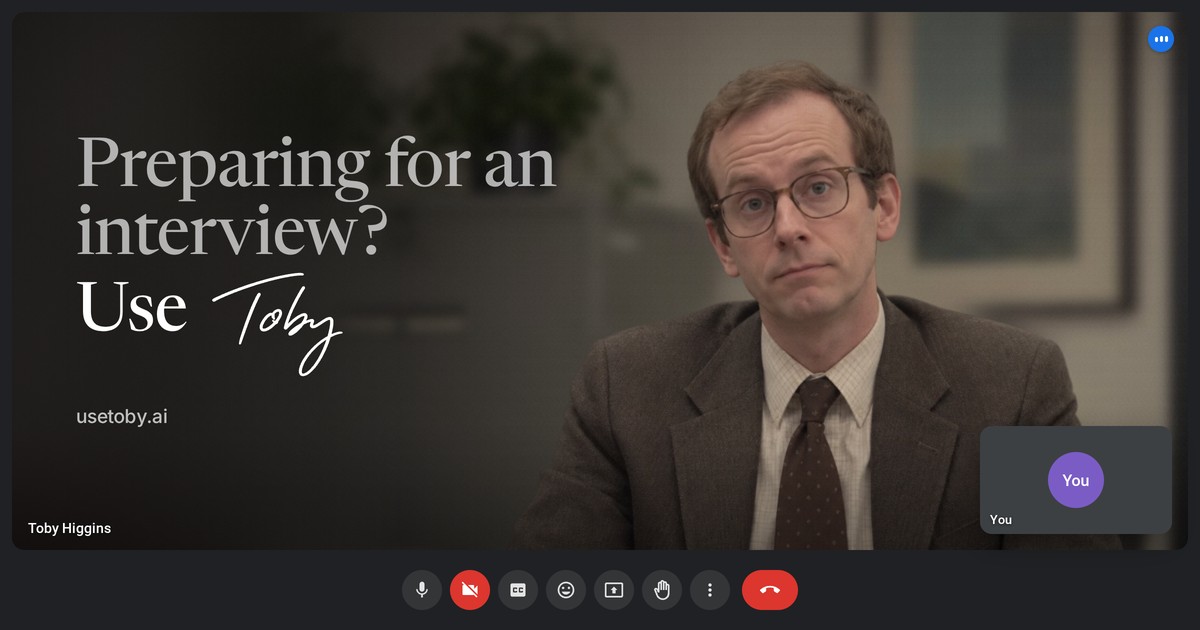
Toby is an AI mock interviewer designed for anyone preparing for a real job interview. You paste a job description, and Toby builds the questions a real panel would ask, from the warm-up to the curveball, then interviews you on a Google Meet, Teams or Zoom-style call. Afterwards you receive a scored debrief that breaks down every answer: what worked, what to fix, and a stronger version of each answer built only from what you said. Toby Higgins, the AI interviewer, asks the questions, listens, and tells you exactly what to fix, positioning the whole product as "the interview before the interview."
The core promise is that this is not a generic list of questions. Toby is built for the interview you have actually got. Preparing for an interview usually means reading a wall of sample questions that have nothing to do with the company, the role or the round you are facing, and then hoping the real conversation goes well. Toby instead researches the company, maps every round and plays the interviewer, then shows you exactly what to fix. Practice happens in a Meet, Teams or Zoom-style call "so the real thing feels familiar," and the closing message on the site sums up the outcome: walk in having done it already, having practised the hard questions before they count.
The first part of the product is preparation. Tell Toby the role and it builds your brief: what the company does, how it makes money, what has happened lately and how the team works. The brief covers the company's stage, size, HQ and business model at a glance, recent news and culture signals, dated, and talking points worth raising in the room. In the worked example shown on the site, a candidate preparing for a Senior Product Manager, Payments role at Fernleaf is given a summary of the company as spend management for UK and EU small businesses (company cards, bill pay and expenses in one account), plus its Series B stage, £45m in funding, roughly 200 staff and a London HQ. Recent news items are dated, such as hiring a new CFO from a listed payments company in August 2026 and launching bill pay in Ireland and the Netherlands in June 2026. Suggested talking points include asking how SEPA failure rates compare with Faster Payments, noting that interchange is most of the company's revenue so authorisation rate is a revenue metric, and offering a short written plan for your first 90 days in light of the company's memo culture.
The second part maps the interview itself. Toby maps the interview process and what each round is assessing, then lists the questions most likely to come up in each one. Every round is shown with how long it runs and what it tests; in the example these are a 30-minute recruiter screen, a 45-minute hiring manager round, a 60-minute product case and a 45-minute values interview. Questions are tagged by competency and difficulty, and marked when real candidates have reported them. The site lists sample questions such as "What made you apply to Fernleaf, and why this payments role in particular?" tagged customer focus, motivation and easy, and a question about leading a squad of six engineers without line management tagged cross-functional leadership, leadership and medium. Users can also browse separate company interview guides.
Practice is shaped around the round you are facing and the time you have. You pick the round (recruiter screen, hiring manager, product case or values) and the length, choosing 10, 20 or 30 minutes, whatever you've got. Real mode runs the interview straight through, like the day itself, with the full debrief at the end. Coach mode gives you a note or two after each answer and a chance to try again, and coach notes only appear once you have finished talking. The call is taken in a Google Meet, Teams or Zoom-style environment so the real thing feels familiar, with your camera on or off, and Toby will wait while you think. If you leave the call, he waits: "he's very patient," and you can rejoin.
The debrief is where the feedback lands. You get a score against the role's rubric, then every answer is broken down: what worked, what to fix, and a stronger version built only from what you said. Each competency is scored 1–5, with the quote behind it, and the debrief also reports pace, talk time, filler words and answer length, alongside the full transcript, question by question. In the example on the site, a recruiter screen debrief scores 60 out of 100 with the headline "Solid examples, light on measurable impact," customer focus scored 3/5, talk time 35%, pace 136 wpm against a 130–160 ideal, and one filler word ("actually" ×1). The stronger version is built only from what the user said and adds bracketed prompts — such as adding the result as a number, from what, to what, over what time — that the user fills in with their real details.
Overall, the method is simple and explicitly described. You paste a job description; Toby researches the company, maps every round and plays the interviewer; you take the call; and you get a scored debrief and a stronger version of each answer. Everything it tells you is anchored to your own words rather than a generic script, which is what makes the feedback specific to your role, your company and your rounds rather than to interviews in general.
The stated benefits follow directly from that loop. Because you have already sat the interview once, in the same style of call, familiarity replaces novelty on the day. Because each competency is scored with the quote behind it, you know exactly what to fix rather than vaguely feeling underprepared. Because delivery metrics such as talk time, pace and filler words are surfaced, you can adjust how you speak as well as what you say. And because the suggested rewrites are drawn only from your own answers, the improved version still sounds like you, with placeholders prompting you to add the numbers and details you left out.
Typical use cases are the rounds the product supports. You might rehearse a recruiter screen before an introductory call, work through hiring manager questions that probe your background and domain experience, run a longer product case round, or prepare for a values interview. Between rounds, Coach mode lets you pause after each answer, take a note such as "Good, specific example. Now size it: from what, to what, over what time?" and try again. Separately, the prep brief lets you research a company before the interview, gathering its business model, latest news and talking points worth raising in the room.
Pricing is pay by the minute rather than a subscription. Your first 5 minutes on a call are free — enough to warm up and see how Toby's feedback works — and prep briefs, likely questions for every round, Real or Coach mode and a debrief on what you answered are included; you save a card to see your debrief, and it is not charged. After that, minutes cost £0.50 each, bought in packs from £5, are only used on a call, and last 6 months. There is no subscription, you can stop whenever you like, and every round and both modes are available. The pricing panel lets you choose a mock interview of 10, 20, 30 or 60 minutes, with £10.00 shown in the example. Toby runs on the web, with sign-up through app.usetoby.ai.
In short, Toby's value proposition is that you can practise the hard questions before they count. It turns a job description into a researched prep brief, a mapped interview process and a realistic mock interview call, then converts that call into scored, quotable feedback and stronger answers built only from what you said — so that on the day, the conversation is something you have already had.
Publisher
A
admin
Launch Date2026-10-14
Platformweb
Pricingfreemium