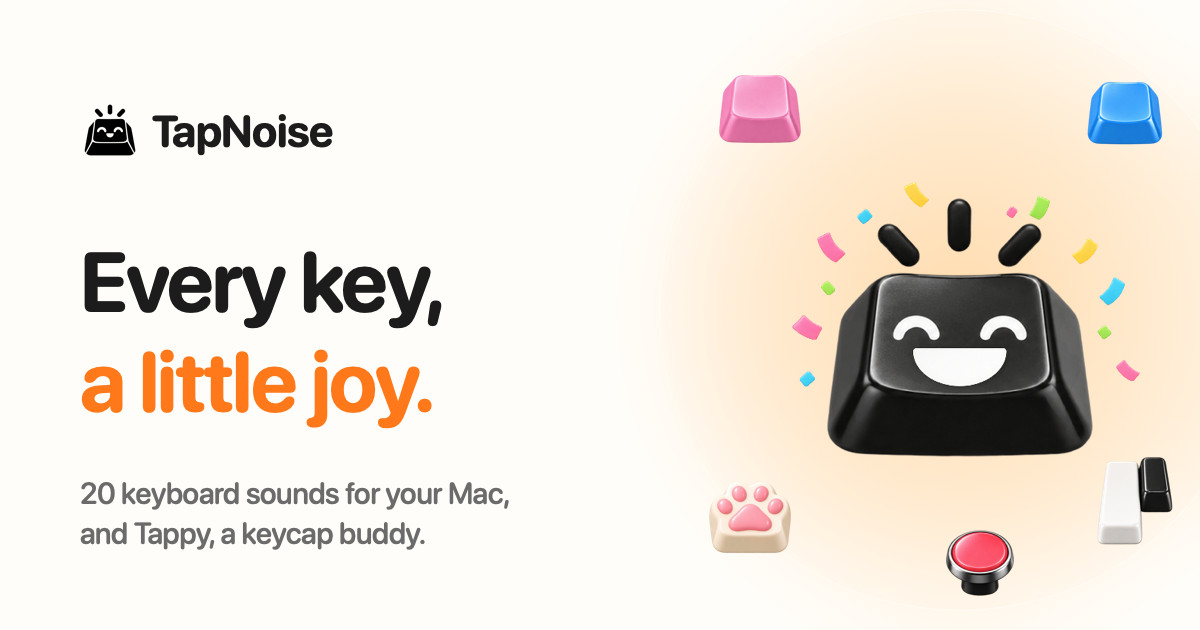
TapNoise is a Mac app that gives your keyboard the sound of a dream keyboard. It ships with 20 keyboard sounds, from a deep thock to tiny paws, and it adds Tappy, a little keycap character that lives on your desktop and reacts to everything you do. TapNoise plays its sounds under every key and in every app on your Mac, and it also tells you when your AI coding agent is done or needs you. It is built for Mac users who want typing to sound and feel better, and for developers who look away from the terminal while an agent works. You can try everything free for three days with no card, and then pay once for one Mac or two.
Most keyboards on modern MacBooks are quiet, flat and identical, which is why so much of the appeal of a custom mechanical board comes down to how it sounds and feels under your fingers. TapNoise exists to bring that tactile pleasure back to the Mac you already own, without buying new hardware. It also addresses a very specific modern annoyance: while an AI coding agent runs, you either stare at the terminal waiting for it or you look away and lose time checking back. Rather than being only a novelty sound toy, TapNoise uses the same sensors that make the sounds to do practical work, so the app is fun first and surprisingly handy second.
The heart of the app is its library of 20 keyboard sounds. Ten are grouped as Keyboards: Thock, Creamy, Clicky, Silky, Hushed, Bumpy, Pillowy, Clunky, Chunky and Retro. Ten more are grouped as Fun: Typewriter, 8-bit, Bubble, Piano, Rain, Paws, Kalimba, Woody, Marbles and Laser. Thock is described as deep and heavy, like a custom board, while Paws is a tiny-paw sound and Rain brings a soft patter. These are the app's own sounds and they play under every key, in every app. From the menu bar you can turn TapNoise on or off, set the volume and switch sounds with one click, and Tappy, Clean Mode and Guard Mode live there too, so you never have to dig through a settings window just to change what you hear.
TapNoise takes keyboard realism further than playing one sample for every press. Most keyboard sound apps play every key the same; TapNoise feels how hard you press through the MacBook's motion sensor, so every key plays as loud as you hit it. Type softly and it whispers, hit hard and it clacks. Every key also gets a take of its own, so fast typing never sounds like a machine gun, and Space, Return and Delete sound like the bigger keys they are. The stereo image follows the key from left to right, which means the sound tracks your hands across the board. On top of raw typing, the app adds sound for the rest of the MacBook: slap it and it says ouch, the lid creaks like an old door and creaks faster the faster you move it, and the charger and USB plugs each get their own little sounds.
Tappy is the companion that turns typing into something you can watch. Tappy sits in a corner of your screen, can be dragged anywhere, presses along with every key, and shows your words per minute underneath. Tappy has moods: Happy while typing along with you, Sweating when you are typing fast, On fire when you are really fast, Dizzy when someone slaps the Mac, Snacking when the charger goes in, Ears covered when Caps Lock is on, Sleepy when it is late, Asleep when you have been away, Party when you level up, and Bye when the lid is closing. Every tap is XP, so you type, level up, unlock hats for Tappy, keep a daily streak going, watch your typing speed, and get a card of your week to share. Hats unlock at levels: the party hat at level 2, sunglasses at level 4, headphones at level 6, a beanie at level 8, a chef's hat at level 10 and a crown at level 15.
The tools section is where the app earns its keep beyond sound. Knock commands let you knock twice on your MacBook to pause the music, mute your mic in a call, or answer a waiting AI agent, while three knocks lock the screen. Guard Mode is designed for leaving your MacBook at a café table: if someone lifts it or pulls the charger, it sounds a loud alarm, and turning it off takes your Touch ID or password. Clean Mode holds the keyboard and trackpad still so you can wipe them without typing nonsense or clicking anything, shows a countdown so you know when it is done, and lets you hold Esc to stop early. A shortcut cheat sheet appears when you hold Command for a second, showing every shortcut in the app you are using, and disappears when you let go. Break buddy reminds you to stretch after a long stretch of work and nudges you when you start hammering the keys. Song Mode lets Piano, Kalimba or 8-bit play the next note of a song on every key, so you can type an email and hear Für Elise. Typing speed appears live under Tappy with your best today and your best ever, and Quiet in calls makes TapNoise go silent while any app is using your microphone, so nobody in the meeting hears your thock.
For developers, TapNoise acts as an audio notification layer for AI coding agents. If you are coding with Claude Code, Codex or Cursor, you can look away while the agent works and TapNoise will chime when your agent is done or needs you, so you stop checking the terminal. A rising little chime plays and Tappy throws a party when the agent is done; two quick taps play and Tappy sweats until you answer when it needs you; a falling note plays and Tappy covers its ears on an error. When an agent is waiting, you can knock twice on your MacBook and its window jumps to the front, or you can simply click Tappy. Connection is done in one click from Settings, Agents, Connect: TapNoise backs up your settings first, adds one small hook, and Remove takes it out again. It works with Claude Code for done, needs you and errors, Cursor for done and errors, and the Codex CLI for done. The cues are made from the keyboard sound you picked, so they sound like part of your Mac rather than another alert, and they stay quiet in calls and follow your volume.
TapNoise is private by design, and the app states this plainly: it hears keys, never words. Instead of reading characters, TapNoise learns which key position went down, like the third key on the second row, so it can play the right sound. It never sees what you type, keeps only counts such as taps today, and has no analytics. There is no account to sign up for and no tracking in the app, and your stats, levels and hats stay on your Mac. Network calls are kept to a minimum: TapNoise goes online to activate and check your license key with Dodo Payments, and once a day to look for an update. Nothing about your typing is sent. From AI agents it hears only done, needs you or error, never your code or prompts, and the hook it adds to each agent's settings file is backed up first so it can be removed cleanly. The app is also built to be light: on a MacBook Air, typing at full speed uses about 4% of one CPU core and around 30 MB of memory, and the motion sensor slows down when you are not typing and turns off with the features that use it.
The outcomes TapNoise aims for are straightforward. Typing becomes more satisfying because every keypress has weight, texture and direction instead of a single flat click. Fast typing stays clean and natural rather than turning into a machine-gun rattle. Your MacBook itself becomes expressive, reacting to slaps, lid movement and plugs. Tappy turns ordinary typing into light progression with levels, hats, streaks and a weekly card. Developers regain attention: instead of watching a terminal, they get a chime and a knock-to-answer shortcut that brings the agent's window back to the front. And the practical tools quietly cover small daily problems such as wiping a keyboard, protecting a laptop at a café table, muting your keyboard during calls, and remembering shortcuts or taking a stretch break.
Concrete scenarios show how this plays out. A developer runs Claude Code or Cursor in the background, looks away to read documentation, hears the chime when the agent finishes, and knocks twice on the MacBook to jump back to the terminal. A writer at a café enables Guard Mode so that anyone lifting the laptop or unplugging the charger triggers a loud alarm, and later uses Clean Mode to wipe the keys without triggering a flood of accidental typing. Someone on a Zoom or FaceTime call keeps the satisfying thock on their desk while TapNoise automatically goes quiet because the microphone is in use. A typist picks Song Mode with Piano, Kalimba or 8-bit and types an email note by note, then checks the live words-per-minute figure under Tappy and keeps a daily streak going. Someone learning an unfamiliar app holds Command for a second to see every shortcut, and Break buddy nudges them to stretch after a long session.
TapNoise is aimed at Mac users generally, and most specifically at MacBook owners who care about how their keyboard feels and sounds, plus developers using AI coding agents. It requires macOS 14 or later. Any Mac with macOS 14 or later plays the key, click, charger and USB sounds, with the built-in keyboard or any keyboard you plug in, and Guard Mode sounds its charger alarm. The motion-based features, which include harder press meaning louder sound, slaps, knocks and Guard Mode's lift alarm, need a MacBook with a motion sensor: MacBook Pro with M1 Pro or M1 Max and later, and MacBook Air with M2 and later. Lid sounds need a lid angle sensor, which covers the same models plus the 2019 16-inch MacBook Pro. Sounds start within a few milliseconds of the key; with AirPods or other Bluetooth headphones, Bluetooth itself adds delay, so TapNoise can play its sounds through the MacBook speakers instead. Pricing is a one-time purchase: a three-day free trial with no key and no card, then Solo at US$9.99 for one Mac or Duo at US$14.99 for two Macs, plus tax, with launch prices of US$4.99 and US$7.99 while launch licenses last. Checkout is by Dodo Payments, every update is included, there is no subscription, and there is a 14-day money-back guarantee. TapNoise is made independently by Rudra Satani, who also makes NotchMind.
In short, TapNoise gives your keys a voice: 20 keyboard sounds, a pressure-sensitive feel, a small desktop companion called Tappy, and a set of genuinely useful tools built on the same sensors. It turns an ordinary Mac keyboard into something satisfying to type on, and it keeps developers in the loop with their AI agents without staring at a terminal.
Publisher
A
admin
Launch Date2026-10-11
Platformdesktop
Pricingpaid