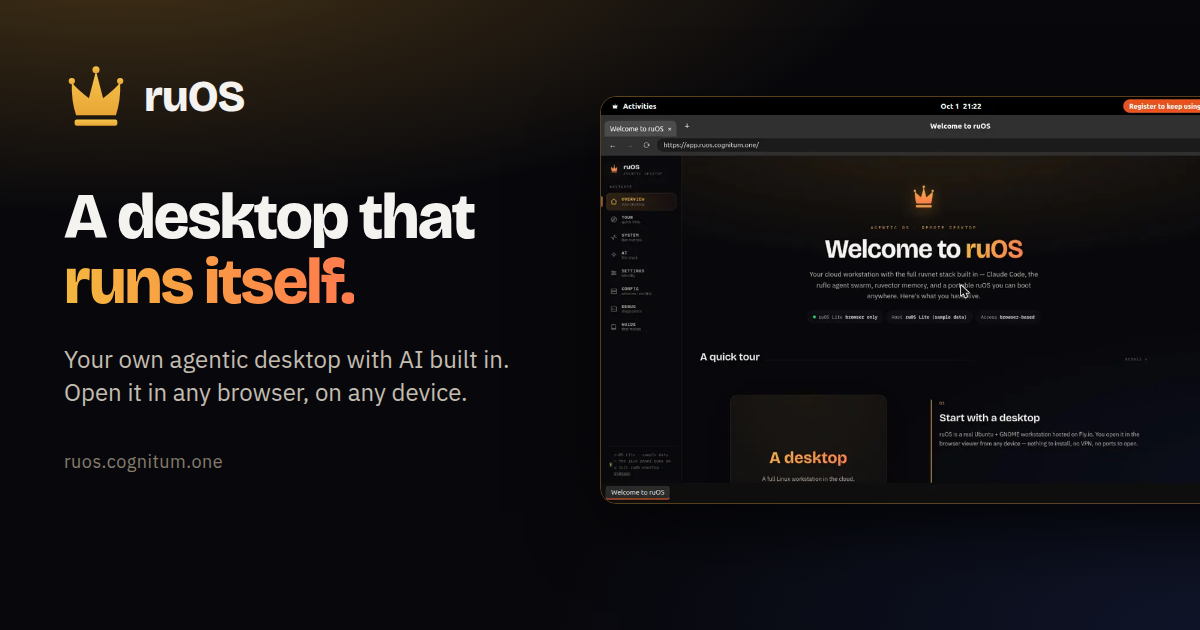
ruOS is a private cloud desktop with an AI team built in. It is designed for people who want an agentic workspace where AI does the work for them — research, writing, and code — without installing anything. You sign up, ruOS sets up your own private desktop, and you open it from any web browser on a Mac, iPad, Chromebook, or Linux laptop. A free option, ruOS Lite, runs a real Chrome browser drawn as your ruOS desktop right in your web page, and opens in about a second with no sign-up required.
Most AI tools today live in a single chat window. You ask a question, you get an answer, and then you copy that answer somewhere else to actually finish the work. Your context, your files, and whatever the AI learned are scattered across tabs, apps, and devices. ruOS starts from a different premise: instead of a chat box you visit, you get a desktop that runs itself, with AI helpers already installed, signed in, and working side by side. Nothing has to be configured, and nothing has to be synced, because the desktop and everything on it live in one place that you reach from any browser.
Everything is ready the moment you sign in. ruOS ships with smart AI helpers built in that write and run code, research on the web, remember your projects, and understand what is on your screen — all working together from day one. Claude Code is ready to write and run code for you. ruflo is a team of AI helpers. ruvector remembers your work, giving your agents long-term, self-learning memory. ruview understands your screen. Codex is available as extra coding help, and VS Code is the code editor. Because the helpers are preinstalled and signed in, the AI stack is ready as soon as your desktop starts — you do not have to wire up models or connections yourself.
ruOS opens in any web browser, so there is nothing to install. The same session reshapes to any screen: sharp on a big monitor and comfortable on a tablet, with no fiddling with zoom. You can start on a laptop and keep going on an iPad, because your whole desktop goes with you. ruOS Lite goes further in simplicity — it draws a real Chrome browser as your ruOS desktop inside your web page, with tabs and windows, a dock of apps, and the ruOS app first. It opens in about a second, and it picks up where you left off: sign-ins, site data, and open tabs are saved and encrypted.
Persistence is built in. Your files and everything the AI has learned are saved automatically, so you can come back tomorrow and pick up right where you left off — even from a different device. The desktop is yours and private: your files, your work, and your AI are kept separate and private from everyone else's. In ruOS Lite, VS Code and extensions are available too — vscode.dev sits in the dock, along with 1Password, Bitwarden, Claude, and uBlock Origin Lite when you turn them on. Your AI can drive it: ChatGPT and Claude see and click the desktop through the ruOS connector, never your extensions, and payments wait for you.
The workflow is four simple steps. First you sign up: enter your email and ruOS sets up your own private agentic desktop, bound to your account, with no setup and nothing to configure — it is ready in minutes. Second, your desktop turns on: a private desktop starts up in seconds with the whole AI stack preinstalled and signed in, including Claude Code, a team of helpers, and self-learning memory. Third, the AI gets to work: ask for something and it is done, with a whole team of AI helpers researching, writing, and coding side by side while you watch — or step away and come back to finished work. Fourth, you open it anywhere: your desktop streams to any web browser and reshapes to the screen, the same session on your Mac, iPad, or laptop, with nothing to install and nothing to sync.
Once you are in, the things you can ask for are simple. It writes and runs code: tell it what you want changed, and it edits the files, runs the tests, and tells you when it is done. It works as a team: it splits a big job across several AI helpers that work side by side. It remembers: it keeps track of what you are working on, so you never explain twice. It researches: ask a question and it browses the web, reads the sources, and brings back the answer. And it goes with you: your whole desktop travels with you, so you can start on your laptop and keep going on your iPad. Hand ruOS a task and it picks the right tool and gets to work.
The outcome for users is fewer hand-offs and less copying between tools. Because the AI helpers run on the same desktop where your files live, research, writing, and code happen in one place rather than across scattered apps. Because memory persists, you do not repeat yourself or rebuild context each session. Because the desktop is private and per-account, your files, work, and AI stay separate from everyone else's. And because everything opens in a browser, switching devices does not mean setting anything up again.
For developers and power users, ruOS is also a build platform. Under the hood it is a real Linux box with the full ruvnet stack and programmatic control, and everything is already installed on your desktop. ruOS runs an MCP server — ruos-computeruse-mcp — so an AI client like Claude can drive the desktop for real: see the screen, move the mouse and type, run shell commands, trigger system actions, and change the resolution on the fly. The exposed tools include screenshot, mouse_move / left_click, type_text / key (xdotool), run_shell, system_action, and desktop_resolution. You can point an MCP client at your desktop using stdio over SSH, and after launch you can resize with desktop_resolution presets of 720p, 1080p, 1440p, or qxga, or a custom width × height, applied server-side via xrandr. A hosted MCP endpoint is on the roadmap.
The ruvnet stack is one command away, all preinstalled. Open a terminal on your desktop and use the same commands the AI helpers run for you: npx ruflo@latest init wizard to set up agent-swarm orchestration, npx ruflo@latest swarm init --topology hierarchical to spin up a team of AI agents, npx ruvector to give your agents long-term, self-learning memory, and npx ruflo to run the ruflo agent runtime. For quick start, ruOS provides an MCP address at https://ruos.cognitum.one/mcp. In ChatGPT you go to Settings → Apps & Connectors → Create, paste the address, and sign in. In Claude you go to Settings → Connectors → Add custom connector, paste the address, and sign in. In Claude Code you run claude mcp add --transport http ruos https://ruos.cognitum.one/mcp.
ruOS in ChatGPT uses only the desktops and metered entitlements already assigned to your account. The ChatGPT app and its linked review surfaces do not present pricing, checkout, subscriptions, upgrades, or credit purchases. Getting started is straightforward: you can try ruOS Lite free in seconds with no sign-up, or get early access by signing up, after which your desktop is ready a few minutes later.
ruOS takes the idea of an AI assistant and turns it into a place you work. It is a browser-reachable, private, agentic desktop where a team of AI helpers — Claude Code, ruflo, ruvector, ruview, and Codex — researches, writes, and codes alongside you, remembers your projects, and follows you from device to device. Nothing to install, nothing to sync, and nothing to configure: sign up once and the desktop does the rest.
Publisher
A
admin
Launch Date2026-10-07
Platformweb
Pricingfreemium
Tech Stack
#Linux#MCP#VS Code#Claude Code#Chrome