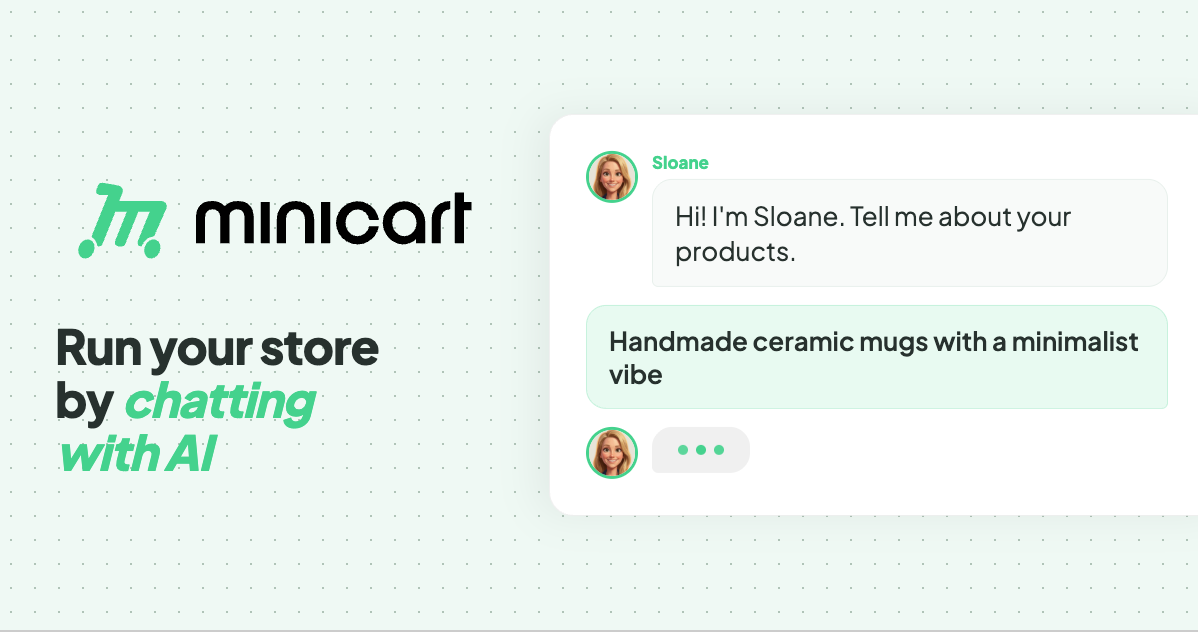
Minicart is a platform that lets makers, creators and resellers launch and run an online store by chatting with AI. Its central promise is simple: take a photo of what you make, answer a few quick questions, and Minicart builds a real website that you own, complete with a polished product listing, a pricing suggestion and a full storefront. From there, a team of AI teammates runs the store day to day. The product is aimed at people who want to sell online without learning ecommerce software — the site puts it as "if you can text, you can run a store." Everything is managed through a simple chat interface, with no code, no design work and nothing to configure, and the site stresses that nothing goes out without your say-so.
Traditional ecommerce platforms ask a lot of a first-time seller. Building a store means choosing themes, writing listings, configuring payments, learning dashboards and app stacks, and often paying monthly fees plus listing fees on top. Marketplace sellers face a different problem: their storefront is a booth inside someone else's feed, so the brand, the domain and the customer relationship all belong to the platform. Minicart frames its purpose around both frustrations. The site describes its store as "a store that's actually yours" — your brand, your domain, your customers — rather than "a booth in someone else's marketplace." It also states that there are no listing fees, ever, and that Minicart only charges a small card fee when you actually make a sale, and that it only earns when you earn.
The first capability is photo-to-store creation. You snap a picture of what you make and answer a few quick questions, and Minicart turns that photo into a polished product listing — title, description and pricing suggestion — and a full website, automatically. The site says one photo is enough to get started and that a store can be live in under 10 minutes. In the example shown on the page, the assistant takes a single candle photo and reports that it built four product photos from it and launched the store. The workflow is described as three steps: snap a photo, we build your store, then go live and sell. Your own domain and brand come with it, and the page repeats that there are no listing fees, ever.
Second, Minicart handles sellers who are already selling elsewhere with one-click imports. You paste your Etsy shop link, your Shopify store link, or your eBay store or seller link, and Minicart pulls in your listings — titles, prices, photos and variations — and rebuilds them on a site you own. The site says a full catalog is imported in minutes, with no exporting, no copy-paste and no re-uploading photos. Crucially, the connection is described as read-only: Minicart states it never touches or pauses your existing store, so you can keep selling on the marketplace while you build. For Etsy users it highlights keeping the shop open and running while finally owning the customer list; for Shopify users it highlights being live in 10 minutes rather than weeks, dropping the monthly fees and app stack, and letting three AI teammates run the busywork; for eBay users it highlights importing listings in minutes while continuing to sell on eBay and owning the customer, not just the sale.
Third, and at the heart of the product, are the three AI teammates who work 24/7. Sloane, the storefront teammate, builds your site, takes payments, tracks your sales and keeps your listings current. Milo, the marketing teammate, drafts lifestyle photos, social posts and discount codes that bring people in. Logan, the logistics teammate, ships orders, tracks inventory, handles refunds and drafts your customer replies. The page shows a day in the life: Sloane turning your photos into three products, Milo drafting Instagram posts for those three new products, Logan prepping a shipping label for an order and writing your reply to a customer question, and Sloane processing the day's payments and sending your payout. Each item is marked done or ready, reinforcing that the owner remains in control of everything the team produces.
Fourth, everything is operated through chat, including bulk changes. The site describes the interface as "if you can text, you can run a store": you manage inventory, draft social posts and talk to customers by sending plain-language messages. A dedicated bulk editor lets you update everything at once — for example, "increase price of all red necklaces by $5" — and your team lines up the changes, figures out what is affected and shows you a list to review. Nothing changes until you confirm: you can check or uncheck anything you want to skip and then approve. The same pattern applies to inventory updates, such as reporting that you have made five new blue butterfly bracelets and 12 ruby necklaces and confirming the new stock numbers. The site states plainly that you are always in control and nothing goes out without your say-so.
Fifth, Minicart emphasizes ownership and economics. The store lives on your own domain under your brand — the FAQ notes it runs on your own Minicart domain, for example yourstore.minicart.com, and that you can connect a custom domain you own. You can bring your own domain or grab a new one, and the store carries your name, colors and style from day one. Your customer list is yours to keep and grow rather than locked inside a marketplace, which the site ties to building repeat customers and a brand you can grow for years. There are no listing fees — list as much as you want — and Minicart says it only charges a small card fee when you actually make a sale.
Taken together, the approach is to replace ecommerce software with a chat-driven AI team. Instead of learning a dashboard, you describe what you need in plain language, and the AI teammates figure out what is affected, do the work and present it for your review. Launch can start from a single photo or from an imported catalog, and operations continue as a running dialogue: turn photos into products, draft an Instagram post, create a promo code, prep a shipping label, write a customer reply, process payments and send a payout. The site summarizes this as "see it in action — watch how your simple text commands trigger a complex chain of storefront updates." The stated control model is consistent throughout: the team proposes, you approve.
The promised outcomes are speed, control and ownership. Speed: a store live in 10 minutes, a full catalog imported in minutes, and 24/7 AI teammates rather than hiring help. Control: every action is reviewed and confirmed before it goes out, with a checklist you can edit before approving. Ownership: your own website, your own domain, your own brand and your customer emails. The site also stresses economics — no listing fees, ever, and paid plans that lower card rates. Real stores built with Minicart are showcased on the page: Butterfly Boutique, Fame City Card Co, Trammell's What The Flip, Treasured Tees and Things and Diecast Car Culture, described as selling trading cards, sneakers, boutique gifts and more, with owners who launched fast and run their business by chatting with their AI teammates.
Concrete scenarios appear throughout the page. A maker photographs what they create and Minicart turns it into a listing and a live store, with one example showing a candle photo producing four product photos. A bracelet maker tells the team to create a 20% summer promo code for all bracelets and gets confirmation that all bracelets are now 20% off with code SUMMER20. A seller asks for an Instagram post for a blue butterfly bracelet. An owner says to increase the price of all red necklaces by $5 and reviews five affected items with their old and new prices. A seller reports new inventory — five blue butterfly bracelets and 12 ruby necklaces — and confirms the updated numbers. And existing marketplace sellers paste an Etsy, Shopify or eBay link and get their catalog rebuilt on a site they own.
Minicart is built for makers, creators and resellers — including craft sellers, trading card and sneaker resellers, boutique gift shops and apparel sellers — who want to sell online without learning ecommerce software or managing a booth inside a marketplace. The FAQ emphasizes that no tech or design skills are required, that there is nothing to code, design or configure, and that the AI teammates handle the setup and the day-to-day. On pricing, the site states there is a generous free plan where there are no monthly fees to start selling, that paid plans lower Minicart's card rates, and that no credit card is required to start. A current promotion offers 45% off the Assistant plan plus a free custom domain.
Minicart's core value proposition is to let anyone turn what they make into a store they own and then hand the busywork to AI. A photo or an imported catalog becomes a live website in minutes; Sloane, Milo and Logan keep it running around the clock; and every change is confirmed by you before it ships. For sellers tired of marketplace dependence and complicated ecommerce software, Minicart offers a simpler path: take a photo, review your team's work, and keep building your business.
Publisher
A
admin
Launch Date2026-09-21
Platformweb
Pricingfreemium