ManyPI is an AI sales agent for lead generation and cold email outreach. It is aimed at teams and founders who need a steady stream of new customers, and it works from a single sentence: you describe your ideal customer, and ManyPI finds matching companies and the people who sign on the live web. From there it verifies every email address, validates pain points and emotional buying triggers, and sends hyper-personalized outreach that turns those signals into sales. The product bundles the whole outbound workflow — lead generation, email verification, cold email campaigns, workflow automation, a CRM and pipeline, a unified inbox, an AI agent, web scraping, data analysis, and API access — into a single subscription rather than a stack of separate tools.
Outbound sales is usually a chain of disconnected steps. A list gets built in one place, verified somewhere else, sequenced in a third tool, and then tracked manually in a spreadsheet or inbox. The ManyPI homepage frames the pain with the simple question "Up late, want more customers?", alongside three starting actions: find new leads, enrich a lead list, and send outreach. The problems this creates are familiar: unverified addresses bounce, duplicates creep in, and bounces can burn a sending domain. Replies scatter across inboxes, and the logic of what happens after a reply lives in someone's head. ManyPI's stated purpose is to close those gaps by running the whole flow — find, verify, validate, reach out, and follow up — inside one product, so that the signal from a prospect turns into a sales conversation instead of being lost between tools.
Lead generation in ManyPI starts with a plain-language description of your ideal customer. The example shown on the site is "Marketing agencies in Berlin with 10–50 employees", and the product returns matching companies along with the people who sign. The site illustrates this with 1,284 companies matching a query and named results such as Northwind Studio in Berlin and Kranz & Partner in Hamburg. Email verification is the second step: every address is checked before you send, so that there are no bounces, no duplicates and no burned domain. Addresses come back verified and scored, for example Northwind Studio at 92 and Kranz & Partner at 87, while a low-scoring record such as Wide Net GmbH at 34 is dropped from the list. Verification therefore acts as a filter that protects deliverability and keeps the list clean before any message is sent.
Cold email outreach is handled with multi-step campaigns sent from your own inboxes, with warmup running in the background and replies collected in one place. The site illustrates a three-touch sequence: an intro on day 0 marked as sent, a follow-up on day 3 also sent, and a last touch on day 7 queued — with a reply from Northwind Studio arriving two hours earlier. Workflow automation then picks up where sending stops. When a lead replies, ManyPI tags it and starts the next step, and the site notes there is no wiring to maintain. In practice this means the sequence, the tagging and the transition to the next action happen automatically once a reply lands, instead of someone manually moving a record and remembering what comes next.
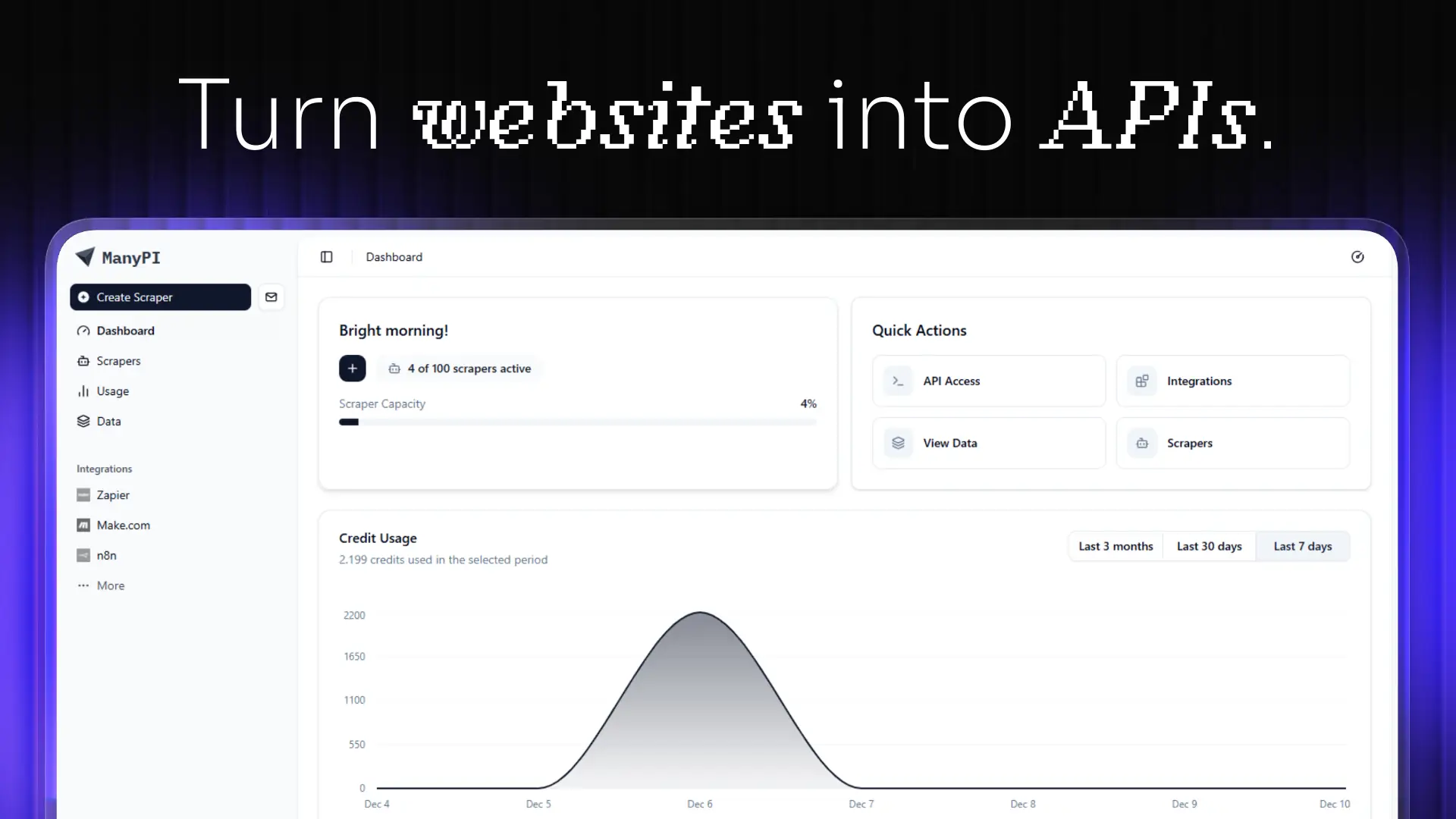
ManyPI also includes the surrounding infrastructure. CRM and pipeline, a unified inbox for replies, an AI agent, web scraping, data analysis, and API plus webhooks are all described as available in every plan. The unified inbox matters because replies from multi-step campaigns would otherwise be scattered across multiple sending accounts; the CRM and pipeline give those replies a place to live and move through; the AI agent is the component that does the finding, verifying and outreach work; web scraping and data analysis support the live-web research that produces the leads; and the API and webhooks let the rest of your stack react to what happens inside ManyPI. Integrations push verified leads straight into the CRM your team already runs on, with HubSpot and Salesforce listed alongside Claude and OpenAI.
ManyPI also exposes its lead generation through an MCP server, which the site notes is now live. The endpoint is mcp.manypi.com/mcp, and it lets you ask for leads from Claude, ChatGPT, Gemini or any MCP client. The distinction the site makes is that the list lands in your table, not in the transcript, so results arrive as structured data rather than as chat text you would have to copy out. Taken together, the product works as one pipeline: describe your ideal customer, receive matched companies and the people who sign, have every address verified and scored, run multi-step cold email from your own inboxes, and let automation tag replies and trigger the next step, with results flowing into a CRM through built-in integrations, the API, or an MCP client.
The stated benefits are revenue growth through better lead finding, cleaner sending through verification that prevents bounces and duplicates, outreach that is more relevant because it is based on validated pain points and emotional buying triggers, and less operational overhead because campaigns, replies, tagging and follow-up steps live in one place. The site positions the product as a single subscription that covers tools which would otherwise be bought separately, and it presents its lead-finding step as the reason teams are no longer searching manually for their next customer. It also states that more than 1,700 growing companies have joined.
Concrete workflows appear throughout the site. A team can start by finding new leads, describing a customer profile such as marketing agencies in Berlin with 10–50 employees and receiving matched companies. Another team can enrich an existing lead list, sending it through verification and scoring so weak records are dropped before sending. A third workflow is sending outreach: building multi-step campaigns from your own inboxes, with warmup, and watching replies arrive in the unified inbox. A fourth is automation, where a reply triggers a tag and the next step without any wiring to maintain. Beyond that, verified leads can be pushed into HubSpot or Salesforce through integrations, and teams working inside Claude, ChatGPT, Gemini or another MCP client can request leads and have the list land in their table.
ManyPI is aimed at organizations that need customers: sales teams, marketing and lead generation agencies, and founders or growing companies. The site displays logos of organizations using it, including Berkeley, Cornell University, Supercent, Codeway, Valsoft and others, and says 1,700+ growing companies have joined. Product Hunt topics associated with it are Sales, Email Marketing and Marketing. It is a web product accessed through app.manypi.com, with an API and webhooks as well as an MCP endpoint for programmatic and agent-driven access. Pricing starts with a free plan and paid plans from $25 per month, and the core toolkit — CRM and pipeline, unified inbox, AI agent, web scraping, data analysis, and API and webhooks — is stated to be included in every plan.
The summary takeaway is straightforward: ManyPI is a single AI sales agent that replaces a fragmented outbound stack. It finds leads from a sentence, verifies and scores every address, validates buying signals, sends multi-step cold email from your own inboxes, and automates what happens after a reply — then pushes the results into the CRM your team already uses or into an AI client through its MCP server.
Publisher
A
admin
Launch Date2026-09-21
Platformweb
Pricingfreemium