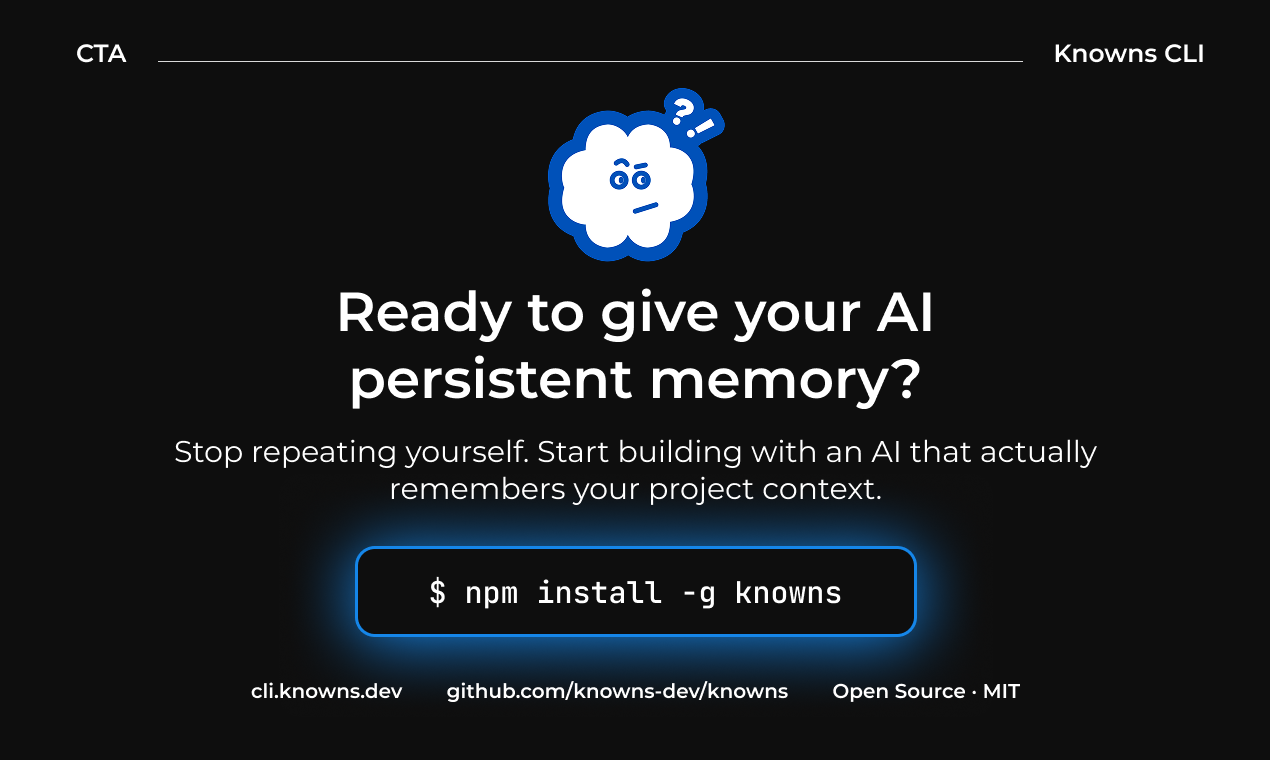
Knowns CLI is an AI-first command-line tool that provides persistent memory for AI assistants by managing project context, tasks, and documentation. It eliminates repetitive context sharing and enables AI to automatically reference project knowledge.
Knowns CLI is an open-source, AI-first command-line tool designed to provide persistent project memory for teams and their AI assistants. It functions as a central system that manages and connects project context, tasks, and documentation, ensuring that both human collaborators and AI agents always have access to the full, structured history of a project. The core value of Knowns lies in eliminating the repetitive need to re-explain project details across sessions and handoffs, thereby preventing lost knowledge and enabling AI to work more effectively by referencing a comprehensive, searchable knowledge base. This tool is built for developers and teams who rely on AI assistance for coding and project management, offering a local-first, vendor lock-in-free solution under the MIT license.
Without a tool like Knowns, project context often disappears, leading to repetitive work and inefficiencies. Tasks, documentation, and decisions typically live in separate tools like issue trackers, wikis, and chat applications, forcing team members to start each session by manually re-explaining the project's current state. This fragmentation is especially problematic during handoffs, where new contributors must ask the same questions, and for AI assistants, which are forced to guess due to an incomplete picture of the project. The consequence is that valuable solutions and decisions are forgotten and later reinvented, wasting time and creating inconsistency. Knowns directly addresses this pain point by creating a single, connected system where all project knowledge is linked and preserved, making context immediately available at the start of any work session.
The first major feature group is its structured task management with acceptance criteria and linking. Knowns allows users to plan work by creating tasks that include clear acceptance criteria, which define what 'done' looks like. These tasks are explicitly linked to related specifications, documentation, and past decisions, ensuring nothing exists in isolation. This linking is crucial because it provides AI assistants with the structured context needed to understand the task's scope and requirements automatically. For instance, when a user instructs an AI to 'work on the auth feature,' Knowns can surface the linked task 'Add user authentication,' its specification with acceptance criteria, and all relevant past documentation, allowing the AI to proceed with full context without requiring manual pasting or re-explanation from the user.
Publisher
A
admin
Launch Date2026-01-14
Platformweb
Pricingfree
Tech Stack
#Node.js#Bun#MCP
Domain Authority
Ahrefs DR5/100
Traffic Insights
Month2026-01
Estimated Visits0
MoM Visits GrowthN/A(+0)
Avg Time on Site0s