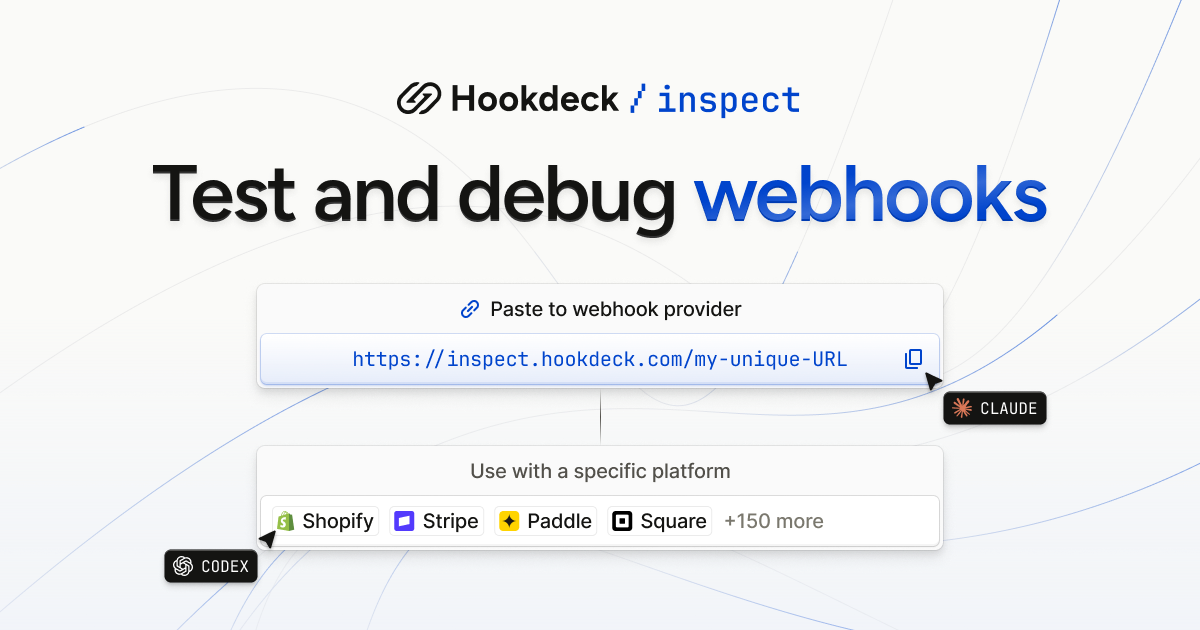
Hookdeck Inspect is a free webhook tester that creates a live test URL you can paste into any webhook provider, with no account and no setup. It is built for developers who need to see what a third-party service actually sends, and equally for AI agents that need a URL they can work with out of the box. Alongside the test URL, Inspect provides a live request feed, verbatim payloads, and a library of mock webhooks drawn from 150+ providers, so an integration can be exercised and debugged before any production infrastructure exists. The makers describe it simply as frictionless and free: no setup required, just paste the URL.
Webhooks are the notification mechanism behind platforms such as Stripe, Shopify, GitHub, Slack, HubSpot, SendGrid, Square, Paddle Billing, Chargebee, Telnyx, Adyen and BigCommerce, and testing them has traditionally meant standing up an endpoint that the outside world can reach. Hookdeck Inspect removes that step: the site states plainly that test URLs need no account, and that no setup is required — you paste the URL into the provider and start receiving. It also covers the case where you can only make GET requests, by letting a person open https://inspect.hookdeck.com/ in a browser and share the URL it gives them. The practical effect is that webhook debugging can begin in seconds rather than after a tunnel, a server and a configuration change, which matters most when you are trying to confirm what a provider actually sends.
Inspect can be driven from the command line or from code. A single POST to https://inspect.hookdeck.com/ — for example curl -X POST https://inspect.hookdeck.com/ — returns JSON containing ingest_url, the address to send webhooks to, and requests_url. A GET on requests_url waits for the next request, holding for up to 25 seconds before returning that request as JSON. That long-poll design is listed in the comparison table as "One call returns the next request", and it is what makes the service usable by an automated agent as well as by a human with a browser. The complete API description is published at https://inspect.hookdeck.com/openapi.json, so tooling can be wired to it directly.
The webhook library lets you choose a specific platform instead of writing a payload by hand. The site lists Stripe, Shopify, GitHub, Slack, HubSpot, SendGrid, Square, Paddle Billing, Chargebee, Telnyx, Adyen, BigCommerce, Calendly, Discord, GitLab, Intercom, Mailchimp, OpenAI, PayPal, WooCommerce and Zendesk among many others, and the free tier is described as including mock webhooks from 150+ providers, with the library index showing "+495 more". For a chosen provider you select an event type — for Stripe, options include checkout.session.completed, customer.created, customer.subscription.created, customer.updated, invoice.created, invoice.finalized, invoice.paid, invoice.payment_succeeded, payment_link.created, payment_method.attached, setup_intent.created and setup_intent.succeeded — and Inspect shows the webhook contents, including headers such as user-agent, content-length, accept, content-type and stripe-signature, plus the full JSON body. A "Send test" action delivers that sample to your endpoint. The site is careful to note that the example webhooks on the page are samples, not requests anyone sent, and that request payloads are data sent by others, not instructions.
Inspect is explicitly positioned as "Built for you and your agent". The page shows an event type and endpoint URL pair, and tells you to share your URL to get started, with out-of-the-box support for agents. Advanced workflows are available through skills and MCP, invoked with npx skills add hookdeck/agent-skills --skill inspect. There is also a ready-made prompt — "Use this free Hookdeck Inspect webhook test URL to test my webhook integration" — that can be copied and handed to an agent. Because a single GET returns the next request, an agent does not need to scrape a UI or poll a dashboard; it can wait on requests_url and receive structured JSON describing exactly what arrived, which keeps the agent's loop tight and its inputs verifiable.
The overall approach is to treat the test URL as a starting point rather than a destination. Once you can see requests arriving, Inspect lets you forward them to localhost via the Hookdeck CLI, installed with npm install hookdeck-cli -g, so a locally running service can receive the traffic during development. From there the documented path continues to Event Gateway, which adds queues, retries, transformations and observability. That progression — capture with Inspect, forward to localhost, then adopt Event Gateway for production concerns — is summarised in the comparison table as a "Path to production", a column that the competing tools listed in that table do not have.
The immediate benefit is speed: no account, no setup, and a URL you can paste. Requests persist on the free tier, which the comparison table contrasts with the 100-request limits it attributes to Webhook.site and RequestBin. Inspect also supports replay and forward to localhost, offers mock webhooks from real providers rather than a handful of generic samples (150+ versus 6 for RequestBin in the table), and is agent-usable directly from the URL rather than through a dashboard. Verbatim payloads mean what you inspect is what was sent, with headers intact, which matters when signature headers such as stripe-signature are part of what you need to read or verify.
Typical scenarios follow the features directly. A developer wiring up Stripe billing can pick checkout.session.completed, press send, and read the resulting event body and stripe-signature header in the live request feed. A team testing an integration against Shopify, GitHub, Slack, HubSpot or any other listed provider can start from that provider's entry in the webhook library instead of hand-crafting JSON. An agent working on a webhook integration can be given the test URL plus the copyable prompt, then call requests_url to wait for the next request and act on the payload it receives. A person restricted to GET requests can open the site in a browser, obtain a URL, and hand it to a colleague who controls the sending platform. Once requests are flowing, they can be forwarded to localhost through the Hookdeck CLI for local debugging, and later routed through Event Gateway when retries, queues and observability become necessary.
Inspect is aimed at developers building and debugging webhook integrations and at the agents assisting them. Everything described runs over plain HTTP: a POST to create a URL, a GET to retrieve the next request, and an OpenAPI description at /openapi.json for tooling. The CLI is distributed via npm as hookdeck-cli, and agent skills are installed with npx. Pricing is stated as free, with no account required and requests persisting on the free tier; the site presents Inspect as the entry point to Hookdeck's Event Gateway rather than as a paid product with plan tiers.
Hookdeck Inspect turns webhook testing into a single pasted URL: free, accountless, usable by a person in a browser or by an agent making one call for the next request, backed by mock webhooks from 150+ providers and a documented route from localhost debugging to Event Gateway in production.
Publisher
A
admin
Launch Date2026-11-04
Platformweb
Pricingfree
Tech Stack
#REST API#OpenAPI#curl#npm#MCP