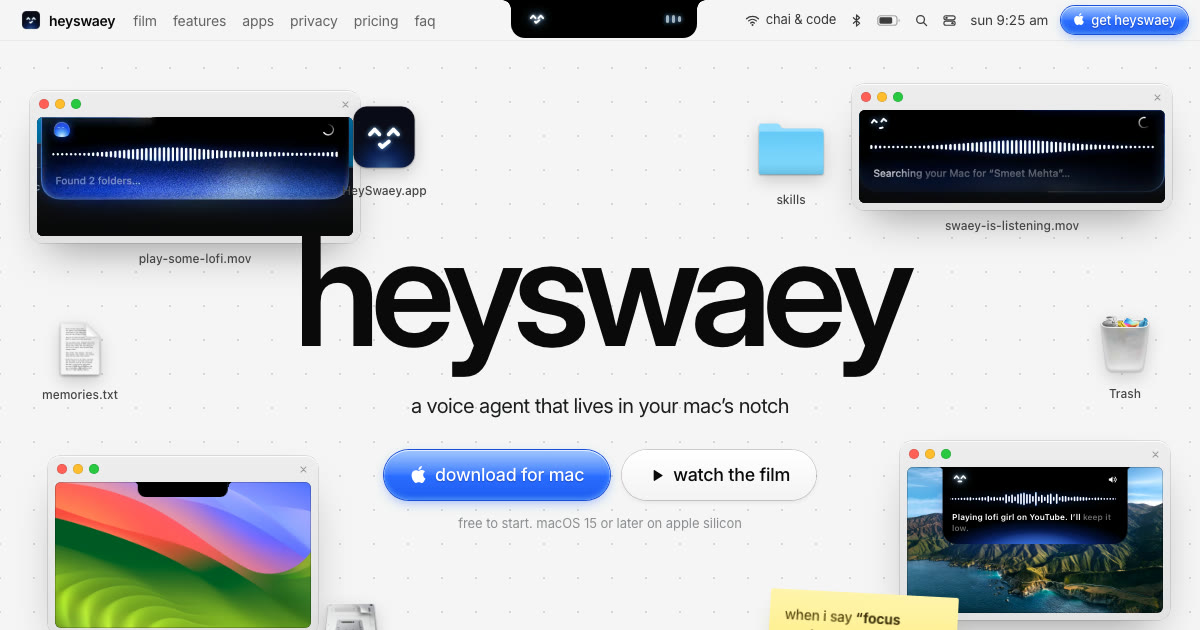
HeySwaey is a voice agent that lives in a Mac’s notch. You say “Hey Swaey” — or press Option-Up — tell it what you want in ordinary words, and it does it: opens apps and files, sends email, plays music, sets reminders, types for you in any app, runs coding agents and turns videos into captioned vertical clips. The site summarises the product as “say it. swaey does it.” It is a Mac-only app, on purpose, free to start, and runs on macOS 15 or later on Apple silicon (M1 and newer), written in native Swift so it is meant to feel like it shipped with your Mac.
The problem HeySwaey addresses is stated plainly on the site: “we talk at 150 words a minute and type at 40. yet every computer still sits there, waiting for a click.” Assistants can set a timer and chat apps can write you a poem, but none of them “will just get up and do the thing on your mac.” So the team built a voice that lives in the notch, learns how you work and actually does the task in your own words, “the way you’d ask a friend.” The site also notes the product is early and Mac-only deliberately, and invites users to say what it should learn next.
Two capabilities sit at the base of the experience. Instant commands — volume, brightness, timers, dark mode, lock, opening or quitting an app, the time and date, a quick sum — are “done on your mac in well under 300 ms, no ai needed,” while weather, travel times and currency “come back in a blink,” and longer tasks get an instant “on it.” Voice typing lets you “hold fn and talk” so that polished text “lands at your cursor in any app,” with the “ums” gone and your “no wait, i mean” fixed. It handles accents, lets you switch languages mid-sentence, and setup asks you to say “hey swaey” four times so it learns how your voice sounds.
Around that core, HeySwaey covers the everyday jobs shown on the page. Email can be written, sent, checked and replied to; it “drafts in your voice and asks before anything goes out,” and works with Mail and Gmail in Chrome. Safari, Spotify and Music let you “play anything, skip, pause, and follow the lyrics in the notch,” and it ducks the music while you talk. Apps and files are found through “its own fuzzy file index” that finds “what you meant, not what you typed.” Calendar and reminders answer what is next and what is tomorrow, plus “the nudge you’ll actually need.” Texts go out through Messages or WhatsApp — “it finds the chat and sends it in one go” — and a name it is not sure about, it asks about first. Places and travel time are answered out loud from Apple Maps, and weather, time and “the hundred tiny questions you’d otherwise open a tab for” are handled too.
Window management is a spoken command: say where your windows go and they go there — halves, corners, full screen, two apps side by side, or every window in a tidy grid — and “put the windows back” restores them. Deeper Mac actions run through AppleScript, typing and Shortcuts: type text, press keys, run shortcuts, script apps, and “risky scripts always ask first.” A “only your voice” mode turns on so that HeySwaey ignores the TV, the podcast and your flatmate, responding to you specifically. There are also helpers that remember: you name one, give it a job, and it works in the background, remembers what you like and answers with its sources.
Memory and safety are treated as first-class features. Tell it once — “i use gmail,” “my manager is sarah” — and Swaey keeps “a little notebook about you, right on your mac,” and you can read and edit every line. Sending an email, emptying the trash or anything risky gets a quick “should i go ahead?” first, answerable out loud or by click, “stop” ends it instantly, and everything it did lives in your activity history. Privacy is described in detail: the wake word is heard on-device and “nothing leaves your mac until you say it,” hearing and speaking run on the Mac so “your voice doesn’t” leave, and when a command needs the AI only its text goes through the server to the AI provider, with a privacy tab listing every request. Screen looking happens only when you ask.
Skills let you teach routines by voice. The example given is: “when i say focus mode, quit slack, turn on do not disturb and put on some lofi,” which runs in under a second from Settings → Skills. Other described routines include a weekday 9:00 morning briefing that reads out the weather, your first three meetings and unread email from people who matter; “good night,” which closes everything, sets tomorrow’s reminders and puts the Mac to sleep; and “ship it,” a dev mode that opens your editor and terminal, starts the server and tells Claude Code what to work on.
For developers, HeySwaey is described as “the only coding-agent notch app that listens and talks.” It kicks off Claude Code or Codex in the background, lets you keep working, and tells you when the agent is done — agent alerts are free on every plan and “it never answers for you.” When an agent says “done,” Swaey reads the change for the shortcuts agents take: a test bent until it passes, an error swallowed by an empty catch, made-up data. It points at the file and line, runs your tests on a yes, and tells the agent what to fix. Plans are read in plain words with the one risk to watch, an idle session can be given its next job without leaving the editor, and a warning appears before anything that cannot be undone. Skills can be written from your repo, its fixes and your past corrections into a .claude/skills folder and a MISTAKES.md file, so the agent stops repeating the same mistake.
The student desk uses the same screen awareness for learning. Stuck on a slide, a PDF or a lecture, you say “explain this” and Swaey reads that exact screen and teaches it one step at a time, marking the part it is talking about and drawing the step the slide skipped. It can ring the line in your working where the slip happened, offer a new picture or analogy when you still do not get it, and end with your problem on a new number to check you really understood. A playing lecture pauses on the frame it is explaining until you say “play.” For vibe coders, Swaey turns a ramble into a full spec — who it is for, the screens, the data, a quality bar with loading, empty and error states, and the security beginners do not know to ask for — then types it into Lovable, Bolt, v0, Replit, Cursor, Windsurf or Claude Code.
Clipping is another described capability. Copy a YouTube link anywhere and it comes up in the notch with “clip it,” and only the part you keep is downloaded straight to your Mac. You can say “clip from 1:20 to 1:50, vertical,” “clip the last 30 seconds and save it,” “clip this video with captions” or “make the captions neon,” and save as a video, a gif or just the sound. You can pick a caption look, a colour, fit or fill, and drag the picture; clips can be found by what is said, matched on whole sentences, and the best moments can be returned best first with hook titles to join into one reel or save individually. Captions are heard on your Mac in the video’s own language, free clips carry a small “made with swaey” tag that pro removes, and links are for videos you own or have permission to save.
Hovering the notch shows a small desk for your day: your next meeting with a join button, the weather, one-click timer, focus mode or “explain this,” the line being sung while music plays, files waiting on the shelf and everything you copied a tab away. You also pick who lives in your notch — a pixel cat, penguin, fox, bunny, panda, monkey or hamster — that peeks over the notch while it listens, looks up while it thinks, dances when your agent finishes and blushes when you say thanks, with each word lighting up as it is spoken.
Plans are stated on the site. Free is free forever at $0 with unlimited voice typing and quick commands on your Mac, 25 pro tries a month of Swaey’s AI with a free sign-in, the notch shelf, clipboard and music free forever, coding-agent alerts free forever, plus auto cleanup and your own dictionary. Pro is $15/mo (or $120 a year) and adds Swaey’s AI to ask, plan and do, AI polish and voice edits, multi-step tasks across apps, routines and morning briefing, email triage and coding agents. Max is $100/mo with the smartest AI for lessons, prompts, agent plans and code checks, quick commands staying just as fast, and about 7× pro’s monthly usage for long multi-step tasks all day. Students get 10% off with a school email, and pro and max include a monthly AI allowance that resets on the 1st.
Technically the product is version 1.3.6, a 618 MB download for macOS 15 or later on Apple silicon, sold directly from the site rather than the App Store, so the first open needs System Settings → Privacy & Security → Open Anyway before updates install themselves. A one-line terminal installer is offered for people who prefer no prompts at all; it checks the app is genuine, signed and intact before installing to Applications and opening it.
The takeaway is simple: HeySwaey turns the Mac’s notch into a place you can talk to, combining on-device speed for the small things, AI for the long ones, memory of how you work, and a confirmation step before anything risky — so “say it. swaey does it” is the whole proposition.
Publisher
A
admin
Launch Date2026-11-18
Platformdesktop
Pricingfreemium
Tech Stack
#Swift#macOS 15#Apple silicon#On-device speech recognition#AppleScript#Shortcuts