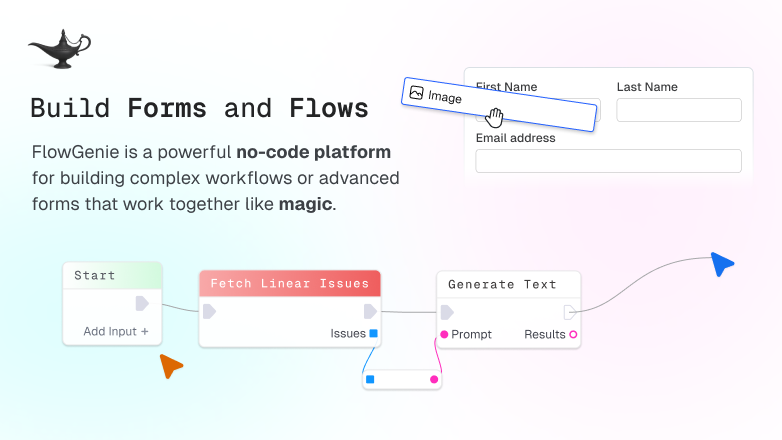

FlowGenie is a comprehensive no-code platform designed to empower users to build sophisticated forms and workflows entirely within their browser, using a visual, node-based flow editor that feels like programming. It is built for developers, product managers, and teams who need to create real logic, automations, and interactive forms without writing code, enabling them to visually program complex behavior that is composable, inspectable, and collaborative. The primary purpose is to provide a blueprint-style editor where the flow itself is the code, allowing users to construct, debug, and deploy automations and data collection tools that can be triggered from various sources and integrated seamlessly into their operations.
Traditionally, building automations and dynamic forms requires significant coding expertise or reliance on black-box platforms where logic is hidden and difficult to debug or modify. Teams often struggle with explaining complex workflows, leading to inefficiencies and errors when screen sharing is the only way to collaborate. Furthermore, handling form submissions, data validation, and subsequent workflow steps typically involves stitching together multiple disparate tools, which can introduce spam risks, data integrity issues, and maintenance headaches, creating a clear pain point for efficient digital operation management.
The first major feature group is the visual, node-based flow editor for building real logic. This editor allows users to construct complex behavior using branches, loops, variables, and nested flows, with every component visible and inspectable, eliminating black boxes. Users can visually program sequences of actions, make decisions based on data, and create loops to process information, making the logic transparent and easy to understand. This approach matters because it democratizes programming, enabling non-coders to build robust automations while giving developers a clear, maintainable visual representation of business logic that can be composed and reused across different projects.
The second major feature group revolves around versatile flow execution and triggering capabilities. Flows built in FlowGenie can be exposed as REST endpoints for external systems to call, scheduled to run at specific times, triggered ad-hoc from within the workspace, or initiated automatically from form submissions. This flexibility ensures that automations can integrate into any part of a user's tech stack and operational cadence. The ability to run flows from anywhere means users can create backend logic, scheduled jobs, or API-driven processes without managing servers, which significantly reduces infrastructure overhead and accelerates development cycles for automated tasks.
admin
Additional capabilities include deep integration between forms and flows, enabling the creation of programmable forms. Users can design forms visually for simple surveys or complex, conditional experiences with dynamic validation. Upon submission, these forms can trigger flows to handle intricate validation, payment processing, or multi-step workflows, ensuring invalid or spam data never reaches downstream systems. Furthermore, forms can be shared via hosted links, embedded anywhere on the web, or rendered using a FlowGenie SDK, allowing deployment flexibility while centralizing structure, logic, and validation management in one unified platform.
The product works overall by providing a web-based, multiplayer environment where users drag and drop nodes to create flows and use a visual editor to design forms. The technical approach centers on a blueprint-style editor that translates visual nodes into executable logic, running on FlowGenie's infrastructure. It supports real-time collaboration, showing team members' cursors as they build together. The platform is designed with AI at its core, though some AI features like building with natural language and smart assistance are noted as coming soon, indicating a roadmap for intelligent automation creation and contextual help during the building process.
Benefits and measurable outcomes for users include accelerated development of automations and forms without coding, reduced errors through visible and inspectable logic, and enhanced team collaboration with real-time multiplayer editing. Users can expect to decrease reliance on developers for simple workflows, improve data quality by programmatically validating form submissions, and streamline operations by connecting forms directly to backend processes. The platform's flexibility in triggering and deploying flows leads to faster iteration and integration, ultimately saving time and reducing operational costs associated with managing multiple disparate tools.
Concrete use cases include building a customer onboarding workflow where a form collects user details, triggers a flow to validate the data, create records in a CRM, and schedule a welcome email. Another example is creating an internal approval system where a form submission initiates a flow that routes the request to managers based on conditions, logs decisions, and updates a project tracker. Teams can also develop automated data processing pipelines, such as a flow triggered on a schedule to fetch, transform, and report data from APIs, or build interactive, conditional forms for dynamic surveys that change questions based on previous answers.
Target users are developers, product managers, and operational teams in businesses of all sizes who need to automate processes or create data collection tools without deep coding. Integrations are facilitated through REST endpoints, allowing connections to external APIs and services. The tech stack is a web-based platform requiring only a browser. Pricing plans are accessible via a dedicated pricing page, though specific tiers are not detailed in the provided content, indicating a need to visit the website for current subscription options and features associated with each plan level.
In summary, FlowGenie provides a powerful, visual alternative to traditional coding for building logic-driven forms and workflows, emphasizing transparency, collaboration, and flexibility. Its node-based editor makes complex automations accessible and maintainable, while the seamless integration between forms and flows ensures robust data handling and process automation. Designed with future AI enhancements, it positions itself as an intelligent platform for teams looking to streamline their digital operations efficiently and effectively, all within a collaborative, browser-based environment.
FlowGenie targets developers, product managers, and operational teams in businesses of all sizes who need to automate processes or create interactive forms without extensive coding. It is ideal for users seeking a visual, collaborative tool to build real logic, handle data validation, and integrate workflows into their operations. The platform serves those who value transparency in automation logic, require flexibility in triggering and deploying automations, and want to streamline team collaboration on digital projects. It appeals to both technical and non-technical roles looking to accelerate development and reduce reliance on traditional coding for backend tasks and data collection.