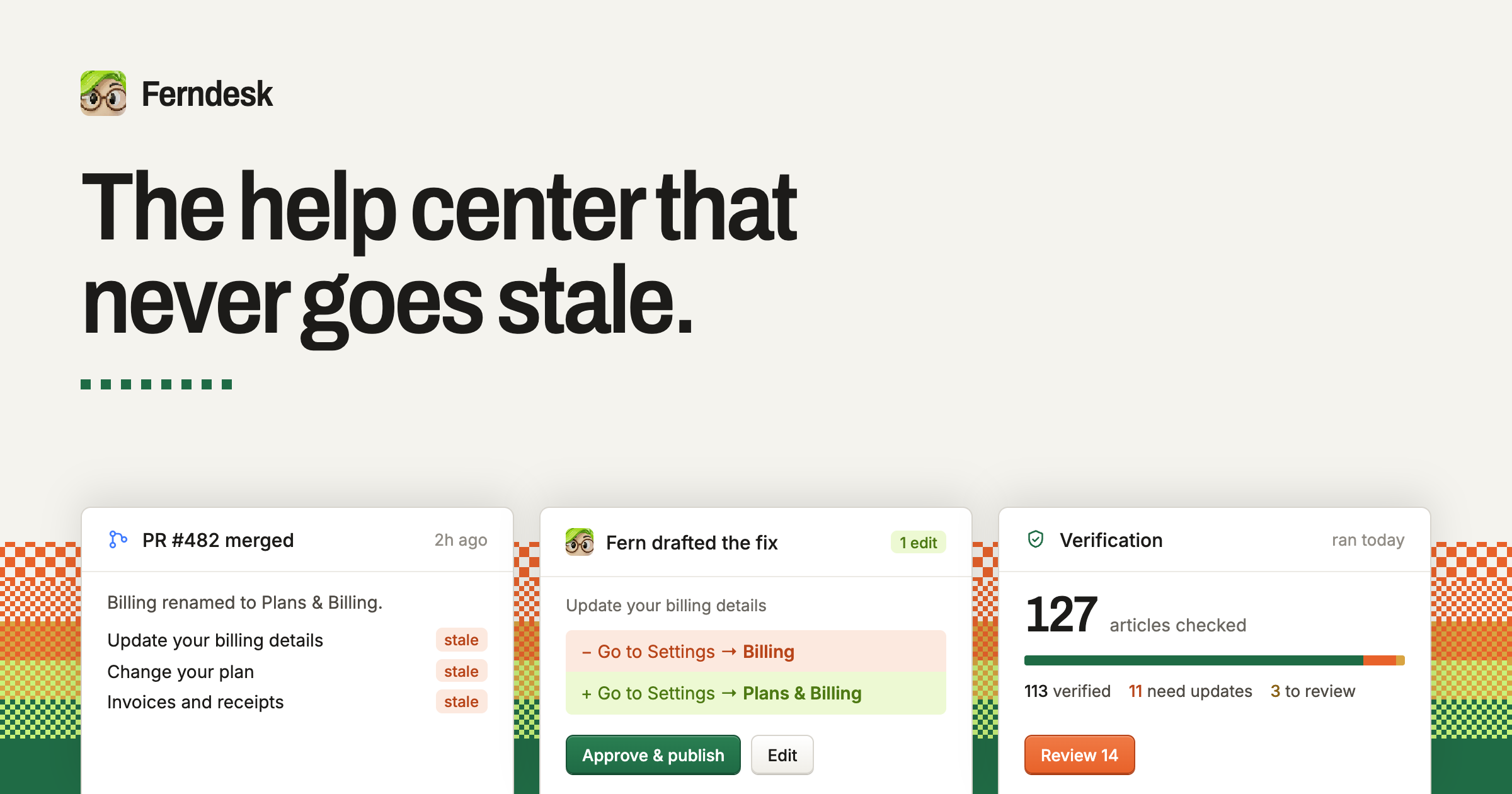
Ferndesk is a complete help center built around an agent named Fern that checks every article against your product, catches what changed, and drafts the fixes for you. It is a single place for a public help portal, AI answers, an in-app widget, API documentation, private docs, translations and analytics. The purpose stated on the site is to keep help content accurate while a team keeps shipping, and to give customers everything they need to help themselves so fewer of them need support. Docs can also be managed from Claude Code, Cursor or ChatGPT.
Ferndesk exists because documentation goes stale the moment a team keeps shipping. The site describes the situation plainly: this month you changed a default, and yet your docs were last updated three months ago. It lists the everyday changes that quietly invalidate help content — renaming a plan, killing a feature, moving the export button, adding a plan, changing the pricing page, breaking a link, shipping a new flow, renaming a button, changing a setting — and points out that it is not the team's fault, because keeping docs true while shipping every week is tough. Customers echo the same pain: Brennan Dunn, Founder of RightMessage, says that before Ferndesk the process for updating documentation was basically hoping they would remember to do it, while Tristan Roth, Founder of ISMS Copilot, says his team ships features every week and that updating docs is hell. Fed, Founder of GummySearch, notes that he used to write articles once and they went stale right from day one, and Laura Elizabeth of Client Portal says writing documentation was something she never did and it showed in her help docs.
Ferndesk's process is presented in three steps. The first is to connect your tools: your codebase, your live product and your support inbox. The site says this takes ten minutes, after which Fern can see what your customers see. Named integrations shown on the homepage include GitHub, Intercom, Linear, Zendesk, Slack, Help Scout and Discord, alongside an example live product such as app.acme.com. The second step is verification: Fern checks every article, and each claim is checked against the code and the product. Anything that is wrong comes back as a change you can approve, together with the reason it was flagged. The homepage illustrates this with a claim marked as no longer true — an article telling readers to update billing details at Settings → Billing when the product now uses Settings → Plans & Billing — presented as a proposed edit with Review and Approve & publish actions.
The third step is that new releases document themselves. When a pull request merges, Fern writes the article before the release goes out. The example shown is PR #530, 'Add image editing to Fern', after which Fern drafted documentation for a new capability, 'Editing images in articles', marked NEW, plus an UPDATED article about automating screenshots in your docs. The four capabilities highlighted at the top of the site are verification, the help center itself, automatic updates and AI conversations.
Beyond maintaining articles, Ferndesk is a full help center that a team can run, described as built to bring tickets down. The public help center can live on your own domain or at /help, is fast and searchable, and is indexed by Google and by AI search engines. AI conversations let customers ask in plain language and receive answers drawn from your verified docs rather than a guess. The in-app widget requires a single script tag and puts search, articles and AI chat inside your product, exactly where people get stuck. When the widget cannot answer a question, escalation hands the conversation off to Intercom, Zendesk or Help Scout, so customers still reach a human channel.
The remaining help center capabilities cover technical and internal documentation. API documentation provides an OpenAPI reference with a try-it playground sitting next to your customer docs. Private docs can be protected with magic link, OIDC or JWT, and are intended for customers, partners or your own team — an internal knowledge base use case. Translations provide a multilingual help center with a glossary and language-prefixed routes; Metricool, for example, has seven languages live on Ferndesk. Analytics reports searches, missed searches, failed answers and feedback, so you can see what to write next. The site also describes a compounding benefit it calls smarter AI: the docs Fern keeps current are the same docs your support AI trains on, which is how Metricool uses Ferndesk to train its AI support agents.
The unique approach is the combination of verification, drafting and human approval. Rather than asking a team to remember to update documentation, Ferndesk reads the codebase, the live product and the support inbox, checks every claim in every article, and returns a concrete change with the reason it is needed. Nothing publishes without you: you review and approve, and Ferndesk publishes from then on. The site frames the shift as moving from hoping your docs are right to knowing they are right, and describes the workflow as connecting your tools, letting Fern check every article against what your product actually does, fixing what is wrong, and writing the docs for what ships next.
Migration is another explicit part of the product. The site argues that the migration teams keep putting off takes ten minutes, because moving help centers normally means broken links, lost rankings and a week of copy-paste. Ferndesk says it brings every article, image and URL over intact, with one click, every URL preserved and redirects created. Importantly, your support tool does not have to change: your inbox, chat and ticketing stay where they are, and Ferndesk keeps reading tickets from it. Imports are listed from Intercom, Zendesk, Crisp, Help Scout, HubSpot, GitBook, Document360 and every other help center. One customer, Juan, Founder of Duplika, describes migrating from Zendesk Guide as feeling like an upgrade — faster, with no paid add-ons, and the knowledge base living at a subfolder of their domain.
The outcomes customers report are concrete. Founders say they save 20 hours a month on docs; Tristan Roth of ISMS Copilot says he does in five minutes what used to take an hour and that Ferndesk makes it easy to ship more and scale. Laura Elizabeth of Client Portal says her support requests have dropped significantly, and that simply being able to see what customers search for and cannot find answers to was huge on its own. SEO Gets reports a measurable drop in churn within three months of launch and even organic clicks to queries they did not expect to rank for. Metricool's Chief Customer Officer, Jose Julio, says they would be miles away from getting this into a working product, after having scoped a custom build on the Crisp API. The site summarises the impact for founders who used to dread updating docs: they now ship features every week while Fern keeps every help article accurate.
Typical scenarios described on the site include a team shipping a weekly release and needing the help article to exist before the release goes out; a founder renaming a plan or changing a setting and needing every affected article corrected; a support team that wants customers to answer their own questions through search, articles and AI chat before opening a ticket; a company moving off an existing help center such as Zendesk Guide, Intercom or GitBook without losing URLs or rankings; a company serving customers in several languages from one knowledge base; and a product team publishing an OpenAPI reference and private or internal documentation alongside its public docs. In each case, the same verified article set serves the portal, the widget, the AI answers and the support AI.
Ferndesk states that it is trusted by more than 100 software teams, and the customers named include Metricool, Zeffy, Andri, PixelFlow, SEO Gets, RightMessage, ISMS Copilot, GummySearch, Client Portal and Duplika — largely SaaS founders, customer success and support leaders, and documentation owners. The site also lists a set of pre-switch questions it answers, covering whether Fern can maintain docs where they already live (no — Ferndesk verifies and updates articles that live in Ferndesk, while your support tool stays where it is and Fern keeps reading tickets from it), what verified means, how often verification runs, what happens if Fern gets something wrong, whether URLs break on import, codebase safety, working without GitHub, custom domains, free trials and what happens if you leave. The signup flow offers a 7-day free trial with no card required.
In short, Ferndesk pairs a complete, self-service help center with an agent that keeps it honest. Import your existing content, connect your codebase, product and support inbox, and from then on every article is checked, every fix is drafted, and nothing publishes without your approval — a help center that does not go stale, and support teams that answer fewer repetitive questions.
Publisher
A
admin
Launch Date2026-10-01
Platformweb
Pricingfreemium
Traffic Insights
Month2026-10
Estimated Visits8.4K
MoM Visits GrowthN/A
Avg Time on Site-
MoM Time GrowthN/A
Global Rank#4,321,152
Bounce Rate-
Updated 2026-10-01