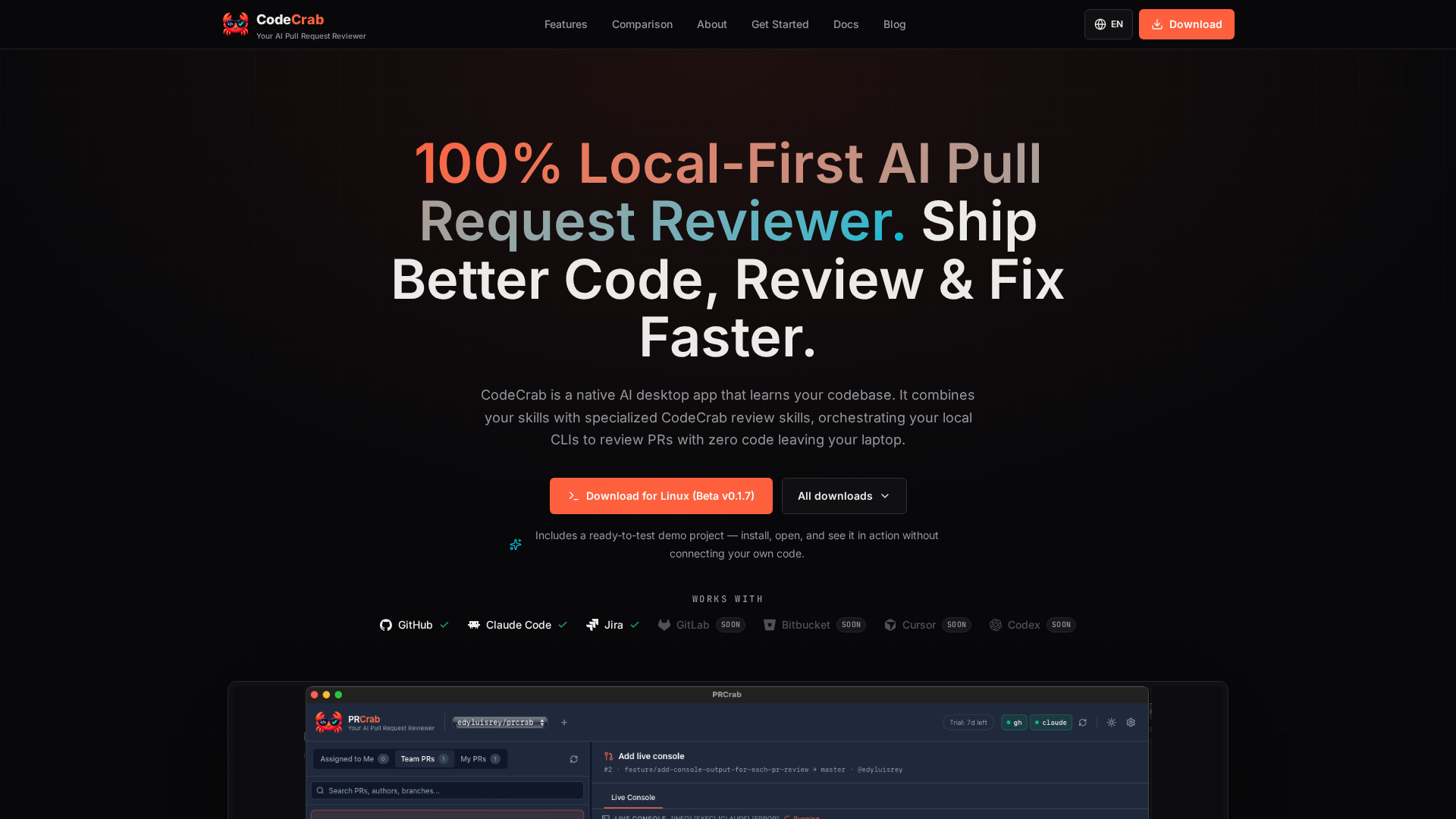
CodeCrab is a native desktop application that reviews pull requests in seconds by orchestrating the local command-line AI tools already installed on your machine. It is built for software engineers who want fast, deep reviews of both their teammates' pull requests and their own work, and it is designed around a simple promise: your code never leaves your laptop. CodeCrab learns your codebase, combines your existing skills with its own specialized CodeCrab review skills, and maps AI observations directly onto the changed lines so reviewers can catch bugs, risky patterns, and regressions before they approve. The product is currently available as a free public beta that runs 100% on your machine.
Modern engineering teams are writing code faster than they can review it. As AI tooling generates code at unprecedented speeds, the primary bottleneck has shifted from writing code to reviewing pull requests efficiently. In practice, that means senior engineers spend hours walking through diffs, and reviewers often lack the full context of the repository behind a change. At the same time, many teams work on sensitive or regulated codebases where uploading source code to a third-party cloud review service is simply not an option. CodeCrab was built by Edy, a software engineer with more than 14 years of experience, including years building systems at Google and Pinterest, initially as a personal tool to perform deep, Staff-level code reviews quickly without uploading sensitive private code to third-party servers.
The first core workflow is pull request code review. You open any pull request from your colleagues, and CodeCrab walks through the diff with you. It maps AI observations directly onto the changed lines, so you can spot bugs, risky patterns, and regressions fast, before you hit "Approve". Crucially, CodeCrab reviews against your entire local repository rather than only the diff: it uses full codebase context, including your types and your test suite. That means observations are grounded in how the change actually fits into the project, not just in the isolated lines that changed. The whole process is 100% local-first, so CodeCrab can catch logic bugs and regressions without uploading a single line to the cloud. The live review interface combines a file tree, a diff viewer, and inline AI observations in one native desktop window.
The second workflow covers your own pull requests. When a teammate leaves an observation on your PR, CodeCrab runs a deep investigation for you. It digs through the code around every comment, connects that code with your project's context, and helps you understand as precisely as possible what the observation really means and what the correct solution looks like. The investigation of every reviewer observation on the diff is deep and read-only, so nothing is modified while CodeCrab is reasoning about the feedback. Once you understand the finding, CodeCrab supports an assisted fix on your local branch, verified against your own test suite. A third, closely related workflow happens before the pull request even exists: pre-push code review of local changes. While you are still working locally, CodeCrab reviews your in-progress changes in read-only mode before anyone sees the diff, detects errors early, investigates each finding as deeply as needed, and helps you apply the right fix while the context is still fresh.
CodeCrab is built to plug into the workflow you already have rather than replace it. You connect any repository, and CodeCrab learns its rules and patterns, building a per-repository review profile that powers specialized review agents and custom skills. Those profiles make reviews tuned to your codebase instead of generic best practices. Your own skills and CodeCrab's agents work together: you can reuse your existing local skills, combine them with CodeCrab's, and extend as far as you need. The app integrates with your local skills, Claude Code, and Jira, and it works with GitHub and GitLab today, with Bitbucket, Cursor, and Codex listed as coming soon. Repositories, skills, models, and language are all configurable, so experienced engineers can enforce their own standards without abandoning their existing setup.
Privacy is the foundation of the product. CodeCrab uses a 100% on-device architecture with zero code uploads: your source code never leaves your laptop or passes through external cloud databases, which makes it suitable for strict corporate environments where no code may be sent to third-party AI clouds. Control is equally deliberate. CodeCrab is read-only by default and never commits, pushes, or posts public GitHub comments without your explicit permission. When you do want to apply a change, CodeCrab generates verified code patches as 1-click local fixes, and it runs your native test suite (cargo test, pytest, npm test) before applying them, so the patch is checked against the project's own tests rather than trusted blindly. Instead of requiring org-wide OAuth admin permissions, CodeCrab uses your own CLI login (gh).
The distinctive approach is tool orchestration on the client side. Rather than locking you into a vendor's fixed model wrapper, CodeCrab orchestrates your local command-line tools, so it can use your local Claude Code and Cursor setups. It connects directly to the AI subscriptions you already pay for, giving you full model and cost control: you choose which AI models to run and control exactly how much you spend on code reviews, with zero server markups or hidden fees. Execution is transparent through a live execution console that shows real-time stdout and stderr, in contrast to an opaque cloud pipeline. The difference from cloud review bots is not the model, it is where your source code ends up: with CodeCrab everything stays client-side and runs as an instant local native application, while cloud SaaS bots upload and process code on vendor servers and run queued background jobs.
The headline benefit is speed without loss of depth. CodeCrab is described as instant and lightweight, with blazing-fast native desktop performance, minimal RAM consumption, and instant startup, so reviews happen in seconds instead of waiting on a queue. Engineers get early bug detection for logic flaws, security risks, and regressions directly on the diff, plus 1-click local fixes that produce verified code patches ready to apply to a local branch. Precision diff navigation with clear changed-file tracking, inline observation badges, and clean multi-file diff inspection keeps large changes manageable. Together these outcomes shorten the loop between noticing a problem and having a reviewed, verified fix, and they let teams ship cleaner, higher-quality code while keeping full control over cost and data.
Concrete workflows include reviewing a teammate's pull request before approving it, where CodeCrab walks the diff and places observations on the changed lines so you can catch risky patterns and regressions with full repository context. Another is turning feedback on your own PR into a solution: CodeCrab investigates each reviewer observation deeply, explains what it means, and assists with a local fix verified against your test suite. A third is pre-push review, where you analyze in-progress local changes and apply fixes before the pull request is ever created, so the PR you open ships cleaner code. Teams working in regulated or security-sensitive environments use CodeCrab because reviews happen entirely on-device with no code uploads. Engineers who already pay for tools such as Claude Code or Cursor can reuse those subscriptions for reviews rather than paying for an additional cloud service. The bundled ready-to-test demo project lets anyone install, open, and see CodeCrab in action without connecting their own code.
CodeCrab is aimed at software engineers and engineering teams who review code daily, particularly those who want deep, Staff-level reviews quickly and cannot or will not upload sensitive private code to third-party servers. It complements existing setups instead of replacing them: it integrates with GitHub, Claude Code, Jira, and GitLab, with Bitbucket, Cursor, and Codex listed as coming soon, and it plugs into local custom skills. Reviews run against your local repository and your own test suites, with example commands including cargo test, pytest, and npm test. GitHub access uses your own gh CLI login rather than org-wide OAuth permissions. The app ships as a native desktop application, currently downloadable for Linux as Beta v0.1.7, and CodeCrab is in free public beta with no code leaving your laptop.
CodeCrab's promise is straightforward: faster, deeper pull request reviews with total privacy. By learning your codebase, orchestrating the local AI tools and subscriptions you already own, and keeping every line of code on your machine, it turns review from a bottleneck into a fast, controlled, read-only step in your engineering workflow.
Publisher
A
admin
Launch Date2026-10-07
Platformdesktop
Pricingfree