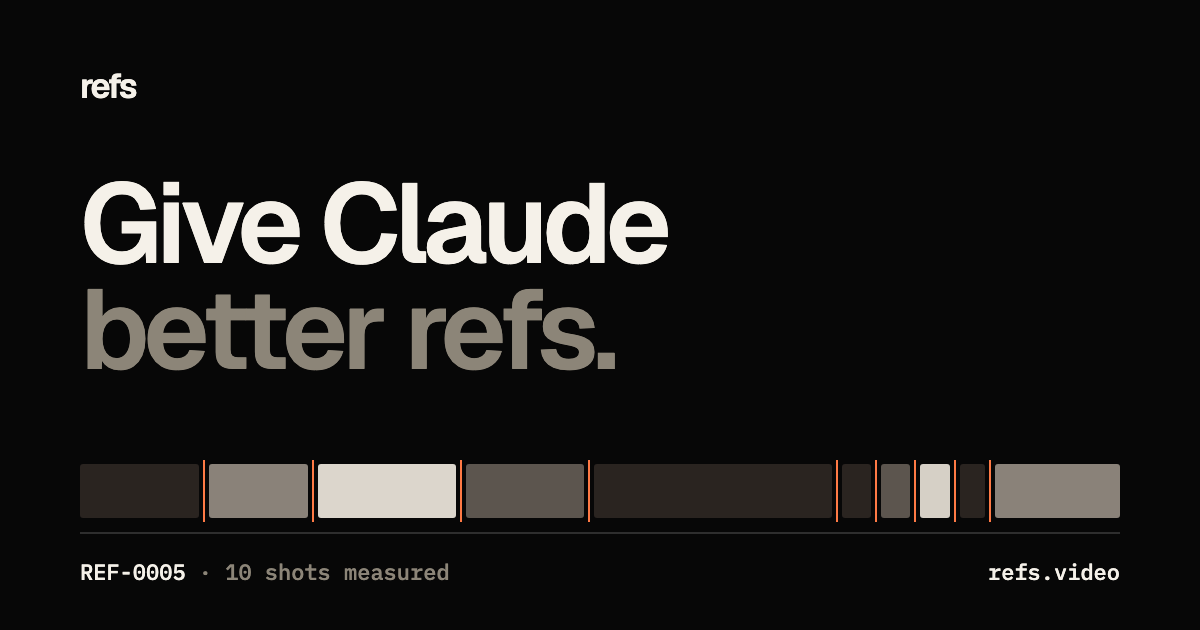
Refs is described as the video reference library for agents: a collection of 3,032 films that moved people, each measured cut by cut and turned into blueprints and prompt recipes an AI agent can build from. The site frames the product with a simple premise — Claude is only as good as the references you give it — and positions Refs as the way to hand Claude better refs. It is aimed at people who plan and produce launch films, motion pieces and explainers and who want their agent to work from real, published work rather than a loose collection of inspiration. The archive is free to browse, while the Pro plan opens up every plate of every blueprint, a runnable recipe for every film, formulas that compare films of one format, and the Refs MCP connection.
The problem it addresses is reference quality. An agent can only plan what it has been shown, and the site notes that Refs is deliberately not a mood board: it publishes measured cuts, timed beats and a recipe for each film, so that Claude copies the method rather than the footage. The archive is built from films studied at Apple, Google, OpenAI, Anthropic, Framer, Notion, Cursor, ElevenLabs, Raycast, Arc, Vercel, Linear and Perplexity, among others, gathered into a single searchable place. By the numbers shown on the site, the library contains 3,032 films, 67,695 shots measured and 28 formulas. Refs does not host the videos: every film plays from its original post and stays its maker's, while Refs publishes its own measurements and analysis and credits and links every source.
Every cut is measured. The site explains that shot boundaries are found frame by frame, and that clicking a shot jumps straight to it. Each film carries a cut map with figures such as cuts per minute and average shot length — the example shown on the homepage is 36 cuts per minute with an average shot of 1.5 seconds — so the pacing of a film becomes a number a planner or an agent can reason about rather than something you have to eyeball. Playback is built for scanning: walk the archive, scroll to move through it, hover a film to play it, move to scrub and click to open, with tap-to-play on a phone. Search runs across the whole archive, so a query pulls matching films out of the 3,032 on record.
Each film is taken apart into a 15-plate blueprint covering hook, beats, shots, type, colour, sound and script. The plates are designed to be flipped through: Format states what the film is in one breath; Card gives length, pace, shots and sound at a glance; Hook breaks down the first two seconds frame by frame; and Make it yours carries the instruction to swap the story and keep the method. The public FAQ describes the blueprint as containing hook, beats, shots, type, colour, sound and script, plus a prompt recipe you can hand to Claude. Free users see the first plates of every blueprint; Pro opens all 15 plates of every blueprint.
A runnable recipe sits at the end of each blueprint. The recipe is written to be pasted into Claude Code and made your own — the example on the site is a prompt recipe asking Remotion to create an original 15-second, 60 fps motion-design showreel for a product, with timed beats spelled out second by second, from a point growing into the mark inside faint circular guides to a full-screen shape wipe and a warm-ivory process chart. Alongside the per-film material, Refs publishes formulas: shared patterns across the strong films of one format, 28 of them in total, with counts of how many films sit behind each. Named examples include The Music-Led Motion Showreel, The Dark Staged Product Reveal, The Live-Drawn Paradox, The Fifteen-Second Service Rescue, The Sonified Chart Relay, The Capability Proof Montage and The Price of Regret.
The core mechanism is the Refs MCP. One command adds Refs to Claude Code, Codex or Cursor — the site shows a claude mcp add command pointing at the Refs MCP endpoint with an authorization header carrying a Refs key — after which Claude can search the archive, pull blueprints and formulas, and plan your film from real references. The demo on the site shows the agent calling a Refs search tool with a query and returning matching entries, such as the Lumi founder launch and product walkthrough, the Warp 2.0 founder-led launch film and the Bolt v2 founder-led product launch. The result, as the site puts it, is the same Claude with better references: ask for a film and Claude studies films that already worked, then plans and builds yours. The Refs MCP is listed as part of the Pro plan with 1,500 credits a month.
Because the references are measured rather than merely admired, the output an agent produces can follow an evidenced method: the hook, the beat timings, the shot lengths, the sound and the pacing of films that demonstrably moved people. Users get a way to brief an agent with cut maps, numbers and recipes instead of adjectives, and they keep the connection to the original work, since Refs links and credits every source and films play from their original posts. The library is also browsable on its own, so the same archive works as a study tool for a person and as a retrieval source for an agent.
Use cases described on the site revolve around planning and producing video. A person planning a launch film can ask Claude for a film and have it study the films that already worked before it plans and builds theirs. Someone building a motion design piece can pull a recipe such as the Remotion prompt for an original 15-second, 60 fps showreel and adapt it to their product. Searches in the demo return matches under labels like founder launch, kinetic type, silent demo, three.js and terminal, with results such as a founder-led product launch or a product walkthrough, which suggests how a specific style or format can be retrieved and studied. Others can work from the formulas to understand what the strong films of one format share, or from the cut maps to match a pacing pattern. The archive itself can be walked as a study resource, with films such as A Miniature Garden Becomes Life-Size sitting alongside dozens of others drawn from YouTube and X posts.
Refs is built for people who make and commission product and brand films — launch films, motion pieces and explainers — and for the developers and designers who drive AI coding agents such as Claude Code, Codex and Cursor. Browsing is free: every film playable from its source, cut maps, hover-scrub and the numbers, the first plates of every blueprint, and search across the whole archive. Pro costs $10 a month billed yearly or $16 monthly, and includes all 15 plates of every blueprint, a runnable recipe for every film, formulas across films of one format, and the Refs MCP for Claude Code, Codex and Cursor with 1,500 credits a month. A launch offer on the site notes that the code PRODUCTHUNT takes 50% off a year of Pro.
Taken together, Refs is a reference library that treats video as data an agent can use: 3,032 films measured shot by shot, 67,695 shots and 28 formulas, packaged into 15-plate blueprints and recipes and delivered to Claude Code, Codex or Cursor through the Refs MCP. Its promise is narrow and specific — give Claude better references, so the film it plans copies the method of work that already moved people, never the footage.
Publisher
A
admin
Launch Date2026-10-10
Platformweb
Pricingfreemium
Tech Stack
#MCP