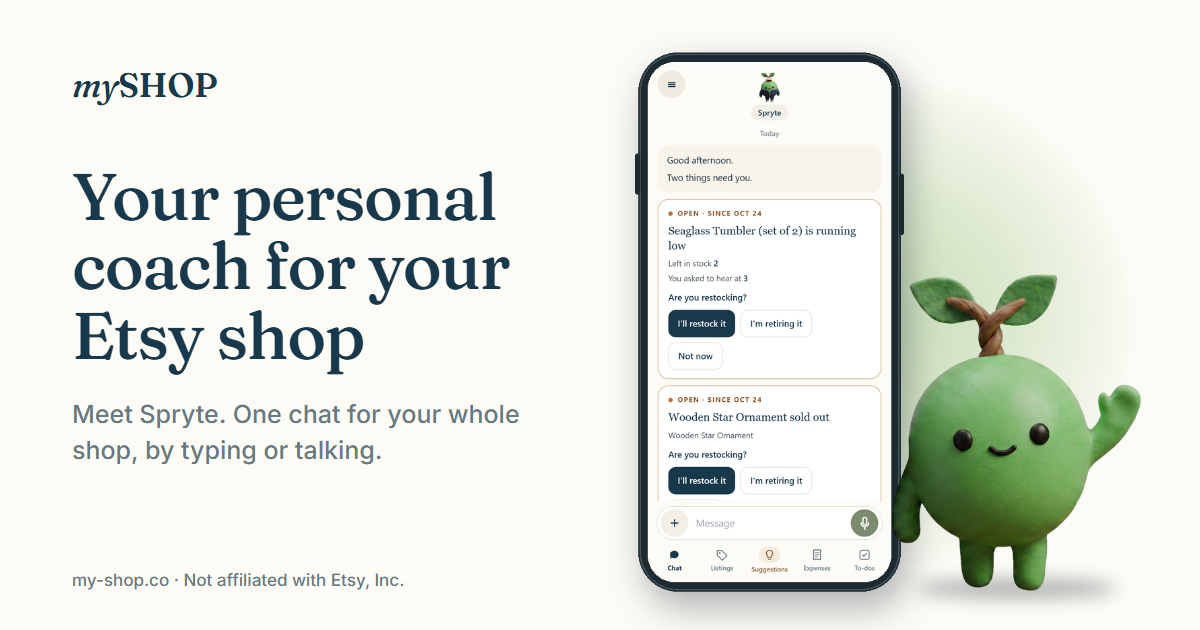
mySHOP is a mobile app that gives an Etsy shop a personal coach called Spryte, together with a profit and expense tracker built for the same shop. It is made for handmade and small Etsy sellers who run their shop on their own and want to be told what to do next instead of being shown another dashboard. Spryte reads the seller's own orders, listings and Etsy fees, then answers questions in plain words and returns one clear next step, ranked by impact. The app also works out what the seller really keeps after Etsy's fees, ads, shipping and the costs the seller logs. mySHOP runs on iPhone and Android, and every feature, including voice, is included in a single price.
Etsy gives sellers the numbers but nobody tells them what those numbers mean. Views go up while sales stay flat, and after redoing the photos, the title and the price, the seller is left wondering whether the listing was ever the problem. A listing can be deactivated with an email that does not say why, sending the seller to a policy page they read twice and still do not understand. Everyone says to get ready for the busy season, but last year's rush is a blur and stocking up tends to happen in the middle of it rather than before it. The alternatives are paying a coach by the hour or learning to love spreadsheets. mySHOP exists for the seller who would rather ask someone who has already read every order and listing in the shop.
The core of the app is a conversation. A seller opens mySHOP and asks anything about the shop, whether that is how the month is going, why a listing is not selling, or whether to charge more for an item that keeps selling out, and Spryte answers from the shop's own numbers rather than from general advice. The site draws an explicit contrast with a general AI chatbot: asked whether to raise the price of a star ornament that keeps selling out, a general assistant produces a balanced list of considerations because it has no idea what the seller charges, while Spryte already knows the price, the two sell-outs and when the ornament sells. Answers come with the one thing to do next, and suggestions are ranked by impact so the seller knows where to start.
mySHOP reviews and scores every listing out of ten. An opened listing shows its review out of ten, five parts displayed as bars, and the three fixes that matter most, biggest first. The point is deliberate restraint: not forty SEO tips, three things, ordered by how much they matter, each with a button that puts them on the seller's to-do list. Because the app connects through Etsy's own sign-in with read-only access, Spryte cannot edit a listing, change a price or publish anything. When it suggests a better title or new tags, the seller makes the change in Etsy themselves, which keeps the seller in charge of the shop at all times.
Receipts and expenses are handled inside the same chat. Etsy knows what came in, but only the seller knows what the boxes, the postage and the glass blanks cost. A seller can snap a paper receipt with the phone, pick a photo already taken, or choose a PDF invoice sitting in email; mySHOP reads the receipt and fills in who was paid, the total, the date and a category, and the seller checks it against the receipt before tapping Add it. Alternatively the seller types it to Spryte or taps the microphone and says it out loud, for example that they spent forty two dollars on glass blanks today, and Spryte puts up a card with the name, the amount, the date and the category, with Save, or simply saying yes, and an Undo on the card. Subscriptions and ads budgets are entered once as every month, every three months or every year and count towards every month they cover, while a single purchase counts on the day it happened. Nothing moves the profit figure without the seller saving it, and every expense stays theirs to change or delete.
The app also handles the day-to-day running of the shop. Spryte speaks first every time the app is opened: a greeting, how the month is going, what is selling, and anything that needs a decision as a card; if nothing does, it says so and leaves the seller alone. Every order waiting to ship is listed soonest first with the ship-by date Etsy gave it, and opening one shows the personalization, the gift note and the buyer's note together in one place so nothing gets missed in the rush. The make list groups everything waiting to ship by item, so all five ornaments get made in one sitting instead of order by order, with a tick box per order or the whole lot added to the to-do list in one tap. Spryte also learns the shop's busy months from its own orders and brings them up while there is still time to make stock, and a light bulb offers the questions worth asking this week.
Getting started takes about two minutes. The seller connects their Etsy shop through Etsy's own sign-in, which gives Spryte read access to listings, orders and Etsy fees and no ability to change anything in the shop. Spryte then reads the shop; the first read takes a few minutes, and after that it keeps up with new orders and listings on its own. While that happens, a short chat covers the seller's goals and when their busy months fall. From then on Spryte speaks first whenever the app is opened. Beyond typing, the seller can tap the microphone and say it, and Spryte answers out loud in a voice chosen from four. Suggestions arrive as cards with easy answers such as "I'll restock it", and saying yes to a suggestion lands it on a to-do list that fills itself, with Spryte asking first every time.
The outcome mySHOP aims at is that the seller always knows their next best step. Instead of decoding charts, they get a sentence about how the month is going and a ranked shortlist of what to fix. Instead of guessing at margin, they see the money that is really theirs: what each order sold for, less the Etsy fees on it, less the costs they logged. Instead of being surprised by the busy season, they get a reminder while there is still time to make stock. The site is careful about the promise it makes: nobody honest can promise sales, but the seller can spend their roughly twenty minutes a day on the things that make the biggest difference.
Typical moments in the app are concrete. A seller opens it and reads that two things need them, one of which is a low-stock card. They ask what has to go out today and work down the orders in ship-by order, with the gift note and personalization already in front of them. They ask what to make this week and work through the make list item by item. They open a listing that is not selling and get a score out of ten with three fixes. They say they spent forty two dollars on glass blanks today and confirm the card Spryte puts up. At the end of the month they ask how much they actually kept and get an answer built from their sales, Etsy's fees and the costs they logged. Before a busy month they get a prompt to stock up.
mySHOP is built for the seller who does it all: someone who sells on Etsy and makes every decision alone, who wants to be told what to do next rather than shown another dashboard, who would rather talk to their shop than learn a spreadsheet, and who has about twenty minutes a day for the business side. The site is equally clear about who it is not for: sellers who want to bulk-edit hundreds of listings at once, who want a keyword research database, or who run several shops from one login. Those are jobs for a listing manager or a keyword tool, and some sellers use one of those alongside mySHOP. Pricing is one plan, with a 7-day free trial that requires a card, then $20 a month or $199 a year with every feature included, voice too, cancellable at any time. mySHOP is an independent app made by Greenstone Market LLC and is not affiliated with, endorsed by or certified by Etsy; it connects to the shop through Etsy's official sign-in and Etsy's API.
mySHOP's value proposition is simple: a coach that has actually read your shop, plus an honest view of what you keep. Spryte reads every order, listing and fee, answers from your own numbers rather than from forum posts, and hands back one clear next step at a time. The expense and profit tracking close the loop by turning sales into the money that is really yours. For an Etsy seller working alone, that is a coaching relationship and a bookkeeping habit in one app, for less than one coaching call a year.
Publisher
A
admin
Launch Date2026-11-11
Platformmobile
Pricingpaid