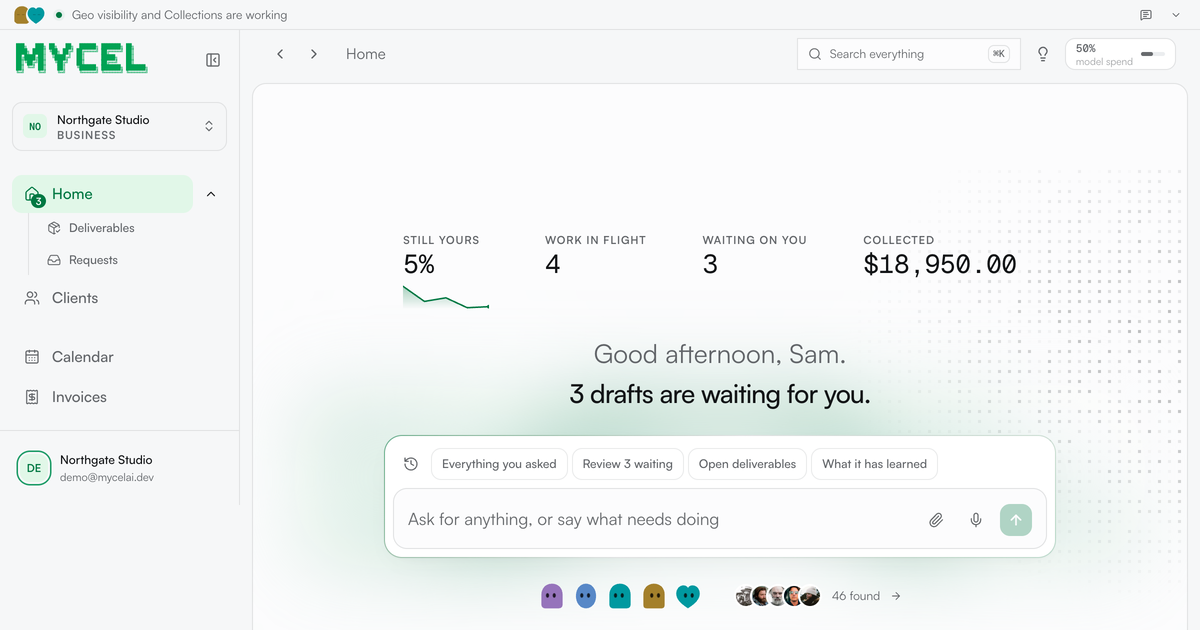
Mycel is an AI platform that runs the work a service business sells — its clients, its deliverables, its approvals and its invoices. You bring one past deliverable, anything you have already sent a client: a close, a proposal, a report or a shortlist. Mycel learns how your firm does it and drafts every future one, waiting for your approval before anything ships. It is built for service businesses whose work still crosses one desk — the agencies, bookkeepers, recruiters, GEO and web studios and contract desks where every draft waits on the same person.
The framing Mycel uses is blunt: you are the last pair of eyes on everything, and that is what caps you. Every deliverable goes through you, every client asks for you by name, and every draft waits for a free afternoon that never comes. The alternatives the company prices against are telling. It compares its own Starter plan — twelve months, two businesses, three seats, nothing to negotiate, listed at $3,588 for a year — with an offshore contractor at roughly $1,200 a month, or about $14,400 a year, where the work still returns to your review every time, so the correction you made in March is one you make again in May. Hiring, it notes, costs $80,000 a year and six weeks of ramp, and the person hired still asks the questions you were trying to stop answering. Mycel's stated position is that it does not replace you; it makes you the only person who needs to look at the draft.
Setup is described as an afternoon. You describe the service, upload one past deliverable and give it this week's work; from there the loop is fixed: it drafts, you approve, you send. The product types named on the site are ordinary service-business artifacts — a close, a proposal, a report, a shortlist — and the company's claim is that it learns how your firm does it rather than producing generic text. Early customers quoted on the site describe exactly that shift. Mailwarm (YC S20) says Mycel 'drafted a client report I would have lost an afternoon to. I changed maybe a fifth of it and sent it.' figr.so says 'the second draft is the part that got me. It came back written closer to how I actually write.' An SEO agency says it stopped rewriting the opening paragraph somewhere around the third draft.
Nothing leaves the business without passing through the approval queue. Before approving you can edit the wording, and that edit becomes training — the correction is kept, which is why the company frames the system as compounding rather than static. Sending rules are configurable: on the demo business, a status update and a document reminder were allowed to go out without stopping for approval, while anything involving money, a commitment or a first approach still had to wait. The payoff is measured on a chart of how much of the work no longer needs you: the share of each draft rewritten by week ran at 94% on 11 August, 28% on 18 August, 44% on 25 August, 0% on 1 September and 5% in the latest week, with one week needing no changes at all. The headline the site draws from that is that drafts need 90% less editing than when you started.
Feature-wise, Mycel groups its work into desks. GEO monitor answers 'when buyers ask ChatGPT' by reporting what the assistants tell your client's buyers, with Claude and Gemini shown as the assistants in play. Invoice chaser handles accounts receivable 'when it is late,' described as money in without you asking twice, and lists Gmail among its connections. Books keeper closes the month with a pack to send. GTM operator works the pipeline daily, generating new conversations with people who fit. Recruiting desk delivers a longlist screened in writing per search, using Gmail and Slack. Contract desk produces a redline ready for your signature per contract, using Notion and Gmail. The company's point is that bookkeeping, recruiting, GEO, legal, web, ops and contract desks all run the same loop across different trades — the judgment stays yours.
Underneath sits a back-office surface covering clients, open engagements, deliverables in flight, invoices and requests. It shows what is owed, what has landed, what clients have signed off and what is overdue: on the demo data, 1,701 jobs run with 96 that did not finish and every one of them on the timeline, $29,150 owed with $18,950 landed in the last eight weeks, and nine deliverables accepted by clients in the same period. A 'worth doing next' list turns that data into specific, explainable prompts — an invoice 37 days overdue with $8,750 outstanding that has never been chased, with seven more overdue and unchased invoices worth $20,400 behind it; a client with four open requests that has never been given a way to see them, where the fix is to open their page, copy the portal link and send it; two engagements the client accepted but which were never invoiced; and an engagement that cannot start because the service declares no job that produces a deliverable. There is an audit view for who changed what, and scheduled runs such as opening engagements for clients that have none, starting ready engagements and a weekly GEO probe.
The methodology is deliberately narrow at the front door. You bring one file, and Mycel drafts everything downstream of it. Each job runs in a disposable sandbox that never holds a credential, and nothing reaches a client until you approve it — a job here means one piece of work done: a message answered, a sync run, a document produced. The dashboard even names what the system will not do: on the demo business, Mycel does not build or maintain the clients' Webflow sites beyond the recommended commercial pages from the visibility work. When something cannot proceed, it says so rather than stalling silently.
The benefits the site claims are framed as things you stop doing. Starter is sold as the point where you stop being the one who keeps it running; Growth as the point where you stop turning the next client away; Scale as the point where you stop waiting weeks for a procurement review. Across all of them the outcome is the same: you remain the only person who needs to look at the draft, the share of each draft you rewrite keeps falling, and the approvals, invoices and client requests that used to live in your head are held somewhere that tells you what is worth doing next.
Concrete uses visible in the product include recurring client reporting — visibility reports on geo visibility and weekly reports on search presence — plus the collection work that follows: raising invoices, chasing collections and closing the books monthly. Client work in flight on the demo business includes a pricing page copy and query job, a four-practice listing audit, a competitor sweep, a reviews summary and local SEO positions across three towns. The pipeline desk runs outbound conversations daily, the recruiting desk screens candidates per search, and the contract desk returns a redline per contract ready for signature.
Integration marks on the site include Gmail, Slack, Notion, Claude and Gemini, and setup steps include connecting LinkedIn to send, giving the work an address to send from and connecting a mailbox for the portal. Plans start with a 7-day free trial; during the Product Hunt launch, Starter is $149.50/month for three months and then $299/month, Growth is $449.50/month for three months and then $899/month, and Scale is quoted on request with no limit on businesses, people or jobs, AI capacity set to your volume and the option to run inside your own private cloud. Starter covers 2 businesses, 3 people and 2,000 jobs a month; Growth covers 10 businesses, 10 people and 10,000 jobs a month, works several inboxes at once, keeps every client's logins apart and adds priority support. Self-hosting is free forever under Apache-2.0 with nothing metered, run on your own servers with your own model key and installed with a single curl command on macOS, Linux or Windows.
Mycel's value proposition reduces to one idea: bring one past deliverable, and every future one arrives drafted, corrected once, and held for your signature. The judgment stays with you; the repetition does not. If you are the bottleneck on recurring client work that still crosses one desk, Mycel is built to make you the only person who has to look.
Publisher
A
admin
Launch Date2026-09-21
Platformweb
Pricingfreemium
Tech Stack
#Next.js#Sentry