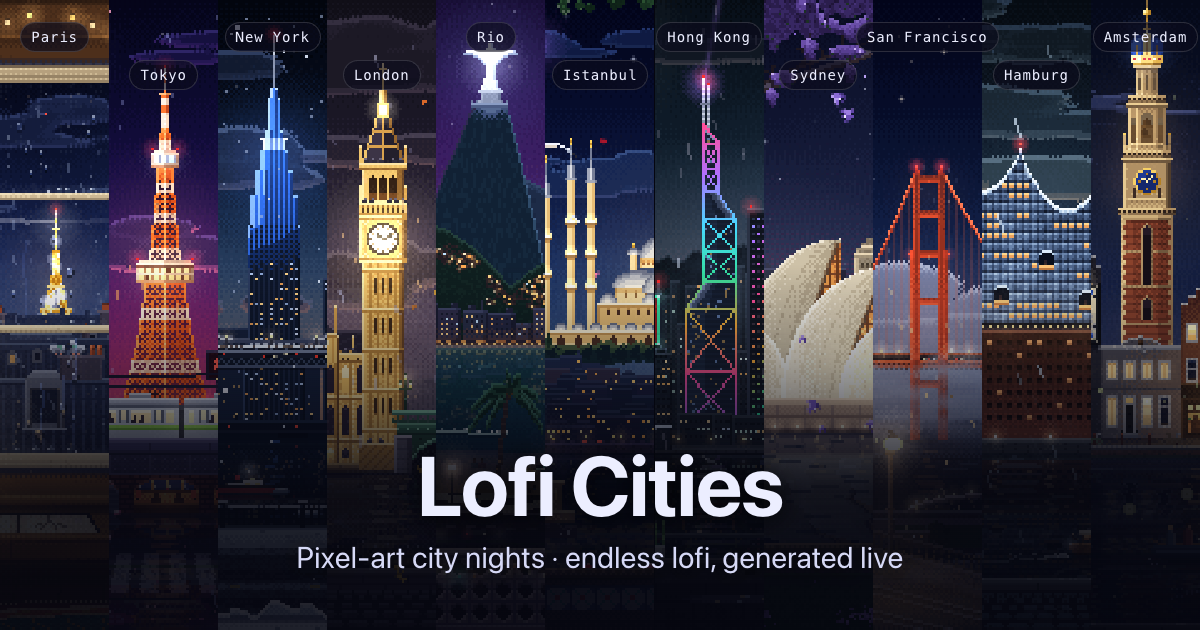
Lofi Cities is a free web app that pairs animated pixel-art city nights with endless lofi music generated live in your browser. Pick a city and let it run: every scene is a 480×270 pixel animation that loops seamlessly every four minutes, with its own weather, landmarks and city sounds, while new lofi tracks are composed on the fly. There is nothing to install, no account and no pop-ups, and it works on computers, phones and tablets. The site says it makes a calm background for studying, working or winding down, and that is exactly who it is for: anyone who wants ambient music and a moving scene without managing playlists, downloads or sign-ins.
Most background music comes from fixed playlists, streams or downloaded files, which eventually repeat or run out, and often require an account, a subscription and a connection. Lofi Cities takes a different route. Every track is composed on the spot with the Web Audio API — a chord progression, a drum groove, a bass line and often a melody — and everything is synthesized in real time with no samples or recordings, so the stream never runs out. The same live approach shapes the visuals: each city is pixel art animated in the browser, and after a first visit while online the whole experience, every city and the music included, keeps working without a connection. There are no cookies and no sign-in; your settings, such as the last city, volumes and vibe, stay in your browser's local storage.
At the heart of the app are sixteen animated pixel-art cities: Paris, Tokyo, New York, London, Rio de Janeiro, Istanbul, Hong Kong, Sydney, San Francisco, Hamburg, Amsterdam, Dubai, Madrid, Rome, Prague and Munich. Each one is a drawn scene with its own landmarks, weather and mood — rain on an attic window under the zinc roofs of Paris with the Eiffel Tower sparkling far off, neon rain by Tokyo Tower with cherry blossoms and a train crossing the viaduct, snow over the Brooklyn Bridge, fog on the Thames, a Copacabana summer night, a Bosphorus rooftop tea garden, Victoria Harbour after dark, a jacaranda night on Sydney harbour, fog pouring through the Golden Gate, harbour lights on the Elbe, canal bridge lights in Amsterdam, a fountain night at the Burj, a summer night on Gran Vía, a night by the Colosseum, lamps on Charles Bridge and a Christmas market in the snow on Marienplatz. The city picker lists every city with its local time and how many people are in it right now, featuring the city with the most people in a wide card above the others. A Tour chip (C) can move on to the next city every 5, 10, 15 or 30 minutes, or follow the night, showing whichever city is closest to 1 am local time, moving west from Sydney to San Francisco as the hours pass, with cities on the same clock taking turns.
Music is shaped through the Vibe panel. Nine styles can be selected: jazzhop (the default, a Rhodes with jazzy chords and a swung boom-bap beat at 68 to 88 BPM), piano (a sleepy felt piano with soft drums), ambient (slow warm pads with barely a beat, for sleep and deep focus), bossa (nylon guitar over a bossa nova groove), synth (80s city-pop synths), house (lofi deep house on a soft four-on-the-floor kick), guitar (a clean electric guitar fingerpicked over a lazy beat), sad (slow minor chords and a lonely muted trumpet) and medieval (a lute and a recorder over hand drums). A new style starts with the next track. The same panel sets the mood — chill for slower and darker, upbeat for faster and brighter — and chooses whether the full band, no drums, or the chords only play. Track titles are inspired by the city on screen. An Up next list shows the coming tracks so you can pick one to play right away, and you can skip forward with the N key.
A separate ambience layer mixes each city's own sounds under the music, and the city sounds mixer gives a slider for every sound of the city — turn the rain up, the traffic off or the bells down — with the setting carrying over to every city that shares that sound. Music and city sounds each have their own volume slider. The Weather chip (W) brings rain, snow, autumn leaves or a clear night to any city, or returns to the weather the city was drawn with, such as winter snow in New York, autumn in London and Hamburg, and spring blossom in Tokyo and Sydney; the city sounds and track titles follow it, so rain brings the sound of rain in and snow a hush of wind, and your pick stays for the next visit. Two timers support sessions: the focus timer runs 25 minutes of focus and 5 of break (or 50 and 10) on repeat with a soft chime at each break and a bell to call you back, while the sleep timer fades the music and city sounds out after 15 to 90 minutes and then pauses.
Lofi Cities also has a light social layer. The glowing pill under the city name shows a live count, for example '23 here now · 5 in Tokyo · 480 today · 12,345 all time' — people with the app open right now, how many are on your city, browsers that came by today since midnight where you are, and every browser since launch; when nobody else is on it shows the rest. The Together button (G) lets you pick a heart, note, star or moon and tap the scene to float it up from that spot on everyone's screen in that city, or release a paper lantern (L) that rises over the city for about a minute, in the same place for everyone, including people who arrive while it is in the air. The Chat button (Enter) opens short messages from the last hour, up to 80 characters and without links, under a random two-word name such as 'sleepy fox' that stays the same for your browser; a smiley button adds emoji, and typing a colon and a name such as :coffee: lists matching emoji as you type. There are no accounts: a random id in local storage, not a cookie, makes your tabs count as one person, the server forgets it about 25 hours after your last visit, and other people only ever see your two-word name. The all-time count is a single number with no list of who, and you can hide anyone's messages; when a few people hide the same person, their messages go for everyone and they cannot chat for an hour.
The overall approach is to keep everything live and local. The music is composed in the browser while you listen, with chords, drums, bass and melody synthesized through the Web Audio API and finished with tape wobble and vinyl crackle — no samples and no recordings, so the music never runs out. The visual side uses pixel-art animations that loop seamlessly every four minutes at 480×270. Browsers block sound until you interact with a page, so clicking, tapping or pressing any key starts the music, and the play button pauses and resumes it. Because everything is generated client-side, the site works offline after a first visit and can be installed as an app through the browser's Install or Add to Home Screen option. Anonymous usage statistics such as which cities are viewed are collected without cookies, and browsers that send Do Not Track are left out of them.
Because the music is generated rather than played back, listeners never hit the end of a playlist, and because it is composed on the fly every track is new. The scenes give the eye something to rest on as well: weather, landmarks and city ambience change the mood without any input, and the controls fade out on their own when you stop moving the mouse, so nothing distracts from the screen. For people who need to concentrate, the focus timer chimes at each break and calls you back, and for winding down, the sleep timer fades the music and the city out. Because it runs in the browser with no install and no account, it opens on a laptop, a phone or a tablet in seconds, and it keeps working offline.
Concrete uses fall out of the design. As a study or work background, you can press F for fullscreen and H to hide the interface, or P for the mini player, a picture-in-picture window that keeps the scene floating over your other apps in browsers that support it. Streamers can add a Browser source set to 1920×1080 with a city page's address followed by ?obs — for example https://loficities.com/tokyo/?obs — which hides the interface and starts the music on its own, letting them switch city with the arrow keys, skip with N or change the weather with W, or add &weather=snow to the address. Anyone who wants a still image can save the current frame as a 1080p PNG with S, and the 16-city video collection on Gumroad provides four-minute 1920×1080 MP4 loops at 60 fps without audio for video or livestream backgrounds. In portrait orientation on a phone, the landmark and billboard stay in view, you can drag the scene sideways to look around it, and swiping past its end switches city.
Lofi Cities is free and runs entirely in your browser — no download, no account and no pop-ups — which makes it usable on any modern computer, phone or tablet, and it can be installed as an app through the browser's Install or Add to Home Screen option. Anonymous usage statistics, such as which cities are viewed, are collected without cookies, and browsers that send Do Not Track are left out of them. The music and city sounds are built on the Web Audio API and generated client-side, so the site works offline after a first visit. It is made by Safa Elmali, can be supported on Buy Me a Coffee, and takes new city requests on X, with Hong Kong, Sydney, San Francisco, Hamburg and Amsterdam joining the first six, followed by Dubai, Madrid, Rome, Prague and Munich. Every city also has a billboard for rent, where a café, shop, studio or brand can be drawn in pixel art and glowing in the scene.
In short, Lofi Cities turns a browser tab into an endless pixel-art night: sixteen animated city scenes, weather and city sounds you can shape, nine lofi styles composed live rather than streamed, and timers, reactions, lanterns and a quiet chat for company. It is free, needs no account, works offline after the first visit, and is built to be left running in the background while you study, work or fall asleep.
Publisher
A
admin
Launch Date2026-09-28
Platformweb
Pricingfree
Tech Stack
#Web Audio API