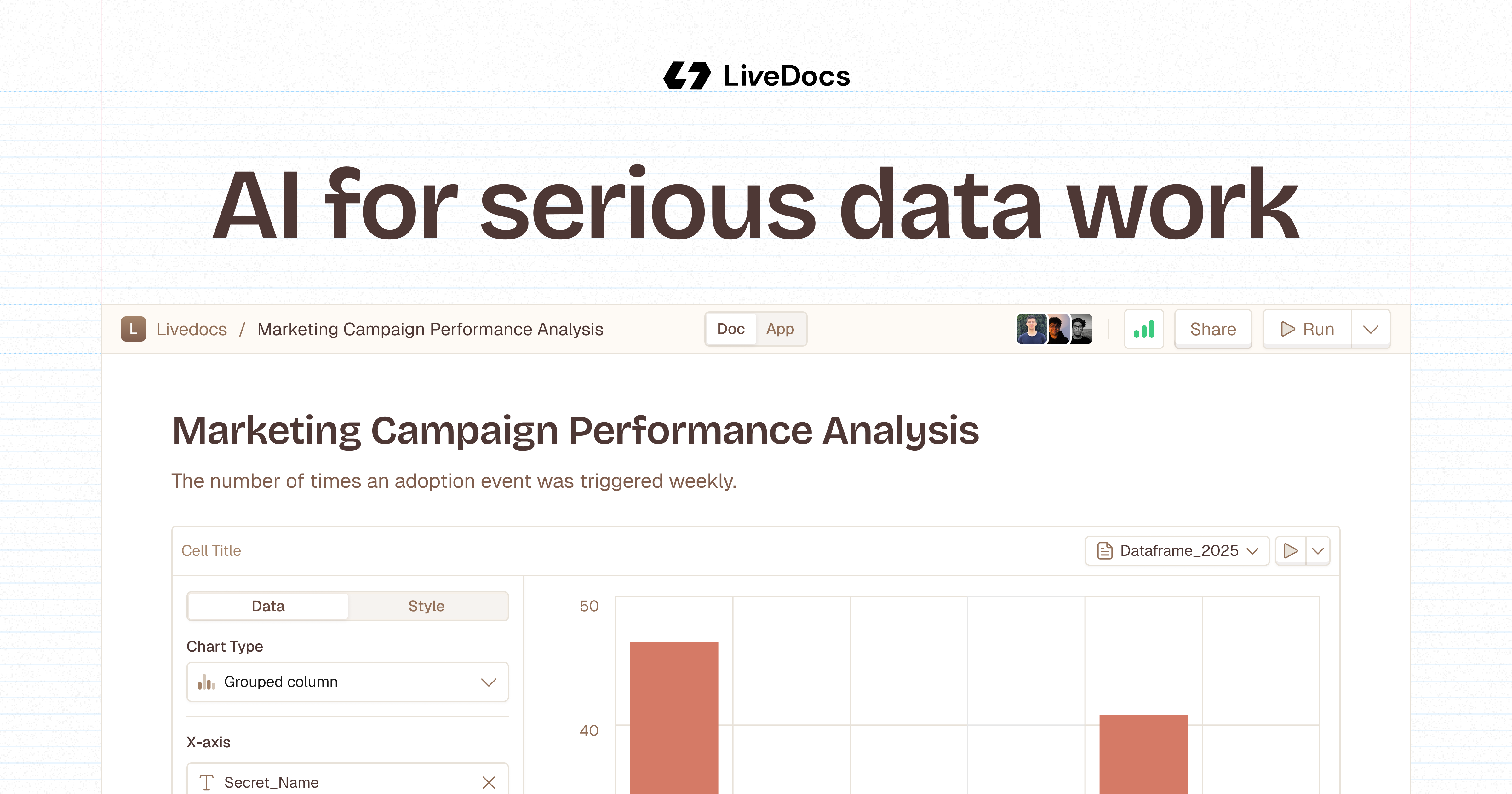

Livedocs is an advanced AI agent designed to transform how teams interact with and analyze data, delivering results from question to insight in mere seconds. It serves as a comprehensive platform for modern teams, enabling users to upload files or connect data sources and instantly generate charts, metrics, and plain-English explanations. The product is built for professionals across sales, marketing, customer analytics, and product domains who need rapid, accurate data analysis without the steep learning curve of traditional tools. Its primary purpose is to democratize data analysis by providing an intuitive interface where complex data work becomes accessible through simple queries and automated processes, effectively giving teams data superpowers with just a few clicks.
Traditional data analysis workflows are often plagued by significant bottlenecks, requiring specialized skills in SQL, statistical programming, or complex business intelligence software. Teams frequently struggle with messy data that needs cleaning and standardization before any meaningful analysis can begin, leading to delays and frustration. The process of extracting insights from spreadsheets, CSVs, or databases typically involves multiple steps of data preparation, query writing, visualization creation, and interpretation, which consumes valuable time and resources. This pain point is especially acute for teams that lack dedicated data analysts or scientists, forcing them to rely on IT departments or external consultants for even basic analytical tasks, thereby slowing down decision-making and innovation.
One of the first major feature groups is automated data analysis and insight generation, where Livedocs uses AI to interpret user questions and produce immediate results. The system can analyze quarterly sales data to identify growth patterns and opportunities, segment customers by behavior and lifetime value, and forecast revenue using historical trends. It performs complex analytical tasks like churn prediction to identify at-risk customers and A/B test analysis to determine statistical significance, all through a conversational interface. This capability matters because it eliminates the need for manual coding or query writing, allowing users to focus on strategic questions rather than technical execution, thereby accelerating the entire analytical workflow from days to minutes.
A second major feature group encompasses comprehensive data preparation and management tools, including robust data cleaning pipelines and merging capabilities. Livedocs can clean and standardize messy data for analysis, combine data from multiple sources into unified datasets through merge and join operations, and handle various data formats like CSVs and spreadsheets seamlessly. This feature set ensures that users start with reliable, high-quality data, which is foundational for accurate insights and trustworthy decision-making. The importance lies in addressing the reality that most real-world data is imperfect and fragmented, and by automating these preparatory steps, Livedocs removes a major barrier that typically consumes up to 80% of an analyst's time before any actual analysis begins.
admin
Additional capabilities include advanced analytical functions such as time series analysis for examining temporal patterns and seasonal trends, cohort analysis for tracking customer behavior over time by groups, and anomaly detection to identify unusual patterns and outliers. The platform also supports specialized business analyses like marketing ROI measurement across channels, inventory optimization to reduce costs and prevent stockouts, and financial ratio analysis to assess company health. Furthermore, it offers tools for price elasticity studies, supply chain analytics, social media analytics, and website traffic analysis, providing a versatile toolkit that covers a wide spectrum of business intelligence needs across different departments and industries.
From a technical standpoint, Livedocs operates as an AI-powered collaborative workspace that combines the computational power of a data notebook with the simplicity of an app builder. Users can add their files or connect to various data sources, and the system's AI agent processes natural language queries to generate SQL queries, build charts, and compute metrics automatically. The platform likely employs machine learning models to understand data context, suggest relevant analyses, and produce visualizations like interactive dashboards with key performance indicators. This approach abstracts away the underlying complexity of data engineering and statistical modeling, presenting results in an accessible, visual format that teams can easily interpret and act upon.
The benefits and measurable outcomes for users are substantial, starting with dramatically reduced time-to-insight from weeks or days down to seconds or minutes. Teams gain the ability to perform sophisticated analyses like customer lifetime value calculations or sales trend identification without needing advanced technical skills, thereby empowering more team members to engage with data directly. Organizations can expect improved decision-making quality due to data-driven insights, better resource allocation through optimized processes like inventory management, and enhanced collaboration via a shared workspace where analyses and dashboards can be built and reviewed collectively. Ultimately, these outcomes translate into competitive advantages, cost savings, and increased agility in responding to market changes or internal performance metrics.
Concrete use cases with specific workflow examples include a sales manager uploading quarterly sales CSV files and asking Livedocs to analyze trends and forecast next quarter's revenue, receiving interactive charts and plain-English summaries instantly. A marketing team might connect their customer database to segment users by engagement patterns, run A/B test analyses on campaign variations, and measure marketing ROI across different channels within a single platform. A product team could use cohort analysis to track user retention over time, perform anomaly detection on usage metrics to spot issues, and build an interactive dashboard to monitor key performance indicators without writing any code, streamlining their weekly review process.
Target users include sales professionals, marketing teams, customer analytics specialists, product managers, and business analysts across various industries who need to make data-informed decisions. The platform integrates with common data sources like CSVs, spreadsheets, and databases, and it likely connects to business applications through APIs or connectors, though specific integrations are not detailed in the provided content. The tech stack involves AI and machine learning models for natural language processing and automated analysis, combined with visualization libraries for chart generation. Pricing plans are available through a dedicated pricing page, with a free tier that allows users to start analyzing data without a credit card, making it accessible for teams of different sizes and budgets.
In summary, Livedocs fundamentally reimagines data analysis by providing an AI-powered platform that turns complex data work into simple, conversational interactions. It addresses the critical pain points of time-consuming preparation and technical barriers, delivering instant charts, metrics, and insights that empower teams to act quickly and confidently. By combining the depth of a data notebook with the ease of an app builder in a collaborative workspace, it enables modern teams to harness their data's full potential without requiring specialized expertise, ultimately driving better business outcomes through accelerated, democratized data analysis.
Livedocs targets modern teams across sales, marketing, customer analytics, and product domains who need rapid, accurate data analysis without deep technical expertise. It serves business analysts, product managers, marketing professionals, sales managers, and operations staff in various industries who make data-informed decisions. The platform is ideal for organizations lacking dedicated data scientists, enabling team members to perform sophisticated analyses like forecasting, segmentation, and dashboard building through an intuitive, AI-powered interface. It empowers professionals to transform CSVs, spreadsheets, and databases into actionable insights through collaborative workspaces that simplify complex data work.