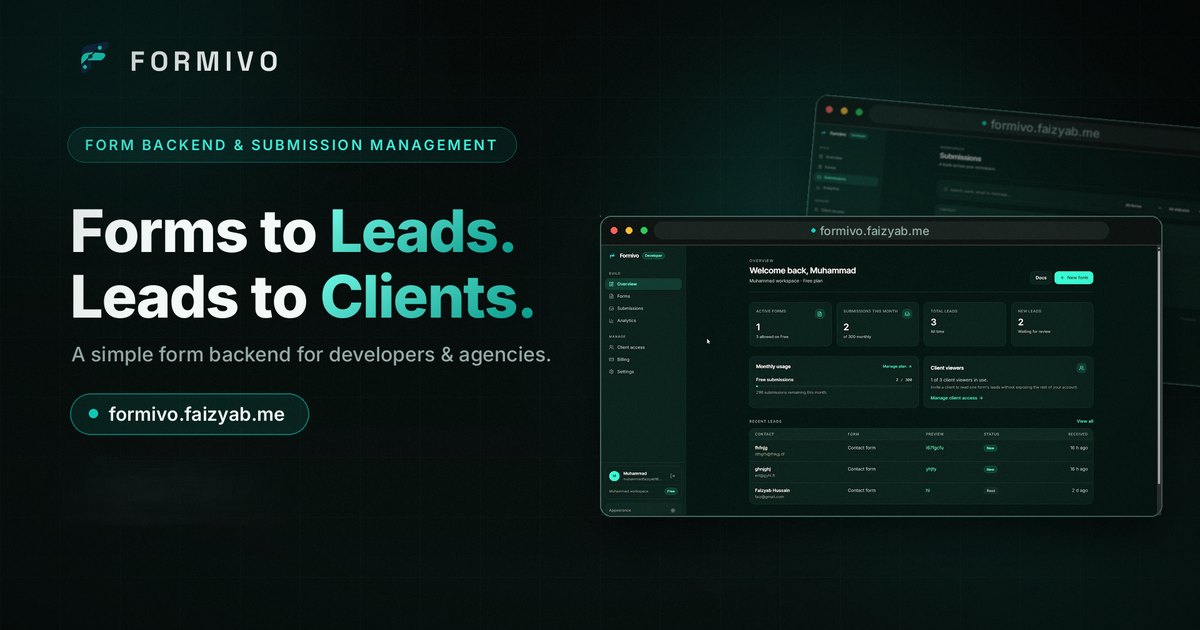
Formivo is a form backend and lead workspace for people who build websites for clients. It connects to the forms you have already built — plain HTML, React, Next.js, Vue, Nuxt, JavaScript, PHP, Laravel, Node.js, Express, Python, Django, Flask or a static site — by setting an existing form's action to a single public endpoint. Every submission is then stored as a complete record in one workspace where you can read, search, filter and track its lead status, and selected submissions can be shared with the client who owns them through a secure, read-only client portal scoped to a single form. Formivo exists to handle everything that happens after the submit button, without a backend of your own to build or maintain.
The product is built around an observation stated plainly on its own site: a form is a moment, but the lead is the relationship. Collecting an enquiry is the easy part; keeping it, organizing it, following up and getting it to the right client is where the workflow usually falls apart. Without a form backend, storage, validation and retries have to be rebuilt for every project, and a notification email is often read once and then archived. Follow-up ends up in a spreadsheet, a note, or whoever remembers the thread, while client updates mean forwarding enquiries and answering "what came in?" by email. Each new project can also mean a different form service and a different login. Formivo targets that submission-to-client handoff specifically and describes itself as not a CRM or an enterprise sales suite, leaving the rest of your stack alone.
Connecting forms is the first capability. You keep your markup, styling and validation: create a form in Formivo, copy its public endpoint, and point the existing form at that URL with method POST. There is no SDK to install, no secret sitting in browser markup, and no rebuild. The endpoint accepts form-encoded, multipart and JSON submissions, needs no API key to submit, and applies a 256 KB body limit with rate limiting. A successful post returns 201 Created with a lead id and a JSON success message. A plain HTML form gets a built-in confirmation page instead, and an optional hidden _redirect field sends visitors back to your own thank-you page. A hidden _gotcha honeypot field provides basic bot protection. Field names carry over unchanged. A Formivo skill can also be installed with one command — npx skills add FormivoDev/skills — so coding agents such as Claude Code, Codex / ChatGPT, Gemini CLI and Cursor can read the exact endpoint contract and wire an existing form without guessing.
Managing submissions is the second capability. Every submission lands as a complete record: the full payload, the source, a timestamp and a lead status. You can search across contact fields such as name, email or message, filter by form or by status, and open full submission detail. Lead statuses run from New through Contacted, Qualified and Converted, so follow-up stays visible instead of depending on an inbox. CSV export is included on Lite, Pro and Agency and enforced on the server, while the Free plan cannot export. Analytics history also depends on plan: 90 days on Lite, up to one year on Pro and up to two years on Agency. Monthly submission allowances are 100 on Free, 1,000 on Lite, 5,000 on Pro and 20,000 on Agency; existing submissions and history are retained when a limit is reached, and new submissions are rejected with a quota error until the allowance resets or you upgrade.
Sharing leads with the client who owns them is the third capability. You invite a client to one form by email; they receive a single-use link that expires, accept it, and get a read-only client account for that form. Inside that view they can see the shared form and read and search its submissions, but they cannot change a lead status, edit form settings, open another form, see billing or workspace members, or invite another viewer. Access is scoped per form, permissions are checked on every request, and revoking access closes the view on the next request. The portal runs on your Formivo link — white-label domains are not available today.
The endpoint is public by design, and the read side is deliberately closed. A GET on the form endpoint returns 405, so stored data is never readable through the public URL. Ownership always comes from the signed-in session, never from a form or submission id supplied in a query string. Postgres Row Level Security policies scope forms to their workspace and submissions to forms the caller is allowed to view, and client isolation is covered by an authorization test suite that rejects cross-account access. Abuse controls include per-form and per-IP rate limits, honeypot fields, a 256 KB body cap and an immediate pause switch. Database and provider keys are read through server-only modules and never serialized into the browser bundle. The overall method is three steps: connect the form you already built, manage every submission in one inbox, and share a read-only view with the client who owns it.
The practical benefits follow from that structure. You stop rebuilding storage, validation and retries for every project, because the form you built posts to one stable endpoint. Instead of a notification email that is read once and archived, every submission is stored as a complete, searchable record. Instead of a spreadsheet or a memory of the thread, leads carry statuses you can act on. Instead of forwarding enquiries and answering "what came in?" by email, each client gets a read-only portal for the one form you shared. Instead of a different form service and a different login per project, one workspace covers every client website you manage. And because Formivo does not replace your design or lock it to a builder, you keep the form you already built while gaining the storage, search, lead status and client access that sit after the submit button.
Typical use cases map to the people behind client websites. A freelance developer takes on a client site, points the contact form at a Formivo endpoint, and gets a reliable backend without maintaining a submission stack of their own. A web agency runs forms across many client websites in a single workspace, filtering submissions by form and keeping each client's data separated. A client project hands the client a read-only view of their own form so leads stop being forwarded over email. A developer working with a coding agent installs the Formivo skill and lets the agent update the form action, add fields and handle responses against the documented contract. A team on a framework such as React, Next.js, Laravel or Django follows one of the fourteen tested integration guides and keeps one POST URL across every framework it uses.
Formivo is aimed at freelance web and full-stack developers, web design and development agencies, and small teams that manage forms across several client websites; it is explicitly not aimed at teams that want a hosted form builder. Integration is language-agnostic: anything that can send an HTTP request works, with tested guides for HTML, React, Next.js, Vue, Nuxt, JavaScript, PHP, Laravel, Node.js, Express, Python, Django, Flask and static sites, plus an API reference covering body formats, reserved fields and status codes. Pricing starts with a Free plan (one form, 100 submissions a month, one client view, no card required), then Lite at $9 per month, Pro at $19 per month and Agency at $49 per month, with yearly billing at $90, $190 and $490 respectively, which includes two months free. Paid plans are billed in USD by Polar as merchant of record, signup is verified with a six-digit email code, sign-in is email and password only, and support runs by email with Pro and Agency prioritized.
In short, Formivo covers the part of a client website that breaks first: collecting submissions reliably, keeping leads organized, and giving each client a controlled view of their own data. You already built the form — Formivo adds the storage, search, lead status and read-only client access that come after it, inside one workspace that scales from a single freelance project to an agency running up to 100 active forms.
Publisher
A
admin
Launch Date2026-11-29
Platformweb
Pricingfreemium
Tech Stack
#Postgres#Polar#Resend