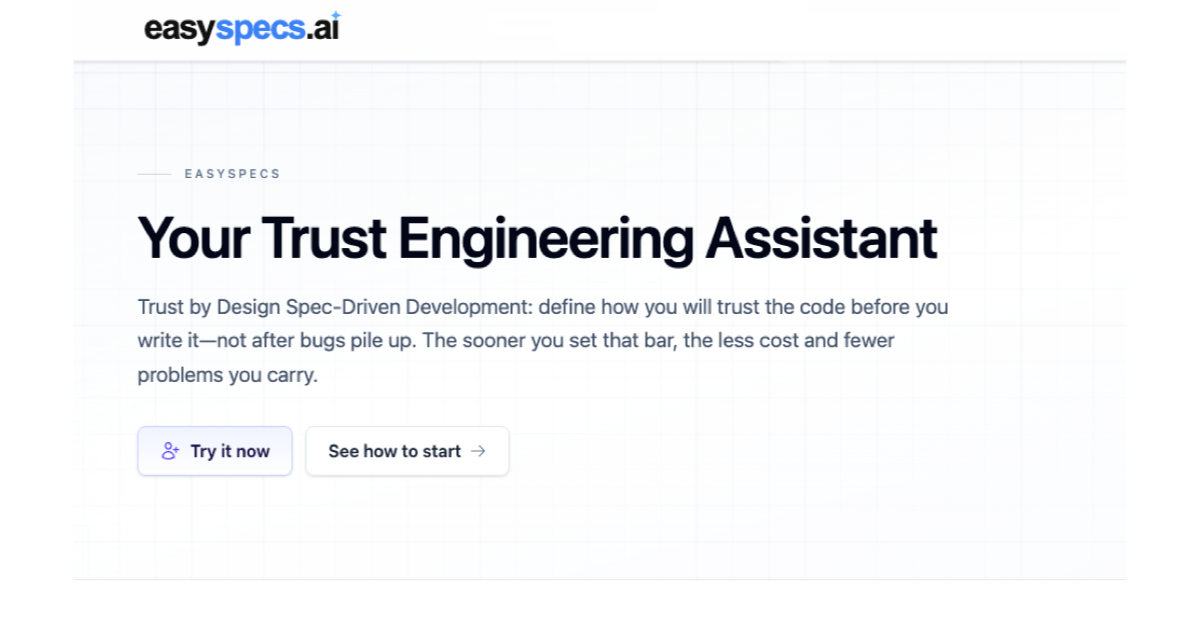
EasySpecs is a Spec Engineering Assistant and spec review platform built for teams practicing Spec-Driven Development. It documents undocumented codebases and turns them into trustworthy specifications, grounds AI agents in reality, and lets teams create Trust by Design Specs before code is written rather than after bugs pile up. The product is aimed at product owners, developers, technical product managers, and organization leaders who need product and engineering to share the same source of truth about an application. Its stated purpose is to close the gap between teams shipping at 1.5x and teams shipping at 100x — a gap EasySpecs describes as trust rather than speed.
AI is accelerating how fast software changes. As EasySpecs frames it, AI agents generate code 100x faster than humans write it, but a team cannot review it all. The result is familiar to engineering leads and CTOs: “Agents generate faster than my team can review. We're drowning in AI PRs.” Developers describe the other side of the same problem: “I babysit the agent the whole run. If I look away, things go wrong.” Spec Driven Development is presented as the new standard, and with it come new consequences — a need for a tool for quality specs, new spec management requirements, documentation that lags, shared context that goes stale, overlap between product and engineering with no place to align together, and surging merge requests that create code review bottlenecks. EasySpecs positions itself as the response to each of those consequences.
Step one of the EasySpecs workflow is understanding the code. EasySpecs produces functional documentation of your project with up to 98% LOC coverage assignment. That documentation is described as the first stone of Trust Engineering and as a foundation: functional documentation of the real system, so every later Spec starts from how the app actually behaves rather than from a guess. The stated benefit is that change requests start aware of real behavior and user intent, which lets teams make informed decisions instead of building on assumptions. Because the documentation reflects the actual application rather than someone's memory of it, it gives the rest of the workflow something concrete to build on — the factual baseline that intent and Specs are later grounded against. Without that baseline, every downstream step would inherit the same uncertainty the documentation exists to remove.
Step two is polishing the intent and grounding it to the current codebase. When intent is fuzzy, EasySpecs helps you craft, clarify, and ground it to the current codebase before agents generate code, so that Spec-Driven Development has something trustworthy to drive. Intent is described as the ask behind the change — captured and grounded in how the app actually works, so product and engineering share one picture before Specs are written. The product surfaces this through a Specs accordion that shows Change, Intent, Diagram, and Spec steps. For technical product managers, the outcome is specs that developers can ship against, ready the moment engineering picks them up and integrated with Jira. This step matters because fuzzy stories burn engineering time: when the ask behind a change is unclear or divorced from the real system, developers end up interpreting rather than building.
Step three is creating Trust by Design Specs. Once intent is clear, EasySpecs creates Trust by Design Specs with structured views and HTML-rendered views, so the change is visible and checkable before you write the code. Every Spec is sided by a Trust Spec. The Spec is the Spec-Driven Development Spec — what to build — presented in structured and HTML views the team can actually read. The Trust Spec holds validators, evals, and checks that sit beside the Spec, so you know how you will trust the change before agents generate code. The Product Hunt description also refers to reviewing specs including Oracles and Rubrics, and to developers working from Specs and Spec of Trust validators. The underlying principle is Trust by Design: define how you will trust the code before you write it, not after bugs pile up — and the sooner you set that bar, the less cost and fewer problems you carry.
EasySpecs works in three steps and frames the whole loop as Trust Engineering: understand the code, polish the intent and ground it to the current codebase, then create Trust by Design Specs — before you ship, not after bugs pile up. Around that loop, EasySpecs acts as spec-driven change management. A dashboard shows change requests and linked Spec status across projects, so every change request and its Spec can be tracked. Documentation auto-syncs, addressing the problem of docs that lag and shared context that goes stale. EasySpecs also presents itself as one Spec-Driven operating system for tech and product, introducing Spec-Driven Development across a team so product and engineering share the same source of truth. The stated aim is that the gap between teams operating at 1.5x and teams operating at 100x is not speed but trust, and that grounding agents in reality lets you scale agentic development without babysitting, documenting the foundation once.
EasySpecs states a set of outcomes tied to each consequence of faster shipping. Where a tool for quality specs is needed, EasySpecs creates quality specs easily. Where shipping faster demands new spec management, EasySpecs provides spec-driven change management. Where docs lag and shared context goes stale, EasySpecs auto-syncs documentation. Where product and engineering overlap with no place to align, EasySpecs offers one place to align together. Where merge requests surge and code review bottlenecks form, Trust Engineering eases merge requests, making spec review the new merge request review. For developers, the promise is concrete: stop babysitting the agent, and start generation from clear intent and checks rather than vibes. For product owners, change requests can be grounded in the real app and shaped into Trust by Design Specs the team can actually see. One testimonial sums it up: “My team finally speaks the same language about specs. The pace of change was so fast we could not align. Now with EasySpecs, all clear.”
Concrete scenarios appear throughout the content. A team working with an undocumented codebase can have EasySpecs produce functional documentation first, so change requests start aware of real behavior. A developer struggling with AI-generated pull requests can move review upstream to Specs and Spec of Trust validators instead of reviewing an endless stream of code. A technical product manager can write a spec against the system that developers can ship against, ready the moment engineering picks it up through Jira. A product owner can ground a change request in the real application, polish the intent behind it, and shape Trust by Design Specs the team can see. An organization leader can introduce Spec-Driven Development across a team so product and engineering work from the same source of truth, with a dashboard tracking every change request and its linked Spec across projects. And a developer working in an editor can stay inside VS Code, Cursor, Antigravity, or any VS Code-compatible IDE while the workflow runs.
EasySpecs is built for product owners and developers — two sides of the same Trust by Design loop — and also speaks directly to technical product managers and organization leaders. The workflow is integrated with Jira and Linear, and with VS Code, Cursor, Antigravity, and any VS Code-compatible IDE on the development side. The product is listed on Product Hunt under SaaS, Developer Tools, and Development, and the site includes a section on agentic coding noting Loop Engineering, Graph Engineering, Context Management, and more. No pricing or plan details are stated in the available content.
EasySpecs positions Trust Engineering at the center of AI-accelerated software delivery: document the real system once, polish intent against that reality, then define how you will trust the change before agents generate code. By turning Specs — including their validators, evals, checks, and the review of Oracles and Rubrics — into something reviewable, it reframes spec review as the new merge request review and gives product and engineering one shared source of truth. The takeaway is straightforward: the gap between 1.5x and 100x is not speed, it is trust, and EasySpecs is built to supply it.
Publisher
A
admin
Launch Date2026-09-12
Platformweb
Pricingfree