Duos is an AI-powered job interview preparation app that lets candidates rehearse a realistic voice interview before the real thing. You paste a link to a real job posting — the site says it can analyze any public link, including LinkedIn — and Duos builds the company, the role, the questions and a personalized interview flow around it. From there you put on headphones and talk out loud to an AI interviewer in a live voice conversation, just as you would in an actual interview. The product is built for anyone preparing for a job interview, from a first internship through to a senior career switch, and its stated purpose is simple: stop guessing why you are not getting hired, fix your blind spots, and land the job offer.
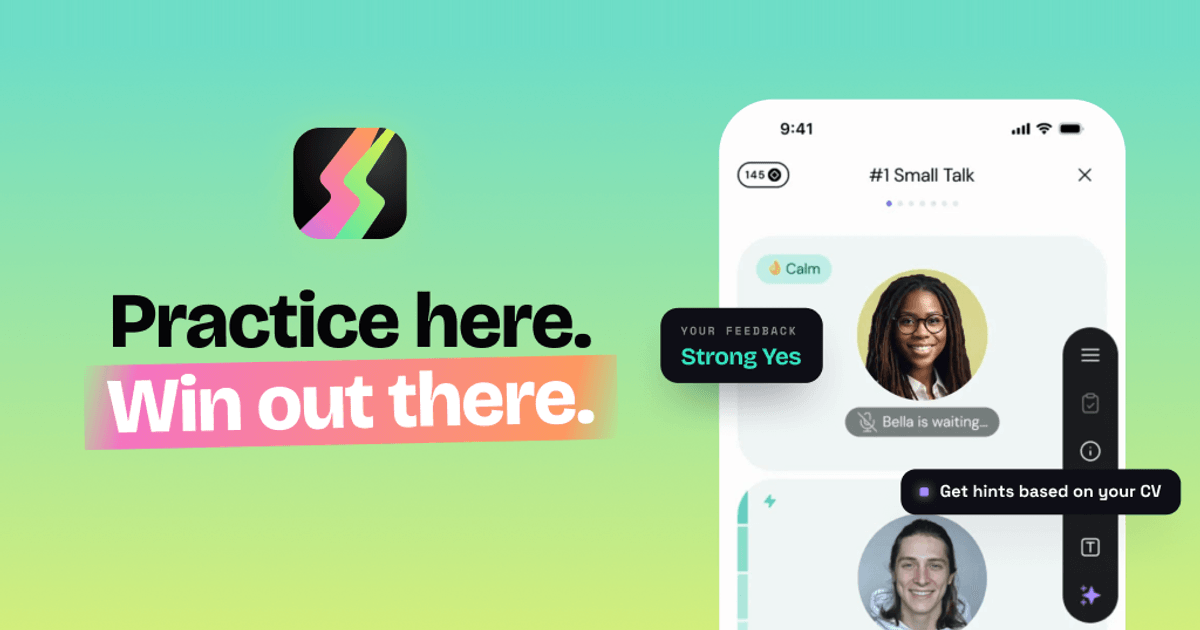
Why Duos exists: the site opens with the blunt premise 'Stop guessing why you're not getting hired' and lists three reasons job interviews suck. First, preparation feels fake — rehearsing answers feels nothing like the real thing. Second, total uncertainty — the stakes are high and you don't even know if you're doing well. Third, no feedback — you get rejected and never hear what went wrong. The Product Hunt description frames the same problem differently, describing interviewing as 'a social game with unwritten rules, scored by people who never explain the score.' Duos positions itself as the rehearsal, a place to practice until you know exactly what to fix, so that you build real skills without risking real interviews. As the closing line of the site puts it, 'Practice here. Win out there.'
Rehearse the real interview. The core workflow starts with a real job. You paste a link to a job posting — the site shows a LinkedIn jobs URL as an example and states that it can analyze any public link, even LinkedIn. Duos then runs an extraction process: reading the job post, pulling out the role, building the company and shaping the questions. You review the recognized job details, which include the company name, the role, the requirements and a role description. From there you pick the difficulty and the interview stages and generate a personalized interview flow. Because the simulation is built from your actual job posting and your CV, the questions stop being generic — the site notes that uploading your CV means the questions get built from your actual experience rather than staying generic.
Talk and read the room. The interview itself is a live, realistic voice conversation. The interface shows the interviewer speaking and then waiting for you, along with emotional state indicators such as 'Pleased', 'Concerned' or 'Impressed', and a personality tag for each interviewer. Sessions are structured in question blocks — the example shown is an all-in-one interview with Mike of roughly 28 minutes and five questions covering small talk, past experience, UX strategy, design thinking, JTBD and Figma, and a Q&A. In-interview tools let you stay in control when you get stuck: you can see what is behind every question ('What does Mike really want to know?'), get hints based on your CV, go back and retry a topic, skip questions you're not ready for, show an example answer, explain the meaning of a question, or restore energy. The site emphasises that you have to talk out loud — 'It's a voice app, because the hardest part of job interviews is talking' — and that all it takes is headphones and ten minutes alone, with the option to pause any time to gather your thoughts.
Get your game plan: the debrief. After the interview Duos produces a structured interview analysis described as a recruiter's opinion, plus an outcome such as 'Strong Yes', a count of red flags and a set of patterns. The example shown includes a hiring manager's written assessment, red flags such as negative remarks about a current workplace and a candidate speech level below expectations, confidence indicators, and a problem score. It also surfaces concrete speech patterns — for instance flagging a frequent filler word, quoting the exact replies where it appeared, and explaining how it affects you ('Stutters interrupt flow and distract from content'). The site promises a full breakdown with practical advice and real examples, and states that interviewers take notes about you and here you get to read them. Duos also tracks your performance across sessions, which the feature comparison table lists as something ChatGPT does not do and other interview apps rarely do.
Stages and interviewers. Duos can run the whole hiring process or you can laser-focus on a single stage: a recruiter screen of roughly 10 minutes covering your background and motivation, a skills round of roughly 20 minutes covering your skills in action, projects, decisions and hard calls, and a manager chat of roughly 15 minutes about working style and team fit. Alongside the stages sits a large roster of AI interviewers, each with a distinct personality, demeanor and difficulty level. Examples from the site include Mike the know-it-all (100% honest, easy), Justin the impatient one (driven, hard), Mirna the mission-oriented (opinionated, mid), Marcus the high-pressure (authoritative, hard) and many more ranging from unhinged to encouraging, from hostile to supportive. The site frames this as 'Every interviewer hits different — choose who you're ready for.'
Privacy. Duos makes explicit commitments about how your data is handled: your data stays private, is never sold and is never used to train AI. Your CV is scrubbed before any AI reads it, no human ever hears you, you can delete everything at any time, and only enterprise-grade, audited AI providers are used. In the FAQ the company confirms that nobody hears your recordings — it is you and the simulator, no recruiter on the line, no audience — that your audio isn't stored, and that you can delete your data whenever you want. The site also states that Duos does not judge your accent: it responds to what you say, not how you pronounce it, although it will still flag a sentence that is hard to follow, because a real interviewer would too.
Why not just use ChatGPT. Duos is positioned explicitly against using a general-purpose chatbot for practice. Its comparison notes that ChatGPT drifts out of character, is always agreeable and rarely honest, asks few questions and then loses track, produces dense forgettable notes, and leaves you on your own. Duos, by contrast, is listed as offering consistent interview roleplay that stays in character, pushing back for real practice, simulating the full hiring process, producing a structured report, and offering tools when you're stuck. The Product Hunt description adds that there is a proudly over-engineered multi-agent stack inside, and that you talk to interviewers who have read your CV and can change tactics mid-conversation.
The outcomes for users are focused on clarity and confidence. Instead of wondering whether you did well, you get red flags, green flags and an explanation of how to fix the patterns behind them. Instead of a rejection with no explanation, you get worked examples of better answers, and you can redo the question or redo the whole interview — nobody is keeping score but you, and failing here is the point. The site says the app builds real skills without risking real interviews, and reviewer quotes on the page describe it helping a freelancer land a first full-time design role in a competitive market, helping candidates practice interview English, boosting confidence, and pushing candidates on technical details such as API security.
Concrete scenarios described on the site and by reviewers include preparing for a specific interview by uploading your CV and the job posting to get a simulation with specific questions; last-minute interview preparation; continuously improving skills to stand out from the crowd on the way to a new adventure; practicing interview English and fixing weak points in conversation; keeping interview skills sharp between real calls while staying in the context of your own profile; and rehearsing for any role and any level, from a first internship to a senior switch. The site notes that Duos will still ask hard technical questions and push you on your projects and decisions, but it is not a whiteboard tool. It also can't predict how a real conversation will go — the point, it says, is that whatever they throw at you, you can answer.
Duos is available as a website and as a mobile app, with 5.0 ratings listed for both the App Store and Google Play. Pricing is straightforward: you get one full interview free with no card needed, and after that plans start at €22.99 a month, less if you pay quarterly, and practice is unlimited. It supports any role and any level. The FAQ answers questions about privacy, about whether you have to talk out loud (yes, it's a voice app), about what happens if you fail (you get feedback and worked examples of better answers), about whether it judges your accent (no), and about whether it supports technical interviews (it runs recruiter screen, skills deep-dive and hiring manager rounds but is not a whiteboard tool).
In short, Duos turns interview preparation from guesswork into a repeatable loop: paste a real job, rehearse out loud with an in-character AI interviewer who has read your CV, then read a structured debrief that tells you exactly what to fix. Interview, debrief, repeat until you're ready — practice here, win out there.
Publisher
A
admin
Launch Date2026-09-13
Platformweb
Pricingfreemium
Tech Stack
#Multi-agent AI stack