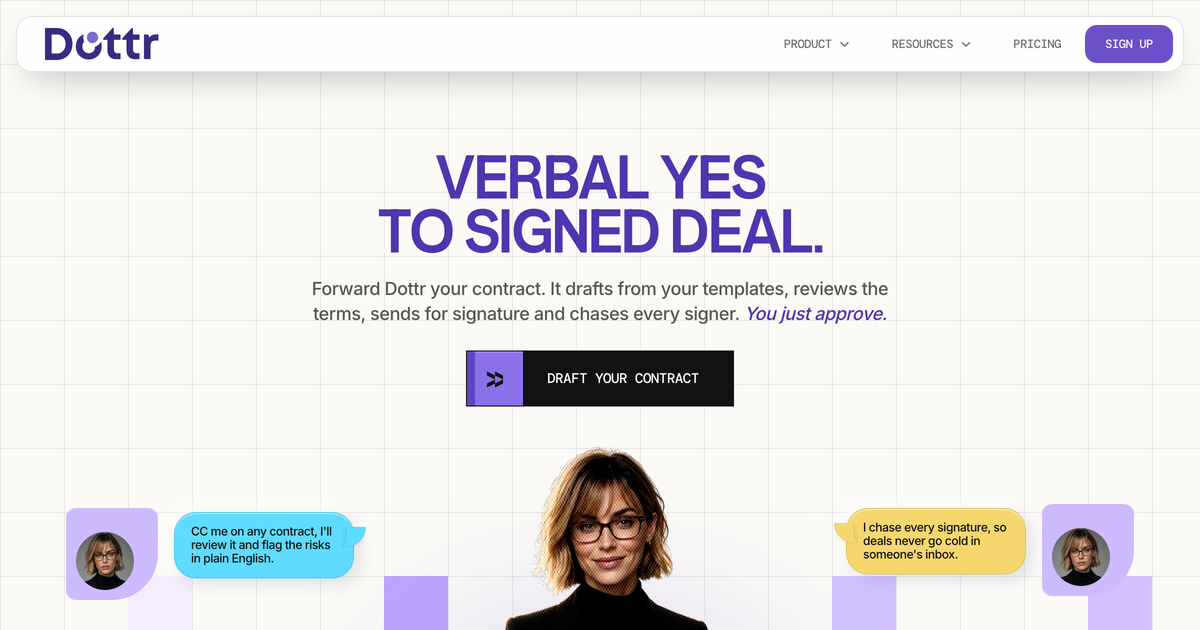
Dottr is an AI teammate for contracts that lives in email. Teams can CC Dottr on any contract thread, forward it a contract, or ask it to draft one, and it works through the contract from draft to signed. According to the site, Dottr drafts from templates, reviews the terms, sends the agreement for signature, and chases every signer while the user simply approves. It is built for teams that handle deals and paperwork in their inbox, including sales, legal, finance, operations, and procurement roles shown across the site. The main purpose is to take a verbal yes to a signed deal without the delay that normally sits between the two.
The site frames the problem around a simple idea: a yes has a shelf life. The day the other side agrees, the clock starts, and while the contract is being prepared, a new stakeholder can appear, the budget can get a second look, or a competitor can call back. Nobody has turned the deal down, but the contract took a week, and the yes did not last that long. The site says time kills deals and that contracts are where the time delay happens. It also describes a hidden bill: outside counsel invoices the review, while drafting, re-sent versions, and a week of follow-ups are paid for in hours nobody logs. Dottr presents its one-dollar contract as the alternative to that bill and to the nine-day cycle described on the site.
The drafting workflow starts from the conversation. A user can CC Dottr on the contract thread, forward the thread, drop in the call, or paste notes, and Dottr pulls out what was agreed and writes the contract in the company's language. The site says there is no new tool to open and nothing to re-type because Dottr reads the thread where the deal actually happened. A user can also tell Dottr the deal in a sentence, or let it take the deal from the thread, and the contract comes back in the company's language. Templates extend this: users can save a contract they like, and the next one drafts itself from it with clauses that are already approved. The site lists examples such as a standard MSA, a mutual NDA, a statement of work, and an offer letter, each shown with a template usage count.
Review is handled clause by clause. Dottr reads every line and flags every risk in plain English, whether the contract is on the user's paper or the other side's paper, and the user approves. The site shows the kind of flags Dottr produces: an uncapped indemnity marked critical, with an explanation that the user would cover the client's losses with no ceiling and that a single third-party claim could exceed the whole deal value; an auto-renewal trap marked high, with an explanation that the contract renews for another 12 months unless cancelled 60 days in advance; and deliverables not defined marked medium, because deliverables to be mutually agreed leave scope open-ended. Each flag includes a suggestion, such as capping indemnity at fees paid in the preceding 12 months, cutting the renewal notice period to 30 days, or listing what ships and when in a schedule tied to milestones. Users can accept a fix, reject it, or say what to change, and the redline appears as a tracked edit. Legal and finance can comment directly on the clause, so feedback stays with the contract instead of a separate email chain. Dottr also compares every version so users can see exactly what moved between drafts before signing.
Signing is part of the same flow. Dottr sends the contract for signature, tracks every open, and nudges each signer until it is signed. Signers need no account, so nothing stalls on a login. The site shows a signing view with an owner, signers awaiting signature, signers who have signed, and a note that Dottr follows up until the contract is signed. It also shows events such as a signing link opened and a reminder scheduled. When the process is complete, the signed copy is filed and sent to everyone. The site presents this step as signature moving from three weeks to minutes and as verbal yes to signature without chasing.
After signing, Dottr keeps every contract and remembers it. The site describes a memory layer for contracts: Dottr remembers the terms, dates, and redlines and answers questions in plain English across every contract the team has ever sent. Examples include asking which contracts auto-renew this quarter, what Acme's payment terms are, whether there are any uncapped liability clauses, or who still has not signed. The site says the more you sign, the sharper it gets. It also watches renewal dates, knows when each contract renews or expires, and tells the user before the notice window shuts, not after. The examples show a Globex MSA with 60 days' notice and a reminder set for 15 November, a Hooli vendor agreement with 90 days' notice and a reminder set for 2 December, and an Acme NDA that expires 30 June with no renewal and nothing to do.
Workflow steps can be chained. The site says Dottr runs the steps a team always runs, such as review against the playbook, approval from the CEO, sending a copy to finance, and returning the signed copy to the PA. A team can set the chain once, and Dottr walks every contract through it. The site shows a plan for a new vendor contract with steps for review against the playbook, approval from Alex (CEO), a notify step to send a copy to finance, and a notify step to return the signed copy to the PA. This turns repeated internal process into a consistent path that each contract follows.
The overall approach is to act as one teammate across the whole contract rather than as a point tool for drafting, review, or signatures. Dottr lives in email, reads the conversation where the deal happened, drafts from that context and from approved templates, flags risks in plain English, produces tracked redlines, sends the contract, chases signers who need no login, files the signed copy, and later answers questions about what was agreed. The site describes this as replacing duct tape with a teammate and as one teammate who does the whole contract, draft to signed, so the yes never has time to go cold. The user remains the approver at the key points: the draft comes back for approval, and the risk review is approved by the user.
The stated outcomes are speed, less chasing, and fewer surprises. Moving from verbal yes to signed deal in the same flow keeps the deal from losing momentum while a contract sits in a queue. Automatic chasing removes the manual follow-up that the site says is never logged but still costs the team hours. Renewal watching aims at zero surprise renewals, and contract memory turns a question about terms into a straight answer instead of a folder search. The site also frames the economics with an example comparison: drafting, legal review, versions, and follow-ups are shown at a total of $920 and nine days on the old path, versus $1 and instant with Dottr, for a stated saving of $919 and nine days per contract. The site says every contract has a bill, and Dottr does the same contract for one dollar.
Target users are the people who touch contracts in the course of a deal. The site shows operations, finance, legal, procurement, and sales roles in its examples, along with signers from the counterparty. The product is email-first, and the site also shows attachment of files and attachment from Google Drive. Signers do not need an account, which makes it easier to include people outside the company. Pricing details on the site include a launch offer of two months free, or two years if a user refers two people, a free sign-up, a free plan mentioned in the data section, and a stated one-dollar cost per contract. The site also says Dottr does not use uploaded contracts to train AI models, including contracts on the free plan, and that it processes a contract only to provide the drafting, review, and signing requested.
Dottr's value proposition is a single email-based teammate that carries a contract from a verbal yes through drafting, review, signature, filing, and later questions. It is designed for teams that want to close deals faster, reduce manual chasing, and keep the terms and dates of every agreement within reach.
Publisher
A
admin
Launch Date2026-10-17
Platformweb
Pricingfreemium