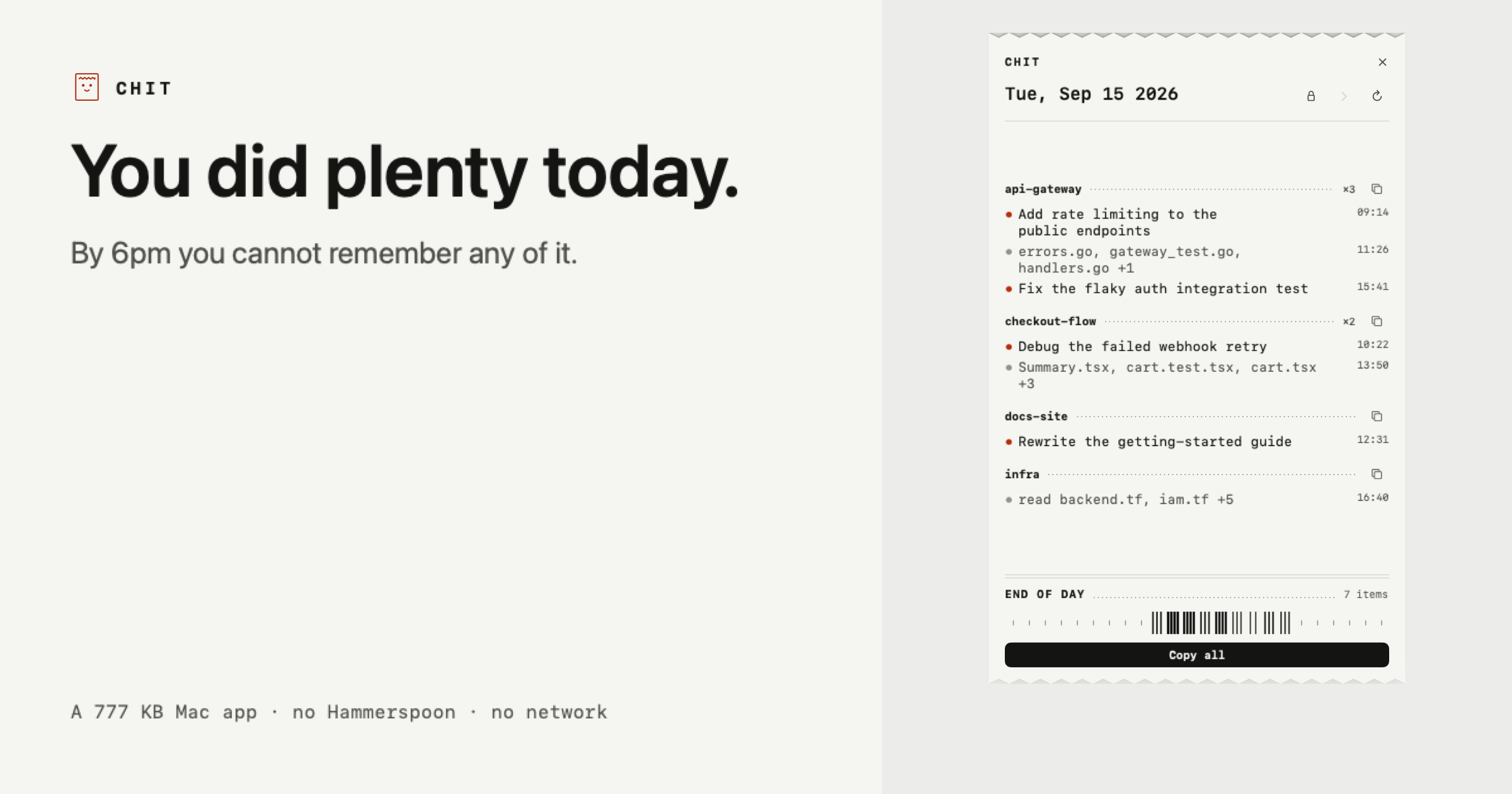
Chit is a small Mac app that reads the Claude Code transcripts already sitting on your disk and prints your day back to you as a receipt. It groups everything you worked on by project, busiest project first, and formats the result so it can be pasted straight into a standup, a task sheet, or a timesheet. The entire application is 777 KB, and the workflow is a single double click: there is nothing to install first, and today's receipt is already on screen when the app opens. It is built for developers who use Claude Code and want a record of what they actually did, rather than a log of everything they typed.
The problem Chit addresses is stated plainly on its own site: you did plenty today, but by 6pm you cannot remember any of it. Claude Code sessions accumulate across repositories, terminals, and worktrees throughout a working day, and the raw material for reconstructing that day already exists as transcripts on the local disk. What is missing is a view that turns those transcripts into something a person can read, remember, and hand to someone else. That gap shows up whenever you need to account for your time: a daily standup where you have to summarise yesterday's and today's work, a timesheet that has to be filled in at the end of the week, or a retro where you are asked what shipped. Chit closes that gap by printing the day itself instead of making you dig through chat history to rebuild it from memory.
The core organising idea is that every session is bucketed under its repository, busiest first, so the day reads as work rather than as chat logs. Agent worktrees fold back into their parent project instead of appearing as separate, unrecognisable strangers in the list. That single grouping decision is what makes the output legible: instead of a chronological stream of conversation fragments, you get a project-by-project breakdown where the projects you spent the most effort on appear at the top. Each project carries its own short list of lines describing what was done, alongside the files that were touched, so you can see the shape of the day at a glance without opening a single transcript yourself.
The receipt is paste-ready. One click copies the day, and another copies a single project, already phrased the way a task sheet or a standup wants it. There is also a Markdown version for the places that render it, so the same day can be dropped into a document, a ticket, or a note-taking tool that understands Markdown formatting. The example receipt Chit shows is the clipboard content, not a screenshot: it prints what you did, not what you typed. That distinction matters, because it means the output is a summary of completed work rather than a transcript of prompts and responses. Claude Code names most of your sessions itself, and where it has not, Chit names the line after the files you touched, so every entry on the receipt has a readable label derived from the work rather than from your input.
Chit also handles days other than today. You can step back through the week when you need to account for a day you have already forgotten, which is the situation the product is explicitly designed around. Performance is not a constraint on that: a full scan of a 2.7 GB transcript folder takes about a second. The receipt prints itself once a day, and how long it is depends on how much you did, with the site contrasting a quiet morning with a full day and with a receipt that has just been copied. That variability is presented as a feature of the format rather than a limitation, because a short receipt accurately reflects a short day.
The same engine is available as a command line interface. Chit supports `chit --today`, `--date=`, `--from= --to=`, and `--markdown`, which means you can pipe the output straight into whatever eats your timesheets. The date and range flags let a script ask for a specific day or a span of days, and the `--markdown` flag produces the Markdown variant for anything downstream that renders it. The CLI gives the same grouped, project-by-project output that the app shows, so a developer who prefers the terminal, or who wants to automate time reporting, is not forced through the graphical interface.
Privacy is treated as a first-class part of the design, and the site states the awkward sentence directly: Chit reads your Claude Code transcripts. Chit opens the files Claude Code already writes to `~/.claude/projects` on your own disk, and nothing leaves the machine. There is no network code in the binary at all, and the app is described as making zero network calls, ever. It is never your prompts: lines come from the titles Claude Code generates, or from the names of files you changed, and what you typed is used only to decide whether a session counted as work and is never stored or shown. Output uses file names rather than paths, so a line says `audit.js` and never `/Users/you/clients/...`, because a path reveals who you are and who you work for. You can also hide whole projects entirely, which keeps client, NDA, or job-hunt work off the receipt; the site is explicit that this hides that project's lines but cannot hide a sentence you typed about that work inside a different project. Finally, Chit is read only: it never writes to `~/.claude`, so nothing it does can affect a session.
Distribution is deliberately transparent. Chit is not notarised yet, so a browser download gets flagged once. The terminal one-liner install installs with no warning at all, and the SHA-256 hash is published next to it. The download is a zip with the app inside that you drag to Applications, and the app requires no account, no Hammerspoon, and no Python. The practical outcome for a user is a working record of the day obtained in one double click, with no setup, no sign-in, and no data leaving the laptop, plus a CLI escape hatch for automation and a copy button for whatever document needs the summary next.
Use cases follow directly from that design. The most obvious is standup preparation: open Chit, copy the day, and paste a project-grouped summary instead of reconstructing the previous day from memory. The second is time accounting, including days you have already forgotten, where stepping back through the week and reading the receipt replaces guesswork. The third is timesheet filling, where the CLI's date and range flags and its paste-ready output let the receipt feed whatever system tracks hours. The fourth is confidentiality-sensitive work: developers who need to leave client, NDA, or job-hunt projects off anything they share can hide those projects completely, and because file paths are never printed, the receipt does not leak directory structures. The fifth is a periodic review, supported by the Pro tier's past days, week and month statements, and dashboard.
The pricing is split into two tiers. The free tier is free forever, explicitly not a trial, and it covers what the site calls the half you use every morning: today's receipt in full, the ability to copy the day or any project, plain text and Markdown output, hiding projects, and the CLI. Chit Pro costs $12 once, not a subscription, and adds everything in the free tier plus every past day, week and month statements, the dashboard, and a key tied to your Mac that works offline forever. The product is a Mac app with a companion CLI, so it suits developers working on macOS in Claude Code who want a fast, local, account-free way to remember and report their day. Chit's value proposition is narrow and concrete: it takes the transcripts you already have, prints the day back as a receipt grouped by project, and makes it paste-ready for the standup or timesheet that needs it, without sending anything off your machine.
Publisher
A
admin
Launch Date2026-09-27
Platformdesktop
Pricingfreemium
Tech Stack
#macOS