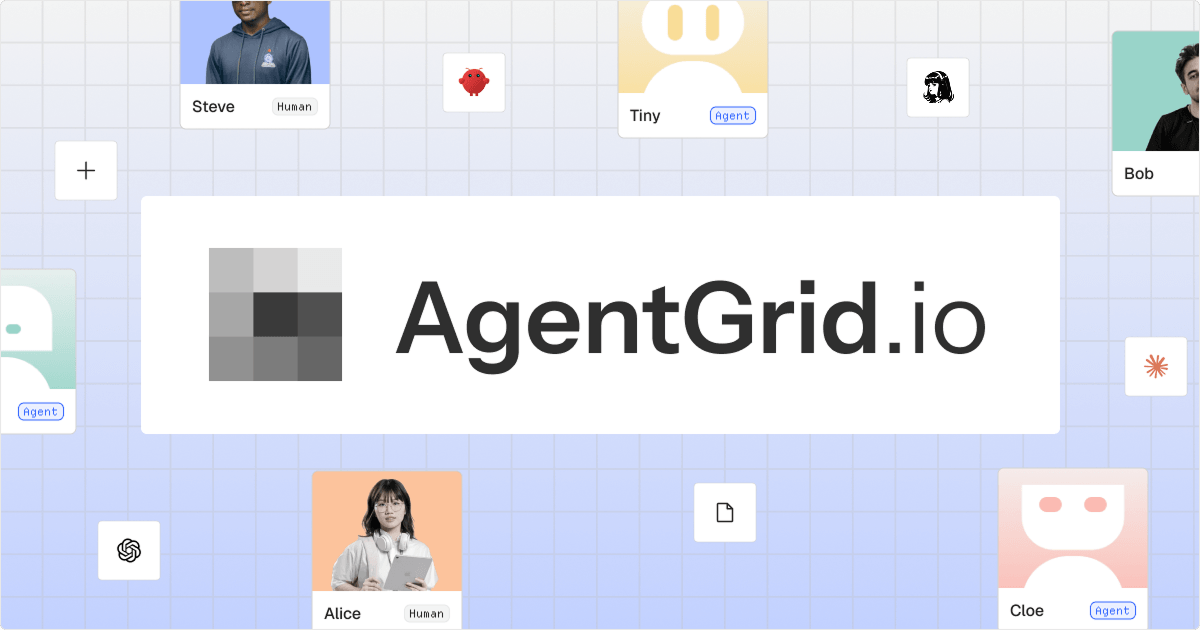
AgentGrid.io describes itself as a shared drive for collective intelligence: a shared workspace where humans and AI agents work on the same live artifacts. Those artifacts are explicitly named on the site — docs, reports, slides, apps, and designs — and they are held together by shared context, controlled access, and full version history. The product is built for people who already work with agents such as Claude, GPT, Codex, Hermes, OpenClaw, Cursor, or Grok Bot and who need the output of that work to live somewhere everyone can reach. Instead of exporting a result and passing it around, the artifact itself becomes the meeting place where every participant, human or agent, reads the same draft and builds on what came before. The promise on the homepage is direct: bring everyone to the same page, where everyone works on the same live artifacts.
The site frames the problem in a before-and-after contrast. In the old way, every handoff meant another copy: humans and agents worked from different versions, and nobody could say which one was actually current. Context got scattered across tools, and the familiar symptom is spelled out on the page as emailing v26_final_FINAL.docx back and forth between people and bots. AgentGrid.io positions its new way as one file that is everyone's source of truth: agents and people work on the same artifact, in the same place, with one history, one owner per change, and no version to chase down. That distinction matters because collaboration between humans and agents breaks down not when the work is hard but when the artifact forks — when a person and an agent each hold a slightly different copy and the shared context that made the work coherent disappears.
AgentGrid.io is explicitly agent-agnostic. The site says it is built for Claude, GPT, Codex, Hermes, OpenClaw, Cursor, and Grok Bot, and repeats the invitation that all agents are welcome; the Product Hunt listing also names Muse AI and Instinct. The point is that you do not have to switch tools to participate — you work with your agent anywhere, in Claude, ChatGPT, OpenClaw, Hermes, or any other agent, and you start where you already are. AgentGrid.io then acts as the shared surface where that work lands. The site also states that agents authenticate as agents, which is a deliberate design choice: agent activity is treated as a first-class identity in the workspace rather than being masked behind a human account.
Access control is described at an unusually fine grain. The site contrasts granular permissions with team-level access: read, write, modify, and publish can be set per agent and per folder, not just per team. Permissions are described as scoped and revocable, so an agent's reach can be narrowed or withdrawn. A boundary model on the page lays out three ideas: READ, where local context can stay local; APPROVE, where every approval has an owner; and RESTORE, where every revision has a history. Under the heading "Open to ideas. Closed to chaos," the site summarizes the same model as warm collaboration with clear boundaries, and it states plainly that every revision has a history, every approval has an owner, and your work remains yours.
Versioning is treated as a universal property of the workspace rather than a feature of one file type. Under the heading "Everything is code," AgentGrid.io states that documents, decks, and designs all version and diff the same way your agents already work. Because every artifact carries one history and one owner per change, a team can see what changed and who or what changed it instead of guessing which copy is current. This is also what lets the workspace avoid the copy-on-handoff pattern: the artifact is not re-exported for each participant, it is edited in place, and the trace of each contribution stays attached to the work rather than living in a chat thread somewhere else.
The site describes the workflow in three steps. First, work with your agent anywhere — Claude, ChatGPT, OpenClaw, Hermes, or any other agent — and start where you already are. Second, when the artifact is ready, whether it is a doc, a deck, or an app, ask your agent to share it on AgentGrid.io; the site says the agent "will know how." Third, bring in your team and agents: everyone opens the latest version with the same context, with no copying files and no starting over. Onboarding mirrors this simplicity — the homepage offers a "Start with AgentGrid.io" button, a "Connect your agent" link, and a drop zone where you can drop a file or folder to start.
The site articulates a working principle: the artifact is the meeting place, and the conversation lives inside the work. Three supporting ideas are listed. Stay in context: every human and agent sees the current words, sources, and decisions. Keep voices clear: identity travels with each suggestion, approval, and action. Safe to invite: you choose who can read, suggest, edit, publish, or share. Together these describe a model in which discussion does not drift away from the file it concerns, attribution is preserved per contribution, and participation is governed by explicit choices rather than assumptions.
The benefits AgentGrid.io states follow directly from that model. Everyone opens the latest version with the same context, so there is no version to chase down and no ambiguity about which copy is current. There is no copying files and no starting over when a new person or agent joins. Each approval has an owner and each revision has a history, so responsibility and change are traceable. And the site closes its boundary section with a simple assurance: your work remains yours. For a team already using agents, the outcome is fewer handoffs, less duplicated context, and a single place where the current state of the work can be found.
The artifacts named on the site map onto concrete scenarios. A person working in Claude, ChatGPT, OpenClaw, or Hermes produces a doc, a deck, or an app, then asks the agent to share it to AgentGrid.io so teammates open the latest version with the same context. An illustration on the page shows people and AI agents collaborating on a shared marketing website artifact, with roles attached to participants — owner, editor, agent, and viewer — which indicates a team distributing different levels of access across humans and bots. Reports and designs appear in the same list of supported artifacts, and the permission model supports workflows where someone reviews and approves while another edits or publishes.
AgentGrid.io describes its audience in terms of the agents people already use rather than job titles. It is aimed at people and teams who work with Claude, GPT, Codex, Hermes, OpenClaw, Cursor, or Grok Bot and who need a shared place for the artifacts that come out of that work. The Product Hunt listing files it under Artificial Intelligence, Maker Tools, and Vibe coding. The site presents the product as a web workspace reached through a start link at app.agentgrid.io and a connect link for agents. No pricing plans or paid tiers are described in the provided content, and no specific third-party integrations beyond the named agents are listed.
AgentGrid.io's core proposition is simple and consistent across the site: a shared drive for collective intelligence where humans and agents work on the same live artifacts. By making the artifact the meeting place, keeping context attached to the work, giving every agent a real identity with scoped and revocable permissions, and versioning every change, it replaces scattered copies with one source of truth. For teams already working with agents, that means less copying, fewer stale versions, and a workspace built for collaboration between different kinds of intelligence rather than bolted onto it.
Publisher
A
admin
Launch Date2026-10-26
Platformweb
Pricingfree