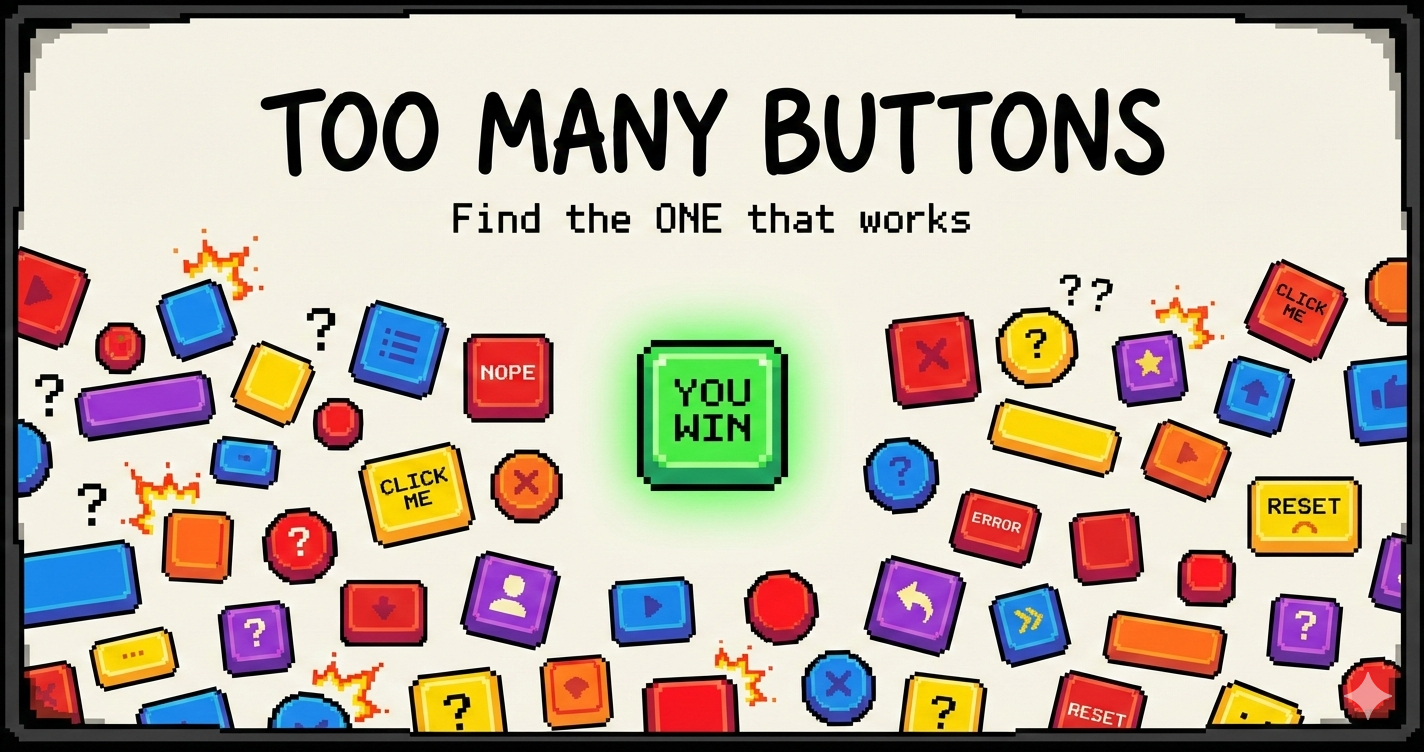
Too Many Buttons is a chaotic browser game that flips the classic button pressing concept on its head. In this game, only one button out of many actually works correctly—all others are traps that unleash pure, unpredictable chaos. It falls into the genre of unfair, intentional chaos games designed for quick sessions of high tension and humor. The game is tailor-made for streamers, content creators, and gamers who thrive on unexpected outcomes and laugh-out-loud moments. Its core value is delivering an experience where failure is not just possible but entertaining, turning every misclick into a spectacle. With DMCA-safe sound effects and visual mayhem, it ensures that even the most chaotic moments are safe for broadcast. The simple premise hides a depth of randomness that keeps players and audiences guessing, making each playthrough unique.
The primary problem Too Many Buttons solves is the predictability of most games. Traditional titles often follow scripted patterns or skill-based progression, which can become stale for players and especially for streaming audiences who crave novelty. This game introduces a core uncertainty where every click could lead to a disastrous or hilarious outcome, breaking the monotony. The chaos is the point—it levels the playing field between experienced gamers and casual viewers, as no amount of skill can predict which button is correct. For streamers, this unpredictability translates directly into audience engagement: raids, reactions, and chat participation skyrocket when the game can randomly shake the screen, pop up fake alerts, or blast loud sounds. The emotional rollercoaster from tension to laughter keeps viewers hooked, solving the age-old problem of maintaining content freshness without complex setups.
The first major set of features revolves around the core mechanic: Only One Button Works. This is not just a catchphrase but a ruthless rule. The game screen displays numerous buttons, each identical in appearance, but only one triggers success. Clicking any other button instantly activates a series of chaos effects. These effects include screen shakes that jolt the player’s perspective, fake alert pop-ups that mimic system warnings, and sudden loud sounds that can startle even the most composed streamer. The visual and audio feedback is immediate and exaggerated, reinforcing the penalty with comedic overkill. This mechanic works because it exploits a fundamental human instinct—the desire to click quickly without proper information. By denying a clear visual clue, the game keeps the pressure on and ensures that even the most careful players will eventually fall into a trap, generating spontaneous reactions.
admin
The second feature group is the streamer-friendly, DMCA-safe sound system. This is crucial for creators who upload or livestream content, as copyright strikes can harm accounts. Too Many Buttons includes a library of pre-cleared sound effects that can be used without worry. The chaos sounds—ranging from comedic boings to dramatic crashes—are built directly into the game and do not trigger any content ID systems. This allows streamers to focus on their reactions rather than muting audio or risk legal issues. The sounds themselves are designed to be loud and attention-grabbing, perfect for creating memorable moments and chat reactions. By integrating these safe assets, the game lowers the barrier for professional streaming while increasing the chaotic flavor. The result is that every wrong click yields an audio reward that is both safe and entertaining, enhancing the viewer experience without production overhead.
The third set of capabilities includes the mode and difficulty selection explicitly offered in the menu. Players can choose between different modes, including one with no timer—allowing maximum focus on chaos without the stress of a countdown. The mode is labelled 'pure chaos' indicating that even without a clock, the randomness keeps play intense. The difficulty selector directly controls the chaos level: more buttons equals more chaos. This correlation is stated in the game's instructions, 'More buttons = more chaos. Choose wisely.' As difficulty increases, the grid fills with more false buttons, drastically lowering the odds of hitting the correct one. This scalability lets players and streamers customize the experience for their audience—low difficulty for quick laughs, high difficulty for prolonged suffering and suspense. The freedom to adjust chaos ensures the game remains replayable and suitable for different segments of a broadcast.
The overall workflow of Too Many Buttons is deceptively simple yet engineered for maximum uncertainty. Players start by selecting a mode and difficulty, then face a screen of buttons. Each round, only one button is programmed to work; all others are decoys that trigger chaos effects. The player must click buttons one by one, attempting to find the correct one while enduring random punishments on every failure. There is no progression system or skill curve—every new round resets the correct button, meaning the game stays consistently unfair. The intentional unfairness is stated clearly: 'This game is intentionally chaotic and unfair. That's the point.' This design philosophy removes any pretense of mastery, forcing the player to accept randomness as the core challenge. The lack of pattern recognition makes each play session feel fresh, as the correct button can be anywhere among a sea of distractions.
Concrete use cases for Too Many Buttons are plentiful in live streaming environments. A streamer can open the game during a 'just chatting' segment to generate immediate audience interaction. Chat can vote on difficulty, or the streamer can challenge viewers to predict whether they'll hit the correct button. The chaos effects—like screen shakes or loud sounds—become running jokes throughout the broadcast. Another scenario is using the game as a penalty between other activities: whoever loses a previous game must play a round of Too Many Buttons on the hardest difficulty. Friends can also play together via shared screen, betting on their success rate. The outcome is always high engagement: chat fills with laughter, gasps, and memes as the game consistently delivers unexpected results. Overall, streamers report increased viewer retention during chaotic segments because the unpredictability prevents lulls.
The target audience for Too Many Buttons includes streamers, content creators, and gamers who enjoy unfair, humorous challenges. The game runs entirely in a browser with no downloads required, making it accessible on any platform with internet access. Its DMCA-safe sounds cater specifically to Twitch and YouTube creators who prioritize copyright safety. While there are no explicit pricing or plan details mentioned, the straightforward design suggests it is free-to-play or offered as a low-cost tool for entertainment. The game's simplicity also appeals to casual gamers looking for a quick break or a party game atmosphere. In summary, Too Many Buttons delivers on its promise of pure chaotic fun by embracing unfairness and transforming it into a shared entertainment experience. Its streamer-friendly features, customizable difficulty, and instant playability make it a standout in the niche of intentional chaos browser games.
Too Many Buttons is specifically designed for streamers on platforms like Twitch and YouTube who need DMCA-safe, unpredictable content to maintain viewer engagement. It also appeals to content creators seeking quick, shareable chaotic moments for videos. Gamers who enjoy unfair challenges, party game enthusiasts, and anyone looking for a fast-paced, laughter-inducing browser experience will find value. The game suits both solo players testing their luck and groups wanting a simple yet thrilling interactive tool for online or local streaming sessions.
Updated 2026-02-28