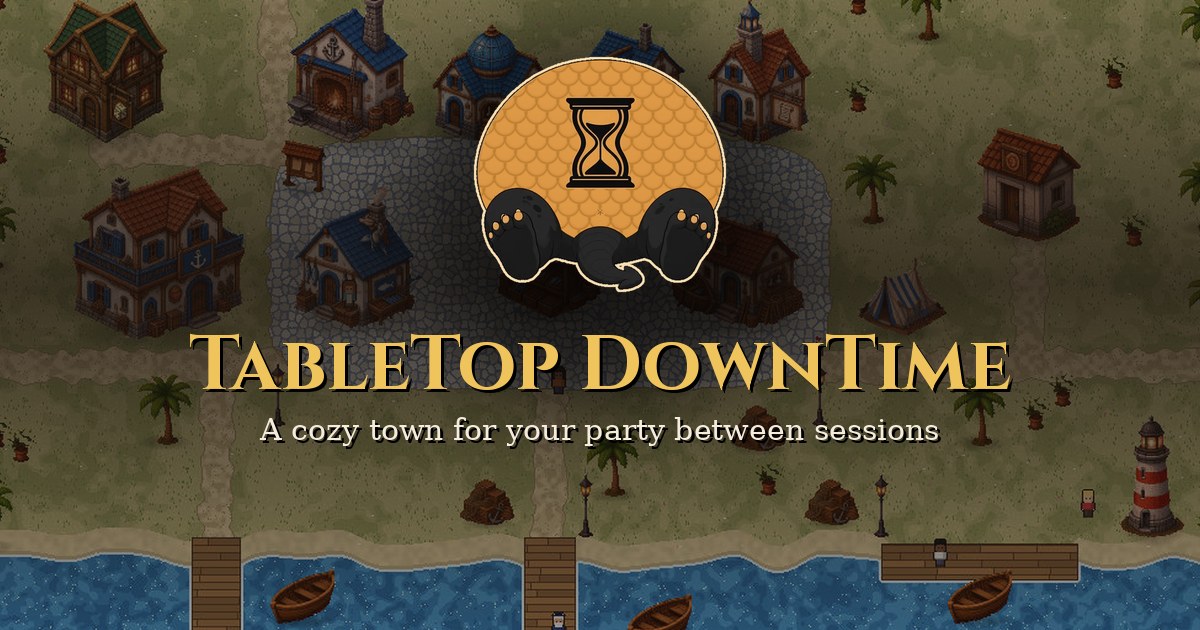
TableTop DownTime is a free-to-play, pixel-art web app that gives a tabletop RPG group a shared town to visit between sessions. It is built for parties playing tabletop roleplaying games such as D&D, Pathfinder and Daggerheart, and its stated purpose is to be a pixel-art town for your tabletop party between sessions. Inside the town the party can craft, cook, take jobs and try its luck at the tavern casino. The game master builds the town and shares a joining code, and players join from their own devices, phones included. No sign-up is needed, no real money is involved, and a visitor can simply choose to explore.
Tabletop campaigns rarely run continuously. Groups meet for a session and then wait days or weeks for the next one, and the story pauses in between. TableTop DownTime fills that gap with a place rather than a task list: a cozy pixel-art town where the party can spend time together between sessions. Instead of leaving players with nothing to do until the next meetup, the app gives them a shared space to craft, visit the tavern, take quests, play the casino, keep pets and receive mail and loot from the game master. The framing is deliberately low-pressure and cozy, and the app positions itself explicitly as downtime activity that lives between sessions rather than as a replacement for the table itself.
The game master drives the setup. The GM builds the town and then shares a code with the group; players enter that code and join from their devices, including their phones. That means the party does not need to configure anything on their side, and a player who only has a phone at hand can still step into the town. The town shown in the app is named Oakhollow, presented with a dragon logo over a pixel-art harbor town. Because joining is code-based and the app is free to play with no sign-up needed, the barrier for a casual player is deliberately kept low: the GM holds the town, and the players simply arrive in it.
Crafting is one of the central activities. The town contains a Forge with a crafting screen where the party crafts using materials carried in their bag. The materials listed in the game are Giblets, Bones, Fragments, Fur, Herbs, Minerals and Scraps, and the interface notes that crafting mats the player is carrying are shown, with zeros staying dim so it is clear at a glance what is in stock and what is not. Cooking is mentioned alongside crafting, and the party can also take jobs, giving groups several different kinds of low-stakes activity to return to rather than a single loop.
The tavern and its casino handle the social and luck-driven side of the town. The tavern is the gathering point the app highlights, and the tavern casino lets the party try its luck, illustrated by a dragon slot machine. Gambling here is entirely in-game: the app states that there is no real money involved, so the casino functions as entertainment inside the town rather than as a monetised mechanic. Quests and jobs sit alongside this, giving the party objectives to pick up and complete while they wait for the next session.
The town also includes pets. Players can keep pets, and stable companions are bought with Giblets, one of the materials in the bag rather than with gold. On top of that, the game master can send mail and loot to players, which turns the town into a channel between the GM and the party even when the group is not sitting at the table. A Bag panel holds the player's inventory, showing currencies and materials, and the interface includes The Bank alongside the bag. Two currencies are visible: Gold, counted in gp, and Town Tokens, which are cosmetic and used for tent decor, with a daily counter shown for tokens earned that day.
Navigation in TableTop DownTime is designed to be immediately understandable. The on-screen instructions are simply to tap the ground to walk, tap a building to go in and tap a person to talk, and that hint can be tapped to hide it once the player knows what to do. There is no complex control scheme to learn, which matters when a player may be opening the app for a few minutes on a phone between sessions. The town is presented in pixel-art style, with buildings such as the Forge and the tavern, people to talk to, and the bag and bank available as panels over the town view.
The practical benefits follow from those facts. The app is free to play, requires no sign-up, and involves no real money, so a group can try it without a purchase decision or an account creation step. Players join from their devices by code, so a full group can be inside the same town quickly. Activities are spread across crafting, cooking, jobs, quests, the tavern casino, pets and GM mail, which gives the party a variety of things to do in short visits rather than one repetitive action. And because the GM builds the town and sends mail and loot from it, the game master keeps a direct line to each player between sessions.
Concrete use cases are easy to see in the app's own description. A group that has just finished a session can use the town as the place where the GM sends mail and loot to the party while the next session is being organised. A player with a few spare minutes on a phone can open the town, walk to the Forge and craft with the materials in their bag, or drop into the tavern and try the casino's dragon slot machine. A party that wants something light to do together can pick up quests and jobs in the town, cook, or spend Giblets on stable companions and keep pets. A game master starting a new group can build the town, share the code, and have everyone join from their own devices without asking players to sign up first.
TableTop DownTime is aimed at tabletop RPG groups, explicitly naming D&D, Pathfinder and Daggerheart players, along with the game masters who run those games. It runs as a web app that players reach from their phones and other devices, and it is free to play. The only currencies shown are in-game: Gold in gp and cosmetic Town Tokens for tent decor, with Giblets used for stable companions, and the app states plainly that no real money is involved.
In short, TableTop DownTime turns the gap between sessions into a place the party can share. A game master builds a pixel-art town, shares a code, and the party joins from their phones to craft, visit the tavern, take quests, play the casino, keep pets and receive mail and loot from the GM, all free to play, with no real money and no sign-up required.
Publisher
A
admin
Launch Date2026-11-15
Platformweb
Pricingfree