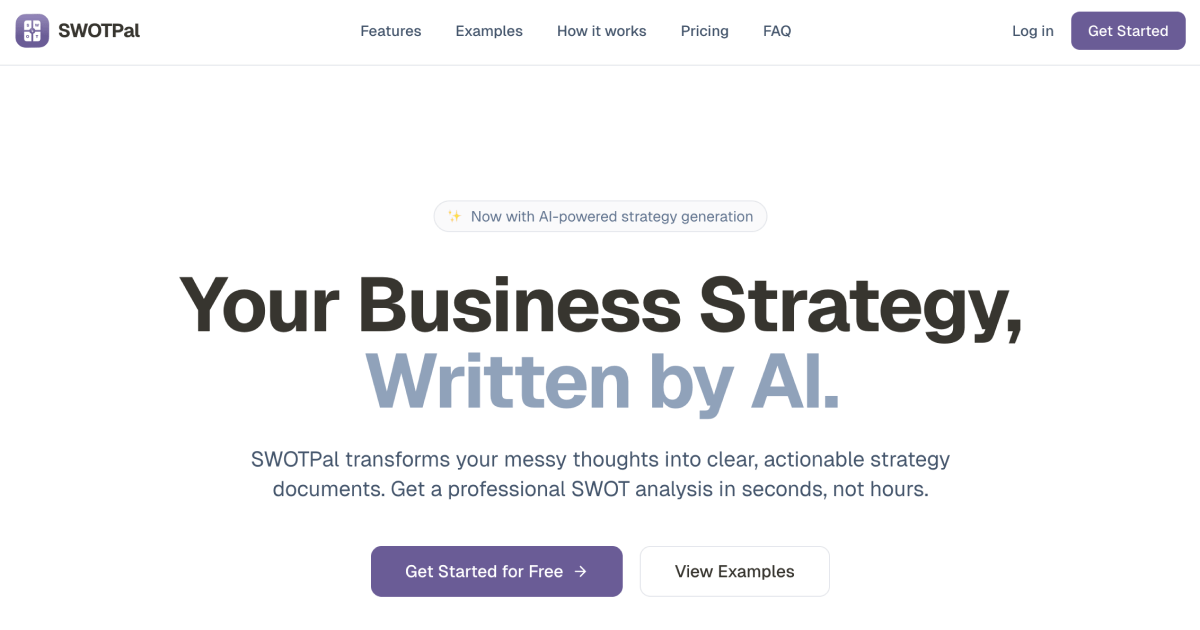

SWOTPal is an AI-powered tool designed to assist business professionals, entrepreneurs, and strategists in converting unstructured ideas and raw data into polished, professional strategy documents. The primary purpose of the tool is to streamline the strategic planning process by automatically generating comprehensive SWOT (Strengths, Weaknesses, Opportunities, Threats) and TOWS (Threats, Opportunities, Weaknesses, Strengths) analyses. It caters to individuals and teams who need to quickly develop strategic insights and actionable plans without getting bogged down in manual organization and formatting. By leveraging artificial intelligence, SWOTPal aims to reduce the time and cognitive effort required for strategic analysis, enabling users to focus on decision-making and implementation rather than document creation. The tool is particularly valuable for those engaged in business planning, market analysis, project development, and competitive assessment, providing a structured framework to clarify strategic direction.
Strategic planning is a fundamental business activity, yet it is often hindered by the challenge of organizing disparate thoughts, data points, and observations into a coherent analytical framework. Professionals frequently struggle with information overload, where valuable insights remain trapped in notes, meeting minutes, or scattered documents, making it difficult to synthesize a clear strategic picture. The traditional process of manually creating SWOT and TOWS analyses can be time-consuming, inconsistent, and prone to oversight, leading to incomplete or biased assessments. This pain point is especially acute for small teams, startups, and solo entrepreneurs who lack dedicated strategy departments and must juggle multiple responsibilities. SWOTPal addresses this problem by providing an automated, intelligent solution that systematically processes input to identify and categorize strategic elements, thereby alleviating the manual burden and enhancing analytical rigor.
One of the core feature groups of SWOTPal is its ability to generate professional SWOT analyses from user-provided input. The tool employs natural language processing to interpret textual descriptions, notes, or bullet points submitted by the user, extracting key concepts and classifying them into the four standard SWOT categories. It identifies internal factors such as organizational strengths and weaknesses, as well as external factors like market opportunities and competitive threats. This automated categorization ensures that no critical element is overlooked and that the analysis maintains a balanced perspective. The feature matters because it transforms a subjective, often messy brainstorming session into an objective, structured document, providing a solid foundation for strategic discussion and planning. Users benefit from a consistent, professional output that can be immediately shared with stakeholders or incorporated into broader business plans.
admin
Another major feature group is the generation of TOWS analysis, which builds upon the SWOT framework to develop actionable strategies. TOWS analysis involves cross-referencing the identified strengths, weaknesses, opportunities, and threats to formulate specific strategic initiatives, such as using strengths to exploit opportunities or mitigating weaknesses to avoid threats. SWOTPal automates this advanced analytical step by logically combining the elements from the SWOT matrix to propose concrete strategic options. This capability is crucial because it moves beyond mere identification of factors to the derivation of practical recommendations, guiding users on how to leverage their advantages and address their challenges. By providing these strategic implications, the tool helps bridge the gap between analysis and action, enabling more effective planning and resource allocation for business growth and risk management.
SWOTPal offers additional capabilities to enhance the utility and flexibility of its strategic outputs. The tool likely allows for customization and editing of the generated analyses, enabling users to refine the AI's suggestions and tailor the document to their specific context. It may include features for exporting the analysis in various formats suitable for presentations, reports, or collaborative platforms. Integration with other business tools or note-taking applications could be part of its functionality, facilitating a seamless workflow from idea capture to strategy documentation. These capabilities ensure that the tool adapts to diverse user needs and integrates into existing business processes, rather than being a standalone silo. The emphasis on actionable strategy documents implies a focus on clarity, professionalism, and practical applicability, making the outputs directly usable in real-world business scenarios.
Technically, SWOTPal operates by utilizing artificial intelligence, specifically natural language processing and machine learning algorithms, to parse and understand user input. The system is designed to handle messy, unstructured text, identifying relevant entities, sentiments, and contextual relationships to accurately assign them to SWOT categories. The underlying model is trained on business and strategic planning corpora to recognize common patterns, terminology, and logical connections pertinent to strategic analysis. The overall approach involves a multi-step process: input ingestion, semantic analysis, categorization, matrix generation, and strategic implication derivation. This technical foundation enables the tool to deliver rapid, accurate analyses within seconds, as highlighted in its description, providing a significant efficiency gain over manual methods while maintaining analytical depth and relevance.
The benefits and measurable outcomes for users of SWOTPal are substantial in terms of time savings, improved strategic clarity, and enhanced decision-making quality. By automating the generation of SWOT and TOWS analyses, the tool drastically reduces the hours typically spent on manual compilation, organization, and formatting of strategic documents. Users can expect to produce professional-grade analyses in seconds, accelerating the planning cycle and allowing more frequent strategy reviews. The AI-driven approach minimizes human bias and oversight, leading to more comprehensive and balanced strategic assessments. Measurable outcomes include faster time-to-insight, increased consistency in strategic documentation, and the ability to quickly iterate on strategic plans based on new information. Ultimately, these benefits translate into more agile and informed business planning, giving users a competitive edge in dynamic market environments.
Concrete use cases for SWOTPal span various business scenarios, such as startup founders developing their initial business plan and needing a structured analysis of their venture's position. A marketing team could use the tool to assess a new campaign's potential by inputting market research notes to identify opportunities and threats. Project managers might employ SWOTPal to evaluate project risks and resource strengths during the planning phase. Another workflow example involves a business consultant preparing a client presentation, using the tool to quickly generate a SWOT analysis from interview transcripts and industry reports. Entrepreneurs exploring new market entry can input competitive intelligence to derive strategic actions via TOWS. Each use case demonstrates how the tool integrates into specific workflows to convert raw information into actionable strategic documents efficiently.
Target users of SWOTPal include business professionals, entrepreneurs, startup founders, strategists, consultants, and project managers who engage in strategic planning. The tool is designed for individuals and teams across industries who require rapid, reliable strategic analysis without extensive manual effort. Integrations may encompass note-taking apps, project management software, or document collaboration platforms to streamline data input and output sharing. The tech stack likely involves cloud-based AI services for natural language processing, a web interface for accessibility, and secure data handling. Pricing plans could range from a free tier for basic usage to subscription models offering advanced features, higher usage limits, and team collaboration capabilities, catering to both solo users and organizational clients seeking scalable strategic planning solutions.
In summary, SWOTPal provides a significant advancement in strategic planning tools by leveraging AI to automate the creation of SWOT and TOWS analyses. Its primary value lies in transforming unstructured thoughts and data into clear, actionable strategy documents within seconds, thereby saving time and enhancing analytical rigor. The tool addresses a common pain point in business planning—the manual and often inconsistent process of strategic analysis—offering a reliable, efficient alternative. By delivering professional outputs that facilitate better decision-making, SWOTPal empowers users to focus on implementing strategies rather than compiling them. This makes it an indispensable asset for anyone involved in business strategy, from solo entrepreneurs to corporate teams, seeking to navigate complex environments with greater clarity and agility.
SWOTPal targets business professionals, entrepreneurs, startup founders, strategists, consultants, and project managers who engage in strategic planning. It is designed for individuals and teams across various industries who need to quickly develop professional SWOT and TOWS analyses without extensive manual effort. The tool is ideal for those lacking dedicated strategy departments, such as small businesses and solo operators, seeking to convert unstructured ideas into actionable strategy documents efficiently. Users benefit from AI-driven automation to save time, improve analytical rigor, and enhance decision-making in business planning scenarios.