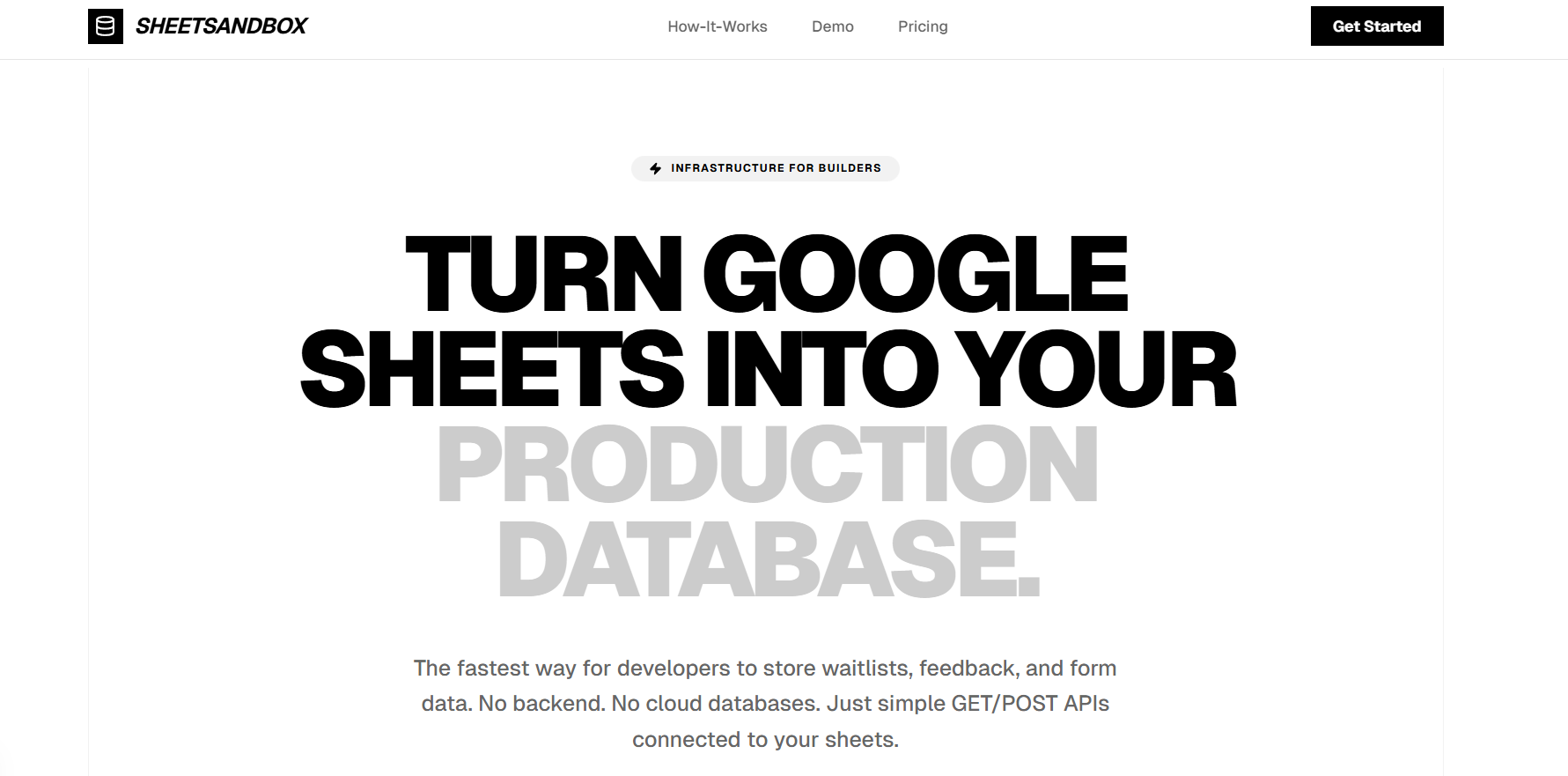
SheetSandbox is a specialized infrastructure tool designed to transform Google Sheets into a fully functional, production-ready database for developers working on small-scale projects and minimum viable products (MVPs). It provides a simple yet powerful API layer that allows developers to perform standard database operations like creating, reading, updating, and deleting data directly within a Google Sheet, effectively turning a familiar spreadsheet interface into a backend data store. The platform is built specifically for indie developers, solo founders, and small teams who need to ship functional prototypes quickly without getting bogged down by complex infrastructure decisions, offering a streamlined alternative to setting up traditional cloud databases like PostgreSQL or Firebase.
Developers often face significant overhead when building early-stage prototypes, as setting up a proper database, managing authentication, writing API endpoints, and handling deployment can consume valuable time and resources that should be spent on validating the core product idea. This infrastructure complexity creates a major bottleneck in the rapid prototyping and validation phase, where speed is critical. SheetSandbox directly addresses this pain point by eliminating the need for any backend infrastructure, allowing developers to use a Google Sheet as their database from the very first line of code, which dramatically reduces setup time and lets them focus on building and testing their application's core functionality instead of managing servers.
One of the primary feature groups is the comprehensive REST API that provides full CRUD (Create, Read, Update, Delete) operations on any connected Google Sheet. Developers can use simple HTTP requests with standard methods like GET and POST to interact with their sheet data as if it were a traditional database, sending JSON payloads that automatically populate rows and columns. This API handles all the underlying complexities of Google Sheets API authentication and request formatting, returning clean JSON responses that integrate seamlessly with frontend frameworks and other services. The ability to instantly create a functional database with a familiar interface removes a major development hurdle, enabling faster iteration cycles.
Another major feature group is the official software development kits (SDKs) for popular programming languages, specifically Node.js and Python packages that provide a more developer-friendly, type-safe interface. The Node.js package offers a promise-based, TypeScript-supported client that simplifies common operations like initializing a connection, posting new records, and fetching existing data with intuitive method calls. Similarly, the Python package provides a clean, Pythonic API with full async/await support, making it ideal for data science scripts, automation tasks, and backend applications. These SDKs abstract away the raw HTTP calls, reducing boilerplate code and accelerating development even further.
admin
The platform also emphasizes security and ease of setup through its integration with Google's own authentication system. Users authorize SheetSandbox to access their Google Sheets via secure OAuth, meaning the service never stores user data directly and operates with the permissions granted by the user's Google account. Each project automatically generates a unique API token for authorization, ensuring that API calls are securely scoped to specific sheets. The entire setup process is designed to take just minutes, requiring only connecting a sheet, generating a token, and immediately making API calls, which aligns perfectly with the need for rapid prototyping without compromising on basic security practices.
Technically, SheetSandbox works by acting as a middleware proxy between a developer's application and the Google Sheets API. When a developer makes an API call to SheetSandbox's endpoint, the service authenticates the request using the provided bearer token, translates the JSON payload into the appropriate Google Sheets API format, and executes the operation on the specified sheet. It then formats the response from Google Sheets back into a clean JSON structure for the developer's application. This approach leverages Google's robust infrastructure for data storage and access control while providing a simplified, developer-centric interface that mimics a traditional database.
The key benefits for users are measurable outcomes like drastically reduced time-to-market for MVPs, elimination of infrastructure management costs and complexity, and the ability to use a tool they already know. Developers can go from an idea to a data-collecting application in under an hour, as they don't need to provision servers, configure databases, or write backend code. This allows for quicker validation of product concepts with real users, faster feedback loops from early-access waitlists or contact forms, and overall lower risk during the prototyping phase since the initial investment in infrastructure is minimal.
Concrete use cases include building waitlist pages for upcoming product launches, where user emails and signup details can be posted directly to a Google Sheet via a simple frontend form. Another example is creating feedback forms for beta testers, where structured feedback data is collected and instantly available in a spreadsheet for analysis. Portfolio contact forms for freelancers or small agencies can also use SheetSandbox to capture lead information without any backend code. Indie developers can use it to store user preferences, application state, or small datasets for side projects, enabling fully functional prototypes with persistent data storage.
The target users are primarily indie developers, solo founders, startup teams, and students who are building small to mid-range projects, MVPs, or prototypes and need a simple, fast data storage solution. It integrates directly with Google Sheets and offers official SDKs for Node.js and Python environments, fitting into common tech stacks for web development, automation, and data science. The pricing model is a one-time payment for a Pro Plan that includes a high daily API call limit, unlimited sheets, access to all SDKs, and lifetime updates, making it cost-effective for projects with limited budgets.
In summary, SheetSandbox provides a uniquely practical solution for developers who prioritize speed and simplicity in the early stages of product development, transforming a ubiquitous tool like Google Sheets into a capable database backend. By removing infrastructure barriers, it empowers creators to test ideas faster, gather real data sooner, and iterate more effectively, ultimately increasing their chances of building something users truly want without the traditional overhead of backend engineering.
SheetSandbox targets indie developers, solo founders, startup teams, and students who are building small to mid-range projects, minimum viable products (MVPs), or prototypes. These users need a simple, fast, and cost-effective data storage solution to validate ideas quickly without the complexity of traditional cloud databases. They are often working on lean prototypes, waitlist pages, feedback forms, or portfolio sites and prioritize rapid development, minimal infrastructure, and familiar tools like Google Sheets. The platform is also suitable for developers in data science or automation who prefer a Pythonic interface or those using Node.js for web development.
Updated 2026-04-30