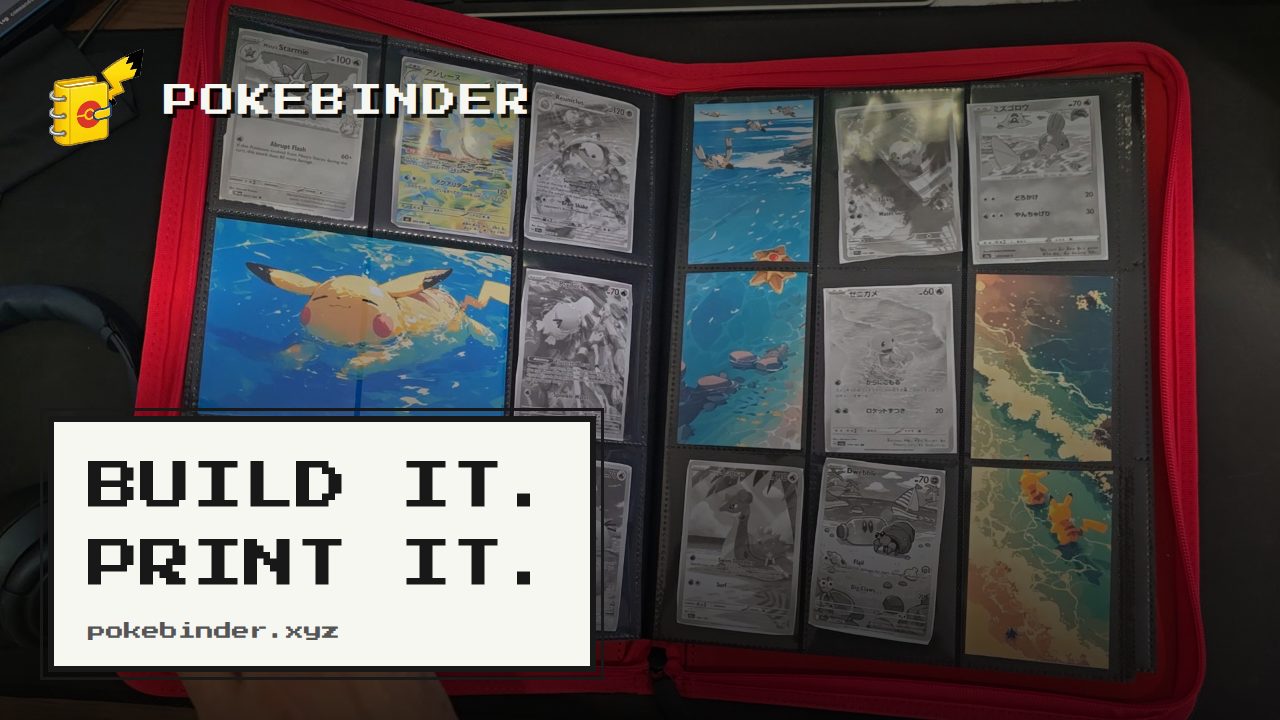
Pokébinder is a free binder planner for Pokémon Trading Card Game collectors. It lets you search a large catalogue of English and Japanese cards, arrange them into 3×3 binder pages, drop your own artwork behind or across the pockets, and then print true-size placeholders for only the cards you do not own yet. The tool is built for collectors who want to plan a binder before spending money on cards, and for anyone who wants a printed stand-in that holds the right pocket until the real card turns up. No account is required, there is no watermark, and your binder stays in your browser.
Collectors often plan binder pages in their heads or on paper, then end up reorganising whole spreads after a purchase arrives. Working out how a page will actually look — which cards sit where, and whether a themed spread holds together — normally only becomes clear once the cards are bought and sleeved. Meanwhile, empty pockets sit as gaps in an otherwise complete page. Pokébinder addresses this by letting you try out layouts and move things around before buying, then printing placeholders so those gaps are filled with correctly sized stand-ins that double as a shopping list of what is still missing.
Card search is the entry point. Pokébinder lets you search over 20,000 English cards by name, set or artist, and over 21,000 Japanese cards by name or set, including the printings collectors actually chase. Both English and Japanese printings are available in one place, and the artist field makes it possible to build pages around a favourite illustrator rather than only a character or a set. You start building from the search page, find the card you want, and drop it into a pocket.
Designing a page is built around a fixed 3×3 grid of nine pockets, with five documented ways to use artwork. In "The Michi page" layout, one image fills all nine pockets and your cards sit on top of it in whichever pockets you choose, so the art carries on around them and the page reads as one picture; take a card out and its slice shows through. You can also stretch one image across a row (one image, three pockets), down a column (one image, two pockets), use a different image in each pocket (five images, one pocket each), or use no art at all with nine cards. In every case the nine pockets stay the same — what changes is how much of the page the art carries. You can zoom and nudge the image until the framing is right, and hovering over a card reveals the binder's own controls.
Printing is where the plan becomes physical. Mark anything in your binder as not owned yet and it prints at exactly 6.3 × 8.8 cm with a dashed cut guide around it. Placeholders print at 300 dpi, nine to an A4 or US Letter sheet, and any artwork you have spanned across pockets prints too, aligned to the same cut guides as the cards. Cut the printed placeholder on the dashes and add it to the page. An amber cart marker indicates a card that is in the binder but not owned yet — that is the one that prints. When the real card turns up, you slide the printed one out and the real one in, and nothing else on the page moves.
The tool works entirely in the browser with no account and no watermark, and your binder stays in your browser. It opens as a two-page spread with a real page curl on a desktop, and turns one page per swipe on a phone, so flipping through behaves like the binder on your shelf. Its distinctive approach is automating the Michi method: rather than printing backing art by hand and cutting it to size, you drop an image into a pocket and let it run across up to three pockets horizontally or vertically, or fill the whole page behind your cards, then zoom and reposition until the framing is right. Pokébinder credits the method as popularised by @peeplop and written up at The Michi Method.
The practical outcome is that you see how a spread will look before spending money on it, and you can change your mind on paper instead of at the counter. Because placeholders print at true card size with cut guides, gaps in a page stop being empty pockets and become settled slots instead. The printed cards also work as a shopping list: you always know what you are missing and exactly where it goes. And because swapping a printed placeholder for a real card leaves the rest of the page untouched, buying something new never forces you to reorganise the binder.
A typical flow starts on the search page, where you look up a card by name, set or artist and drop it into a pocket of a 3×3 page. You then arrange the page, add artwork, and check the print preview before committing. From there you print placeholders for the cards you do not own, cut them on the dashed lines, and add them to the physical binder. Another common scenario is planning a themed or artist-focused spread, testing whether the layout reads as intended before buying. The walkthrough video covers the whole sequence in sixty-five seconds: search, arrange, print, cut, sleeve, done. The binder view is also used simply to flip through pages on a phone or a desktop.
Pokébinder is aimed at Pokémon TCG collectors, including those who chase specific printings in English and Japanese and those who build art-led binder pages, as well as collectors who want to visualise a spread before buying. The site describes itself as an independent fan project made by one collector, and states that it is not produced, endorsed or supported by Nintendo, Creatures Inc., GAME FREAK, The Pokémon Company or Wizards of the Coast; card images are served from their original sources. Pricing is free, with no account, no ads and no watermark.
Pokébinder turns binder planning into a single browser-based workflow: search the cards, design the page, print what is missing, and flip through the result. It is free, requires no account, and keeps your binder in your browser, while its true-size placeholders and Michi-method artwork spanning remove the guesswork from building a Pokémon TCG binder.
Publisher
A
admin
Launch Date2026-09-30
Platformweb
Pricingfree